
Systematics
Unity in Diversity
12 Systems
Systematics Topics
- Ken Pledge – Concrete Significance of Numbers in Experience
- Martin Zwick Systematics Papers
- Archives
- Compendium
- Complexity Rising **NEW** July 2017
- Enneagram of Personal Life
- Gathering 6
- Introduction to Systematics
- Legominism
- Logo Visual Thinking
- Numbers in the Gospel of St. John
- On Time
- Recommended Reading
- Systematics: A New Technique in Thinking
- Singing in the Forest
- Structural Communications
- Systematics Basics
- Systematics Videos
- The J.G. Bennett Online Library
- The Origin of Systematics in Gurdjieff’s Talks
- Understanding Complexity
- Progression of Categories
- Synchronicity and Emergence
The Concrete Significance of the Number in Experience
The Concrete Significance of the Number in Experience
Its Relevance to Systematics and The Enneagram Cosmology
By Ken Pledge
This article was first published by the UNIS Institute in 1993
Ken Pledge
Born London 1935. Mathematical physicist. Heard of work-ideas and read Ouspensky, Gurdjieff (G), and Bennett’s (JGB’s) Dramatic Universe (DU) Vol. 1. while still at college in late 1950’s. First visited Coombe Springs (CS) and met JGB in 1960. Subsequently lectured in physics for 2 years at a Technical College, and also attended JGB’s Gurdjieff-work, education research groups, movements etc. Around 1963 abandoned teaching to live and work at CS as research fellow and on the staff of JGB’s Institute, during period when JGB was developing Systematics and writing DU3 and DU4. Co-author with JGB and Henri Bortoft of Towards an Objectively Complete Language in Institute journal, Systematics (1965); author of Structured Process in Scientific Experiment (1966) reprinted in Enneagram Studies (1983) and The Cipher of Genesis (1970) republished 1982 with additional material by CS Press. Returned to physics and math lecturing in late 1960’s until took early retirement as senior lecturer from a Polytechnic in 1988. Conducted occasional experimental London groups during late 1970’s to study work-ideas and work with people interested in ‘thirdreading’ Beelzebub’s Tales. Has worked since 1985 to investigate G’s and JGB’s ideas; especially the math and physics of JGB’s DUl; re-writing and extending the physical Appendices of DUl for a forthcoming reprint In 1987 was invited to give talks at Cave Junction Seminar (cf. Trust in Impressions Summer 1988).In June 1992 conducted 10-day seminar on G’s and JGB’s ideas and cosmological world-picture at Claymont in West Virginia, and in July-August gave related talks at Cave Junction and 2 Rivers Farm in Oregon.
In Volume 1 of The Dramatic Universe(1) by J.G.Bennett (JGB) he introduces this progression of ‘categories’ associated with the numbers one to twelve:
12 Autocracy
11 Domination
10 Creativity
9 Pattern
8 Individuality
7 Structure
6 Repetition
5 Potentiality
4 Subsistence
3 Relatedness
2 Polarity
1 Wholeness
JGB connects them with what he calls the concrete significance of these numbers in our experience. So this is what he says(2) about the first few:
“The categories emerge from our experience by a process of discovery. Moreover their emergence from the stream of immediate presentations proceeds in a definite sequence. The categories themselves follow an ordered series and can be defined by the minimum number of terms that a system must possess in order to exemplify them. The first category is that of wholeness, which requires only one single term; namely, an element of experience that stands out in our awareness as present and persistent If we go further and say that this element is itself and not other, we have already made the step to a two-term system and the category of polarity. Polarity thus emerges as an inevitable consequence of the recognition of wholeness as an element of experience that is not its totality. The antithesis of ‘this and not that’ leaves us with two bare, or unrelated, terms. We discover, however, that the elements of our experience are always related; hence we find emerging the third category of relatedness, which requires at least three terms for its exemplification. Relatedness, in tum, is incomplete unless we bring it back to immediate experience with the characteristics of ‘thus and so’. Since we find ourselves always obliged to take our experience as ‘thus and so’, we have to admit the fourth category of subsistence. Once again, it is necessary to go beyond ‘thus and so’ in order to take into account all that might be, but is not, present This additional element of experience is the category of potentiality that requires five independent terms. These are followed by the categories of repetition (requiring six terms) and structure (requiring seven terms). This series must be continued until as many terms are included as are required to give the measure of concreteness that we are capable of grasping. Naive realism is satisfied with a one-term scheme in which there are no distinctions of subsistence. Naive dualism cannot go beyond polarity. Thus at each step in the progression of the categories, we find a greater ‘sophistication’.”
Abbreviating JGB’s characterizations of the categories in Volume 1, he says:
Wholeness is “singular, relative and omnipresent in experience”;
Polarity is “a difference (as between two things) that gives rise to force” and
Relatedness is “triadic – comprising affirming, denying and reconciling elements”.
Subsistence he describes as a “limitation of existence within a four-fold framework of terms” and, to illustrate it, he appeals to the structure of space-time, which has three dimensions of space and one of time.
Potentiality he describes as “multiple subsistence” or “two relationships having a common first term” – by which he means a common first term for two alternative sets of three terms, before a choice is made between them.
Repetition “combines identity, difference and relatedness in a single system”. In fact you might regard repetition as six-fold, inherently circular or cyclic for the simple reason that if you draw a regular hexagon inside a circle, you can fit into it exactly six equilateral triangles. These triangles suggest that there may be something about the circle which is intrinsically six-fold. So then, you might say “If a triangle represents in some way a form of relatedness then cyclic repetition may somehow involve six kinds or forms of relatedness”.
Structure is “self-regulating in discontinuous groups of three and four terms”. There is a discontinuity in between them. This comes from Gurdjieff’s generalization of the musical octave.
But, as we go further up the scheme, JGB’s postulations become harder and harder to justify. You can, I think, see that there are fairly plausible reasons for giving the categories their properties going up to about the number seven; but thereafter it becomes increasingly a matter of what seems like guess-work accompanied by what, as a teacher, one would call ‘hand-waving arguments’.
So eighth as Individuality is “the unique source of initiative residing in organized structures”, says JGB. This jump from structure to individuality is particularly difficult to see any justification for.
Ninth as Pattern he calls “that which gives active form to an organization of individual initiative”.
Tenth as Creativity is “polar as both the source of order and the vehicle of disorder” and
Domination, eleventh, “reconciles order and disorder through the agency of creativity”.
Finally, he says, the twelfth category of Autocracy is “the primary affirmation producing actual or potential experience.”
So this is JGB’s scheme in Volume 1 and up to about half way it seems fairly reasonable. Each higher-numbered category requires a little something extra which the previous one doesn’t have.
But where did this progression come from? Because it is, of course, the basic scheme which eventually, in Volumes 3 and 4 of The Dramatic Universe, evolved into Systematics. In fact, it evolved twice. In the Introduction to Volume 2 there is a deeper reformulation of the notion of a multi-term system, which is made much more prominent than when it first appeared in Volume 1.
I remember him coming through the front door at Coombe Springs: “I’ve got exactly the right name for it”, he said, beaming. “We’ll call it ‘Systematics’.” So I was in at its christening. It wasn’t a new name because it also appears as the title of a section in Volume 1, but it doesn’t have the connotation there that he later gave it, as these first six categories developed and evolved into instruments for potentially understanding any concrete situation.
JGB wrote and re-wrote The Dramatic Universe several times. I have two earlier versions which were never published. One of them is almost entirely a treatise on physics and philosophy, with a bias wholly towards physics. It dates back to the 1940’s. Nevertheless, some of the physics in the finally published Volume 1 is taken from it – word-for-word.
A later version appeared for private circulation in 1952, with thirty mimeographed chapters bound into ten parts. It’s much more like the final version of Volume 1, but doesn’t have all its twelve categories. It only has wholeness, relatedness and structure, and it’s clear that this choice was directly and decisively influenced by Beelzebub’sTales. By 1952 Gurdjieff had been dead two years. JGB had been given copies of Beelzebub in 1948 and, if you read Witness(3) you’ll find out how hard he attacked them. In 1949, being JGB, he set himself to read them almost continuously for several days, right through that summer’s seminar at Coombe Springs, until at the end his tongue was so swollen he had to drink iced water or his teeth would have cut it to pieces.
In the published Volume 1, JGB says that he isn’t giving a presentation of Gurdjieff’s cosmology; that it’s mostly his own essay, and that he’d shown it to Gurdjieff. Since Gurdjieff died in 1949, he must therefore have shown him, not the version that was eventually published, but one much closer to the 1952 version. Gurdjieff said it was very interesting, but “It’s your work and not mine – all the same, it will be good publicity for Beelzebub.” (4)
If you look at that 1952 version you will see that it’s JGB’s endeavor to come to grips with Beelzebub. In Volume 1, which was published in 1956, he says: “after perhaps thirty careful readings” of Beelzebub… So by then he must have read it, as he got his first copy of Beelzebub in 1948, about four times a year.
It was JGB’s way, which he had already performed with Ouspensky’s presentation of Gurdjieff’s system, to try and write down his own formulation of everything that had been shown him and told him. When Ouspensky fled from England in 1941, he left JGB behind him and, in the absence of Ouspensky’s eagle eye, JGB decided that he would start to write out his own understanding of ‘the system’ as Ouspensky had presented it I’ve got copies of two of the three volumes that he then wrote. It was his own version of Ouspensky’s In Search of The Miraculous, and not unlike it.
Therefore, when JGB got hold of Beelzebub’sTales,he started yet again, with the additional ideas he found in Beelzebub, to attempt an all-encompassing philosophical work. But this time he found that what he’d begun as a treatise on the physical world now merged with Gurdjieff’ s ideas, and he could no longer keep them apart. So the stimuli behind JGB’s categories are, very largely, the whole ‘ideas- table’ of Gurdjieff s system as presented by Ouspensky and finally as presented by Gurdjieff himself – without the numerical detail of In Search of the Miraculous, certainly without the diagrams – in Beelzebub’sTales.
JGB definitely adds, as his own contribution, wholeness as a distinct form which must be used if the world is to be interrogated and made sense of. It is, in fact, the most obvious thing. If you have a problem, then it’s something you can draw a circle around and say: “This is the problem, this is the whole that concerns us here, everything outside it is irrelevant to our studies, this is what we must try to understand.” But, every whole is a part of some larger whole, and that in tum of some still larger whole. This is the simplest way in which you can say: “This is how the world is built, how it is constructed.” Hence: “Wholeness is omnipresent – but it is relative”.
You have this, of course, in Gurdjieff’s system as presented by Ouspensky, in his notion of worlds-within-worlds; each one standing to the next “as zero to infinity”: the cosmoses, the ‘relatively independent concentrations’ in Beelzebub. But Gurdjieff himself, in his teaching in Russia near the end of the First World War, presented only these two: the laws of three and seven which, possibly, you could say, included worlds in their formulation; and those two, with wholeness, can be regarded as involving the same systematic way of looking at the world.
So that all those three together plus the law of five-foldness (in his ‘Step Diagram’ of reciprocal maintenance) are Gurdjieff’s contribution, or his communication, because I don’t think, and neither did JGB, that Gurdjieff himself invented the extraordinary cosmological scheme that he presented in Russia. Because the law of three expresses a trinity doctrine, I think it’s very likely that what Mouravieff says(5) is possible: that it is an esoteric Christian system which was hidden from the world for various reasons; which Ourdjieff, because he was a man of quite incredible determination and persistence, came upon, learned about, and made himself able to understand.
So really, the inspiration for JGB’s categories is Gurdjieff’s laws of three and seven; because you can see that JGB is simply putting in extra meanings for the remaining numbers: imagining plausible qualities from them. Why should he do this? Well, JGB was something of a mathematician and, to a mathematician, there is a sense in which every number is a number and is, therefore, in some way just like every other number. But there is also a sense in which every number is unique.(6) I shall be talking about this later.
JGB was, in fact, related to one of the greatest of all English mathematicians: Arthur Cayley. Cayley and Sylvester were ‘heavenly twins’ of mathematics in their time, towards the end of the 19th century.(7) And it’s interesting that Cayley was the mathematician who invented matrices and multi-dimensional geometry; because it happens that multi-dimensional geometry is an important part of JGB’s own scheme of describing the physical world. In Volume 1 of The Dramatic Universe he has a five-dimensional geometry, and then stretches it to a six-dimensional geometry. But this is JGB’s own contribution, not Gurdjieff’s.
As it happens I’ve spent the last six years trying to reformulate JGB’s five-dimensional geometry in such a way that it’s genuinely accessible and its results are exactly produceable; and the best way I found to do this does use matrices. So it’s interesting that both of these two mathematical instruments which this relative (he wasn’t an actual ancestor) of JGB invented; come into JGB’s own presentation of how to make sense of the physical world.
So, to a mathematician every number is a number in its own right. It has its own pattern; and there seems no reason, to a mathematician, why you should only pick on three and seven. In Witness, JGB says that he thought Gurdjieff only concentrated on the numbers three and seven for traditional reasons; having drawn upon sources which held these two numbers to be sacred.
But, if you have three, and if you have seven, you are led immediately to the enneagram. This is a pattern which appears in the decimal system (that is, the system in which you can have in a decimal place any number nought to nine), only as a result of the inner combinations that result when you consider one, three, and seven. So you can say if you like that wholeness is inherent, though to some extent concealed also, in the pattern presented by the enneagram.
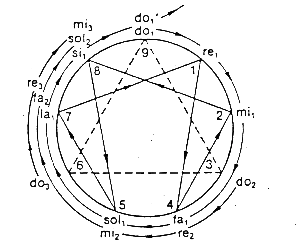
This beautiful pattern with six inner-lines in a definite order running from number to number inside the circle appears when you divide one by seven. You get 0.142857 142857 142857 forever. As this sequence of six numbers repeats itself continually as a block, you indicate that by writing a dot over its first and last numbers. But if now you add on another ‘one-over-seven’ you find that the same sequence occurs, only it starts in a different place. It starts, in fact, at two – but it’s the same sequence. If you add on another ‘one-over-seven’ it starts at four. If you add on another ‘one-over-seven’ it starts at five. If you add another ‘one-over-seven’ it starts at seven and, finally, if you add the sixth ‘one-over-seven’ it starts at eight But of course, if you add on one more ‘one-over-seven’ the whole block of 142857 vanishes. Because you will have ‘seven-over-seven’, which must be one so, as a decimal, it is going to be 0.9999… recurring: which you write as 0.9 with a dot over the 9.
So there is this quite extraordinary pattern: for six additions you get the sequence repeated, starting always at a different place; then, when the seventh appears, it vanishes: and you are suddenly there at 9, the apex of the triangle. Of course, if you have ‘one-over-three’ you will get .3333333 so that this will give you 0.3 recurring at 3. ‘Two-over-three’ will give you 0.6 recurring at 6. ”three-over-three’ will again give you 0.9 so it will take you to 9 again.
For anybody with some appreciation of patterning, the two combine in quite an extraordinarily beautiful pattern. And it is one and three and seven: wholeness, relatedness, structure – but there is nine and so that is the number of this pattern: the whole pattern is in this figure.
It’s quite remarkable. Here is the sum – just to show you why it has to come out 142857 when you divide one by seven:

Seven from ten leaves three so you’ve got thirty; four sevens are twenty-eight (so these give_ the one and the four) subtraction gives you two left over or twenty; twice seven are fourteen gives you after subtraction six left over; eight sevens are fifty-six so you get four left over (giving the two and eight) five sevens are thirty-five giving five left over, and finally seven sevens are forty-nine, so you have one left over (whence the five and seven) and then you’re back where you started from. So you are again starting with one and nought just as you did at first Therefore the whole argument must carry on through all over again; repeating always this same sequence of six steps. But if you add a ‘one-over-seven’ you will start with 20 in the sequence. If you add another ‘one-over-seven’ you will start from 30 and so on. And that is why each extra ‘one-over-seven’ makes you start at a different number in the 142857 sequence around the enneagram circle. It’s because you start at different places in the division sum that you do.
But in the sum for division of one by three, you immediately get three into ten again, so that you only have the one number 3 inside the recurrent 0.3 decimal. Multiplying by two you will simply get 0.6; by 3 gives you 0.9 again.
I think it’s worth giving the complete sums because that way you can see by experience: “Yes! It really is like this”. It doesn’t take very long – assuming that you can still remember how to do long division. You look at them and you think: “Yes, there is no way out of it, there is no way around this. Numbers really are such quantities that they must do this. These numbers one and three and seven in our decimal system obey such laws that this must happen to them”.
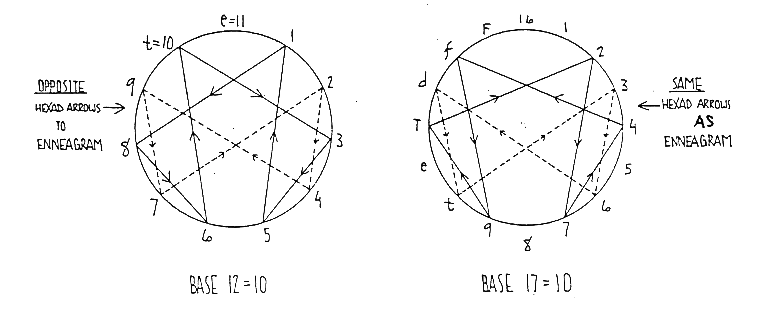
Interestingly enough, if you don’t use the decimal system but use the duodecimal system, where you can have two extra numbers in a decimal place (since ten and eleven are now single numbers and twelve is ‘ten’) so that you have eleven numbers around the circle instead of nine: the same enneagram-like zigzag figure appears. but now its arrows point in the opposite direction. You must lose the recurrent decimals triangle, because three is a factor of twelve. However, five isn’t a factor of twelve and so a recurrent decimal of four numbers, a ten now appears for the successive additions of ‘one-over-five’. So there is something about seven-ness that produces that kind of hexad in both the decimal and duodecimal number systems, but to symbolize laws of both seven and three the decimal system is required. To symbolize laws of seven and five needs the duodecimal system; but now the law of seven works backwards. (8)
Laws of Numbers
Now, there’s something deceptively attractive in the way JGB presents his endless sequence of numbered categories in Volume 1. It all seems very simple. Once you’ve got experience, this is how things ’emerge’ within your experience. They appear before you and wave their arms about. And they’ve got sometimes one arm, sometimes two arms, sometimes three arms, and so on. But they get more and more complicated. Each new category is like a new Hindu god with more arms, and heads to match. Unhappily, there are always more arms and heads, so that in the end you find yourself helpless, confronting an endlessly hydra-headed monster.
It’s plausible; but it didn’t satisfy me. Because I wanted to know why the various numbers had these patterns in the first place. What is so special about three-ness? What is so special about four-ness? It means they have a certain pattern that five-ness, and one-ness and seven-ness haven’t got It’s like the old Chinese cosmology in which the world is resting on an elephant, which is standing on a turtle. You say: “Well, what’s the turtle standing on?” I wanted to know why these numbers have these properties. What were the laws of numbers that made them have these forms, which JGB could then assign to his categories? Perhaps one could cut down JGB’s godheads to some manageable number. After all, Gurdjieff himself managed magnificently, with the laws only of three and seven.
At first I didn’t know anything about the laws of numbers. I thought it would be pretty complicated to find out what they might be, and I didn’t even know where to look. And then I found a book about the logic of algebra (9) and came across a whole set of laws. But they were all arranged higgledy-piggledy, as if the people that had discovered them didn’t have any idea that there could be some kind of orderly way in which you could take them, and develop numbers themselves from them. Yet they were quite clear and, after a while, I looked at them and wrote down what looked to me the order to put the laws in, to actually produce numbers: to grind out numbers, when you allowed the laws to operate.
I found that there was a way of looking at number which nobody seemed to have thought of. If you looked at these laws that logicians had discovered to characterize and describe what properties numbers had, and arranged them in the right order, it was quite obvious that, for a start, there were two quite distinct kinds of numbers. You could develop these two kinds of numbers quite independently from one another and only at the end bring them together and say, “The numbers that we shall now describe will have both kinds of properties.”
It’s very important that there are these two kinds of numbers because, I think, you can connect the fact that there are these two kinds of numbers with the fact that in Gurdjieff’s cosmology there are only two kinds of law: the law of three and the law of seven. Where does this duality of two kinds of numbers and laws come from? Can you combine them into a single law? In a certain way the enneagram clearly does combine them, but it still keeps them distinct.
Well, what is the law I decided must come first? It’s very simple. It is a law which says this:
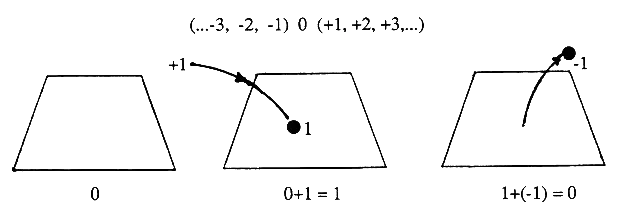
0 +1 = 1, “Nought plus one equals one”. This, I decided, is the first and simplest possible law you could have in number. But what does this law mean? It’s important to have a picture of what these things mean.
It can mean this: There is a table and it is empty and onto this table something is put: a dot, say. And the putting of it is the operation “Plus one”. And when it’s on the table you forget about the table. You’re only interested in the thing that’s on it So the nought is only on the left-hand side. It vanishes on the right-hand side because there you take the table for granted. This is the first law of the first kind of number. It defines what addition means.
But when you repeat things, there is no longer the novelty of the first time. For a second dot put on the table the situation is already different, because the first is already there and the table is now taken for granted and the zero forgotten about. So now we have a law 1+1 = 2 with no zero and we can go on and on adding more dots to those already there: 2+1 = 3; 3+1 = 4 etc. So in general we can write them all as a+b = c with different numbers a, b, c.
Suppose you want to take the first off the table. Ah! You can’t do it! You haven’t got a law that says you can do that. A law that says you can do that has to say that this happens: “One plus x equals nought again” : 1+x = 0. So what is x? x is equal to minus-one. If b dots are on the table and we take them all off at once we will write that as b+x = 0 so that x = -b. This is now our third law. It gives you subtraction and it takes dots off the table again. But having invented negative numbers we can put them in our second law, and so get things like a-b = c. So our first three number laws define addition, its reiteration and subtraction. They tell us all about what plus and minus mean for numbers, and enable us to write down three kinds of additive numbers like this:
Law of Three
Now in Beelzebub’s Tales, Gurdjieff, when introducing the law of three in Purgatory, calls the affirming and denying forces (amongst other names) the ‘force-plus’ and ‘force-minus’.(10) If we take this to mean they correspond to positive and negative numbers, then the reconciling force can only be the zero. And since the table, as the zero, is there before any points are put on it, the reconciling force appears, therefore, as the original or zeroth ‘force’. Clearly then, the ‘first’ force must be the ‘force-plus’ as the putting of points on the table and, finally, the ‘second’ force is the ‘force-minus’ because it corresponds to taking them off.(11) You can see now why the ‘zeroth’ is also the ‘third’ force which we become blind to, because on the right-hand side of 0+1 = 1 it vanishes.
Although it’s there, you don’t take it into account any more. Because you’re only interested in the things that are on the table, not the table itself.
A + B = C is the additive law of three in arithmetic
This law of three is all about balancing identical atomic units. If you ever act as treasurer of some organization, you will see it working when you balance the books. Affirming and denying forces are income and expenses, whose units (pence or cents) must agree exactly at the end of the year.
If you perform ‘titration’ in chemistry, you add, say, a known acid solution drip-by-drip to an alkali solution until the indicator changes colour. Then you know you’ve added just enough H+ ions to neutralize the OH– ions in the alkali. Here the identically interchangeable unit each additive point symbolizes, is the unit charge of an electron. Now a lever-balance has two pans to put weights in, and a pointer for indicating balance. So it can have three ‘weighing-states’: either one pan goes down, or the other goes down, or the two pans balance – just as they do when they’re both empty. Hence ‘balance’, like the empty table, is obviously best symbolized by zero.(12) So you can see now why, in Purgatory, Gurdjieff also calls the third force the neutralizing or equilibrating force.
Now if you invent numbers which are entirely multiplicative, you will use corresponding, but different, formulas to those for the purely additive numbers. In place of “Nought plus one equals one” you will have “One times two equals two”: 1 x 2 = 2. “Nought plus a equals a” now becomes “One times A equals A”: 1 x A = A.
What does the “a plus x equals nought” become? Aha! You are now going to have “A times X equals one”. X therefore is now equal to ‘one-over-A’. So X = 1/A is the reciprocal of A now, not the minus you got for the pure additive numbers. Instead of A+B= C we will now simply get that AxB = C, as these don’t contain 0 or 1.
If you look at 0 + 1 = 1, clearly the first additive number you get is one. But in 1 x A = A you’ve already got one, so the next number that you get must be two. You’ll have “one times two equals two”: the first multiplicative A you can have is going to be two. But if the first A is two, then the first X is going to be ‘one-over-two’ or a half. So what must you now be talking about?
You’re talking about cutting the thing that ‘one’ means, into two halves. You can’t cut a point in half because it hasn’t got any extension. That’s why the things in the law of three are ‘atomic’: it means un-cuttable. This thing that you’re talking about now is intrinsically extensive. So it’s intrinsically something that can be cut The first cut therefore separates the wholeness of it into two equal parts. Each one of them is a half of the original whole.
If the ‘one’ is a three-dimensional solid and you now make a second cut perpendicular to the first, you can get, as the result of two cuts, that four quarters now equal the original one. A third cut, perpendicular to both of those, can then give you eight eighths, still equal to the original ‘one’.
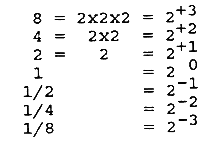
Now let’s invent a symbolism. Eight is two-times-two-times-two or 2x2x2. We can write its three two’s multiplied together as 2+3. Similarly we can write 4 = 2×2 = 2+2 and, carrying on, 2 = 2+1. The numbers +3, +2 and +1 are the ‘powers’ of 2 and tell us too how many times the original one has been cut, and powers add when their numbers are multiplied, because 2x(2×2) = 21+ = 23. You can see now that ‘one’ must be 1 = 20 or “Two to the power nought”. Because, having no cuts at all, it says one whole and so it has only one part. But two-halves and four-quarters and eight-eighths are all equal to this ‘one’.
So we see that we can write the halves, quarters and eighths as negative powers of two: 1/2 = 2-1, 1/4 = 2-2 and 1/8 = 2-3. Because if we do this, then 2+1-1 = 2+2-2 = 2+3-3 = 20 = 1 and the opposite positive and negative powers simply cancel to give zero. So we get a ladder of multiplicative numbers that isn’t like the additive sequence; even though the additive sequence provides it with its power-numbers. All the way through it’s concerned with wholeness. And it’s a bottomless vertical scale. It goes up and it goes down because two to negative powers are diminished by cutting and two to positive powers magnified up by it. We apply such rising or falling numbers if we use microscopes or telescopes, or ‘scale-up’ and ‘scale down’ maps:
What else do we have? Well, you have immediately, here, in the relation between the numbers 20 and 2+1, the musical octave rising from one up to two. It’s called the diapason, which means ‘through- all’ the seven steps involved. Hence in Beelzebub Gurdjieff uses the word diapan to mean ‘octave’. In going from 2+1 = 2 to 2+2 = 4 you go through the second octave. From four to eight, through the third octave. So you begin to see now why I say this is going to be concerned with the law of octaves. Because if you didn’t have this you wouldn’t be able to have the octave scale.
Pure multiplicative number is intrinsically extensive and so continuous. It deals with a continuum, which in principle you can go on cutting forever, and never get to zero. In pure multiplicative number you don’t start from zero. What is given to you is not the zero. What you start from now is some given whole.It’s like a star, when you look through a telescope that magnifies it up and you see it has become a whole sun, or maybe a planet: something which is a continuous whole. No longer a tiny twinkling point but a large round whole, as our own sun appears to us by eye to be.
Now the additive numbers appear, not as multiplicative numbers themselves, but as the various powers of two: the simplest number-base. But, since the zero and the positive and negative numbers express the law of three, this law is expressed by the multiplicative numbers too, in another way:
For X/Y = Z can also be written in base 2 power-notation as 23-b = 2c where X = 23, Y = 2b and so Z = 2c. So the law of three a – b = c in the additive power-numbers produces in the multiplicative numbers the multiplicative law of three X/Y = Z.
Whence Newton’s Second Law of motion F/M = A expresses a multiplicative law of three: “Force over mass equals acceleration”. Newton saw mass here as a force too. (13)
Clearly two is the first number-base you can have. And if you wanted to, you could take three as the number-base, or four, or five. But if you took four, you would already have all of those numbers, because two twos are four anyway. You simply miss out every other number-base two number.
Law of Seven
Why do I say that the law of seven has to do with this? What is the law of seven anyway? How is it presented to you? It is presented to you by analogy with the possible modes of vibration of a stretched string. And a stretched string is a one-dimensional continuum. It is in fact the simplest continuum you can have. Because it corresponds to what you would get from a point, if you allowed it to move in space and it left a trail behind it like a spider’s thread.
The octave comes out of this because of Pythagoras, who is recognized as the discoverer of two great mathematical results. One of them is about those triangles which have got a right-angle in them: that the square of the length of the longest side is equal to the sum of the squares of the lengths of the other two sides. That’s what’s usually called Pythagoras’s theorem.
But, his great discovery, greater than that cosmologically, was that if you have a stretched string and you pluck it in the middle and listen to the sound it makes (and you’ve got a musical ear, of course) and then you stop it again, without changing the tension in the string, and pluck it so only half 1/2 the string vibrates, then you will hear the note exactly one octave above that first note. And if you mark off different fractions of the length that are simple small ratios (like two-thirds 2/3 or three-quarters 3/4) you will, by plucking them, be able to get two notes that sound most harmonious with the fundamental note, that sounded when you plucked the full length of string.
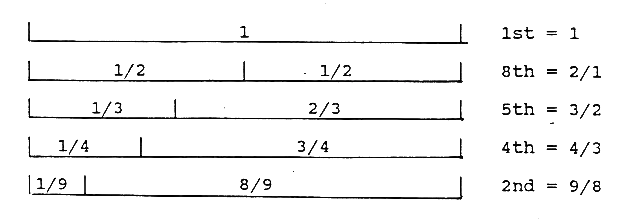
Relative to the fundamental as 1, the pitches or frequencies of the notes these ratios produce are got by inverting them: so 1/2, 2/3 and 3/4 give pitches of 2/1, 3/2 and 4/3. If we number the octave-notes 1st, 2nd, 3rd, 4th, 5th, 6th, 7th and 8th; the whole string vibrates with the fundamental or 1st; half alone vibrates with the 2/1 octave-note _or 8th, two-thirds alone with 3/2 or the 5th note, three-quarters alone with 4/3 or the 4th note.
Now Pythagoras believed 1+2+3+4 = 10 (which is called the tetraktys)(14) symbolized fundamental laws of space and probably, he thought, also of music. So as 1, 2/1, 3/2, 4/3 used up 1 to 4 he stopped there and made a second note from (3/2)/(4/3) = 9/8. He saw too that (4/3)x(3/2) = (2/l)x1 = 2 tells you that pitch-ratios have to be multiplied together to climb from 1 to 2 up the octave.
So he contrived a 3rd note between 2nd and 4th from (9/8)x(9/8) = 81/64; 6th and 7th notes inside 5th and 8th from (9/8)x(3/2) = 27/16 and (9/8)x(27/16). He then found the intervals 3rd-to-4th and 7th-to- 8th were less than 9/8 and both the same: (4/3)/(81/64) = (2/1)/(9/8)x(27/16) = 256/243. So he built an octave with the same kind of two-shock structure that Gurdjieff used.
To climb up ‘through all its seven steps’, we multiply them, so (9/8)5x(256/243)2 = 2:
Pythagoras’s Octave
|
8th = |
(3/2) x (4/3) |
= 2/1 |
|
7th = |
(3/2) x (9/8) 2 |
= 243/128 |
|
6th = |
(3/2) x (9/8) |
= 27/16 |
|
5th = |
3/2 |
= 3/2 |
|
4th = |
4/3 |
= 4/3 |
|
3rd = |
(9/8) 2 |
= 81/64 |
|
2nd = |
9/8 |
= 9/8 |
|
1st = |
1 |
= 1 |
|
8th/7th = 256/243 |
|
7th/6th = 9/8 |
|
6th/5th = 9/8 |
|
5th/4th = 9/8 |
|
4th/3rd = 256/243 |
|
3rd/2nd = 9/8 |
|
2nd/1st = 9/8 |
This was the first time anyone in Pythagoras’s 500 BC Greek culture found out how numbers come, via musical ratios, into the world. So it was an immense discovery. And it’s still of very great importance in music because you can’t get round it. 3/2, 4/3, 9/8 are still ratios that you need to have in order to hear harmonious notes which sound well with each other using stringed instruments.
You can see now that unless you have a continuum, you can’t talk about this stretched string. You can’t talk about vibrations. You can’t talk about the ratios that make what happens when you pluck strings sound harmonious, unless you’ve got multiplicative numbers. Pure multiplicative numbers alone, using bases two and three, make it possible to express these ratios. Only these two bases are needed because all the ratios R that Pythagoras used can be got by using positive and negative integers for p and q in the formula R = 2p x 3q.
So, for example, we have 9/8 = 2-3x3+2 and 256/243 = 2+8x3-5 .
The ‘Major’ Scale also uses base 5, to get extra ratios R = 2P x 3q x 5r . This gives a nicer 3rd = 5/4 than Pythagoras’s. But it makes 3rd/2nd = 10/9 and 4th/3rd = 16/15, widening his 256/243 interval. If you make 6th/5th = 10/9 too, then 6th becomes 5/3 and so, keeping 7th/6th = 9/8 makes a 7th of 15/8. Hence the final 8th/7th = 16/15 too, and so (9/8)3x(10/9)2x(16/15)2 = 2 is the diapason.
Major Scale Octave
|
do’ = 8th = |
(3/2) x (4/3) |
= 2/1 |
|
si = 7th = |
(5/2) x (9/8) |
= 243/128 |
|
la = 6th = |
(3/2) x (10/9) |
= 27/16 |
|
sol = 5th = |
3/2 |
= 3/2 |
|
fa = 4th = |
4/3 |
= 4/3 |
|
mi = 3rd = |
4/5 |
= 81/64 |
|
re = 2nd = |
9/8 |
= 9/8 |
|
do = 1st = |
1 |
= 1 |
|
8th/7th = 16/15 |
|
7th/6th = 9/8 |
|
6th/5th = 10/9 |
|
5th/4th = 9/8 |
|
4th/3rd = 16/15 |
|
3rd/2nd = 10/9 |
|
2nd/1st = 9/8 |
I’ve sometimes wondered why Pythagoras didn’t also write the tetraktys as 10 = 2+3+5 and see that as 22 = 4 this can be connected with the 3-4-5 right-angled triangle that has the smallest integers for its sides and, as 9+16 = 25 obeys his theorem. If he had, he’d have got the Major Scale too.
New Kinds of Numbers
Now there’s one law which unites the two kinds of properties of numbers and so creates numbers which have got both. It’s called the distributive law. And it’s like this: You have a number A and you multiply it with a number B+C, (which has additive properties too, because it’s got the plus in it), then this is the same as A-times-B plus A-times-C. So this law is Ax(B + C) = AxB + AxC.
Why is it called the ‘distributive’ law? Well, it’s as if you’ve got a can of paint, and you paint all the furniture in a room. You distribute the paint A over the things in the room. The room is the brackets here, and the B and the C are the things in the room. And you paint each of them, one after the other, and it comes out as A- painted-B, and A-painted-C, as the right-hand side tells you – where you’ve now forgotten the brackets, just as you forgot the table as zero.
If you’ve got this law, only then can you add, subtract, multiply and divide positive and negative numbers and get new rules like Ax0 = 0, Ax(-B) = -AxB and (-A)x(-B) = +AxB. (15) Without it, you’ve still only got one multiplicative whole. If you always divide this whole, then you’ll talking about two to some power. If you tri-vide it, all parts into three parts each time, you’ll have three to some power. If you quinti-vide it, you’ll be talking about five to some power. So there’s still just only one thing, in all its multi-visible varieties, in the world. If you’re going to have a world with lots of things in it that can be divided and added together again, you’ve got to have this law.
And it’s important, because only this law, in fact, enables you to define a decimal. So if you haven’t got this law you can’t have the enneagram with all its beautiful recurrent decimals because you can’t have decimals. So the things that the enneagram is all about must be things to which this law applies. Otherwise, you can’t do the sums you need to do. To show this, suppose you write down a decimal like nought point one-four-two-eight= 0.1428. Then this means:
0+1/10+4/102+2/103+8/104 = 1/10(1+1/10(4+1/10(2+1/10(8))))
The left-hand side is nought plus one-over-ten, plus four-over-a-hundred,plus two-over-a-thousand, plus eight-over-ten-thousand. So you look at it and see it is one-over-ten into, one-plus- one-over-ten into, four-plus-one-over-ten into, two-plus-one-over-ten into eight You see, you’ve always got the same number A= 1/10 multiplying each successive bracket on the right-hand side; and you can’t possibly get that without the distributive law. And 1/10, you see, is a multiplicative number. It’s a tenth part of a whole that’s been ‘deci-vided’.
Finally, this law permits a quite new kind of number ‘i’ for which i2 = -1. With decimals we can show all positive and negative numbers as lengths above or below a zero along a line. So if a number Y is multiplied by i2 it becomes -Y; but multiplied by i it becomes iY and has no length on this ‘real’ line. So we invent a line for such ”imaginary’ numbers perpendicular to the real number line.
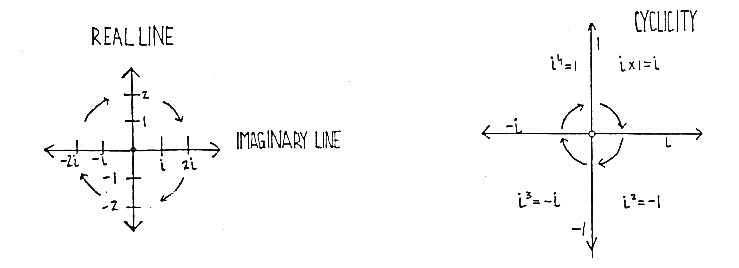
Multiplying by i rotates Y through 90 degrees onto this ‘imaginary’ line, so that it becomes iY. Multiplying iY by i now gives i2Y = -Y again, a rotation through 90 degrees, onto the real line below zero. Multiplying -Y by i produces -iY on the ‘imaginary’ line the other side of zero from +iY, again a rotation of 90 degrees.
Finally, a fourth multiplication of -iY by i gives -i2Y =+Y on the real line again. So we’re back where we started and can go round again in the same way. If Y=1 we have that i, i2, i3, i4 = i,-1,-i,1 recur as the four cyclic fourth ”roots’ of unity. The two lines now give us a four-fold framework for representing any number ‘thus-and-so’ as either X+iY or as a vector: a length having its own direction from the zero and own clockwise angle to the real line.
A Significant Illustration
Now I’ll show you how some of these laws can actually apply. Suppose this narrow rectangle is a long straight piece of wood. If you use it to do geometry with, then it’s interesting that anything that you can prove by geometry requires only two instruments: this straight-edge and a pair of compasses whose angle you can adjust You don’t need to calibrate the straight-edge. But some things you can’t do by geometry. You can’t trisect any angle, for example.(16) Some you may do, but not any one. To do that you need in principle to perform infinite processes of progressive approximation.And effectively that means you’ve got to have a calibrated ruler which has got on it units and smaller and smaller divisions and subdivisions of those units.
But, how do you make a ruler? This is where the laws of number come in. Suppose this end is going to be the zero-end of the ruler. You take the compasses and fix your unit by forcing the compass-points one unit apart. You put one compass-point on the zero-end and, rotating the compass, go along the edge to the ‘first’ point, which is then zero-plus-one or one unit from the zero along the edge. You take the zero-end compass-point off (so now/forget)the zero, rotate about the ‘first’ point and, where the free point touches the edge again, is now one-plus-one or two units along the edge. And you keep ‘walking’ like that until you get to the end of the straight edge.
You’ve now got to the far end with the compasses. So what do you do next? Well, you may not be able to trisect an angle with straight-edge and compasses, but you can bisect a line. And that’s a base 2 multiplicative number operation. So you now treat each of those units created additively as multiplicative ‘ones’. You squeeze the compass-points in a bit and then draw bits of circles from both ends of the unit intersecting on the face of the ruler, and draw a line between the intersection-points. That gives you two-to-the-minus-one or 1/2 of ‘one’. By repeating this, you can get halves, quarters, eighths,.. of the unit, and so on.
In principle, there’s no end to this multiplicative subdividing process. Whereas the additive unit-generating process had to stop where the edge did, we stop the subdividing process when we reach the finest subdivisions we need.
What have we achieved by these actions? We must have achieved something, because we’ve gone around an enneagram. We started off at O (equivalent to 9 here) and went all the way round to 4 in getting to the end of the ruler; and those additive actions were all outside.
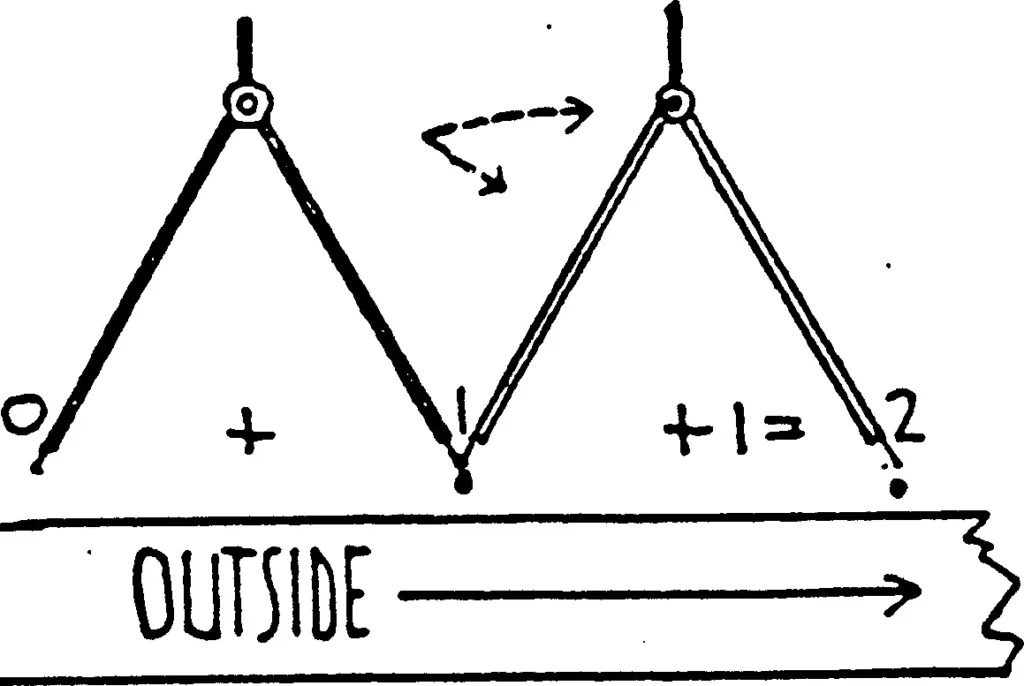
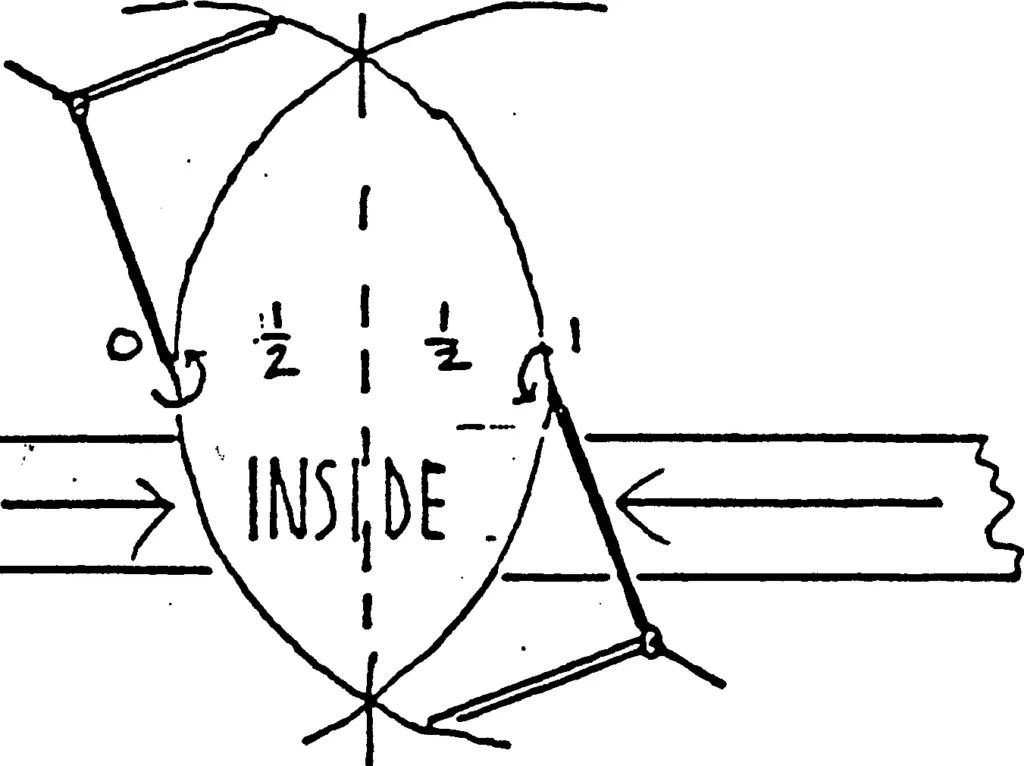
But in dividing and subdividing we were going inside each unit. That took us up the left-hand side of the enneagram, which is all about internal actions. These required us to reverse the way the compasses were used, and continually make new adjustments to the compass-points, for each new and finer subdivision. Hence O to 4 is outside and 5 to 9 is inside. The enneagram is a very compact way of showing how all that we’ve done comes together to form a complete whole.
Now a piece of wood exists. As long it exists it has “being”. What you’re doing is projecting, on to this wood- being, the laws of arithmetic. These are laws of “will” because they tell you what’s possible and what’s impossible; just as the rules of a game tell you what’s allowed and what’s forbidden. So, you’ve imposed, onto its being, laws, which are will-laws. And what you come out with is something which has achieved a “function” which you can now call: a “ruler”.
These actions have created for you a measuring instrument. An instrument is a three-fold thing. Once you’ve got a ruler, then it’s like the atomic bomb: you’ve got to use it. You can now do what, if you haven’t got one, is impossible, and that is, do science.Because until you can measure, you can’t do science. Lord Kelvin, in the last century said: “If you can’t measure then you can’t do science, because until you can, what you’re doing is just stamp- collecting”.
Now in the base 2 = 10 notation, numbers 0,1,2,3,4,5,.. become 0,1,10,11,100, 101,110,. so that 1/10,1/102,1/103,.. now mean 1/2,1/4,1/8,.. and only 0 or 1 can appear in a binary ‘decimal’ place. Here the 0 or 1 signify ‘No’ or ‘Yes’ to the question: “Does the length we’re measuring include this next finer subdivision?”. So each new 0 or 1 gives an extra binary unit or ‘bit’ of information about length. The same goes for the units, so 101.1001 gives us 7 bits of length-information.
In information theory, 1 bit of information involves selection of 1 from 2 distinct alternatives; 2 bits involve selecting 1 from 4 etc. So selecting 1 note from an octave of 8 involves 3 bits and 1 from 2n distinct alternatives n bits. 7 bits of length-information have selected from 27 = 128 alternative lengths. So there’s no ‘exact science’, because an exact length-measurement would need an infinite number of bits. To allow for this, scientists apply a theory of errors, which provides for any measurement an extra plus or minus number for its error. Kelvin didn’t mention this; but he should have. (17) Scientists know they’re always working with approximate numbers.
I’ll show you something interesting. The numbers in ordinary decimal places convey between 3 and 4 bits, because they select from 10 alternatives 0 to 9, not 0 and 1 and 23 = 8, 24 = 16. You find each decimal number is worth about 3.3 or 10/3 bits. So 101.101 = 4+1+1/2+1/16 = 5.5625 in decimal. But its 5 places give us 5×10/3 or about 17 bits, ten more than the measurement really produced! Even 5.56 gives us about 3×10/3 = 10 bits, so that last 6 is a little too accurate.
Now we were all taught at school that π is twenty-two-over-seven. It’s not, of course. Taking it as 22/7 just makes the sums easy to do. Actually π is an infinite non- recurring decimal 3.141593… and 22/7 is 3+1/7 = 3.142857 recurring. But to two decimal-places they are both 3.14 and so both convey about the same 3×10/3 = 10 bits of information. What’s interesting here is that 3 and 1/7 are the two numbers involved in the two laws of three and seven, and 10 is the only number-base filling its circle with their beautiful combined enneagram patterns, and π is the area of a unit-circle containing all the cyclic nth roots of unity.
What Makes Every Number “Unique”?
Now I said every number is unique, different from every other number. How is a number unique? What makes three intrinsically different from five, or nine, or eighteen, or a million and two? Well, I can now give you two answers: one outward and additive, the other inward and multiplicative. The additive property only depends on the number of ways you can look at that number as a collection of points. You simply ask this question: “In how many ways can you describe them?”
If you’ve only got one point on the table, clearly there’s only one way you can describe that. And that’s to say: “It’s one”. But if you’ve got two points on the table, then you can say: “Well, it’s either two or it’s one-plus-one”. Either you can look at it as the collection of two, or you can still see that there are two elements which are distinct. And if there’s three, you can say: “Well, it’s either three or it’s two-plus-one, or it’s one-plus-one-plus-one.” You do this kind of thing when you look at the patterns of one to six dots on dice. If you have four though, it starts to get interesting. You can have four, or you can have three-plus-one, or you can have two-plus- two, or you can have two-plus-one-plus-one, or you can have one-plus-one-plus-one-plus-one.
So: 1 = 1; 2 = 1+1; 3 = 2+1 = l+l+l; 4 = 3+1 = 2+2 = 2+1+1 = 1+1+1+1 etc.

There are five ways of looking at four points; three ways for three points; two ways for two and only one way for one. These are called the possible partitions, the ways of segregating all those point-sets into subsets. Its number of possible partitions is an unique additive property of a number.
But inwardly a number n has unique multiplicative properties too, concerned with n as a number-base cutting a given multiplicative whole into n equal parts.
The number n0 always means the whole before it’s cut up ‘n-wise’: producing n+l separated parts each of size n-1. When we wanted to take point 1 off the table, we had to invent a new law 1+x = 0 that made it possible. The distributive law gives us a way to reverse these n-wise cuts. Using 1/n now, it both adds and multiplies to restore, like Humpty Dumpty, the one-ness of the original whole together again. We’re then talking about how nth ‘roots of unity’ multiply n times to make one whole. Only the distributive law can give us the rules to do this like (X)x(X) = (-iX)x(+iX) = +X2 and (-X)x(+X) = (-X)x(+X) = (iX)x(iX) =-X2 when we invent ‘i’. If Xn = 1 we then get n answers for X, which are 1’s nth ‘roots’.
Now n = 1 isn’t a number-base like 2 as powers can’t increase or decrease it; but X2 = 1 can be written (X+l) x (X-1) = 0, telling us either X = +1 or -1. These are the two square-roots of 1 and are the two opposite unit-lengths from the zero on the line of real numbers. So they correspond to dividing a string of length 2 units at its centre-point as zero. When plucked, this whole string will sound a fundamental note of pitch 1/2. If either unit-length is plucked it will give the same octave-note of 2 x 1/2 = 1 only if the zero-point exactly bisects the string, and this is what corresponds musically to x2 = (-1) x (-1) = (+1) x (+1) = 1.
When n = 3 we have to use the number ‘i’ for which i2 = -1 and invent the imaginary number-line. We now move off the real line of the string to picture the wholeness of unity as a circular continuum having unit radius and area π .
This unit ‘pie-diagram’ is cut from the centre, like a cake, into n equal slices all-at-once. Its centre is the zero-point of both lines, and one cut is always at +1 on the real line. The nth roots of unity are then where then cuts come. So for n = 2 the pie divides by the(+1)- 0 -(-1) cut into 180 degree 1/2 slices. But if n = 3 we trivide the pie, making 3 root-cuts into 120 degree 1/3 slices, and if then n = 4 we crucivide it by 4 cuts at +i,-1,-i,+1 into 90 degree 1/4 slices.
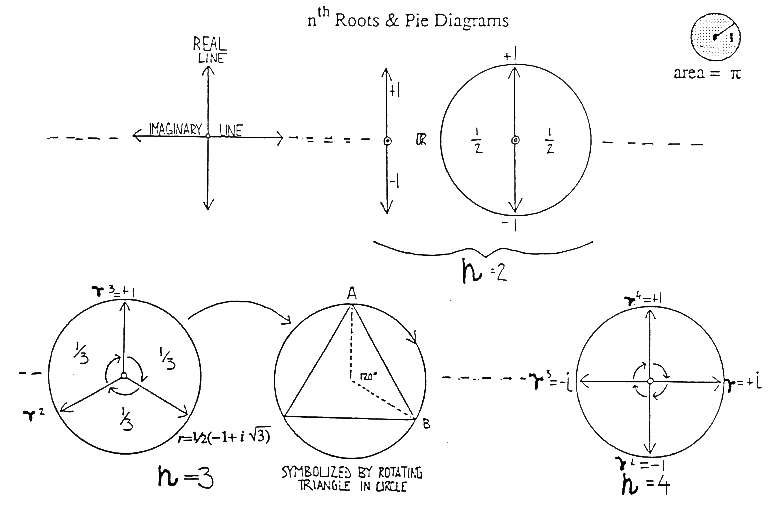
The n roots of 1 always have the form r, r2,r3, …, rn = 1 which makes them cyclic and gives them recurrent properties around the pie-circle. When n = 4 : r = +i. So we can represent them as triangles, squares etc. all rotating inside circles.Whence we begin to see coming out a justification for JGB’s notions of number- systems as the ‘inner categories• of experience. To investigate them we must explore the systematic properties of number-bases.
To re-unify the pie we start at any slice and add them all up piece-wise, working round the pie as we go, to get 1/2+1/2 = 1/3+1/3+1/3 = 1 where these fractions are now powers of one. So when n = 2 we get x2 =11/2 x 11/2= 11/2+1/2 = 11 = 1. Each addition signifies a multiplication of the root we started from. So nth roots of 1 multiply n times, and their fractional powers add, to give 1.
Recurrent Cycles, Vibrations, Waves and Even-Tempered Octaves
The simplest way you can describe a recurrent cycle with numbers is not unlike the roots of unity. The numbers that are the nth roots of unity are all n fixed vectors at definite angles either side of 1 around the pie-circle; and we have to multiply them to get them to jump from one to another. But numbers that represent recurrent cycles are vectors that rotate around it with their angles to 1 always increasing with time exactly like clock-hands; where the circular face of the clock now represents the pie-circle. Every time angles increase by 360 degrees a new cycle begins.
Recurrent cycles have their own dynamism like the clock driving-mechanism. This is important for understanding the enneagram as a moving diagram.
But in music a vibrating string alternately squashes and expands the air around the string; and these periodic disturbances of the air produce a ‘wave’ that travels away from the string to our ears with the speed of sound in air.
Now the pie-circle uses both the real and imaginary lines for its numbers; and it’s easy to see the tip of our rotating vector traces out a circular motion produced by combining two complementary motions to-and-fro along the two lines.
If we move a piece of paper along the real line underneath the pie-circle and ignore the real line to-and-fro motion, we’ll get a wave from the to-and-fro motion along the imaginary line. And if we move the paper along the imaginary line and ignore the imaginary line to-and-fro motion, we’ll get a wave from its to-and-fro motion along the real line. As air is ‘real stuff’ and so needs only real numbers to describe it, we take only the second one and call that ‘the wave’.
Waves are important for describing what happens in the ‘real world’. When we hear the fundamental and octave-notes of a vibrating string; they sound ‘alike’ because their waves fit exactly into each other in the 2/1 ratio.
Now the enneagram hexad ‘one-over-sevens’ give an ‘even-tempered’ scale whose 21/7+1/7+1/7+1/7+1/7+1/7+1/7 = 27/7 = 2 produces the ideal diapason in World Three.
But as 21/7 is impossibly ‘irrational’ it must be altered to get intervals that sound well; narrowing 4th/3rd and 8th/7th and widening all the five others to keep the diapason equal to two in the lower worlds twelve, twenty-four etc. Then three mutually reinforcing octaves can blend around their enneagram symbol.
Ant piano keyboard is tuned, not to a seven-note, but a twelve-note even-tempered octave rising in 21/12 semitone- steps up the diapason with its seven white and five black keys. So its white notes rise in five 22112 tone-steps with two semitones where 256/243 and 16/15 are in the Pythagorean and Major scales. No note is an exact ratio like 3/2, 4/3 but the ear can’t detect this. As pianos have seven octaves equivalent to one another, using the black notes too you can play them in any key.
But a 21n octave has no semitones, hence there’s no way to tell note-placing in an octave and so any note is as good as any other. You can only get the conditions for that in, World Three. (18)
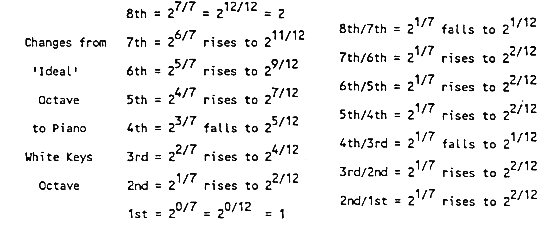
It is recurrent cyclic patterns of roots of unity that make musical octaves recurrent. The ideal even-tempered octave diapason = 21/7x21/7x21/7x21/7x21/7x21/7x21/7. We forget 0 in 0+1 = 1. But 2×1 = 2, and we usually ignore the 1 too. Yet this means 21/7 = (2×1)1/7 =21/7x11/7 and so, although only the real root 21/7 is used, the 11/7cycle recurs hidden behind the successive multiplications of 21/7 make all the octave-notes that sound alike in different octaves fall into 7 ‘equivalence-classes’. That’s why you give them the same name: A,B,C,D,E,F or G.
The piano’s diapason 212/12 = 2. But only even-tempered octaves recur exactly.
Multi-Term Systems
Now JGB’s ‘n-term-systems’ combine together n ‘independent’ but ‘mutually relevant’ interacting terms. But any number n has outer and inner properties: expressed by its number of partitions and its cyclic nth roots of unity, which recur hidden behind any other number when its own nth root is self-multiplied n times.
Suppose you first write down n ‘terms’ as then letters of an additive collection (A+B+C+D+..). Now the additive numbers appear for multiplicative numbers as the powers of number-bases. Hence partitions and nth roots show themselves in the pattern of powers when (A+B+C+D+..) is self-multiplied n times. The distributive law then brings all n terms into conjunction (as when AxB meant ‘A-paints-B ‘) making them ‘interact’ in as many ways as the number n has partitions.
[For clarity, the x signifying multiplication will mostly be dropped now]
So for the two-ten n system you’ll square (A+B) to produce A-squared plus two – AB plus B-squared. In this way, you get two-fold conjunction-terms like A2 and terms like A1B1. Hence you’ve now got the two kinds of powers that exhaust the partitions 2 and 1+1 of the number two.
So: (A+B)2 = A(A+B)+B(A+B) = A2+AB+BA+B2 (19)
So what is the concrete significance of this pattern for our experience?
Well, if AB = BA the things in brackets behave like numbers. If not, then order matters and we must write the pattern AA AB BA BB. Now systems can be subject to extra conditions that alter their number of terms. Two empty ‘places’ ()() can each be ‘filled’ by A or B. Both first and second place can be filled 2 ways, giving 2×2 = 4 pair-terms. But if A or B can’t fill more than one place, there are 2 ways for the first but only 1 for second. We only get 2xl = 2 pair-terms AB BA. These two give us JGB’s principle of polarity. It enters into the way forces act. Newton’s Law of ‘action-and-reaction’ is written FAB = -FBA. It says if there are two bodies A and B, then there’s a direction AB from A-to-B and BA from B-to-A; and the force FAB of-A-on-B is equal and opposite to the force FBA of-B-on-A. So all this two-fold polarity is implicit in its two labels AB and BA.
Something similar happens in JGB’s polar dimension of eternity. Positive charge is directed ‘up’ in eternity, but negative is ‘down’ and, as there’s the same amount of each kind in the universe, another exact equality of opposites occurs.
Now a clear and very familiar example of what this ordered (A+B)2 pattern can mean appears as (H+T)2 =HH+HT+TH+TT. Here H and T mean ‘Head’ and ‘Tail•, you’re tossing a coin twice, and HH HT TH TT are the 4 possible outcomes: pairs ordered in time.
This linear pattern appears because the terms in (A+B) have two ‘names’. Hence numbers like the 2 in 2AB are called the binomial coefficients.You can produce the first few by multiplying eleven (in decimal notation the two 1’s are two-named as 11 = lxl01+1xl00) by itself various numbers of times n to get the famously important expanding number-pattern that’s called ‘Pascal’s triangle’:
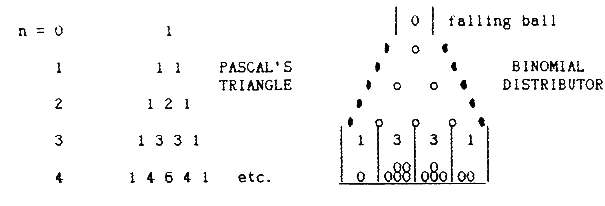
But if you tossed two indistinguishable coins at once, you couldn’t tell HT from TH and would have to lump both together as 2HT like numbers. The two H,T names aren’t ‘parts’ but the two opposite aspects of a single coin (the single top 1 of Pascal’s triangle). They’re two alternative possibilities, which multiply by 2 at each toss. As 1+2+1 = 4, 1+3+3+1 = 8, the Pascal triangle-numbers tell you how many conjunctions occur of different kinds between these two. Three tosses have eight possibilities:
(H+1)3 = HHH+(HHT+HTH+THH)+(TTH+THT+HTT)+TTT, but if three indistinguishable coins are tossed HHT HTH and THH all look the same, so you lose information.
Yet another picture of the same pattern is this pinball-machine. I .call it a ‘binomial distributor’, because it works by Pascal’s numbers. As balls fall down it, the pins deflect them left L or right R and Pascal’s numbers 1331 give the numbers of possible paths into the cans under the last 3 pegs. You can see that once you’ve got to n = 2 you’ve got the machine’s basic expanding pattern. If we collect balls from the middle cans we lose information about which of the 3 paths they took, which are now named (LLR+LRL+RLL) and (RRL+RLR+LRR); but we don’t from the outer cans because there’s only one path into each of them.
‘Lost information’ is related to increase in entropy or disorder and so to the irreversible ‘flow of time’.‘Selection’, ‘choice’, ‘alternatives’, all imply at least two distinct things to have meaning, so ‘laws of two-foldness’. Hence JGB in Volume 1 calls eternity “storehouse of potentialities”, and for him time is the “condition of actualization” that compels “fixation by selection” from these potentialities. By this he makes time a dimension having only one direction. (20)
The inner two-fold multiplicative properties come out when you talk about probabilities. If you divide the various Pascal triangle numbers by the total number of possibilities involved you must get a sum of fractions equal to one.
Each fraction is the probability that its kind of outcome will occur when tosses are made, and the 1 signifies the one certainty: that some outcome must happen. If only one thing can happen then it must happen, and it’s probability becomes 1. Hence if outcomes are selected by chance, only blind compulsive will is involved. In the pinball-machine this is provided by the force of gravity: balls must fall. So for the pattern of distinct possibilities HH +(HT+TH)+ TI= (H+1)2 we get the pattern of probabilities 1/4+(1/4+1/4)+1/4 = 1 which is the same as the sum of four fractional pie-slices for the four 4th roots X = +1,+i,-i,-1 of x4 = 1. Clearly the one-ness the whole pie now symbolizes is the one certainty involved, and if HT,TH become indistinguishable we must unite their pie-slices to get 1/2. The two 1’s two-named by 101 and 100 on Pascal’s triangle that belong to the opposite coin-faces H,T are now two-named as the two opposite square-roots of x2 = 1: X = +1,-1 that together slice the pie of certainty into equal halves.
There’s a lot more to probability than this. But it does make obvious the two simplest rules about combining probabilities. When 2 possibilities exclude one another, their probabilities add like 1/2+1/2 = 1 for (H+T). But if something can only happen by combining two alternatives, they multiply like (1/2)2 = 1/4 for HT. We first get both these rules together when 1/4+1/4 = 1/2 for (HT+TH); just as n=2 gave us the machine’s basic pattern.
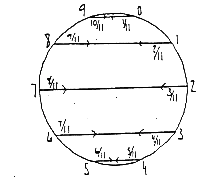
Is there a way we can relate the two-term system to the enneagram? Well, we don’t really need to, as the 22 doesn’t require more than 4th roots of unity. But if we include the zero as a separate number on its circle opposing 0.9999… as 1, its ten 2-term ‘choices’ are indicated by the ‘elevenths’ as recurrent decimals. For 1/11 = 0.090909…; 2/11 = 0.181818… up to 9/11 = 0.818181… ; 10/11 = 0.909090…. Any ‘eleventh’ is a recurrent horizontal directed line like the raster on a TV screen produced by a saw-tooth timebase.. But we don’t need laws of 3 and 7 for such jumps. One-term ‘ninths’ are still recurrent points.
It seems clear from all this that JGB’s notions of two-termsystems were a little too simplistic. He didn’t put into them all the properties of ‘two-ness’ that really apply. By removing the restriction that cut down the pair-terms from 22 to 2xl a whole lot of JGB’s ideas appeared quite naturally. This suggests that we should extend JGB’s two-term system to cover all the combinations of opposite properties that come with powers of two and first appear for 22 =4. Numbers then emerge that can be both added and multiplied, have got sharply opposite real and imaginary roots of unity, and are fully cyclic. It then covers all possible two-fold opposition-symmetries and includes information theory about the selection of possibilities enabling us to know things. This connects two-foldness with what JGB calls function. It describes results of things that happen, not the workings of three-fold acts of will that make them happen.
We couldn’t have calibrated our ruler if we hadn’t been able to use all 3 dimensions of space in working with the compasses. And if we then use the ruler to measure the length of something, we have to perform zeroth, first and second operations that again use all 3 dimensions of space. Because we have to put the zero-end of the ruler at one end of the thing we’re measuring; then swing the ruler-edge freely around until it and the thing are ‘aligned’. Only then can we read its binary divisions and subdivisions to get bits of length- information.
Three-Term Systems
For three-ness, you have three partitions into three, two-plus-one, and one-plus-one-plus-one. So if you have (A+B+C) or A-plus-B-plus-C and you only square it, you won’t get three’s partitions, as you’ll again produce terms like A-squared and AB. You get some of them by cubing (A+B) but not those involving C too. You’re only going to get them all if you cube (A+B+C). Then you’ll get 3-fold conjunction-terms like A-cubed = A3, A-squared-B = A2B1 and ABC= A1B1C1in a pattern produced by the 33 = 3×9th roots of unity. Hence for three-named terms we shall have: (A+B+C)2 = (A+B+C)x(A+B+C) = A2+2AB+B2+2BC+C2+2CA – is 2-fold,
but (A+B+C)3 = A3+3(A2B+B2A)+B3+3(B2C+C2B)+C3+3(C2 A+A2C)+6ABC – is 3-fold.
Now the concrete significance of this pattern in experience has to do with “laws of three-foldness”. I can introduce these by talking about how a lever-balance works. Because just what you can get a lever-balance to do depends on how completely you apply its own “law-of-three”.
Let’s suppose you put the thing you want to weigh in the left- hand pan. Call this the denying pan. Ordinarily you would weigh the thing by just putting weights on the right-hand pan. So call that the j{1rmini pan. Then the most economical set of weights you need rises in powers of two of the unit: 20 = 1, 21 = 2, 22 =4, 23 =8, 24 = 16 etc. (This tells you the things you’re dealing with are essentially multiplicative wholes). Kitchen-scales using pounds and ounces used exactly this set of ounces. Since 3 = 1+2, 5 = 1+4, 6 = 2+4 etc. you can weigh 1,2,3 units with the first two weights; 1,2,3,4,5,6,7 with the first three; up to 15 with four, 31 with five. Here you always add – affirming.
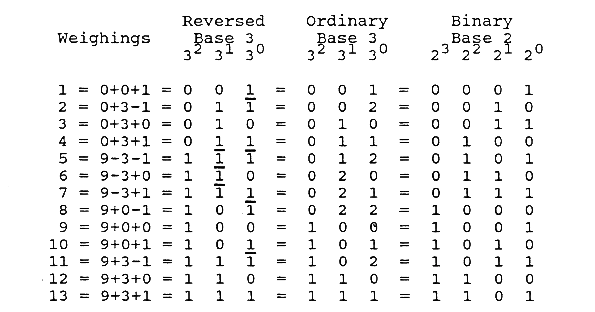
But the most economical weight-set possible uses both pans : affirming and denying. This set uses the unit in powers of three: 30 = 1, 31 = 3, 32 = 9 .. and now 2 = 3-1, 5 = 9-3-1, 7 = 9-3+1 etc. Here the minus tells you to put that weight in the denying-pan with the thing you want to weigh, and you can weigh up to 13 with just these three weights; up to 40 with four, to 121 with five.
And the first three weights in this set are especially significant, because their powers of three 0,1,2 are the three numbers you can have in a ‘decimal’ place in base 3, so they have concrete significance for the 3 law-of-three forces. For example, by affirming, denying and reconciling – in effect using all three of these law-of-three forces and numbers – you can solve this seemingly impossible problem: “How can you detect 1 single counterfeit amongst 12 coins by just 3 weighings of them among themselves; finding out too if it’s heavy or light?” Well, you do it like this:
All 3 weighings U, V, W can give balance, or affirming-pan or denying -pan down, symbolizing these by 0,1,2 we can write UVW =001,120, 212 ect. Next, as U,V and W can all be 0, 1 or 2 there are 33 = 27 possible results of 3 weighings expressible as UVW = 000 followed by the first 26 base 3 cumbers 001 to 222, (whose 1st, 2nd, 3rd digits use multiples 0, 1 or 2 of 32 = 9, 31 = 3, 30 = 1).
But these appear in complementary pairs like 001 and 002, 121 and 212 etc. with 2 and 1 interchanged, telling us the opposite weighing-results for heavier or lighter coins in pan 1, when equal number of coins are in both pans. Since 000, 111, 222 are excluded (as we must weigh the counterfeit at once to get 1 or 2; consequently 111, 222 bane no 0 we can use), there are 12 such pairs – which we can arrange so that each weighing contains 12/3 = 4 each of 0, 1 and 2.
We can now arrange the 3 weighings to get UVW to reveal the counterfeit coin: eg. a heavy counterfeit coin 1 with UVW = 001 isn’t in the weighings U,V at all, but is in W’s affirming-pan. So for a light counterfeit coin 1, the complementary 3- weighing UVW = 2 will occur. We might have, for example, this arrangement:
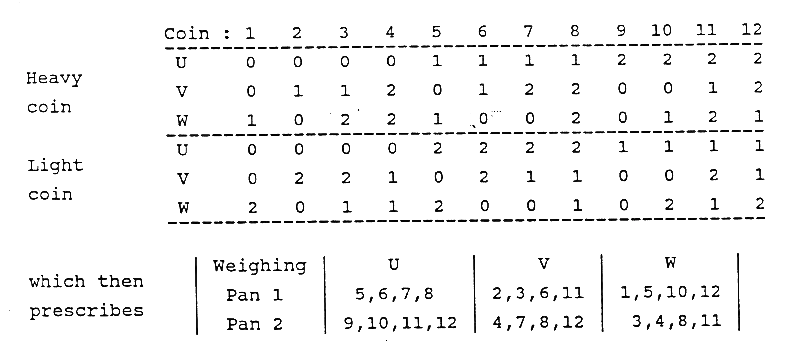
Whence eg. UVW = 210 tells us coin 7 is the counterfeit, and it is light. (21)
Now this set of 33 = 27 three-fold UVW weighing possibilities is the same as the set we get for (A+B+C)3. It’s just differently three-named: using 0,1,2 instead of A,B,C. Notice that we had to treat the three names 0,1,2 equally in labeling the coins, just as we would in a ‘decimal’ place. The three extreme cases UVW = 000, 111, 222 excluded themselves from participating in the final weighing-scheme; just as AA,BB didn’t appear in Newton’s Law; and HH,TT for a tossed coin lost no information. But when we pressed into service the 24 UVW actually used it was 1 and 2 that gave us 12 complementary pairs of opposites.
Once we have three-foldness the character of zero as prior to ‘opposites’ (as with the originally empty-table) shows itself. For two-foldness 1 and 0 show an ‘absolute’ opposition: of ‘either-all-or-nothing’. But when we get to three-foldness, the 2 appears and now forms a complementary ‘opposite something’ to 1. The original role of zero reappears.
So what I said earlier about the two-fold and three-fold weight-sets was not quite right. For the two-fold method of weighing, no alternative is seen other than putting one of the base 2 weights on the affirming pan or not; so these are 1 and 0. But for the base 3 set 3 alternatives are seen: putting a base 3 weight in pan 2, not putting it on at all (0) or putting it in pan 1. So all three forces: denying, affirming and reconciling are being used. Hence we can invent what’s called a ‘reversed notation’ to describe it, where 0,1 and Ī are written for each of the base 3 weights 32, 31 and 30 if it’s not used (0) or is in the affirming (1) or denying-pan ( -1 ). You can then see how, after the first, the other 3-fold possibilities repeat this 3-fold -1,0,+1 pattern. But there isn’t any reversed notation for binary one-pan weighings, so I’ve put them down for 1 to 13 in usual base 2 notation; with ordinary base 3 for comparison:
However, the coin problem treats complementary opposites as ‘either-or’ absolutes. This shows us the lever-balance’s law-of-three is simply mechanical. No distinction is made between UVW conjunctions like 012 and those like 002. Instead, all 24 used are treated merely as 2×12 different alternatively labelled possibilities. In spite of its three-fold setting, it’s basically a two-fold information theory problem. To select 1 from 16 = 24 coins needs 4 bits; 1 from 32 = 25 needs 5.
In principle, three 3-fold weighings can select 1 from 27 and hence provide between 4 and 5 bits, so they should be able to select 1 from 24.
The Enneagram Cosmogony
Now the three lever-balance weighing-states are static states, and so are the three-fold weighings UVW. A transition from one to another has no meaning. Yet our actions making the ruler involved transitions from one law to another. Hence if we’re looking for a dynamism that can express the possible actions of the will itself, we need a more dynamic generalization of the meaning of 0,1,2. This is what JGB attempted in Volume 2, and what he achieved was extraordinary. However, he made one serious mistake that made him confuse the whole patterning of the triads in the various worlds of will; and three enormous omissions: the greatest of which, for him, was that he didn’t take the enneagram seriously and apply it. This meant he had no check upon the accuracy of his results. Because, as Gurdjieff said: if you really know and understand anything correctly, it fits naturally around the enneagram. If he’d done this, he’d have seen that he’d made some mistakes.
This A-plus-B-plus-C cubed is particularly important because it gives you what, I think, must be the twenty-seven-fold pattern of the Will in World Three. If any world exemplifies all forms of three-ness it’s going to be World Three and, if we keep our eyes open for applications to Gurdjieff’s cosmology, we can see here that, since we can represent (A+B+C) by a triangle in a circle, and as this also symbolizes the three cube-roots of unity, the right-hand side terms of (A+B+C)2 must display 9-fold and (A+B+C)3 in some way display 3×9-fold cyclic symmetries.
Hence (A+B+C)3 terms fit exactly round an enneagram whose inner-triangle points 9,3,6 are at A3,B3,C3. If we take the six terms 3A2B, 3B2A, 3B2C, 3C2B, 3C2A, 3A2C of (A+B+C)3 to be indistinguishable triples, they fit neatly between A3,B3, C3at its points 1,2,4,5,7,8. All so far are still the (A+B) cubed kinds of terms. But only (A+B+C)3 gives us 6ABC terms too and, by symmetry, we must put them at the circle centre because they involve all three of A,B,C and only the centre is equidistant from these three. The law of seven can then fit its hexad neatly inside the circle and form its even-tempered octave: its hexad zigzagging between the triples 1(3A2B) 4(3B2C) 2(3B2A) 8(3A2C) 5(3C2B) 7(3C2A). All these triples are of the same kind ; and indistinguishable in the same way, so each is ‘as good as’ any other: the property of the notes in the 21/7 octave.
Now A,B,C are again ‘names’, not just ‘numbers’, and different kinds of cyclic order occur: 3A2B are three indistinguishable bi-cyclic triples AAB, ABA and BAB; whereas 6ABC are three cyclic triples ABC, BCA and CAB and three anti-cyclic triples BAC, ACB and CBA. So we can represent them as smaller encircled rotating- triangles, with 3 orientations, on or in the enneagram-circle. For the three encircled triangles AAA, BBB, CCC all three orientations are identical. (22)
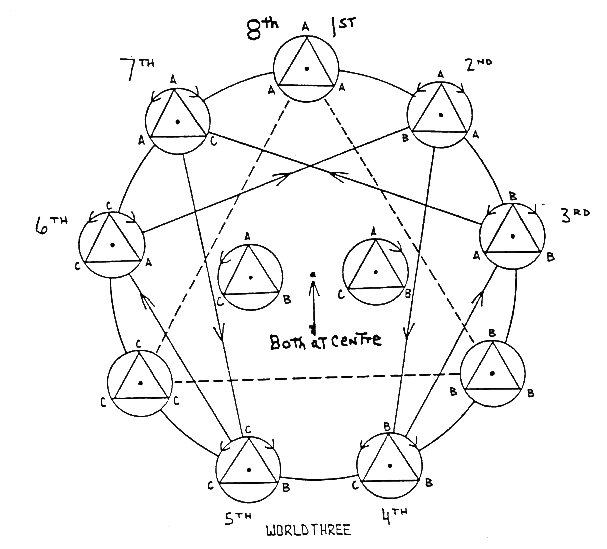
To get an enneagrarn for (A+B+C)2 we must distinguish between, for example, AB and BA. If we took 2AB, 2BC and 2CA as indistinguishable, they’d only fit midway between A2,B2 ,C2 on a circle, all of these being still the kinds of terms we get from (A+B) squared. Assuming it’s rather easier for the Will of World Three to produce two-fold than three-fold terms, I’ve given them the benefit of the doubt in this (A+B+C), (A+B+C)2 and
(A+B+C)3 diagram which, as you can see, is just hinted at in the symbol inside the top box of Gurdjieff’s “Step-diagram”. If you don’t assume this, then you jump straight to the (A+B+C)3 enneagram inside the (A+B+C)2 one.
We’ve now built up for ourselves sufficiently powerful number-tools to open up this apparently inscrutable symbol and reveal its inner structure. It tells you about the creation of the world and goes right down to the formation of World Six, which I shall be talking about later.
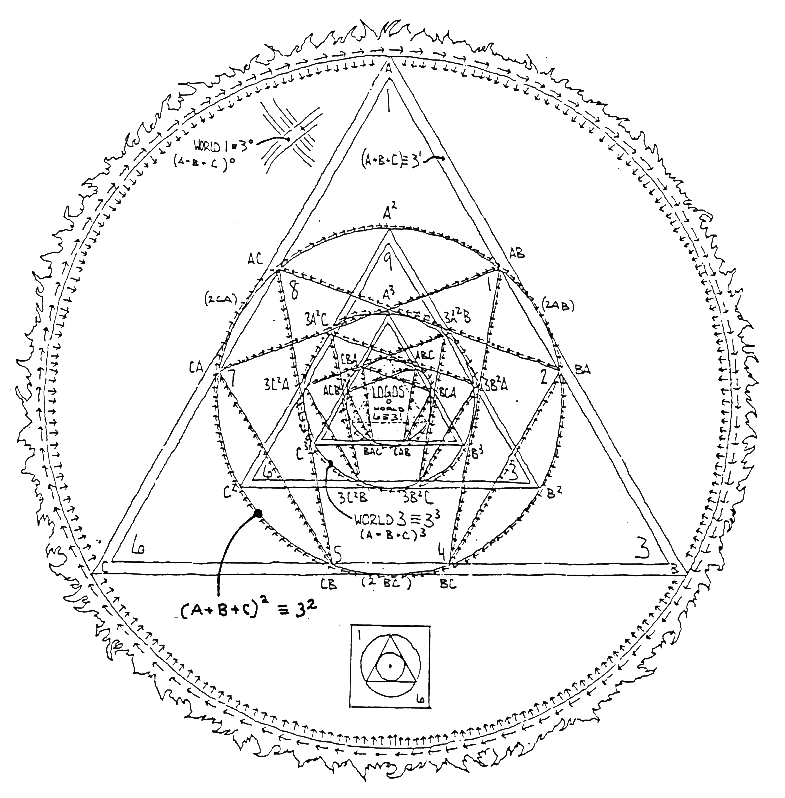
World One, however, is World 30. It’s the single, whole Will before it ‘trivides’ into the triple will of World Three recombining first as Three-squared 32 and then as Three-cubed 33. It’s symbolized by the outermost circle of the World-creation diagram as the pie-circle, signifying that compelling certainty that everything must pass away which Gurdjieff calls ”The Merciless Heropass”, or Time (I’ve shown this by the arrows all playing follow-my-leader around the outside) whereas for two-fold probabilities the certainty 20 is that something must happen, by selection from eternal and timeless alternative potentialities. When we gather information about what, left to itself, did happen; we find it happened in the direction of increasing disorder or entropy. But (to paraphrase St. Augustine) somehow we never seem to know the hidden cyclic act behind the change. (23)
Because “Heropass” is 30 and not 20 it has strange, inscrutable what-I-call ‘Zeroth Language’ cyclic properties, as Gurdjieff relates in the extraordinary chapter in Beelzebub called The Relative Understanding of Time. The ‘”Heropass” is, you see, really the ‘Zeropass’ that annihilates – reduces to nothing – everything that can happen or has ever happened or is now happening or ever will happen. So this ‘Z’ echoes the Zoroastrian source or Zurvan tradition which JGB reckoned the conception originally came from. But 30 also means the whole substance of the pie itself that Gurdjieff calls “Etherokrilno”, which I’ve suggested in the diagram by the little shaded area. When the big (A+B+C) triangle appears inside this pie-circle, all three of A, B and C, as three cube roots of this 30 unity, have equal status 1/3. The Three-fold Will has appeared and so must act. Yet all its actions must pass away. This dilemma forces the creation of the world.
But what happens to this World-creation diagram for Worlds Six and below? Gurdjieff tells you in Beelzebub : The Whole that is World Three, which he calls ”The Most Most Holy Sun Absolute”, becomes modified by “changing the principle of the functioning” of its laws of three and seven. JGB realized that some authorizmos(24) or self-limitation of the Will must occur somewhere, of the kind giving two polar terms AB BA with two-foldness. If you notice in a hail-storm that all hail-stones are around the same size, you know some selective action is going on somewhere up in the clouds. But he didn’t manage to locate this one in World Three because its twenty-seven-foldness escaped him. (This was his second enormous omission.) So his account of the process of creation “although magnificent in its bold outline” was inevitably lacking and defective.
But here three empty ‘places ( )( )( ) become significant; the authorizmos now preventing any one of the three forces A,B,C from taking-up more than one place in any triad; so diminishing the forms available to them from 3x3x3 or twenty-seven to only 3x2x1 (which is called ‘factorial-three’ and written 3! with an exclamation-mark after the three, as I’ve shown it) or six. The first place can have any one of the three, but the second can have only one of two, and then the last place can only have the remaining one, so there are only three-times-two-times-one or six laws. If these six are now ‘possible’ laws, the remaining 3+3×6 = 3×7 = 21 forms become ‘impossible’ in the lower worlds.
So all twofold conjunction-terms vanish, only those bringing-three-together are left. When AB BA became distinct they only showed two-fold linear symmetry of stark opposites, of the Newton’s law kind. But now the six triads ABC BCA CAB BAC ACB CBA split apart into two complementary cyclic symmetries of tristinct three-fold triplets to express laws of their own. Since A3,B3,C3 vanish too, the symmetry reason pushing 6ABC into the (A+B+C)3 circle-centre also disappears.
JGB only considered the will in the worlds below World Three, the first of which is World Six, whose six laws he formulated in Volume 2. His idea was that, in succeeding worlds, extra twin-sets of laws appear as the three forces become progressively more dependent on existence. First a dependent force in the third place produces six more laws (world twelve); then in second place twelve more (world twenty-four); finally in first place twenty-four more laws produce world forty-eight. However, sadly, this choice was the wrong one. JGB used to tell us that, when he was director of research for the BCURA (25), he assembled a team of brilliant inventors, some of whom were so difficult to work with that they had to be allowed to work away on their own. After a while, JGB said, he would hold a meeting for ‘killing babies’; when all the various bright ideas these awkward geniuses had evolved were weeded out, and unworkable ones discarded. I’m now going to apply JGB’s baby-killing procedure to his own misconception.
After thirty years of pondering this, I finally saw that the only really viable alternative is to take the dependence on existing beings (for Gurdjieff’s ‘Step-diagram’ tells us more than bare ‘existence’ is involved here) as concerned, not with the place of a force but the kind of force: taking it as firstly force 2 for world 12; secondly force 1 for world 24 and finally force O for world 48. Only world 48’s own 24 triads now ‘incorporate’ a reconciling force 0 depending on ‘living’ beings. This is why the body is such a versatile instrument of the human will.
As long as the two-fold terms in (A+B+C)3 are present, symmetry puts the 6ABC triads within World Three at the 0 of both number-lines in the very centre of the enneagram pie-circle. But when they vanish, the 6ABC are left ‘hanging in mid-air’. This compels a new beginning for tristinct three-fold symmetry forming World Six, by which the hitherto ‘zeroth’ force becomes an independent ‘third’ force in its own right, instead of a sort of ‘poor relation’ of the other two. (In the original version of Beelzebub, Gurdjieff indicated this: writing that, in order to get the creation in motion, “Our Endlessness” had to specially vivify this force, “by the force of His Own Will”. But in the published version this was left out). Henceforth it no longer ‘means nothing’. As it happens, this does correspond to JGB’s notation; in which A,B,C are replaced by 3,1,2 not 0,1,2.
As ‘two-fold’ terms of the same kind as (A+B)3 associated with the World Three hexad have disappeared, we now have to associate the remaining six triads with one instead. To do this we examine their complementary tristinct cyclic symmetries in two sets of three, which are:
|
8 |
213 |
CBA |
ABC |
312 |
1 |
|
7 |
321 |
ACB |
BCA |
123 |
2 |
|
5 |
132 |
BAC |
CAB |
231 |
4 |

312 is clearly the ‘original’ triad in the sequence as it corresponds to 012. Opposition of 12 and 21 in the triads 123 and 213, 321 and 312 is set by opposite enneagram inner-lines 2-8 and 7-1. For 231 and 132 their central 3 also marks them out as the bottom two triads. So triads like 312, 123, 231,132,321,213 now appear at the enneagram-points 1,2,4,5,7,8. Thus left-hand triads go ‘up’ the left- hand side of the new enneagram, right-hand ones ‘down’ its right-hand side. We have no choice in the matter: the tristinct symmetry dictates this unique arrangement.
All this has now introduced into processes below World Six the primordial ·opposition between involutionary and evolutionary actions. Once begun, right-hand triads are easy and ‘go-by-themselves’; whereas left-hand triads are hard and demand continual effort and attention. Between 4 and 5, the neutral reversal of sequence-order of forces from 231 to 132 occurs. When calibrating the ruler-edge these opposite kinds of actions appeared in making outward additive units and the multiplicative subdivisions inside them. In both sequences the very same 2-force appears in all three triads. The piece of wood was actually a 2*-force. For if 2* means being-dependent 2: this triad-sequence below first occurs in world 12; and our actions making the ruler were so basic that they formed an image of it. By impressing laws of arithmetic onto it, it acquired ‘its own laws of 3 and 7’ because the enneagram we had to conform to implied both.
|
Concentration |
8 |
2*13 |
312* |
1 |
Order |
|
Freedom |
7 |
32*1 |
12*3 |
2 |
Expansion |
|
Interaction |
5 |
132* |
2*31 |
4 |
Identity |
With JGB’s method of introducing existence-dependence,this can’t happen. But if being-dependent forces appear in the order: first 2*, second 1*, third 3*, seven sets of six triads in world 48 will have their own enneagrams; the eighth ‘pure’ set linking-up with World Three. The octave of world 48 will-structure below (which is JGB’s third enormous omission) then makes’ resonances’ possible between enneagrams from different worlds. For if the enneagram is a moving diagram, several can superpose, like waves. This is what I meant by saying that if JGB had checked his results with the enneagram, he’d have seen his way of taking existence- dependence was mistaken:
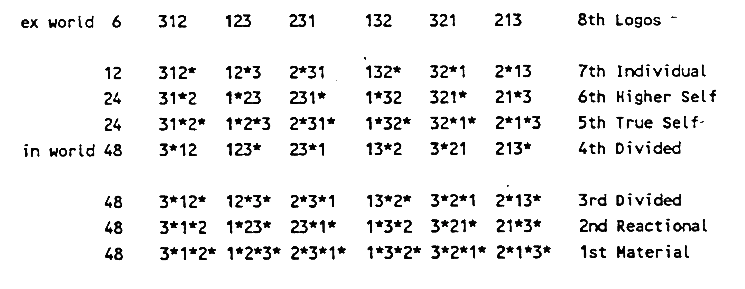
A synchronous seven-fold structure then characterizes fully evolved human experience. A single action of a ‘”Man No.7″ may then participate simultaneously in seven different enneagrams and have seven distinguishable meanings, on seven different levels of his seven-fold integrated human will. Now this is something Gurdjieff spoke a lot about, and ordinarily it seems totally incomprehensible; but nothing remotely like it can be inferred from JGB’s own treatment.
Notes 1st to 8th correspond both to Gurdjieff’s ‘Man-numbers’ and JGB’s ‘Selves’ and provide one single overriding enneagram for the whole scheme. The 4th/3rd ‘barrier’ now makes very appropriate JGB’s name ‘”Divided” Self and the 8th/7th makes ‘Man No.8’ (JGB’s ‘Cosmic Individual’ incarnating the Logos) inaccessible ‘”from below”.
Specific features of Gurdjieff’s teaching now fall naturally into place: 1st, 2nd, 3rd notes are the ‘servants’ in his parable of the house in disorder, who from among them elect a ‘deputy steward’ (3rd) in preparation for a real steward (4th) who hears the master (5th) who alone realizes (6th) what his house is.
In Gurdjieff’s simplest model (presented in Russia) of what happens when the law of seven is ‘changed’: two semitone-shocks appear in octaves and three octaves successively become blended into one around their modified enneagrams. Only one octave is involved-until 3 is reached; a second enters at 3 and triads like 231 and 132 then hold them together. At 6 the final octave can come in, concerned with the aim the whole has to achieve. Here the triads like 321 and 213 have to harmonize all three processes; and if 2, 1 or 3 are 2*, 1* or 3* it can only be done imperfectly – whence the inevitable ‘Purgatory’ of world 12.
The enneagram with its 3 octave-processes really only comes into operation in world 12, because there, for the first time, 2*- forces appear in the world. This is because, as JGB saw in Volume 2, existence first becomes defined there. And if you have 2* this means you have material that can be finer and coarser and get itself transformed. In World Three you’re talking about theology. In Beelzebub the 6 triads are ’emanations’ called the Theomertmalogos. So ‘cosmogony’ begins from World 6, and world 48 is the world of JGB•s ‘spiritual psychology’.
If all the world 48 triads form an octave, what are the other two octaves involved? Well, the simplest answer is something like this. The 1st, 2nd and 3rd selves are, roughly speaking, the powers of the physical body, the feeling-centre and the ordinary mind. Everyone has these three, but not many people can really develop them properly. They’re for living in the world with, and the world itself is, as far as the enneagram of these ‘selves’ is concerned, the second process that comes in at point 3 as ‘other’. As a child you grow up, and you’re more-or-less protected from the world as ‘other’ by your parents and teachers at school and so on. And if they do their job reasonably well, these first 3 selves get developed apart from the world. They’re the do-re-mi of the first octave at points 0,1,2 of the selfhood enneagram; but they don’t take you to point 4 because there’s a barrier between the lower and upper triads of what JGB calls the ‘divided’ self – the mi- fa interval between the 3rd and 4th octave- notes.

The shock at point 3 of the world as ‘other’ upon you as ‘self’ comes when you have to go out into the world and make your own way as an independent 4th self. If your parents and teachers didn’t warn you about this, they did nothing to prepare your 4th self. Gurdjieff’s father did a lot to prepare Gurdjieff’s 4th self, even when he was a child, as he tells you in Meetings with Remarkable Men. A developed 4th self isn’t as rare as some people would have you think. There are quite a few people who get a grip on themselves and carve out a successful way in life. Things come together for them because 3*12 gains access to pure 1-forces and 2-forces. But it still involves only 3*-forces; there’s nothing ‘spiritual’ about their kind of success: nothing immortal about it. For that you have to move to the 5th self, and the way things happen for you is reversed. The 4th self can be the obyvatel, the ‘good-householder’ who honourably fulfils the ‘ordinary’ duties of the enneagram’ s right-hand side (by marrying, bringing-up children and so on) then turns towards the spiritual life of the 5th self.
A 5th self is the first one to get involved in pure 3-forces from world 24 that don’t depend on existing things. This is an eye-opener. Because a whole new world opens up of endless inward possibilities. But you see that you need help to begin to connect with these new possibilities. All that can be achieved with 3*-forces now seems very small, and so does your 4th self that depends on them. And that’s where the third process of ‘the work’ comes in at point 6. Your need gives you access to it. So, you see, this transition across the bottom of the enneagram corresponds to Gurdjieff’ s teaching about ‘magnetic centre’, and you begin to see coming out now the outlines of a ‘three lines of work’ enneagram.
Now the triads in world 48 are symmetrical. A line down the middle of the enneagram divides them into all those with 3 on the left, with 3* on the right. The right-hand side is about what worldly people fondly call ‘the real world’: the ‘outer world’ of fact. The left-hand side is about the ‘inner world’ of value. Hence the involutionary and evolutionary triad-sequences, associated with these two, are also Gurdjieff’s ‘two streams of life’ described in From the Author. Resonances between enneagrams in these two worlds can bring them into harmony for evolving human beings.
As the 1-4-2 inner lines of the enneagram stay on the right-hand side, and don’t yet zigzag across to the left-hand side, the selves up to 4th can lead a kind of ‘self-contained’ existence. This is what Gurdjieff called ‘sleep’, and it tends to occur because the involutionary triad-sequence is self-per-petuating; giving the familiar cycle of “the rich get richer and the poor get children”. This is reinforced by what Gurdjieff calls “the consequences of the properties of the organ Kundabuffer” which, Keith Buzzell has suggested can be represented as a sort of vertical mirror down the centre of the selves enneagram. This mirror then reflects the right-hand half of the 2-8 line back to form the right-hand half of the 7-1 line, cutting the self off from the 3-force triads at points 7 and 8 and producing a spurious closed inner-line cycle.
But as regards ‘awakening’, it’s most significant that if this mirror is removed, the 7-1 line comes across from the 6th ‘higher-emotional’ triads like 31*2 to triads like 3*1*2 of the feeling-centre with 1* and a pure 2-force; and the 2-8 goes across to the 7th ‘higher-intellectual’ triads like 312* from the 3*12* triads with 2* and a pure 1-force of the ordinary mind. These tell you how the impulse arises for completion of the will. Triads with ‘pure’ 3-forces can complement those with existence-dependent 3*-forces. This is how the wish arises in you: to cross from one stream of life to the other.
But, as Gurdjieff says in From the Author: “To cross into the other stream is not so easy – merely to wish and you cross. For this, it is first of all necessary consciously to crystallize in yourselves data for engendering in your common presences a constant unquenchable desire for such a crossing, and then, afterwards, a long corresponding preparation.” Then ‘the work’ can transport you.
Notes and References
- The Dramatic Universe by J.G.Bennett. Hodder & Stoughton, VoLl:1956; 2:1961; 3:1966; 4:1967.
- Ref.1.Vol.1 p.32.
- Witness by J.G.Bennett. Turnstone Books, 1975, p.260.; Idiots in Paris Coombe Springs, 1980, p.11.
- Ref.1. Vol.1 p.ix.
- Gnosis by B.Mouravieff. Agora Books, Praxis Institute Press, 1989, Book One, Foreword.
- A Mathematician’s Apology by G.H.Hardy. Cambridge, 1969, p.37.
- Men of Mathematics by E.T.Bell. Penguin Books, Ch.XXI.
- Recurrent decimals depend on 9. Any 1/n produces an r-fold recurrent decimal 0. xif 1/n = x / (l0r-1) whence 1/7 equals 0.142857 = (10-1 + 4 X 10⁻² + 2 x10⁻³ + 8 X 10⁻⁴+ 5X 10⁻⁵ + 7 X 10⁻⁶ (1 +10-6 + 10-12 +..) in which the GP (1 + 10-6 + 10-12+ ..) = 1 / (1-10-6 = 106 /(106 – 1) = 106 / 999999 and so 1/7 = x / (106 – 1) = 142857 /999999; 1/9 = 0.1 and 2/3 = 0. 6 = 6/9 recur as one-fold points; 3/11=0.27 = 27/99 as a two-fold line. Writing t,e for 10, 11 we find in duodecimal 12 = 10 notation that 1/7 = 0. l86t3 5 and 1/5 = 0.249 7. The next base showing the 1/7 hexad and 1/5 tetrad is 17 = 10 with 16 points on the circle. Writing T,d,f,F for 12,13,14,15 we find 1/7 = 0. 274t9 7′ (same arrows as enneagram hexad) and 1/5 = 0.36di .cf. (a)The Gentle Art of Mathematics by D. Pedoe, Penguin Books, 1963, p.128. ff. (also a Dover reprint). (b) A Concrete Introduction to Higher Algebra by L. Childs. Springer-Verlag New York, 1988, pp. 101, 212 ff.
- A Survey of Modem Algebra by Birkhoff & MacLane. Macmillan, 1963. Ch.1.
- Beelzebub’s Tales to His Grandson by G.I.Gurdjieff. Routledge & Kegan Paul, 1950, p.751.
- In a base 3 modular arithmetic 3 = 0 (mod 3) so the sequence 312 becomes identical with 012 (mod 3). cf. Basic Mathematics by R.G.D.Allen. Macmillan, 1968, p.52. cf. Ref.l. Vol.2. p.120.
- cf. Introduction to Number Scales and Computers by FJ .Budden. Longmans. Ch.7.
- Principia by I.Newton. Definition II. Great Books. No.34. Encyclopaedia Britannica, Inc. p.S.
- cf. (a) The Presocratic Philosophers by G.S.Kirk & J.E.Raven. Cambridge, p.229-30. (b) Tone. A Study in Musical Acoustics by S.Levarie & E.Levy. Greenwood Press, Westport, Connecticut, 1980. Ch.2.
- In Ax(B+C) = AxB+AxC put C = 0, then Ax(B+O) = AxB+Ax0. But B+0 = B so Ax(B+O) = AxB tells us that Ax0 =0. Now put B+C =0 so that C = -B, then Ax(B+C) = AxB+Ax(-B) = 0 gives Ax(-B) =-AxB. If we also replace A by -A then (-A)x(B+C) =-AxB+(-A)x(-B) =0 so (-A)x(-B) = +AxB.
- Any geometrical construction is equivalent to specifying a number with rational numbers and square roots. cf. (a) Number The Language of Science by T.Dantzig. Allen & Unwin, 3rd Edition, 1947, p.289. (b} A Concrete Approach to Abstract Algebra by W.W.Sawyer. Freeman, San Francisco, 19S9. Ch.11.
- cf. The Physics of Experimental Method by HJJ.Braddick. Chapman & Hall, 1966.
- In Ref.10 (p.753-4} Gurdjieff widens 4th/3rd, narrows 8th/7th and ‘disharmonizes’ 6th/5th. This digs intuitively far deeper than his earlier teaching in Russia, when he used the narrowed Major scale intervals. cf. In Search of the Miraculous by P.D.Ouspensky.Routledge & KeganPaul, 1950,p.125. cf.(a) The Hidden Face of Music by H.Whone. Gollancz. (b) Science and Music by JJeans. Cambridge, 1961. (c) Modem Mathematics and Music by FJ.Budden. Mathematical Gazette, c.1980, p.204.ff.
- JGB does introduce this pattern, but mistakenly treats it as 4-term, in Ref.l. Vol.2 pp.215,263.ff.
- Ref.1. Vol.I Ch.8. cf. Optics and Information Theory by F.T.S.Yu. Wiley, 1976. Ch.4.
- If we only wanted to detect the counterfeit, we could find it among 24 coins, weighing in 8-sets.
- If the triangle vertices A,B,C are where 9,3,6 are on an enneagram- circle we can ‘read’ this as ABC. Rotating the triangle anticlockwise through 120 degrees then produces BCA; another produces CAB; yet another ABC again. But to get the ACB, CBA, BAC, ACB ‘anticycle’ we must rotate clockwise and read them backwards. ABA, BAA, AABgives the same ‘bi-cycle’ whichever way the triangle rotates.
- “Si non rogas intelligo.” cf. Confessions of St.Augustine. Book XI, Ch.14. Everyman Library, p.262.
- Ref.1. Vol.1 pp.66,153. cf. Vol.2 p.70-1.
- The British Coal Utilization Research Association. After JGB had resigned in 1942, this post eventually became filled by Dr. Jacob Bronowski in 1950. cf. Witness p.202-3.