
A NOTEBOOK ON THINKING IN THE SIX TRIADIC FORMS
Anthony Blake
Part 4
Quick Links
TRANSITION TO THE TETRAD
Three plus One Equals Four
In the context of set theory and transfinite numbers, Rucker makes the following observations:
At any time one has many thoughts present in one’s consciousness But now, by moving to a higher level of self-consciousness, one can group all of the past thoughts together into a new thought T. T and the old thoughts make up a new and enlarged state of consciousness, and by once again stepping outside oneself, a new and still higher thought T. appears. cf Whitehead
The relevance of these remarks to our present enquiry is obvious. Vie would like to add that the ‘many’ thoughts which Rucker refers to can, in our context, be represented in our thought as just three independent ones. We have, as yet, not given a rational for this reduction; at least, not fully. But, we have implicitly assumed an argument of the form: ‘There is that than which no lesser can be thought’. In this wise, relatedness has to be at least three-fold; while choice has at least to be two-fold. Put in this fashion, what we are asserting is quite obviously the case.
Rucker, in his exposition, talks of both consciousness and self-consciousness. His ‘self-consciousness’ enables a transition to be made from one level of thought to another (though he expresses it as a movement from one level of self-consciousness to another). In our scheme, we would like to have consciousness as ‘horizontal’ or extensive, while self-consciousness will be ‘vertical’ or intensive; again, the former is ‘additive’ while the latter is ‘multiplicative’. The correlation of self-consciousness with multiplicative unity is useful since it ties in with our feelings about reflection.
Given our notion of a reduction and given our distinction between additive and multiplicative consciousness, we have a model for the step from one ‘system’ to the next, as exemplified in the transition from triad to tetrad. However, this transition has been expressed here purely in terms of our own thinking and powers of conceptualization. de have, as yet, no basis for what we have been calling the physical reality of the system (in this case, the tetrad). It is not surprising that concern with the tetrad should have arisen in our century in the context of psychology.
Nearly all our intellectual activity, in its tendencies towards abstraction and precision, centres around relations. The activity itself especially in its capacity for reflection, is triadic; as is evidenced in the dialectic of Hegel.
However, in none of this is there a sense of what is, whether we take this psychologically or as a purely ontological or even materialistic question. As we have seen, the triad does not concern ‘matter’ per se.
For us, the very beginning of Plato’s Timaeus, speaks just of this in allegorical form:
|
Socrates: One, two, three; but where, any dear Timaeus, is the fourth of those who were yesterday my guests and are to be my entertainers today? |
|
|
Timaeus: tie has been taken ill, Socrates; for he would not willingly have been absent from this gathering. |
Plato says that the ‘fourth’ is missing and Timaeus says that he is ‘ill’. It is in such terms that Jung talks of the fourth. The two sides are expressed with clarity in Plato: he is the absent, the unconscious; and he is ill, the shadow. Jung considers the triad to be the masculine spiritual principle, while the fourth is the feminine; and he makes much of the fact that the Church was forced ray popular feeling to elevate the Virgin Mary to almost divine status as a necessary ‘compensation’.
Let us look again at our treatment of the tetrad in terms of (a) three dimensions of space with one of time and (b) three dimensions of time with one of space. In the former, the three lack movement – nothing ‘flies’ – whereas, in the latter, the three lack anything that moves -they are movement or change without being the movement or change of anything. Similarly, we can make a scheme for the relatedness of measurements in physics but only to the neglect of the observer. Again, we can deal with the dynamics of the psyche, but only to the neglect of the external world.
It is usual, once we have added a fourth, to deal with the tetrad as ‘consisting of complementarities or of relations. It is extremely rare to deal with it as a tetrad (which we attempted to do with the triad, that is, as a whole). In order words, we rarely, if ever, deal with the intrinsic order of complexity which the tetrad represents. The derivation of the tetrad according to the formula ‘three plus one’ is itself a misleading reduction; but it is still useful. Similarly, with the formula ‘two plus two’.
We must note the following about the ‘linkages’ between the terms. These ‘linkages’ really amount to the sub-sets of terms taken in pairs. Thus, with the dyad, we have only one (a,b); and with the triad, we have three (a,b), (b,c) and (c,a). In the tetrad we have six. To enable us to visualize the step from triad to tetrad, we may take as our point of departure the six combinations of the three terms of the triad as signifying the linkages in the tetrad. This move was hinted at before, when we implied that it is the tetrad which ‘allows’ the six combinations to be distinguished.
Approximate Derivation of the Terms of the Tetrad from those of the Triad
We are imagining that the tetrad is in the form of a tetrahedron, to allow us perfect symmetry. We are then making the equivalences:
bac = (B,C)
acb = (C,D)
cab = (A,C)
bca = (A,D)
cba = (B,D)
Where a, b, c, and d are the terms of the traid
and A, B, C, and D are the terms of the tetrad
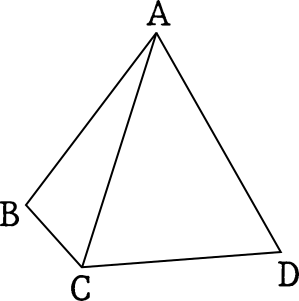
The equivalence’s have been made without any regard to possible content and meaning.
Of course, the lines in the figure do not signify that there is anything ‘between’ the terms. The terms are enfolded in each other: thus, (A,B) signifies ‘A in B and B in A’. However, this enfolding is necessarily accompanied by an unfolding. We want to argue that there will be a most enfolded term – the hidden – and a most unfolded term – the given. The tetrad contains the operations of enfolding and unfolding. It brings out of the hidden into the given and folds away the given in the hidden.
In our exploration of the representation of the tetrad by means of the combinations implicit in the triad, we will suppose the following general interpretations for the three terms of the triad:
1 – the higher order of complexity
2 – the lower order of complexity
3 – the transitional order of complexity
We then make the following interpretations for the combinations:
123 unfolding
213 enfolding in the strong sense i.e. of multiplicative unity
132 diversifications: one into many
231 unification: many into one in the weak sense of additive unity
312 pattern
321 novelty in the intermediate sense of distribution.
The picture may be clarified by recourse to a diagram:
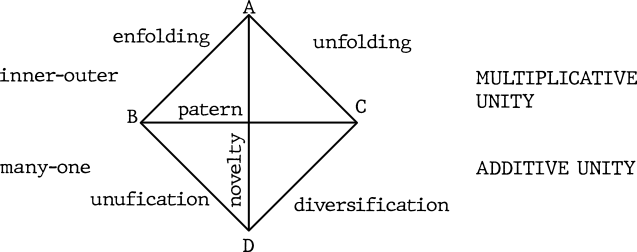
In terms of our discussions, the ‘top-half’ of the diagram represents time and the ‘bottom-half’ represents space.
Our reference to ‘distribution’ means the way in which multiplication and audition (in this context) combine.
The nomenclature for the six combinations has been explicated (up to a point) on here.
We can now attempt an interpretation of the terms of the tetrad.
|
A: |
what is enfolded and can be unfolded |
GOAL |
|
|
B: |
what is one and can be many |
GROUND |
|
|
B: |
what is outwardly diverse and inwardly unfolded |
AGENT |
|
|
C: |
|
INSTRUMENT |
The terms given in capital letters are those used by J. G. Bennett. We will have occasion to refer to them. They are, of course, relatively vague even while being more immediately meaningful than the descript-ions we have used ourselves. They are vague in the sense that they convey very little of the connectivity – or, rather, the mutual involvement – of them with each other. This points to a dilemma which will confront us throughout our exploration of the tetrad: on the one hand, any designation of the terms separately enhances clarity; but, on the other, this renders opaque the nature of the tetrad as an order of complexity involving each term in the others.
The tetrad confronts us with this dilemma by its very nature. The order of complexity is such that we have to regard the terms as simultaneously independent and merged into each other; the prospect of which must make us feel that the terms are being ‘smeared’ together. de can no longer have distinct concepts without losing what is essential. Of course, we find such a state of affairs in our thinking already but we have come under the influence of the models of logic, mathematics and the like which have persuaded us that rational and progressive thought is possible only on the basis of making clear distinctions. We have already encountered great difficulty in making sense of the triad where we have to deal with only three terms. With four terms, something seems to ‘snap’; our thinking becomes fuzzy and we are tempted to abandon any attempt to grasp the tetrad as a higher order of complexity altogether, and reduce it to additive combinations of lesser orders.
There is no way out of it: we must allow ourselves to think beyond distinctions and see where this takes us.
We are able to guess at some principles. For example, we can explore the contrast between the terms we have labelled A and D; if we permit ourselves the model of additive and multiplicative unities. Thus:
D: represents an aggregate of elements in external compresence
A: represents an enfoldment of elements in internal coalescence
The ‘elements’ mentioned in both definitions may be considered as the ‘same’ elements. In this respect, we are following the logic of the monad; and using it to allow us a sense of the unitive character of the tetrad as including diversity.
Our conception of D suggests the dimension of space (as in one of our earliest representations of the tetrad). Our conception of A suggests another kind of dimension, the one which we have most associated with it at a future time. Proceeding from these considerations, we can make sense of Bennett’s suggestion that the term D stands for the actual state of affairs, while the term A stands for the ideal state of affairs. Further, we have to allow that the ‘line between ‘ them which we have labelled ‘novelty’ does not indicate the incursion of extraneous elements in space and time but suggests the emergence of new characteristics in the ‘passing’ from aggregation or ‘addition’ to enfoldment or ‘multiplication’. This ‘line’ is characterized by the triadic combination 321 in which the initiative is with the transitional order.
In an extreme sense, we take the content of the situation as: at D to be a set, and at A a being. The transition from set to being; that is, from unity of common boundary to unity of inner togetherness; must involve the other two terms, but in different ways. To arrive at the possible meaning of these terms, we can consider the figure as rotated through ninety degrees, with B now at the ‘top’. Then:
C: represents the operation of groups of elements upon each other
B: represents the partial unification of elements into hierarchies
Thus, we are regarding C as operational and B as organisational. In our definitions, the word ’group’ is used instead of e.g., ’sub-set’ to indicate that a greater degree of cohesion is involved. We may think, for example, of the situation becoming divided into one part which is an experimental apparatus and another which is the phenomena of the experiment, an aspect of nature. That is why, in our earlier definition we referred to this term as an ’articulated nexus’. We use the word ’nexus’ rather on the lines of Whitehead; and, when we add the word ’articulated’, we signify a division within the nexus which can be described as an operation between the distinguished parts.
In respect of the term B, we speak of ’organization’: the elements are organized at different levels. These different levels do not operate on each other; they each contribute a mode of coherence. Thus, the term B associates with a kind of ’inner space’; while the term C is temporal.
We gather the sense of some underlying categories of ‘space’ and ‘time’ which have to be understood in the guise of a ‘twist’ in these projecting them into two complementary forms.
‘Space’ appears in the actual, D, and in the organizational, B. ‘Time’ appears in the ideal, A, and in the operational, C.
We may also regard the time of the ideal as expressing a higher order of space and the space of the organizational as expressing a higher order of time. This, then, exemplifies our earlier point of the ‘smearing’ of concepts between the terms.
The ‘line between’ the terms B and C we have characterized by the triadic combination ‘pattern’ (312) which signifies the ‘passing’ from operation to organization, or the reverse. It bespeaks a correspondence between the outer and the inner and we would expect it to exhibit synchronous phenomena. Again, the transitional order (3) has the initiative.
Implicit in any organization is a group of operations; also, every group of operations expresses an organization. To give a simple picture: think of brain and hand; or, even, of eye and hand. The eye sees and the hand does. The seeing of the eye is, of course, really the seeing of the brain which is modelling reality (of operations). The hand expresses the intelligence within the eye.
We can develop the picture further, thus:
A: head
B: eye
C: hand
D: feet
where these terms signify more generally than the words refer. Thus, ’foot’ means all that gives support and may well include the blood and digestion.
The eye is enfolded in the brain in cognition.
The hand is enfolded from the brain in action.
The eye is single with respect to the foot.
The hand is versatile with respect to the foot.
Such simple pictures enable us to appreciate how we must have at one and the same time such pairs of concepts as cognition and action. The tetrad is both static and dynamic; it is both activity and order; it is innovative and conservative.
Four Terms
We have used the combinations of the triad as a device for beginning our exploration of the tetrad. Yet, as is fairly well known, examples of quaternities abound. Our simple example shows something of the character of all of them. It would be difficult, once we had started enunciating eye, hand and foot to stop there; in some sense, we would always be impelled to add a fourth, in this case the head. There is a given sense whereby we can identify something that is missing from a group of only three terms. It was this, that in the first place, gave us leave to make the transition from the triad to the tetrad. However, what we are dealing with now is not that transition but a simpler ability to recognize a ’missing element’.
We have also seen that actually dealing with the ramifications of an order of four terms is extremely taxing. It is something that has long been recognized. In alchemy, it was expressed by the description of the missing element as the ‘recalcitrant fourth’. And, we have already encountered this ’recalcitrant’ person in the Timaeus of Plato. Plato’s own account of the need for four terms is obscure in the extreme and has taxed commentators for centuries. What he does is to extend the relational notion of the ’mean’ to allow for two such ’means and adduces, as his reason, that:
if the universal frame had been created a surface only and having no depth, a single mean would have sufficed to bind together itself and the other terms; but now, as the world must be solid, and solid bodies are always compacted not by one mean but by two … and that is that! He then goes on to speak, as he has just been doing, of the four Empedoclean elements: earth, water , air and fire. The four elements of classical thought can be arranged, thus:
|
FIRE |
||||
|
|
WATER |
AIR |
|
|
|
EARTH |
The doctrine of the elements and the Pythagorean doctrine of Number both addressed themselves to the question of the fundamental constitution of all things. The ’elements’ were not within a framework o£ chemistry, nor even of states of matter as in physics; they were not substances in the modern sense. They were aspects of the constitution of existence. Sometimes, they were correlated with combinations of the opposites: dry, wet; hot, cold. These qualities were concepts aimed at encapsulating the essential characteristics: we can suppose that ’dryness’ meant firmness or clarity, while ‘wetness meant dispersion or diffusion; ’hotness’ meant activity, while ‘coldne¬ss ‘ meant passivity.
We might add, here, that the Democritean doctrine of ‘atoms’ was yet another attempt to arrive at fundamental elements which constitute the universe. All such views are usually, today, described as naive and confused; mainly because such views have had to give way to more empirical and quantitative descriptions to allow for the growth of scientific activity. Even though we can make a correlation with the elements by using acceptable modern descriptions:
|
PLASMA |
||||
|
|
LIQUID |
GAS |
|
|
|
SOLID |
this has only limited application and tells us nothing of the actual content (chemical and physical) of the ’states’ but only of its constitution. It is found that these states merge into one another. And, for example, if we consider such things as the free electrons within a metal lattice, then we have a gas ’inside’ a solid. To understand how these terms are ’related’ we need knowledge of their underlying content. In this respect, we can appreciate how it is that we have to take into account something that the Greeks could not: the interpenetration between the macroscopic and the microscopic domains. The states of matter cannot be understood without reference to molecular, atomic, electronic, nuclear and quantised phenomena.
The scheme we nave is only phenomenological in the most crude sense – namely, that of our senses!
Besides its interpretation with respect to the domain of physical reality, the tetrad of the elements was also applied in cosmology and psychology. Fire, for example, was strongly associated with the demiurge, the ’maker of the world’. Amongst the Stoics, it was the ‘cause of becoming’. On the other hand, amongst the Gnostics such as Valentinus, fire represented the ignorance that underlay all forms of suffering. This suffering was described as the ‘affections’ or ’passions’: grief (air), fear (water) and shock or bewilderment (earth). Thus, it was by the removal of ignorance that the passions were dissolved, a very Eastern doctrine!
Significantly, in these schemes fire has a special status as the ground or cause of the other three. In this wise, we have the form 3+1=4 and not a true four-fold equality. Thus:
In the three elements there plays and is spread abroad and lies concealed the fire; from them it is kindled and with them it dies, for it has no separate character of its own like the other elements out of which the composite things are fashioned.
(‘Excerpts from Theodotus’)
It is indeed fascinating now well this description accords with our account of ‘future time’. In this respect, we may add that its alternative description as ’of the god’ correlates it with the power of creation which we would, of course, align with the future. Our ’future’ is the culmination of the integrative combinations of existing elements which, at the same guise, is capable of unfolding as well as enfolding. Remember that we correlated this term with the ‘impossible’ togetherness of everything at once, how, in our enquiry into the ‘systems’ we have tried to adhere to a principle of equality of status between terms. Thus, in the triad, we followed the rule that each of the terms could be expressed in terms of a ’product’ of the other two (i.e., not as an existential result but as a meaningful implication). In the tetrad, since we find that there is one term which is, typically, given the status of either ’synthesizing’ or ’underlying’ the other three; we must suppose that there is an equivalent role for each of the other three terms. The apparently ’special’ term of the tetrad – which, in figures, is to be found either at the top or the bottom of a diamond shape – parallels the ’third force’ in the triad. We first meet the concept of the ‘third force’ as the ‘mediator’ acting between the other two. But, if we allow strict equality of status, then we have to have recourse to the figure of an equilateral triangle which loses all positional meaning from the terms. What we did then was to consider both ‘betweenness’ and ‘product’ relations as obtaining between the terms in their various combinations, which amounts to considering a non-spatial kind of ‘figure’ being ‘rotated’ in our imaginations. Similarly, we have already used rotations in these our early explorations of the meaning of the terms of the tetrad.
Thus, if we think of the diamond figure (in this case, a spatial representation appears easy and useful) we can conceive of the ‘top’ term as a synthesis of the others and the ‘bottom’ term as the ground (or underlying ‘substance’) of the others. We can then rotate the figure, bringing what had been the ‘horizontal terms’ into ‘vertical’ positions. We are then able to think of the meaning of these terms in an analogous way to before.
What was this way? First of all, we found two ways of regarding what may be called, in neutral terms, the ‘common element’ of the other three: as (a) synthesis, in the sense of enfolded culmination, and (b) ground, in the sense of unfolded residue. We must also add, that these descriptions must be allowed diverse elaboration, including: (a) ultimate substance or most fine matter, and (b) least substance or most coarse matter. These, in their turn, can be resolved into ‘spirit’ and ‘matter’ and so on. We cannot avoid such ‘disorderly’ diversifications of meaning. Secondly (and this furthers the import of the last statement) we take account of the mutuality of the terms by regarding the ‘top’ term as ‘in’ the ‘bottom’ and vice versa.
Let us elaborate what we mean by considering the following propositions:
|
The top term is hidden in the bottom term |
||
|
The bottom term is hidden in the top term |
||
|
The top term is hidden in itself |
||
|
The bottom term is hidden in itself |
We need to add that the over-riding category is that of existence. Note, that we are avoiding as far as possible the sense of relation
The terms are more than related: they are in each other. Thus, the top term must include the bottom and vice versa. However, the way in which each ‘contains’ the other differs between all six states.
We can also see that, if we regard the top term as the ‘ideal’ and the bottom as the ‘actual’, then we are not going to have the ideal turned into the actual. The ideal is already in the actual and not apart from it.
Now, what happens when we ‘rotate’ the tetrad? we recall that the very same characteristics will not apply and that we can proceed only by analogy. As in the case of the triad, we may discover formal similarities.
We are taking the figure on page XXX and rotating it so that B now stands at the top of the diagram. We are thinking analogically on the model provided from the original orientation of the figure and its interpretation. Thus, now B (which we can refer to, for the sake of convenience as either 1 agent’ or ‘organism’) takes on something like a synthetic role, or acts as the ‘focal culmination’ of the other three. This is immediately intelligible, when we consider the ‘agent’ as the ‘final cause’. As we shall see later, when we come to consider Heidegger’s treatment of Being, this term will be correlated with thought.
Under the guise of purpose or thought, the term designated by the sign B, now appearing at the top of the figure, stands for the whole arrangement whereby ‘subjectivity’ is brought into the domain of ‘objectivity’; the latter, of course, now represented by the bottom term, the ‘nexus’ (described by Whitehead in his scheme as ‘Public matters of Fact’) wherein we have placed the action of one thing upon another. In many respects, this arrangement is the most common one when it is supposed that the ‘agent’ is always the human agent, who is, indeed, the culmination of ‘independent intelligence’. What we have is: ‘the entity acting in the world’. Action itself is organized or structured on many levels. We can be more or less sophisticated in our descriptions of what amounts to the complex ‘apparatus’ whereby the organism acts upon and within the world it perceives.
Our present ‘vertical line’ is ‘crossed’ by the line constituted by the ideal and the actual. In Whitehead’s scheme, the ideal consists of what he calls the ‘eternal objects’ which are ’determinative’ of matters of fact; the actual consists of the ‘actual occasions’. Here we have, in Whitehead’s terminology, the ‘prehensions’ which are involved in the interpenetration of the subjective ‘inner world’ of the agent with the objective ‘outer world’ of the nexus.
The ‘culmination of the culmination’ suggested by this arrangement is self-consciousness which is necessarily unitive.
The orientation suggested by any arrangement of the figure stems from regarding the term in the top position as culminative of the other three.
However, we have also to consider whether or not we can find a meaning in arrangements whereby we alter the relation of terms in respect of their axes. Thus, we could have an arrangement such that:
|
A |
||||
|
|
C |
D |
|
|
|
B |
and so on. |
LOGIC OF SYSTEMS
The Formal ‘Logic’ of Arrangements of a System
Why should we think that such arrangements could have a meaning? The reason is that we can take, as our underlying figure, the tetrahedron (in three dimensional space) and realize that our various arrangements are projections of this figure into two-dimensional space. Similarly, with the triad, we took as the underlying figure an equilateral triangle and projected this into various combinations; our original two-dimensional figure was represented in one-dimensional space. This is extremely important! It provides an easily intelligible model for the way in which the ‘fine-structure’ of a system emerges.
(a) The system is first of all pictured in a figure which allows every one of the terms an equivalent status.
(b) This figure is then projected into a space of one less dimensions, giving a number of arrangements.
Thus, the two-dimensional triangle of the triad is projected into linear sequences; the three-dimensional tetrahedron of the tetrad is projected into ‘horizontal and vertical’ arrangements in the plane. We would then suppose that the pentad would have a figure requiring a four dimensional space and would be projected into three dimensional space in various arrangements. The number of arrangements for a system of order N will be N!.
In retrospect, we can regard the dyad as being represented in a line and then projected into a point! However, we find that a point does not appear to be able to provide two arrangements, as required by our formal scheme. But, the answer is clear, the point in the representation can have one of two values. This is, precisely, the either/or an interesting confirmation of the value of our scheme.
Naturally enough, any given projection of a system can itself be further projected into a lower order of space; however, it is pretty clear that, once we try to project the first projection, we are forced to decrease the number of terms. Thus, if the triad is projected into lines, projecting these lines can only be into points, which are single-valued or either/or. The best we could do would be to reduce the three terms to two, as alternatives. How, in fact, when we try to describe the ‘linear arrangements’ we find ourselves doing something just like that. We are forced to ‘consider one thing at a time’. When we explained what a linear arrangement meant, what we did was to reduce the combination of the first two terms to one thing and, similarly, reduce the last two terms to one thing; then, we considered e.g. the first thing to be the ‘question ‘and the second the ‘answer’.
What we did not do at that stage was to make this explicit. It is worthwhile for us to pause and review the possible formal structure of triadic n forms.
Note on the Formal Structure of Interpreting Triadic Forms
Say, that we have a form thus:
a b c
then, when this is projected further, it must reduce to:
x
Further, we suppose, on analogy with the case of the dyad, that
x can take only one of two values. We will use the convention:
x = 1, or x = 0
Now, in our thinking, when we regard the combination abc, we begin to ’read’ it, conventionally, from the left. Our first move must be to reduce the content ab to one element.
a b = p
to which we give a meaning. We are then faced with the reading of the remaining part. This can be regarded in one of two ways:
(i) by the reduction of b c = q
(ii) by the more complex reduction, initially;
p c = x’
If we adopt the reduction (i) we then have the further step:
p q = x
We thus have two ways of arriving at x and, it may well be, that this provides us with the two possible values of x
x’ = 1 x = 0
We will write out below the structure implicit in x’ and x.
x = ( (a,b) (b,c) ) = 0
x’= ( (a,b), (c) ) = 1
In these alternative final steps, the meanings reduce to values.
In respect of the triad, these values must derive from the two ’contrasting’ terms of affirmation and denial. This tells us that our final, summary, interpretation will take the form of either something being affirmed, or of something being denied. These ’values’ can then be discussed in such terms as: action/non-action; change/conservation; increase/ decrease, and so on, depending on the context.
What our formalism does show is that our final result must be ambiguous and present us with a choice.
We would summarize this discussion by identifying the following terms as best describing the two alternative ’values’ of a triadic combination:
x = 0 the implicit
x = 1 the explicit (we can now drop the marker on the x)
We can also bring this distinction into the same field of discourse as has been occupying us for some time and associate:
the implicit with multiplicative unity
the explicit with additive unity.
Let us now briefly experiment with more specific content. Let us take the combination 123.
We must remember that we are reading from left to right and that this introduces a bias such that our pair (a,b) is really the ’vector’ a-b. What we are going to do is to consider the factor of ’coming before’ as signifying ’dominance over’. These are unsatisfactory terms but may allow us to do what we want. We also need to ascribe some values to the terms, which we do in the following way (cf. Pledge)
1 = +1 triadic arithmetic sigurd
2 = -1
3 = 0
Then, applying in a qualitative way the notion of ’dominance’:
a b c = 1 2 3
a b = +
b c = –
and, (a,b), (b,c) = 0
and, (a,b), c = + (i.e. 1)
It is fairly clear that such results, or basically similar ones, are inevitable whenever we try to interpret a combination. What is interpretation? It is the assigning of values and meanings. Most importantly, it requires that we ’work out’ or ’calculate’ the sum-total of the expression given the initial values and the rules of addition. It is fairly clear that, in our minds, we have various ’rules’ concerning the combination of values, rules which we have reflected in our use of meanings associated with:
addition
multiplication
vector-product
We have to ascribe values to the elementary terms of our starting expression; otherwise, we would not be able to come up with any result and we would be left simply with the initial expression itself. We have to apply rales of combination, otherwise we are unable to signify the ’total’. This is the only logical way to proceed,
The alternative is to offer up various possible models (or theories) and see whether or not they ’match’ a given combination in some way. It was probably something on these lines that led to the traditional descriptions for each of the six forms which were developed by J.G. Bennett. To make a match, we have to rely on some intuitive sense of meaning. Perhaps this is yet another case of the different approaches inherent in the two sides of the brain: one of which ’calculates’ while the other has a ’feeling for wholes’. However, no matter what the intuitive basis, a dimension of calculation is need for there to be a more complete understanding.
In regard to the two sides of the brain, we should add that the non-calculating or ’feminine’ side of the brain is also associated with language and the power of words. There is no way – that we can see – in which a dimension of language can be neglected in interpretation. There is a power in words and we have been constantly relying upon this power and our feeling for it in our explorations. It is not possible to reduce the power of words to matter of calculation or ’mathematical logic’. For example, the very word ’combination’ has a power precisely because it can be understood without there being any explicit formal model for what it means. Thus, words have power just because they do not have the precision of formal structures! Without this power, we would not be able to proceed. Through words, we can immediately begin to do something, without knowing just what it is that we are doing beyond the ’impression’ which the words are making within us.
In our discussion of the formalism, we had to refer to both ’meaning’ and to ’value’ (in the mathematical sense). The term ’meaning’ has to do with words, while value has to do with formalism.
We can, of course, visualize a higher order of formalism in which we see into the power of words. It is really this with which we are concerned, It presupposes that we have the possibility of directly grasping the structure of our experience. We can, of course, grasp this structure only through experience itself. Thus, we arrive at an extremely important exemplar of our dyadic distinction between the two forms of understanding;
a = a
a = b
Both words and formalism belong to the latter.
A Note on the Formalism of the Monad.
In systematic terms, the monad in its original representation has the form of a point. A point cannot, it seems, be projected into a lower dimensionality of space, itself having zero dimensions.
This would mean that: we cannot think about the monad. This is, indeed what we found to be the case: to be precise, we could not think about the structure of the monad, because it has no systematic structure at all. Its content is ’with’ its content – and that is all we can say. Our extended discourse on the monad was needed just in order to convey this, ‘We can add, also, that although there may be no formal structure with which we are able to ’calculate’, we remain free to use words.
We can, just as an interesting experiment, see what we can derive from a projection. What we would have to deal with would be a ’negative line’ (of dimensions, that is, of the order -1). The line entails the dyad. What could our ’negative line’ mean? It must mean something like: there is no choice.
The line, in its turn, can be projected and, thus, we would run through all the systems and be left with the realization that the monad does not involve choice, relatedness, etc. We arrive at the monad only by denying ourselves the forms corresponding to the higher orders. In a similar fashion, remember, we concluded that the dyad ’denies relation’.
From time to time, we have touched upon the question of the ‘prime matter’, the underlying ‘stuff’ out of which everything is made. We have seen that this is a most interesting question and has many orders of description and analysis implicit in its. We want to say here, that
the ultimate category of prime matter is the monad.
This expression is of quite a different order from those in which, for example, we consider the underlying constitution of things in terms oi fundamental particles. However, very interestingly, it does suggest that we should never allow ourselves to think of e.g. the fundamental particles other than as a ‘community’ and mutually engaged with each other in an ’ecology’. It may well turn out that the very constitution of the fundamental particles depends on their totality, or even, upon the total number of them. The usual assumption in physics – which is a natural and even necessary one – is that the particles are intrinsically indistinguishable from each other except in terms of position and momentum.
Our proposition concerning the monad brings into focus a further and most interesting question; what is that makes for a ’term’ in a given system? What does it mean that we have one term in the monad and two ‘terms in the dyad? Especially when we see that this is not at all to say that we have ’one thing’ in the monad and ‘two things’ in the dyad. We have already argued, with respect to the monad, that what we have is not a set (a thinking of many as one). Indeed, in some respects, the state of ‘mere’ aggregation does not emerge until the triad or the tetrad.
Let us consider this question from a different starting point to that which led us to the monad as Prime Matter. In this new starting point, we take a ‘subjective’ view and characterize the oneness of the monad as participation in. This parallels what we said about ‘assimilation’. There is a monad for us if we are in it ‘like’ everything else that is in it. In this sense, the Biosphere is a monad for us. Life on any other planet cannot be a monad. Or, we have to say that it is an abstract or conceptual type of monad and not a concrete one. Linking this with our earlier formulation of Prime Matter we arrive at the interesting possibility that this ‘matter’ is accessible to us only when we arrive at that ‘reduction of order’ in which our matter and the matter of the content are the ‘same’.
The proposition of Gurdjieff’s, therefore, that ‘everything is material’ is the prposition that there is one total monad. In such a way, we can arrive at the monad of any collection of totalities through the realization of a Prime Matter in which these and ourselves share. ‘Matter’ in this guise is akin to the ‘Unlimited’ (apeiron) of the Presocratics. To repeat, to arrive at this we have to make a reduction from all considerations of choice, relatedness, etc. This is a far more radical reduction than that advocated by Husserl in his phenomenology. To what does it correspond?
Our answer is that it corresponds to experience itself!
THE MONAD IS EXPERIENCE (WITHOUT DISTINCTION)
It is the beginning and the end of understanding, especially when we undertake to follow the way indicated as a = a.
Every content of the monad has the same value as any other and any ‘part’ has the same value as the whole. This is an exemplification of Prime Matter.
What Makes a Term of a System?
The most facile use of systems simply takes collections of things as they appear and, discourses about their connections. This is something that we have steadfastly resisted. Instead, we have explored always seeking for some insight into what the terms of the system might ’be’ or might ’mean’. Wi have never taken this for granted. We have striven to begin, as far as this possible, from the irreducible structure of the system and then proceed towards the content of the terms in that structure. It has been a programme that has constantly failed. After all, we must talk about something and a bare ‘three-foldness’, for example, gives us very little to talk about. Therefore, what we found ourselves doing was to take what was already at hand in the form of ’exemplars’, examples or models which have the appearance of exemplifying the given system. Of this, our prime example is the Trinity. We must, then, also remember our earlier comments when we were discussing Whitehead’s ideas, that there is an issue of revelation; that is, it is highly probable that we could not find a starting point for an investigation of a system without that system having been, in some sense, revealed to us.
We contrast – but not in an exclusive sense – the revealed with the given. What is given is experience, the monad; though we have to reduce our experience to arrive at experience itself.
If there is any given structure of the understanding, it is that of ’opposites’ or, at least, of contrast. These, quite ’naturally’ drive us forward to consider the possibility of relation. Yet, we can say very little of relation beyond some vague apprehension that the ’different’ should be linked in the ’same’. How this works and in what ways this works, we cannot say.
We would claim that our natural understanding brings us to the brink of the triad but, without the assumption of principles which have no apparent source in the content of our experience, we can go no further. Throughout our exposition, we have made use of ’verbal testimony’ which is always, as far as we are concerned, a revelation. This applies whether we adopt the theology of the Trinity or the science of the catalyst.
A Theosophist may argue that the ’terms’ and the form of their combinations are, in reality, spiritual principles or even beings. This is much the same orientation as that of the ’Platonist’ mathematician. It argues that our experience is ’governed’ by ’angelic agencies’. When we understand, an angel speaks!
Alternatively, we may think that the forms inherent in the systems are projections out of the inconceivable totality OMEGA, which is referred to in mathematics. We can imagine a series of projections from OMEGA terminating in the systems we attempt to study. Thus, every system we study is an infinite reduction from the Ultimate. If, as we have seen, we analyse the meaning of systems by projecting them into ‘lower dimensionality’ then we can see that the systems that we have may be, themselves, part of such projections. We do not have to ’build up’ the systems: they are already projected ’downwards’.
Another startling possibility emerges from these notions: the systems that we have been studying must be only partial representations of the total projection from the next highest system. Therefore, we will tend to find that, even with respect to the overall system, we are having to consider various possibilities even though we have only one form to deal with. This may explain why it is that our definitions of the terms, for example, of a given system tend to shift from time to time. Such multiplicity should not surprise us. Every term, then, is a degenerate form of two ’higher’ terms.
This point was not made perfectly explicit in our account of the interpretation (or calculation) of the value of a triadic combination There were two steps. Firstly, taking the three terms in a line, we reduced them in pairs, starting with the first on the left; then we made another reduction, in one of two ways, resulting in one term. Hence, we had first the projection and then the reduction. It is in the reduction that the number of terms is reduced. In the case of the triad, as we saw, we had two ways of making the reduction to one term This entailed us also in making a further projection from the line to the point. Hence, the first reduction takes us to either: (a,b) and (b,c); or to (a,b) and c. The next projection takes us to a point in which the two derived terms are ’overlayed’. These, then, are reduced to one term.
Thus, projection is a representation into a lower order of dimensionality. Reduction is a compilation of the previous terms into a collation of one less in number by the summation of values. Projection is associated with meaning and words; while reduction is associated with value and rules of combination of values. Also, projection is to be associated with the ’spatial’ side of the brain while reduction is to be associated with the ’linear’ side of the brain.
The reduction, therefore, which reduces the number of terms and results in relatively degenerate versions of higher order terms proceeds by calculation. This calculation can be inverted, and this is what we did when we proceeded from the six combinations of the triad to the four terms of the tetrad, using the device of treating the combinations as representing the collation of pairs of terms belonging to the tetrad. Now, since this made use of the combinations, the step we made was from the projection of the triad; but, before the reductio to two terms was made.
We should note that there is no easy formula to follow in making the reductions. Thus, when we project the tetrad onto the plane, there is no obvious way in which we can conform the four terms into three and turn a square into a triangle! However, let us remember one of our main starting points, which was the treatment of the tetrad as: 3 + 1 = 4. What we have called the ’synthetic’ character of the top term is nothing else but a quasi-removal of this term and a reduction to three terms! What we tend to do – and which is confirmed by our reasoning – is to take the fourth term and ’enter it into’ each of the other three.
If we take our nomenclature of A,B,C and D for the four terms of the tetrad, then the reduction proceeds to form new terms of the kind:
(A,B)
(A,C)
(A,D) where A is the ’synthetic’ term
Clearly, this reduction depends on A being chosen as the synthetic term. Therefore, there are at least four possibilities for the reduction These possibilities represent one part of the combinatorial ’fine- structure’ of the tetrad. The further possibilities depend on there being made further projections. Thus, any of the four possible three-term reductions has six possible projections in the line. Hence, there are 24 possible forms of the tetrad, in terms of what we can read in a line. If we stop our projecting at the triad, then there are only four. Then, if we project further than the line, we come to the point and each of the 24 possible forms has two values, giving 43 in all.
Thus, a single tetrad has 48 distinguishable values when reduced to a single term. This goes some way to explain what we mean by ’order of complexity’. Since the triad has 12 (2 x 6) possible values, the ratio of tetrad to triad is 4.
The dyad has 4 possible values (either term takes either value) and hence the triad has 3 times as many possibilities as the dyad. This would then suggest, strangely enough, that the monad has two possibilities! However, what we have done is muddle the projection and reduction from line to point. The dyad has two values but the monad has only one. Hence, the possibilities for the monad are 1, for the dyad 2, for the triad 6 and for the tetrad 24. We note that we multiply the possibilities by the order of the system. A pentad would give us 120 possibilities. Further, for the tetrad, we have:
1 set of four terms
4 sets of three terms
24 sets of two terms
48 sets of one term (even though we have only 24 values)
77 sets in all
When, we realize that there are implicitly five different tetrads being projected from the pentad, the sense of complexity becomes very strong.
We should also notice that the various ’sets’ are grouped according to the order of the system. Thus, in the tetrad, there are four groups of sets and, in the triad, three, etc. Thus, the complexity of a system under projection and reduction conforms to the system. In the case of the tetrad, the four groups in the scheme shown above themselves form a a tetrad which reflects the nature of the starting point. Thus, the first set is the synthetic unity, the ideal. The second set is the agent, or organism. The third group is the nexus or instrumentation/operation. The fourth group is the actual, the ground. A term, therefore, reflects the order and structure of the system. It is quite close in meaning to Pythagorean number. What was not in the Pythagorean scheme was anyway to distinguish alternatives, which has to do with content and meaning and words. But they themselves used words to this end without clear recognition of what they were bringing in to their system unknowingly. Thus, a famous expression of theirs is that ’Justice is a 4’. Justice in the Greece of that time amounted to retribution. What they meant was that a system of retribution that would not disrupt a society would require four distinct roles. Very probably, a study of the exercise of power in a society would confirm this.
To return to the question of the terms of a system. Every term of a system expresses the nature of the whole but from a particular aspect: it will make certain things explicit and others implicit. The number of terms is the number of aspects: there can be no others.
Thus, it is that we say that the triad, exemplified in communication or dialogue, requires three persons; while the tetrad, exemplified let us say in a society, requires four classes of persons. In the case of the communication (triad) we need the third person as referee or audience (in the case of psychotherapy this is the unconscious, in the case of debate is audience or judge, in the case of sexual dialogue it is the child or alternative, etc.). In the case of society, we need the fourth class as embodying the whole with respect to the divinity, hence theocracy.
The fourth term is always problematic, as in the case of the philosopher class advocated by Plato, Of course, four-fold schemes for societies are very common, e.g. the division in Hindu culture and amongst the Celts between workers, merchants, warriors and priests. (Interestingly enough, we can see an example here of how both the top and the bottom term constitute the whole: the society is founded on the labour of the workers, while it is also ’made out of’ the quality of its priesthood. Hence the contrast between the Marxist and the theological views.)
The Derivation of Terms According to Number
If we out aside for the moment any kind of models we might have for the systems, in which the nature of the terms is generally described and for which, therefore, we could find examples; how can we proceed to identify the terms of a system? There are, after all, no restrictions on the kind of thing they might be. As far as the words we use are concerned, we can take their meanings in a variety of ways.
Thus, in English (since the time of Shakespeare) we can use a noun as a verb and a verb as a noun. A process word can be taken to refer to an entity, and so on.
Our tentative suggestion at this point is as follows:
- we make a beginning with one of the terms
- we do this by choosing something which seems to us important in the context we are interested in
- the choice of this term (x) does two things
- determines the ‘scale’ of the system’s term
- determines the content of the system
- it does this by invoking, implicitly, the relevant monad; wherein any content gives a view of the whole
- by the determination of scale we have a measure of the other terms; in particular, these have to correspond in ’size’ to x and divide the remainder of the relevant content equally between them: it is this which is the ‘determination according to number’
- this amounts to some kind of ’multiplicative reasoning’ rather than to additive, i.e., the ’calculation’ takes into account the mutual implications of any combination of the terms
- the effect we are looking for is a kind of ‘enhancement’ such that the addition (or combination) of a further term literally adds another dimension to the model
It is the principle of ’dividing up’ the content space of the system equally that gives us the language-based rule of choosing terms which are of the same class as each other. It was this rule which was applied in the case of the ‘Trinity, where we have to have three Persons, if any one of them is taken to be a Person. Thus, once we have chosen one term, a great deal is determined with respect to the choice of the remaining ones. The practice of ’dividing equally’ the given content space into ’equal’ terms does develop the capacity of discovering the nature of the systems. In this way, what the systems can mean is not fixed by the models we have come to recognize so far. There is always the possibility of seeing something new by choosing an unusual starting point.
Thus we have at hand a very unusual and powerful method for creative thinking. On one occasion before we have referred to the work of de Bono (in talking of the relevance of the triad to ’lateral thinking’). We can now see that such methods as he advocates are primitive derivations from the practice we are advocating. The simple numerical form of the systems and their common representations (an arithmetic and geometry) allows us to evoke experience in powerful combinations.
This will not tend to happen if we have in front of us standard models to which we must respond by association. The power of the systems – as we have been at great pains to point out – lies in their combinatorial structure.
In part, the situation of deriving, terms for a system may be likened to the composition of a sonnet. Once we have written one line, very much is determined: we have one less line to complete and the meaning we want to convey must be divided between these lines. The creation of a sonnet can be extremely complex; but we would assume that it corresponds to some faculty which we all have, at least to some degree. It is the same with painting or with music: the first brush-strokes or the first bars ’set the tone’ of all the rest. Examples from art should warn us that our principle of ’equi-division’ cannot be taken naively. Thus, we know that the lines of a sonnet do not all have equal power: more or less is said in them and they have different orders of relevance to the other lines. A sonnet is not a 14-term system. Indeed, we should add here that a work of art, must involve at least three orders of system for it to be effective. Thus, there must be both a ’building up’ from lesser meanings and also a ’revelation’ from a higher order; their ’ratio’ being in a certain order of communication.
In contrast to the complexities of art, we can illustrate our method in a more ’homely’ way. As an exercise, we are going to take the system of number four and choose as the first term ’table’.
By this we mean the table as an item of furniture and not a list. The table designates a certain scale: the other terms must each be like a typical item of furniture, or in some way commensurate. Of course, in this exercise, we do not yet know what we are thinking about, what the content is. Confronted with the word ‘table’ on its own, we could find a variety of associations; but we have already thought of it as an item of furniture. We are then led to consider the whole as describing the ‘totality of furnishings’. But, with one term as just a table, these furnishings are going to be rather meagre! We find ourselves picturing the minimum requirements for the furnishing of a room.
What are the other essentials?
The choice of table suggests another term: a chair.
What then is left?
Well, the table and the chair provide for day-time activities. The table can be used for work together with the chair, while the chair alone provides for study. What happens at night? We need a bed!
At this point, we seem to have already the minimum requirements. However, the proposition of sleeping and waking leads us to think of light. This we can include, as an item of furnishing, as a lamp. We could, alternatively, change the character of the term somewhat and include a window; even though this hardly counts as furnishing. The lamp or window is the ‘top’ term of the tetrad.
The bed is the ‘bottom’ term, by contrast.
The table and the chair are the ‘horizontal terms’.
The chair is in the ‘agent’ role, since it is most closely associated with the occupant in his waking mode. The table is in the role of instrument representing the nexus (of possible activity).
In the case of a painter, for example, the ‘table’ may be replaced by an easel. The requirement is a surface for working on.
We have an evocative scene. Even in the minimalist settings of Samuel Beckett, we have these things (cf. ‘Stirrings Still’, his latest work).
The four terms do ‘equally divide’ the content space; and we begin to understand this space as representing the living space of a person. The top term ‘encapsulates’ the others in that it enables them to be used. The lamp is switched off for the use of the bed and switched on for the use of the chair and table. However, light is not essential] for the use of the chair, since the man can make use of it in the dark; for example, just to think.
Also, the chair is the place where guests can be placed.
The table is where the man can eat, take in nourishment; as well as being the place where he makes something. The food will be brought into the room, while the work will go out of the room.
And so on. I£ is quite amazing how quickly the four terms evoke all kinds of possibilities and meanings. In this case, it is particularly striking because of the banality of our starting point. Also, we notice something significant: the whole scene is defined by four walls The very room itself is a tetrad!
We can ’transpose’ the situation and take the four walls as our starting point.
In one wall, we have the door.
In another, the window.
Against another, we have the bed.
Next to the fourth we have the table and chair.
We then have the two contrasts: in the ’openings’ to the outside world, one is ’physical’ (the door) and the other ’mental’ (the window – giving light and view); in the contents of the room, we have one that is active and the other passive (table and bed, respectively) Prom the aspect of light, we can transpose the situation even further and recall Ouspensky’s model of the bed, the sewing machine, the microscope and the telescope; each in increasing measure requiring light, beginning with the bed that requires none and ending with the telescope that requires we look out of the window. (It is interesting that a modern microscope generates or provides at least its own ’light’ – which might consist of electrons).
It may seem, in retrospect, that the process turns out to be far more easy than it at first appeared. The reason for this is that, at a certain point, we are able to suddenly recognize from our experience what we are thinking about. The tetrad is evidenced all around us.
It is a real property of the world. We arrange the environment and our activities in a four-fold way because that is how they work best. Trial-and-error in life leads us to same conclusions as fundamental principles. Even with such an elementary entity as a room, we know that we tend to have either rectangles or circles; and the square, equi-sided, represents the rectangle as nearest to the circle and conveys a sense of balanced life with the occupant at its centre.
In many ways, tetrads are easier to recognize than triads. This is because it lends itself to the world of artefacts.
The world of artefacts itself can be represented in a four-fold way;
|
ART |
|||
|
|
APPARATUS |
TOOL |
|
|
OBJECT |
A Further Note on the Projection and Reduction of the Triad
in preparation for considering the projection of the tetrad from the four-dimensional pentad, let us clarify still further the projection of the triad from two-dimensional to one-dimensional space. We want show how this alters our conception of the terms. The projection is shown below, from the triangle a,b,c to the line a’,b’,c’.
|
b |
|||
|
a |
c |
||
|
a’ |
b’ |
c’ |
Now, in the figure of the triangle we have b in the role of ’higher synthesis’. This is a convention, but it is one that is in some way in the form of the figure. It is under this convention that people continue to associate, e.g. even towards the union of opposites.
But, in the figure of the line, b’ has the role of ’between’ or mediation, or balance point.
We could have inverted the triangle and then b would have been given the role of, e.g. ’common factor’. But, the ’upright’ representation is by far the most common.
Thus, we see that our interpretation of a term is very much affected by the representational space into which it is projected!
Continuing further, we take the reduction.
The most obvious reduction is to generate the dyad formed as follows:
a’ b’ c’
(a‘,b’) … (b’, c’) or a’’…c’’
The ambiguity we encountered before about whether or not this in its turn reduces to two or four values arises from allowing, or not, each of the two terms to have two values independently (thus 2×2=4). Even though we have two possible operations with the dyad, equivalent to addition and multiplication; with the monad we can have only one. Thus, e.g. a”= 1, c’’ = 0 and this gives 1 or 0 as alternatives by the application of:
1 + 0 = 1 and 1 x 0 = 0
Strictly speaking, the monad has no value (or, any value). We make the projection:
a’’ . . . . c’’ ( )
where the symbol ( ) signifies that the value is indeterminate and is chosen for its similarity with the symbol for the empty set. This corresponds, in fact, to the meaning of the monad in that it does not say anything: there are no propositions in the monad.
Now, let us look the other way, towards the tetrad. When we consider the projection of the tetrad from three into two dimensional space, this can be done in a number of distinct ways which we want to divide into two classes.
In the one, the projection conserves the four terms; but reduces the equality of their mutual standing. This class includes all the ’diamond shape’ figures.
In the other, we take projections which reduce the number of terms (at extremities, that is) to three. In this class there are two sub-classes.
(a) projections in which one of the lines of the triangle figure that results contains one of the terms in its middle.
(b) projections in which one of the terms appears in the middle of the triangle so produced.
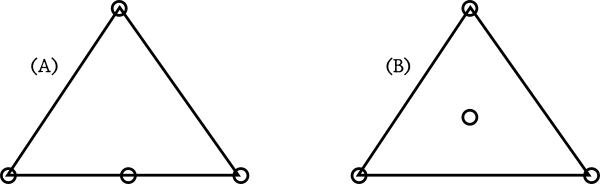
We have in (a) and (b) two different ways of thinking about the tetrad in triadic terms. In (a) the tendency is to ‘share’ the middle term equally with its neighbours, just as we did when reducing the linear form of the triad to a dyad. In (b) we share the middle term equally with the three other terms.
Both (a) and (b) have four different versions (depending on which is chosen as the middle term) giving eight in all. If we analyse the diamond shape figure into triads, we get only four, and these are spurious, since one of the terms is totally neglected.
Thus, we can imagine the tetrad being first projected into two-dimensional form as triangles; then reduced to eight different triads. Each of these, in turn, can be projected and reduced to give in all 48 different triadic combinations. We then have to interpret these which we do by reduction to dyads, etc.
Now, the form in which we have the tetrad projected such that one term is in the middle of the triangle (b) corresponds with a form we have met before in exploring the triad: that of vector space. Thus:
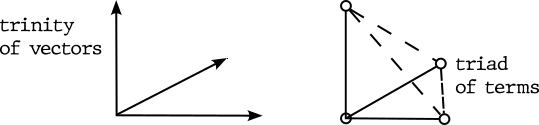
The vectors give the points defined as:
1 0 0
0 1 0
0 0 1
The origin (0,0,0, when conceived of in the context of the tetrad, begins to take on a meaning. In fact, it is just the spatialization of the vectors that, of itself, begins to suggest a fourth term. This fourth term will, of course, be the synthetic or unitive one from which the others diverge.
What all this amounts to is that the geometry of our representations influences our thought, de ourselves believe that something of this kind pertains in nature: it is not simply a result of the human psyche. The idea of non-explicit geometries somehow influencing the possibilities of combination within a domain of the natural order is not regarded with favour in the present climate of science. Sheldrake, in his work on morphogenetic fields, has come up against some quite violent opposition. For our part, as we indicated before, he has not grasped the nettle of ‘higher-order represerntaitions’ and what they might mean in nature; only supposed the existence of ‘fields’ of an unspecified constitution.
Just as we have used concepts from the domain of arithmetic and number, enabling us to perform operations akin to ’calculation’, so we can and do use forms of geometry to represent the possible meanings of ’equality of distribution’ and ’projection’.
Arithmetic, geometry and language are the main tools of all our thinking. We could represent them as a triad. Arithmetic (which here can include its relevance for algebra, etc.) is the most abstract and definite. Language is the most concrete and indeterminate. Geometry lies ’between’ them! Or, is it the ’higher synthesis’ – which Plato would approve? And, where is the ’missing guest’?
THE TETRAD
Heidegger, Being and the Tetrad
In the ’An Introduction to Metaphysics’, summing up his discourse in the chapter ‘The limitation of Being’, Heidegger writes (p.202):
The being which we took at the start as an empty word must therefore, contrary to this appearance, have a determinate meaning. The determinateness of being was shown by the discussion of the four distinctions.
Over against becoming being is permanence.
Over against appearance being is the enduring prototype, the always identical.
Over against thought it is the underlying, the already there.
Over against the ought it is the datum, the ought that is not yet realised or already realized.
Permanent, always identical, already-there, given – all mean fundamentally the same: enduring presence, on as ousia.
His diagram of the contrasts of being is as follows:
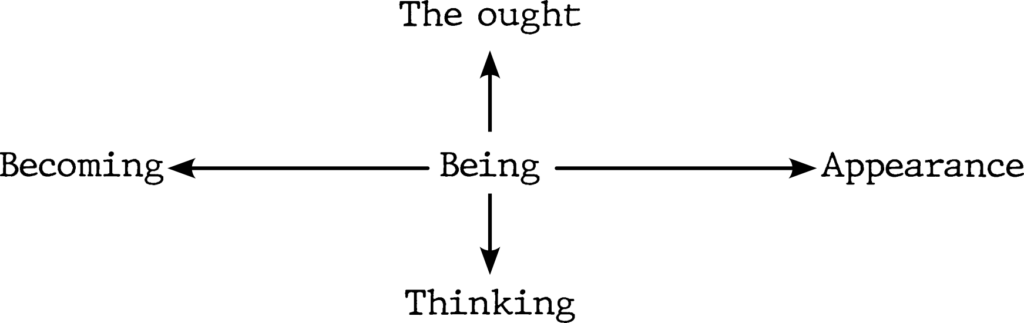
Heidegger refers to thinking, or thought, as the ground of being; but,
as being itself becomes fixated as idea, it strives to make good the resulting degradation of being … this is possible if something is set above being, something that being never is yet but always ought to be.
We will not attempt to summarize the argument which Heidegger follows through in his long discussion of being and thought. The important thing is his criticism of ’modern thought’ (indeed all thought in the West since the Greeks) which has turned the logos into logic as a self–sufficient enterprise somehow apart from being. It is this which then requires the super-idea of the ought, or value; and turns value into a ’something already-there’ in order to avoid a mere subjectivity.
It is then ‘something’ to be attained or realized; and there is this suggestion in the use of a word like ’goal’ for this term; something to aim at. Heidegger’s position is that it is a given (datum): What is given? Being.
But, Being is not given as a being. There is a fundamental duality of Being and beings. Being is not alongside beings; nor is it ‘behind’ them or ‘above’ them in the way that Plato suggests. Only very extended contemplation through dwelling on the meaning of words can enable us to see what is the Being in beings; and that, we do not see as we might see an object, but in the realization that it is being shown through us. Man is like a clearing in the forest.
So, we cannot put Being in relation to thinking, etc. There is no relation. In a sense, thinking and Being are the same: it is that sense which is crucial. Heidegger dwells extensively (e.g. in ‘What is Called Thinking?’) on this:
“to gar anto noein aston te kai einai“
“for the same: taking-to-heart is so also presence of what is present”
is the translation he gives of a fragment of Parmenides, usually translated as:
“for it is the same thing to think and to be”
Heidegger asks (in a way that, strangely, echoes the words of Gurdjieff in ‘Life is only Real, then, when I Am’):
What does the word to anto, the same, mean?’
And, he answers:
‘It means what belongs together’.
Belonging together is not being related; it is not a ‘sameness in difference’. Let us remember that relatedness is that which enables us to reason; since we can pass from one thing to another by way of a third. It is relatedness that lies at the foundations of mathematics. But, relatedness will not answer to being. The fundamental proposition concerning being is:
BEING IS
Thus, we cannot arrive at being by any combination. In a sense, then, being lies beyond even our ‘multiplicative unity’. In Heidegger’s terms, such a complex unity would be on the side of beings, not of Being. Being is not the total import of the four terms becoming, appearance, thinking and the ought. Being is not anything that is put together: it is. The question is:
What is the Being of beings?
We cannot ‘pass’ from beings to Being, or the converse; even though we may talk of Being disclosed in beings. In contrast with beings, in speaking of what it is that Being is, Heidegger sometimes makes use of
the nothing
since Being is no thing, is not a being.
The whole fabric of western thought, based as it is on relatedness, is unable to accommodate Being. We find that thought is stilled; it must lose its dynamism in an exhaustive encounter with the ‘same’.
The whole import of ’What is Called Thinking?’ is given in the first pages: it is that we are not thinking and that thought is hiding from us. This ’thinking’ is the thinking which is together with being. It is not the thinking of the sciences, in which everything is being turned into something else in relation. We can see how western thought has gone: we begin to believe that there is a relation between, e.g. heaven and earth; this leads us inevitably to think that heaven must be like earth and earth like heaven, and, in time, we lose the distinction in astronomy. If Being were to be related to beings then in time we would think of Being much like a being; and, in fact, this is just what is at the back of the criticism of the concept of Being by modern philosophers, whose starting point anyway is that there can be only beings.
Heidegger asks ’what is called thinking?’ and sets out four paths: firstly, concerning the meaning of the word ’thought’; secondly, concerning how it has been with thought since the Greeks; thirdly, how we can begin to think; fourthly, what it is that ’calls’ thinking forth. These do, in our scheme, correspond to a tetrad. There is some ’composition’ made of the four, even though Heidegger is concerned to arrive at the final way as the important one. We have a schema on the following lines:
|
from WITHIN |
||
|
the Established PAST |
the required FUTURE |
|
|
from WITHOUT |
The four terms are versions of the same question: What is Galled Thinking? From without, we have the study of words and their meanings (out of which Heidegger derives his equation that – to think is to thank). From the past, we have tradition, the tradition in which we begin our enquiry; what has been taken as thinking over the last two thousand years? The ’future’ term is the call upon us to think. Thus: we may write ’Think!’. From within, we have the call to thought which is of Being.
The enquiry is an activity. By setting up the four terms, we are able to go on the way towards finding what it is in which the four belong together. At that point, it would appear that the four terms dissolve away: something is shining forth.
This is the essence of Being.
AS we shall see, this is suggesting to us that Heidegger is projecting from the pentad into the space of the tetrad.
But, it would seem to us that what he is doing amounts to a reduction to the monad. This should not surprise us; for the pentad does mark a ‘return’ to the monad, in that it is the sense of unity which is of central concern, such a unity not having a ’central’ place since the monad.
Our sudden introduction of the pentad is somewhat precipitous, and we will leave further discussion till later. Here, we will only comment that it will be inevitable that the tetrad will have an appearance for us that is a projection from the ‘four-dimensional representational space’ of the pentad; just as, also, will we see it as an ’archetype’ for the triad.
We have, still, to bring out two important and fundamental ideas:
(a)
(b)
the ’sameness’ of the tetrad
how Heidegger’s treatment of Being can show us the way in which we can understand how the systems are in experience
We may adduce a third, deriving from these two:
(c)
that the tetrad is Being as the triad is Will
The Sameness of the Tetrad
We can represent to ourselves, conceptually, that in going from the triad to the tetrad there is an extension of some kind of the ’sameness’ and ’difference’ which we had in the triad. We might expect there to be both an increase in sameness and an increase in difference. To speak of ’increase’ in this context is problematic. What could it mean?
The increase in difference suggests a more intricate structure, a greater articulation. This would mean that the terms are more like entities than in the triad, which can be perceived in their own right. The terms of the tetrad would not require the others to be what they are; contrary to how it is with the terms of the triad. In the dyad, more extremely, each of the terms is meaningless without the other. Thus, in the tetrad, we shall think of the terms more as beings than as Persons, as existents rather than as impulses.
The greater degree of difference is not one in which the terms become more greatly different from each other; as it were, extending the length of the ‘line’ between them. The reason for saying this is that there can be no line. To afford each term equal access to the others requires the three-dimensional configuration which entails three ‘axes’ of difference. In our discussion so far, we have introduced these axes implicitly:
hidden – exposed
active – passive
atomic – holistic
which axes do not coincide with necessarily with any ‘line of connection between any pair of terms. Thus, we can have ‘more difference’ in the sense of having more kinds of difference; and this is the appropriate sense. Using some of the nomenclature we have already introduced for the terms of the tetrad, we can make correlations like the following:
A. IDEAL: hidden, holistic, active
B. AGENT: hidden, atomic, active
C. NEXUS: exposed, holistic, passive
D. ACTUAL: exposed, atomic, passive
The use of three dimensions is unusual, since most representations of the tetrad rest on two-dimensional arrangement. The more usual approach is to explicate each term by use of two pairs of opposites, as was done with the four elements and the qualities hot-cold, wet-¬dry.
Thus, our meaning of an ‘increase in difference’ is really that of an increase in kinds of difference which are ‘overlaid’ upon each other because of the requirement of equitable distribution.
We pause briefly to draw attention to the correlation between the above descriptions of the terms and the example we had in the last section from Heidegger concerning the calling of thinking.
Words are the actual. Tradition is the nexus. ‘Think!’ is the agent. ‘Being’ is the ideal,
Now, what of sameness? How can there be an increase in sameness? Already, from our discussion of difference, we should sense that we are not in the domain of the triad where, naturally, what we mean by these terms is related to each other. The sameness of the tetrad is a deeper sameness. We have that, for example, in the sense in which the terms of the tetrad are in each other. Thus, the agent is ‘in’ the nexus; the ideal is ‘in’ the actual (Heidegger’s datum). That this is so is necessary. The terms of the tetrad do not cohere by connection but by being in each other. To anticipate ourselves, this ‘being in’ is what leads us to say that the tetrad is being.
The terms of the tetrad ’belong together’. This does not mean that they exist side-by-side. It does not mean that there is some kind of ’glue’ that binds them into a whole. No, they belong together because of what they are. Unless we have a sense of what they are, we have no sense of the tetrad. Unlike in the triad, the terms do not serve to link each other together: they are together because of what they are. They are the same because of what they are; only in what they are, are they the same.
This greatly changes our orientation towards what being is. It is rather as if we have here a discovery of being akin to our discovery of Prime Matter in the monad.
The important thing to note is that what is is the meaning of a tetrad. There need not be ’one’ Being of beings. Every tetrad constitutes a Being of its beings. Heidegger himself makes much use of the tetrad: mortals, gods, earth, heaven (or sky). The Being of this may not be the Being of another tetrad (nor not it either!)o If we look to the question of Being, then we must regard the formation of beings through which we have that concern. Is it through chairs, minds, winds, passions, galaxies, atoms, colours or what? Is it through all of these and more? Is it through will, thought, touch, ecstasy, God? v/hat are the beings through which we contemplate Being? Bo we include the spirits of the waters, or the angels of the intellect? Bo we exclude the quarks of physics or the vacuum state? Whatever we have gathered, so be it!.
Then, as Heidegger would say, we ’let lie together’ and ’take it to heart’.
The tetrad can be called a mood of sameness. It would be nonsensical to attempt to ’prove’ that there must be four terms before we contemplate Being, or this sameness. We speak of four only because it is the least that is more than three. If we can begin from a feeling of relatedness, then we can arrive at the mood of the same, of Being. We know that we have come to the ’same’ when we have overcome the restlessness of relation: the drama gives way to serenity, uncertainty to simple presence.
That we should find this sense of simplicity in ‘going higher towards a greater order of complexity’ should not be surprising. What we have done is to look for the ’increase in sameness’,
Heidegger would say that the Being of beings is not a being; but this is relative to the ontological scope of the tetrad. The Being of some beings may itself be a being for which, in its belonging together with other beings, there is yet a further Being. Is Being thoroughly and completely present in the beings which are present? Is the Being which can disclosed through man, particularly in his question of Being, all? These are questions which Heidegger would eschew. There cannot be more than what there is. What is hidden from us is nothing. The difficult and necessary thing is to stay with what is. There is nothing ’beyond’. And so on.
Yet, if we anticipate the pentad, there must be ‘orders of sameness’ Presence is limited.
The Being of beings is the all of their sameness. In this guise, the tetrad reflects itself:
|
ALL |
||||
|
|
SOME |
ONE |
|
|
|
NONE |
How the Systems Are
The mode of ‘letting lie together’ and ‘taking to heart’ is the mode in which we can be capable of understanding a system. The systems are not fabrications; they are not even companions of the ‘systems’ of systems-theory with their technological origins. Heidegger’s prescript¬ion is the best that there is. It is of no value whatsoever – and a turning away from reality – to draw lines between terms, to seek out a ‘machinery’ of their operation. Brom time to time we have attempted to do just this; but, only in order to bring us back at the end to what it is that lies before us and, to take it to heart. There is no machinery in the systems. They are self-revealing, self- explanatory. When we let the terms lie together and take this to heart, we find a sense of what it means. We do not need to go on counting out the terms and affixing labels to them (giving them tags).
It is not easy to let them lie together. For that reason, it is sometimes necessary to exhaust our tendencies towards mechanical explanation, or logical enquiry. At the end, all our fabrications must facie away. At times, perhaps, we are rather like geometricians who make constructions in the figures they examine to lead them towards a perception (and even ‘proof’) of an interesting relation. These constructions are, in their turn, also like the ‘hypotheses’ of Plato which meant ‘stepping stones’; we step forward and do not remain precariously balanced on any stone.
Each system ‘is’ in its own way: it lies together in its terms in its own way; it is a way of lying together. Even though ‘lying together’ is a phrase that comes from Heidegger’s concern with Being, which we have associated with the tetrad, it serves us still for other systems. But, we must have caution. What if there is a lying together such that one thing turns into another, or even ’eats’ another? What lies together is not composed of quiet abstractions; nor is it like objects gathered on the table before us, a still life. In the case of Being, we let beings be, in all their becoming, appearance, shining forth and unconcealedness; we take to heart what is the same in them. But, if we bring to mind how it is with matters of the triad: maybe, we do have to so qualify the sense of ’lying together’ as to require another phrase. There, in the triad, the things spin and change places, even make each other appear or disappear; it is the magic box out of which causation and identity are being born; it is the elementary magic of the world. Yet, in some deeper sense, further in to this magical flux, there is the ’lying together’. This, after all, is what the Trinity is: God is Three, else He can do nothing! And yet, deeper still, there are not three but only that which is relation; creating as it were, things out of itself to be related. For, the things related do not create their relation; unless they are persons, who always can, it seems. Bo, naturally, what we find together is the persons in the Person; which may be ’I’ or ’You’ or ’He’, for with the one of these comes all three of these. The persons do not lie together but mirror each other, look into each other’s eyes; and, in each other’s eyes they alter in the moment, creating past and future.
To anticipate ourselves, what we take to heart in the triad is not being but seeing: in front of relatedness we are drawn into ‘seeing seeing’, so that we may feel we are regarding that which sees us also. What we let lie together – in the triad – is how the persons there themselves let each other lie. In its heart is the deep admission of alternative reality: that, the other is also.
It is love; it is prior to the tetrad, to the sameness; it defines “the better beyond contrast with the worse. It creates the ALSO.
But, what is it like, this drawing closer to what lies together; or this taking to heart? What are the things that lie together?
Let us take a fairly familiar class of experiences: listening to music. We switch on the hi-fi or radio and listen to the concerto. At first – in this, our paradigm example – we hear sounds from the machine. Next, we realize that these are being made by musicians, i.e., by people skillful with instruments; that somebody is making these sounds and not just the machine in my room. Then, we can realize that these sounds produced by these people, are expressing the thought of an artist; that somebody is saying something in these sounds. It is with this latter stage that, very probably, most people would believe that they begin. Lt is a most salutary and interesting experiment to set oneself to shift from level to level. The interesting point is that the sounds remain the ‘same’ at every level; but they also ’change’ from being mechanical sounds, to musical sounds and to intellectual sounds as we go ‘deeper in’. Indeed, it is rather like passing inside, through various layers and surfaces of meaning. We may never get any further than our penetration through mechanics to activity to thinking; but this process of penetrating further is what is important. We arrive towards the person thinking in music; the sense of this: it is in the music; the music is itself a dialogue, intensely personal, no longer simply ‘from an artist’ but in itself personal, speaking. We pass from the mute, the observed, to the speaking.
So with our experience. Do we not have some sense of experience as experience? Does it not, at times, pass from a mute collection of incidents into a living voice? Then, does it amount too much to ask: Is this our voice?
Experience speaks: if we are able to let it and take it to heart.
If, in talking of the triad, we come to the Person; this is not always the case. There is also. We can think in Being. We are the subject of what we let lie together; what belongs together.
If we see the ‘triad’ then we are seen. If we are the tetrad then the tetrad is what is.
We cannot see that we are being seen until the triad. Then, there is revealed the also. So, we go on.
Experience lies together with experience. The ‘terms’ are that which articulate this. The ‘terms’, alee, are experience. So is the portrayal of the terms and their exemplification. The terms, together, speak experience. In them, the content and the form are one; in them, what is in experience or what experience is about, is made the ‘same’ as how experience comes to be in us or through us; through them, we are ‘locate in experience. The ‘terms’ are the ‘representatives’ of experience. How is this possible? How can it be that experience in one guise should be able to represent experience in another?
In speaking, in belonging together; in denying, in ‘also’; in persons, in beings; in act, in essence: experience is taken to heart. Experience ‘is’ the terms; the heart ‘is’ the ‘systems’. Wherever we can ‘think’ inexhaustively; there, there is a truth. To give the ‘names’ of truth in numbers is most profound, since: it arises from the absolute given which is:
I?
Or, simply: ( )?
The Triad as Will and the Tetrad as Being, etc
To set the scene for our discussion, we need to begin with the dyad.
For the moment, we will remain in the realm of discourse of Martin Heidegger. There, we find the question of truth: how is man with truth? Heidegger takes as his point of departure the Greek word aletheia. The term ‘lethe’ means hiddenness, concealment, coverdness and veiledness; the prefix a- makes the privative – disclosed, unconcealed, etc.
The possibility of truth means that, since there can be disclosure, the most original truth is lies in revealing the hidden as hidden.
Thus, hiddenness and concealment belong to unhiddenness and disclosure. Untruth arises not just as error but as something integral to truth itself: man stands co-originally in truth and untruth.
In discussing Parmenides, Heidegger reaches the point at which he can explain that the 1 goddess of truth’ leads the philosopher before the ways of discovery and concealment, between which the thinker has to choose by understandingly distinguishing the two and deciding for one. The choice is not a moral one. It is ‘built into’ the being of man.
In his existence as finite being, he can realize the not, the ultimate negation that lies with the possibilities that make the future active; for, with possibility, there is always a limit and, in his existence, which arises from the future, man encounters this limit, this not.
So, he also discovers himself as ‘already there’, as a fact; which fact he has not decided: this is his throwness, his facticity, which belongs to the past. In the movement from future to past, he finds himself with other beings and, ‘fleeing’ the awful sense of his absolute negation, encountered in his finitude, he ‘loses’ himself amongst them: this is his falleness, which belongs to the present.
So, man can consider himself to be a social being, or a member of a species, or even a man of property; all of which cover over the essential realization of himself as a particular and unique finite being. This suggests that the choice before the thinker is that between an ‘authentic’ and an ‘inauthentic’ being for himself.
These last terms suffer from their ‘moral overtones’ which should be excluded. There is something deeper at stake, which is Being. We may represent it thus: there is a choice between truth as the disclosure of the disclosed and truth as the revelation of the hidden as hidden.
We have put it in this form to parallel our earlier discussion of the dyad as the choice between ‘something’ and ‘nothing’ (1 and 0).
We allow ourselves, then, to take it that the theme of the dyad is truth and its mode of operation, choice. Truth and untruth arise together but we have to choose between them (because, as we said earlier, the dyad denies relation). If we stay in the realm of beings, then we can have only the disclosure of the disclosed. Concerning the Being of beings, there is the revelation of the hidden as hidden. The inauthentic is, then, rather like concealing the concealed; it is not deliberate falsification. The authentic is towards the truth as revealing an abyss. It is in and through this abyss that man can discover himself – as a finite being. That is way much is made of death. In the inauthentic mode man is ‘living for ever’. He has only the everyday sense of time as a mere succession of instants; not the full-blown realization of past, present and future as each having a unique value.
If we can accept that the dyad brings us face to face with the issue of truth, what does this tell us about the next system, the triad? Can we justify our association of the triad with will?
We begin with remembering our exploration of the triad as time. Reflecting on this, we can discern a possible parallel with the dyad: there, we had truth and our possible response in and as choice; let us say that, with the triad, we have time and our possible response in and as will. What could this mean? Firstly, we may regard will as our explanation of time. The ’future’ has the immense significance of what we might do; with its implicit ’can’. The past has the overpowering significance of what we cannot do anything about. The present has the mysterious significance of how these two, the past and the future, meet and pass over into each other: which is the mystery of will itself.
We explain the ‘openness’ of the future in terms of the outcome of our will. There is even a sense of ’omnipotence’ about the future; at least, in the sense that ’anything might happen’. It is when we take into account the present that we have the sense of our own will acting towards or in the future most strongly; for then we have some sense of ourselves and our own role or responsibility. Indeed, the present is the locus of our responsibility. As far as the past is concerned, we are impotent.
Thus, the future arises as that which ‘gives’ the will its scope or power. The past arises as that which limits or denies the will. The present arises as that which enables the will to act. The idea that we can will tomorrow is delusion; a fact which bedevils our resolves and promises. When the day after tomorrow arrives, we may find that we have not willed. Thus, will is connected with the possible in contrast and in connection with the actual.
We explain our feelings about the future, present and past by reference to ’our’ will. Without some sense of being able to alter the course of the future, we would have no sense of time as we have it and no human life as we have it.
This all sounds as if time and will are both to be regarded as human phenomena; which is very much Heidegger’s position. If, however, we disregard this stricture, then we can come to a second view of time and will. In this, as in our earlier discussion, the future and the past are distinguished fundamentally in their structure. This entails a model of the ’future’ which is not that of the everyday ’tomorrow’; but, rather, of a different order of being. In a very deep sense, the future is more than the past. Yet, it does not exist like the past did!
In this model, the present has the role of translating between past and future: it ’reads’ the past and ’expresses’ the future in its own language As far as the past is concerned, the future contains the impossible. For example, that all that seems desirable and attainable – reading from our memories and experiences – should come together and be realized all at once. The main characteristic of the future which sharply distinguishes it from the past is that of inclusion. This means inclusivity in both space and time: everything, all, at once. Or, to take a more extreme example, that of liberation; release from all constraints all at once. This kind of future will appear to us as both the ’plenum’ and the ’void’: it is full of the desirable or empty of limitation.
Now, when we come to will, we have something more complex than choice! Choice is the either/or. Will has to combine exclusion with inclusion. And, for will to be significant, it has to combine the impossible with the possible. We see the combination thus:
|
|
Inclusion of |
+ |
exclusion of |
|
the tone of this amounts to:
|
|
affirmation of |
+ |
denial of |
|
Note that will, in this model, relies already in its foundations and arising upon the prior reality of past, present and future.
Note, further, that we have here revealed a sense of ’affirmation’ and of ’denial’ that ascribes to them a different content: they are not affirming or denying each other. We have not, to date, addressed ourselves to this issue, speaking of the character of the terms of the triad so-to-say in a vacuum.
Now, anything constructed in the present must already belong to the past. Anything not constructed must, still, belong to the future. In what way can there be anything of the present? There cannot be anything. It is in this that we have the third factor. It is nothing. And yet, what else can there be but the present to affirm or deny anything? further, does there not have to be a person to affirm or deny?
But, the person characterized by the combination outlined above cannot be identified. He is not the person who has been; nor can he be the person who ’will be’. He is he who is not; out of time. The present, therefore, is not ’in’ time.
In this way, will is revealed as understanding. It is impossible for me to alter the future: the future is already ’condensing’ into the past. It is always ’too late’ for me to act. Freedom is not in power over the course of events but in the realization of what they mean. It is not a matter of choosing between alternative futures; since the ’alternatives’ are interconnected in unforeseeable ways. There is nothing that I can ’do’ that can make a significant difference; in any case, for whom would there be a difference? The nature of time is such that I can only live the life I do live. For whom, then, are there any options If there is some ’act of will’ which alters the future, in the sense of the things which will happen and become material of the past, who is it who would have lived in the ’deficient’ future? There is no one other to myself to enjoy or suffer what befalls me. Thus, the ’act of will’ annihilates itself.
Alternatively, we have the ’act of will’ just in order to live our lives!. It is the confirmation of our ‘present’. It is to say that what happens to us is ourselves. ’Will’ is synonymous with ’real life’. It arises in a peculiar reflection upon what happens to us. It ’turns about’ the things happening to us into things happening from us. It does this by the understanding in which they are the same. Thus: affirmation and denial become one.
We must remember that we tend to evaluate events in terms of the ensuing causes that they appear as. Thus, important things make a difference. But, can this be so? Are we to imagine that some act of will sets in motion something that, in its turn, is effective by a mechanical causality? Can we imagine that we ’decide’ and then ’stand by’ observing the significance unfolding? Is it not more likely that decision leads only to decision? Will leads to will? I lead to I? Surely, it is in this: that I can lead myself to I; that there is will? There is no faculty of will; we must also remember that, in classical thought, the highest form of will was in love. This is likely to be forgotten in the context of thoughts about ‘will-power’ and the ’will-to-power’. Where there is will-power, we are overcome. In place of who we are, there is power. Will-power is another version of mechanical causation. For example, people are mostly susceptible, weak, liable to be influenced. The ’strong personality’ overcomes them. What we want to say about will sounds very strange: it is that it is the most ineffective thing; it is that it is the bringing of ourselves towards the nothingness in which we are. An effective will teaches nothing. Will reveals its divine truth by being ineffective.
The whole idea of being able to choose a future is absurd. Will is never a matter of choice. Will can operate only by a Yes! and No! together. Thus, it is should be obvious that will is not logical. The Yes! and Not need to cancel each other in a nothingness. Otherwise, there would be a gain, which is not in the nature of time. Wisdom teaches that the only gain of will is to bring us to the point at which will is revealed as impotent.
It is the emotional sense of will which brings most suffering. It is the source of guilt. It is the agony of time.
However, what has this to do with the three-term system? The answer is simple: only with three terms could this strangeness of the will be possible. And, when the strangeness of the will is revealed, then that of God is disclosed: the Trinity is inevitable.
This brings us to the third view, that in which the will is seen as the ultimate meaning of control. It should be fairly obvious that any control system can itself be subject to control; this is, after all, a principle in management, A cybernetic system can be altered by an intervention from another level; e.g. in changing the objectives or goal. If we allow at all that there is positive meaning in the exercise of control over events, then any given control system can be over-ridden by one of a ’higher’ type and so on until we reach some ultimate form of control. Religious people can sometimes argue that there is a God whose will can over-ride or control human will: Siam which is the notion of the Omniwill. However that may be, control suggests ’someone’ in control and the term given to that is will. Thus, will is to be associated with control in a personal sense. What we would need to establish is that the meaning of ’person’ in this context is three-fold. The great American psychologist and thinker William James argued that the main characteristic of will was to be found in the act of attention. Will is exhibited when we attend to something – say, a purpose – for a duration without external stimulus to do so. In other words, when the context is indifferent our attention can be self-directed; it can be of itself and not a reflex.
Needless to say, any act of attention takes place within a field of possible distraction. Distraction itself takes its meaning from the act of attention. It is the obvious face of ’denial’ or resistance. It would Then seem that the act of attention has to involve both:
(a) positive, affirmative, orientation to a content
(b) negative, denying, orientation to all other content
However, if anyone tries to concentrate on the exclusion of the irrelevant, he will find himself fighting an impossible battle. In order to exclude some content, it seems necessary to be aware of it in the first place! This is the well-known problem of how not to think of a pink elephant. The practical solution is always to concentrate on something else and forget about the lurking chimera! Exclusion is not a positive act.
Nevertheless, exclusion is more than it appears. Simone Weil in her most wonderful essay ’Waiting on God’ insists that it is necessary to attend to some problem and not allow oneself to follow habitual impulses hastening after an inappropriate solution. Let us consider this in the context of making some resolve in life, or achieving some goal: there, we find it is necessary to exclude the imagination of ways and means, that is, how-to. The reason for this is the same: all that our minds will supply in the sense of ’how-to’ comes from the past set of mechanisms which will not serve the new purpose. These mechanisms, in fact, will so distort action as to make it impossible of attainment.
So, there is a very real sense in which exclusion is an independent and necessary component of the purposeful act of attention, de can gain experience of what it is like: we have to learn how to say ’no’ to what is not appropriate, without struggle. Things arise in our minds as temptations. Not to succumb to these temptations requires a resolve, a steadiness.
At the same time, we must note that what we are positively attending to is not easy to sustain: it will not correspond to a definite experience such as we have already stored in our memories. In the case of solving the difficult problem, we have the problem itself which it is not easy to grasp as such. Everyone comes across this in problem-solving and recognizes the importance of seeing what the problem really is. Usually, we can only take it ’so far’; just as in the case of intending a new achievement.
Thus, our act of attention is a combination of affirmation and denial. Is there, then, any need of a third force? Well, first of all, we have to be able to discriminate between the relevant amid the irrelevant, or between the ’good’ and the ’bad’. This is irreducible. When we attend to the problem, we are looking towards, or opening ourselves towards, the real solution of this problem: the problem ’means’ the solution. So, what are we in fact looking at? In a sense, it is a nothing! We are looking where we do not see! On the other hand, the temptation of possible solutions assails us. How do we know in advance that any of these will not do? Similarly with our practical affairs: how do we know that a certain line of action we suggest to ourselves is not just the thing we require to realize our purpose?
In the extreme case, we may well be forced to say that/we attend to positively is nothing; whereas what we have to exclude or deny is everything we know. But, this would, mean that every act of attention in the sense we have been discussing is the same; or, only distinguished by what we happen to exclude. Thus, in facing a mathematical problem, I am unlikely to be bothered with pink elephants.
There is an issue of relevance. Somehow, I distinguish between the relevant and the irrelevant, or the good and the bad; even when I am in front of something new. But, I do not do this by application of a rule, nor from any established operation of mind. Also, neither the affirmation nor the denial by itself can serve. If I practice denial alone I end up with a blank stalemate. If I practise affirmation alone it turns into an abstraction.
Thus, we find ourselves arguing for a third component or aspect of the act of attention which must concern the way in which affirmation and denial are balanced in us. The third component neither affirms nor denies. It is also true to say that it both affirms and denies. These two statements become intelligible when we take it that the ’third’ combines the two others. If we write:
a + b = c
it is easy to allow a to represent a positive number as ‘affirmation’ and b to represent a negative number as ‘denial’; and then to allow c to be a zero number. The full nature of the third term is given by:
+ = 0
i.e. (i) combination (ii) equivalence (iii) identity element for the combining operation. This bare formalism can only be suggestive. For example, the proposition c=0 signifies the third term as neither affirming nor denying. Also, the operation ’ + ‘ signifies both affirming and denying, further, ‘=’ signifies the equivalence of these two. That is to say, the combination will ’work out’; it can be solved. Or, there is a ’logic’ or ’logos’ which enables this. It is the conviction: ’There is a solution’. Better still: ‘The solution is’. We can even call this – ‘The logical act of faith’. It entails that by the denial and the affirmation; nothing is distorted or lost. It is the claim of authenticity.
We should pause and remind ourselves in very strong terms that this element of authenticity cannot arise ’in general’. It is not the ’logic’ of classical thought with universal claim. It can arise only in respect of the particular and has to be initiated and renewed on every occasion. It is universal only in the particular; rather akin to morality which should not answer to general conditions but only to the contingencies oi the specific confrontation. Hence, it is hazardous. It is control but not control by rule. The ’rule’ is only that which arises ’from within’ on the occasion. Hence, all attempts to designate what it is that great minus do are futile.
The reality that the freely sustained act of attention is established by a combination of affirmation and denial implies a criticism of e.g. Popper’s one-sided insistence on refutation: there has also to be a positive connection with the truth. Oven the idea that refutation is itself a kind of rule is misleading, since there are diverse modes in which denial operates, even in physical science.
To recapitulate:
i) the act of will is represented in the free act of attention
ii) the act of attention affirms a certain content (a ’goal’)
iii) as a correlative consequence, the same act of attention is required to deny a certain content (which seems to arise ’of itself’ and deflect attention from the goal).
iv) affirmation and denial are held in balance in the conviction of attainment (the reconciling factor)
v) even though the reconciling factor is the combination of affirmation and denial, it acts as something in itself, as that which is pure.
The third factor turns out to be an extraordinary kind of a priori. It is that by virtue of its inherent faith in what is not yet as already now. It is an ’active’ kind of a priori which finds a vindication in some way. It may even be, for example, that the act of attention leads to a result, an insight, in which the original affirmation is realized as quite mistaken. Thus, it has the power to enable us to escape entirely from our preconceptions. It lends itself to Platonic views; since there is in it the faith in the already-there solutions If we consider it from the stand-point of the ’solution’ then we can even in the same moment as the solution discover a new problem, which is the real problem that is answered in place of the apparent one with which we began.
Hence, our ’ultimate control’ is not that governed by fixed ideas or parameters. The ultimate control must be capable of creating the means of control. In this sense, when we will, we cannot know what we are doing!
Our discussion has established the logical foundations of what Matchett calls ’meta-control’. In meta-control, the third factor is meaning. How is this? It is in the sense of the ’already-there but not- yet’. Thus, the third term is seen as ‘continuously’ in operation so that creation is continuous. Por, of course, the already-attained becomes part of the context for the to-be-attained, all this will be explicated when we go through the forms of combination of the three terms at a later time. But, it is essential to realize that meta-control arises within the flux of time. It is not something in itself outside of time. It is not something ’looking down on’ or overseeing a process; it is in the very heart of the process itself.
We began with this thought: will is our response to time; it is our being-in-time. There is no reason to suppose that this is something exclusive to human being. In so far as there is time for a being or a state of affairs, then there is will, ho time, no will.
We find the meaning for our deepest sense of control in what we absolutely cannot control, which is the in-timeness of our existence. Whatever act of will we make or even imagine, we cannot put a stop to time. Instead, it is time as death which will stop us! Thus, will is inherently futile as a way of ’overcoming time’. This is very important. What is possible, however, is to ’be’ more in ’the future’ and less in ‘the past’.
Our discussion of the triad, will and three-foldness has proved to be rather extensive and we have yet to give an account of the tetrad as being. However, we can take as a point of departure what has been implicit up until now: space. Of course, by space we will not mean simply the geometries of distance. By space, we mean all that is in:
(a) spatial relations
(b) presence
(c) occupancy
The first is exemplified by ’here and there’, ’above and ‘below’, ‘inside and outside’, etc. The second is exemplified by both presence and absence. It is the closest of the three to being itself. The third is exemplified by such things as ’size’, ’density’, ’fullness and emptiness’. To designate the categories further:
(a) space as locus and topos: here-and-there; within-and-without
(b) space as content: presence-and-absence
(c) space as containment: full-and-empty
Thus, we can have an aspect of space as: ’here-presence-fills’. We are not dealing in the space of abstract material objects as dealt with by physical science. When we say ’there is (something)’ we have to be saying this is somewhere, even though this may not be in either Newtonian or Relativistic space. Also, we tend to talk of our own being as ’within’ in contrast to ’without’. These are more than metaphors. If something is, it is somewhere; it has a presence which can be registered by beings ’around’ it. In a sense, space is configured by ’where’ beings are. For beings to be, there must be places of ’absence’. In this sense, space has the general character of absence. Space itself is a not.
Of course, we do take from the characteristics of three-dimensional space the property of ‘within’ as ‘being hidden’ to form the metaphor of the ‘being within’, and, it is quite obvious that the being of a man is not somewhere inside his body (or his brain). Or, is it? What if being itself did have a location? hoes it not turn out that being must be associated with location? When astronomy discovered that the ‘heavens’ were built on the same laws as the ‘earth’ we were driven to put being ‘inside’ what exists, he have yet to find a way to encounter other beings of a different order to those of earth.
We have, at the very least, to invoke an outer and an inner location for a being. The outer location is derived from other beings. The inner location is derived from the being itself. Other beings point and say: He is there. The being himself points to himself and says: I am here. There is outer location; here is inner location. The outer location is derived from denial: he is not here. The inner location is derived from an affirmation: Here I am. But, this interplay of affirmation and denial is not the fundamental thing. The primary act is the affirmation of what is not here: there. Then: there is contained in-here, as there. Further: here and there are together (in a world), Finally: the world is there. There is a greater and a lesser ‘here’ and a greater and a lesser ‘there’. The greater is that constituted in the ‘world’: the lesser here and there are in the world as the greater here; the world is beyond the lesser here and there as the greater there, Being-with is fundamental.
It is usually considered that the primal ‘there’ signifies our perception of something, while the corresponding ‘in-here’ of the there signifies our mental representation or model and has to do with conception. This is largely a fabrication and there is no need to talk of perception and models as if we knew what these were in the first place and could build everything upon them, vie know, however, that the ‘in-her there is not as the there is in itself as its here. In this obvious sense space is significant as a not. It is also significant in being-with.
It allows beings to be side by side, together, without fusion. This is very remarkable. The being-with which constitutes what we mean by ‘world is not simply made out of what is together, it is in the mode of togetherness of these beings ‘from the beginning’. We contradict what we said earlier about ‘there’ being primary. The reason for this is that all four modes are , in their own way, primary!
The mode of togetherness of beings is ‘in’ the beings. This is the concrete living-being space not the abstract Euclidean space. Thus, the world is ‘here’ in a greater sense. Simply, there is more to the world than myself! My being does not fill the world. The world reveals a space of being within which beings can disclose each other,
But, when we say that ‘the world is there’ we also mean that it is hidden from us, or transcends us. The ‘transcendent’ is there, while the ‘immanent’ is here. We contain the world and the world contains us This is obviously not a topological statement. In Heidegger we find this tetrology of being; which we give with our correlations:
lesser there: what and how being
lesser here: something
greater here: nothing
greater there: notness.
The term ’nothing’ arises because the world arising out of being-with cannot itself be a being; in being nothing it enables beings to be with each other. The notness arises in the guise of what is not everywhere, since the world is everywhere. Clearly, Heidegger’s position is far removed from that of Wittgenstein of the ’Tractatus’, who could say: ’The world is everything that is the case’.
Heidegger’s language is at its most obscure in the tetrad we have briefly outlined. We can make an easier entry by considering the following:
there (lesser) is the objective
here (lesser) is the subjective
especially when we take into account that, although it is quite usual to stop at this point and endlessly consider the interplay between objective and subjective, in fact, there is something more: that the subjective and the objective are together. What kind of being is this togetherness? We have given it the name ’world’; but, by this, we intended far more than the Wittgensteinian collectivity of facts. The particular subjectivity is ’contained within’ another order of objectivity and subjectivity. The togetherness of the subjective and the objective is itself both objective and subjective in an analogous sense. We may think of this in the following way: that the Being of beings is itself both subjective and objective as beings are.
Here we have exemplified that double sense of a complementarity which is characteristic of a tetrad. To anticipate ourselves, we can adduce an example of a tetrad from a quite different context (one that occurs in the work of Jung):
Husband Wife
Brother Sister
which involves the social taboo of incest. In the present context of our discussion, this is reflected in the taboo of not allowing what we have called ‘the world’ to be treated as a being. Thus, the sense of ‘objective’ and ‘subjective’ is and is not the ‘same’. And so:
here (greater) is the indwelling of Being
there (greater) is the supremity of Being
It must be realized that all we are saying can be based upon the simple regard for space, specifically in the guise of ‘here-and-there’. From this we can begin to recognize what we have in respect of the tetrad which is equivalent to what we found with the triad: our response to space is consciousness.
Clearly, consciousness already presupposes time. In this sense, time is included in space. It is no mere accident that truly four-dimensional space is has become a possible topic of not only mathematical but physical enquiry.
In our present enquiry, we have to attend very carefully to the phenomena of here and there which do not permit of a ’reconciliation’ such as we find in the present of time. Bo; here-and-there immediately suggest an all-inclusive here and an all-inclusive there. This is something very much more difficult to grasp than time in its three-fold distinguishableness, But, why consciousness? Consciousness because it simultaneously reveals both here and there; it transcends here and there to constitute a world: consciousness is the world. To claim consciousness as subjective being is delusion. It is the very same consciousness that reveals what is there; and, it is the very same consciousness that reveals that what is there and here are together. Consciousness is the very substance of togetherness. It implies a ‘fusion’ of what is together but is unable to realize it. Thus, it enables the world to be.
In consciousness, we experience things together but are unable to make things be a being together. Consciousness is, therefore, the failure of unity. It is by this failure that we live and have our being. Consciousness is not of things that are ‘given’: it is the permitting of given-ness. Consciousness transcends subjective being; but not towards objective being. Consciousness does not give us who we are. It allows us the ‘space’ to be.
The notion that consciousness is the space to be is unusual; but we can easily discern its over-all character of sameness and fairly easily appreciate that it does not ’make’ things appear as they do, but allows them to appear. We may, for convenience, regard consciousness as space on a higher level. Though we meet it personally, it is not contained in tne personal (the subjective ’here’): it enables the personal and the impersonal to appear together. It is not apart from beings but in the being together of beings. Our sense of proximity is given both by physical space and by our own self-feeling (Heidegger would say that a man’s being manifests to him in the way he feels). Contrary to Heidegger, we would say that consciousness is made apparent to us by feeling as will is made apparent to us by thought. Thus:
Time Space
Will Consciousness
Thought Feeling
Understanding Being
Through will we come to understand laws: that is, necessity. Through consciousness, we participate in being.
The assignation of four terms to ’space’ in the sense we have been meaning it derives, essentially, from requiring ’something more’ than the triad. It means, quite literally, to go beyond reason^ since reason as ratio and logos belong to the triad. Reason stops with Hegel’s dialectic. It does not give us what is. It is exemplified by the form: ’if … then …’. It teaches us that we could not understand necessity without ’having freedom’. It shows that the individual act is always three-fold and therefore never atomic.
What we do in going to the tetrad is to both ’add one term’ and to ’suspend relatedness’. Our suspension is akin to that of the epoche of Husserl (a putting into parenthesis): it is not denied or suppressed but our regard is somewhere else.
we find that when we regard things as ’how they are’ then it is better to deal in four terms than in three. In the triad, we are concerned with what things do rather than with what they are. The tetrad can take many diverse forms and fulfil many diverse interpretations. It is as rich as the world and all that is in it. Thus, in its foundation the tetrad is psychedelic!
Finally, we can interpret Heidegger’s ’being as thinking’: the tetrad projects into the triad; hence we think out of being. Thought appears very close to consciousness but, as soon as it ’moves’, it belongs to the will. ’Movement’ is then a reduction of being; something that is suggested in relativistic space-time. To think is to become a person locked into space-time limitation, subject to laws but also capable of understanding them. The person is then a ’veil’ over being and, in being, the person finds ’peace’.
THE SIX FORMS
Phenomena of Light: Example of the Six Forms
It will be useful at this juncture to return to the simplest exemplification of the/triad and explore what the six forms could mean. We need to balance our excursions into profound metaphysics with some more down to earth physical phenomena; to remind ourselves that the systems are not peculiarities of man’s being but truly universal. Also, the simple physical phenomena are able to illuminate the more profound meanings. It is a situation analogous with the use of number in the first place. If we begin with the most extreme abstraction in number, then we can proceed towards the concrete through physics.
Our simple example is this: we have a source of light (1) and an opaque object (2); the two are related by the light (3). The opaque object is complex and we are going to allow it a range of properties, from that of pure absorptivity (blackness) through that of partial reflectivity (colour and whiteness) to perfect reflectivity (as a mirror). Light (3) is truly the third force, since it unifies source and object in itself. It ‘comes from’ the source ’to’ the object. It shows the object: but, to say this already anticipates our analysis. The primal phenomena is given by the nature of light as ’from … to’, de then also consider that something characteristic of its source (from which it came) is conveyed to its destination. We know this in physics primarily as the frequency distribution; but we may bear in mind amplitude as well, so that we think of ’colour’ and ‘intensity’. Furthermore we need to realize that ’light travels in straight lines’; which is an expression of the principle of ’least action’, meaning that source and object are connected in the most direct way possible. The connection that light makes entails a certain kind of ’union’ between source and object. This is related, as we shall see, to phenomena in which source appears like object and object like source. They can do this only by means of a ’third’; i.e., they do not change roles with respect to each other but only in respect of the third. This is extremely important finally, we can have at the back of our minds that the source can be represented as a point, the object as a plane and the light as a line. In this way, we see encompassed a whole geometry.
Our first representation is given by:
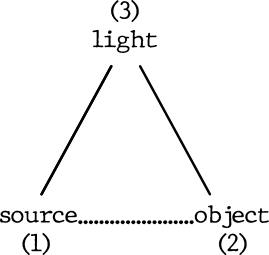
Physically, light travels from source to object, however, we ’know’ that source and object are united in a ’zero-interval’, also characteristic of the light ray. We invoke this ’high-level’ physics just in order to sustain our triadic assertion that the source and object are unified in the third force, the light. It is this unification that is the actual object of the triad,
We must note, however, here at the very beginning , how we have simple physical exemplification for some of our earlier assertions; in particular that in the triad we have the unification of the causal and the synchronous. The ‘causal’ is the ’from … to’ of the light ray while the ’synchronous’ is in the ’zero-interval’ of the space-time scalar.
We make our first reduction in a way we have not made explicit before: we consider all the ’connectivities’ or links between the three terms to be of equal value. It is this which will enable us to make the projection into two-dimensions; ana allow us to ’geometrize’ the relation in various ways. When we can geometrize, we can draw pictures to represent various real possibilities, without having to annotate with verbal distinctions, or Qualities. Nevertheless, this is a reduction and we must be alert to its consequences.
Next, in making the projection, we have to take account of the observer. The projection (which is from the two-dimensional form of the triangle to the one-dimensional form of the line) presupposes a perception. In perception, as we mean it, there is both analysis and synthesis. Let us explain. In the phenomena of light, what is happening has to be seen in order to become known. This means that there must be inserted an eye (or detector) into the arrangement. It also means that the data so received must be read or interpreted. In the case of a human observer, this involves what the observer is attending to. Thus, although the eye may be at a certain place, nevertheless what is seen may not be the particular local phenomenon. what is detected is an appearance which is immediately translated into a meaning entailing more than what appears. In a sense, the meaning is prior to appearance. That is because the mind ’behind the eye’ is making the act of projection which renders the appearance as a meaning. This is very important. The two – projection and appearance – are integrally linked into one whole.
Given the above, we now follow through the various projections. We consider’ the triangle from the three perspectives of its terms and allow ourselves to scan from both right and left, to result in six forms. These are given below, each with an interpretive diagram and brief description. The order they are given is significant: the first three are relatively straight forward; they are then paralleled with the more complex three in relation to their final term (appearance).
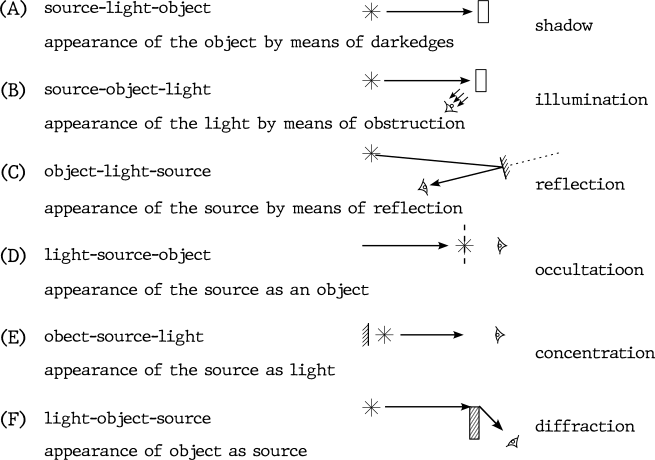
The sequence of the terms, which is represented in the diagrams by means of the arrow of light, is reversed by the ’mind in the eye’ when it reads the appearances.
Thus, in (A),the object appears, but how it appears is by blocking off the light which is coming from a source. If we use the convenient terminology 1-2-3 , etc, we can say that what appears is according to 1-2-3; but what is seen is according to 3-2-1. Thus, the shadow of the object comes from the light which comes from the source: the source is first, then the light and then the object. But, when the eye registers the object, it does this as a shadow or set of dark edges which is then, simultaneously property of the light from which the source is inferred. Of course, in reality, the eye would have already seen (in some fasten) the light as coming from the source; that is to say, other forms of the relation make up the context for any one form of seeing the relation. It is for this reason that we can recall our comments (made while discussing time) that a language is constituted out of the possible combinations which can be made ’present’.
In case (B), what appears to the eye is light. But, again, immediately this is seen as the object and, again, the source is inferred. From cases (A) and (B) we begin to suspect that there is a difference in reading the appearances between tie first step and the second. This may prove to be very important for our theory of projection end reduction. Let us take case (C)
The object (as mirror) sends out rays which reveal the source: in this case, as a virtual image. The eye sees the source and, immediately, the light rays and then infers the mirror.
Case (D) requires some explanation. It is the first of the more complex cases. They are more complex because they entail phenomena in which the simple linkage ‘from … to’ is over-ridden in some way. This way seems to involve a greater degree of inference or reasoning for the phenomena to appear. In case (C) we are saying that light coming towards a source produces the appearance of an object. What this means is simply that a source of light can ’hide’ another source of light behind it. (In this way, the source turns into an object) The ’mind in the eye’ sees the source as an object, immediately and then infers a light behind.
In case (E) we have the object (say, a mirror as in (C)) behind the source which, of course, enhances the light coming from the source in a certain direction, What the eye sees is light and, then, immediately, the source of the light. The (mirror) object behind is then inferred.
We should note that there can be many different kinds of phenomena in this case according to the properties of the object behind the source. We may be able to see an image of the source in the mirror, for example. Thus, our ’inference’ may not be entirely a matter of indirect reasoning, Case (E) is a very extreme case and, indeed, one would not expect the phenomena to be accessible to unaided vision. Nevertheless, there will be a distribution of light ’around the corner’ of the object, such that ‘the object turns into a source’. Then, the ’mind in the eye’ immediately realizes the source as object and infers the incident light.
Thus, for the first time, we have a clear principle: the linear combination of terms produces an appearance which is read in reverse sequence. Thus, an appearance c is produced by a-b-c and read as c-b-a. Naturally enough, we can correlate appearance with experiment and reading with theory; and this explains in a very clear way the truism that ’facts are theoretical’. What is seen is not what appears.
We should also note that what is appearance in one form is not explanation in another. Thus, 3-2-1 does not explain 1-2-3. The reversal of sequence from appearance to reading does not entitle us to explain one appearance by its complementary of opposite sequence. But, let us note this:
|
1-3-2 |
and 2-3-1 |
depend on which side of the ’mirror’ the eye looks |
|
|
1-2-3 |
and 3-2-1 |
depend on which side of the object the eye looks |
|
|
3-1-2 |
and 2-1-3 |
depend on whether the eye is looking ’behind’ or in front of’ the source |
Thus, we have three basic set-ups with two alternative appearances for each: we reverse the phenomena by switching sides with the eye. The three basic set-ups are those derived from the three original projections
|
light |
gives 1-3-2 (shadow) and 2-3-1 (reflection) |
|
|
source |
gives 3-1-2 (occultation) and 2-1-3 (concentration) |
|
|
object |
gives 3-2-1 (diffraction) and 1-2-3 (illumination) |
We are almost ready to follow this through to show in some detail the ensuing process of projection and reduction. Before we do so, however, we wish to address ourselves to the question of detail, What we have in the various combinations is a set of forms, or outline shapes. These can be looked at more closely. For example, take the case of ‘illumination’ (1-2-3): can we find a content so-to-say ’between’ 1 and 2 and ’between’ 2 and 3? Yes. We do so by obeying the logic of the triad and making the ‘ between’ term in each case that which is neither of the other two. Thus, 1-2-3 translates into:
1-(3)-2-(1)-3 or, the two forms: 1-3-2 and 2-1-3
Thus, we might suspect that 1-2-3, illumination, is ‘composed of’ 1-3-2, shadow, and 2-1-3, concentration. The first part (1-3-2) says that the light does not get through; the second part (2-1-3) says that light is ’sent back’. The first part is negative and the second positive. This will afford us guidance in interpreting the reduction of the linear projection of three terms into two.
3-2-1 translates into: 3-(1)-2-(3)-1 which is the combination of 3-1-2 (occultation) and 2-3-1 (reflection)
So, is diffraction a combination of ’occultation’ and ’reflection’? well, not if we stick to the obvious meanings of those words; but we have to remember that they were merely indicative labels. Both parts of the combination deal with ’secondary sources’. The first says that the proximate source obscures what is directly behind it while the second says that an object deflecting light acts as a source: combined, they mean the whole, that the object ’turns into’ a source. Again, the first part is obscuring or negative and the second, positive.
All the other forms may be worked out in a similar fashion. We now turn to the reduction. This has to take account of the two directions, the one of appearance and the one of reading.
Let us take 1-2-3. According to our original notion of the reduction to two terms of these three, we will follow the formula given by:
a – b – c goes to (a,b) – (b,c)
(a,b) signifies a union of source and object and (b,c) a union of object and light. Thus:
(1,2) the ‘light-giving’ is transferred to the object
(2,3) the object is translated into light
and:
(1,2) – (2,3) means ‘the object shines’
In the further reduction, we have:
(1,2) the source ‘disappears’ in the object (negation)
then:
(2,3) the object ‘disappears’ in the light (assertion)
And, therefore, the whole reduction is that ‘light appears’
When the appearance is read, the reduction is reversed:
(3,2) the light ‘reveals’ the object
(2,1) the object ‘reveals’ the source
We realise how, at one and the same time, we can say that we ‘see’ light, we ‘see’ the object and we ‘see’ the source of light. The light ‘contains’ the source and the object. It is the natural synthetic whole of the phenomena.
To ‘make appear’ and to ‘reveal’ are seen as opposite and complementary. The appearance is by negation (veiling) and assertion (manifestation). The revelation is by assertion (of proximate cause) and negation (in favour of ‘ultimate cause’).
When we read appearances, we have a choice of stopping with the given or going on to the ‘ultimate’. In 1-2-3, illumination, we may regard the object or realize the source. There is a dyad of proximate and ultimate. The ultimate is hidden by the appearance. The proximate is given in the appearance. Thus, when I look at an illuminated object, the light tells me of the object’s characteristics (reflectivity, texture, etc.) but these characteristics depend on a source o flight to become known. Also, I may look at a ‘green’ object but see it as black, because the incident light is red!
Let us return to the formalism of the reduction. In our interpretation, we have implied that the reduction expressed as:
(a,b) can be expressed ‘as’ b
thence (b,c) can be expressed ‘as’ c
which implies that ‘a’ can be expressed ‘as’ c
(if two things are equal to a third then they are equal to each other)
We have assumed that what enters into our ‘expressions’ is a valid representation of the phenomena. Thus, in the reduction of 1—2—3, first ‘1 appears as 2’ and then, ‘2 appears as 3’; hence ‘1 appears as 3’. The word appearance is engendered by the fact of being observed (by an eye or detector) which is placed so as to receive a certain ‘view’ of the whole which is a consequence of how the terms are aligned. In other words, the eye is placed so that it receives or registers the final term in a sequence, which is ‘hiding’ or veiling the term preceding and, this in its turn, hiding or veiling the initial term. However, this ‘veiling’ is not that of opaque objects one after the other: the sequence of terms is, in fact, translucent. Thus, the preceding terms can also be said to ‘shine through’ the succeeding ones. This is a proper meaning of ‘appearance’.
The whole of this reduction belongs to perception. In the final stage, the final reduction is to something that can be registered either as ’light’ or ‘dark’; but, it is, in fact a ‘zero’. Registration must be of an either/or type; but the final reduced perception is simply that of something. The something is the reduction to the monad. The registration in terms of light/dark is of the reduction to the dyad: the two together reveal the line or sequence. The full reading of the phenomena is of the triad, which is revealed in the combination of the sensual eye – at one ‘end’ of the process – with the mental eye – which is able to ’see’ the sequence ‘from the side’ – as is reflected in our diagrams.
Thus, the original geometrical character of the whole phenomena is restored in the various levels of the perception: the source as point, the ‘something’; the light as line, the sequence given in light/dark; and the object, given in the understanding, in a plane.
The character of our example may prove to be unique, or exceptional; and other possible candidates turn out to be recalcitrant to our treatment. For the moment, we will simply reflect on our example and its analogues. It does, of course, closely parallel certain descriptions of the Trinity. The Father is the source. The Son is His image. This is literally paralleled in our case (C) of reflection but is also implicit in case (B) of illumination. The Holy Ghost is the light, which is ubiquitous as the union of Father and bon in Love. In most interpretations of the Trinity, it is more or less said that, although one or other of the Three Persons may he prominent in any divine occasion, nevertheless it is all Three who act. This is, again, precisely echoed oy our example. Indeed, it is made clear that there is a complementarity of two axes of perception, one of which is ’sensual’ and the other ’mental’. In the case of the Trinity, we would say that the two axes are, respectively, ’mental’ and ’spiritual’.
It is interesting that the Son is treated in the doctrine of the Trinity as ’opaque’: because it is He who shows the Father.
Let us lay out some suggestions of the correlations we suspect:
(A) ’shadow’ 1-3-2 the Son as a being appearing in a definite time and place: Incarnation.
(B) ’Illumination’ 1-2-3 the Holy Ghost appearing; the ’Comforter’ who comes ‘after Christ’.
(C) ’Reflection’ 2-3-1 the Son revealing the Father; ‘I and my Father are One’ (also ’There is none Good but the Father who is in Heaven’|
(D) ’Occultation’ 3-1-2 God as Creator (rather than as Love)
(E) ’Concentration’ 2-1-3 God as Love; made possible by the ’sacrifice’ of Christ; Christ returning unto the Father
(F) ’Diffraction’ 3-2-1 the absolute freedom of the Son; He is wholly God
We begin to suspect that all that can be said intelligibly concerning the Trinity is contained in the six forms! It is in this that there resides the triadic logic; a logic that does not work by the contrast of true and false, which is dyadic, but through the combinations of the three terms. Hence, triadic logic is permissive rather than restrictive (as we said earlier: ’the dyad denies or excludes relation’) Triadic logic is the logos in its positive creative sense. Therefore, it cannot appear in explicit form in e.g., physics, since the laws of physics are expressed primarily as constraints or impossibilities. It may well be that we are entering a new phase with the growing interest in the evolution of higher orders of complexity in physics, chemistry and biology; where we must take account of the positive possibilities as well as the restrictive statistical laws,
Since triadic logic is permissive, it does not lend itself to simplistic verification. Thus, in physics, if we find something happening that should not according to the ‘laws’ then we reconsider the laws. Whereas, in triadic logic, we have possibilities; and, if any of these do not appear there is no clear falsification.
We have to admit that triads – following through our theme of perception – must involve pax an observer. This is not necessarily something new, since physics, too, requires an observer. However, with the triad, the mode of observation is meme integral to the phenomena. The combinations will not appear unless they are set up to appear. Being able to set up all six modes of appearance amounts to understanding. There is little doubt that experimental exploration must involve a background of triadic logic. Once a relation is suspected, it can be explored from all ’sides’; though this will require technical ingenuity. Similarly, a scientist may begin to suspect that a collection of appearances have, underlying them, a single simple relation; then he so-to-say ’reverses the projection’ to arrive at this relation.
Thus, the triad teaches that it is true that the scientist ’makes the phenomena appear’ and that they do not just happen; but this becomes almost a truism, de can also think of the example of diffraction which required quite elaborate investigation to uncover but, once discovered and ’read’ rendered intelligible natural phenomena such as that of the colours of mother-of-pearl
Triadic logic made real in experience enables us to read the book of nature.
Significance of Giving: Example of the Six Forms
We are now to examine a triad in which the character of the terms is that of persons rather than of phenomena. This means that what is important is intentionality. It would appear that we have to re-think our way of arriving at the six forms.
We have signified the meaning of the sequence of terms as appearance but now, we must speak of intentions. Our language needs to be teleological. In pursuing our present analysis, we will come to see that the form of the forms remains the same while their reading has to be different. In particular, a difference arises because there is no observer: the result of a sequence is given as an end in view from the perspective of the initial term.
The meaning of a gift is various. For example, a gift may be given as an enticement or as an act of charity. In the first case, the gift is for-the-sake-of something which might be given in return; but in the second case it is given without regard for a return. Thus, a man might shower gifts upon a woman to entice her to sleep with him. In the case of true charity, we might expect the donor to give without requiring anything from the recipient, not even gratitude, no matter how often in practice people fall from this standard.
The for-the-sake-of is mediated by the other term. Take the form 1-2-3. The donor gives for the sake of giving. We will call this ‘display’. The recipient is needed as a means to the end. The six forms are outlined below, their meaning being fairly obvious.
|
|
Display. The donor gives for the sake of giving. His ‘virtue’ is displayed through the recipient. |
|
|
|
|
|
|
|
Enticement. The donor gives for the sake of the recipient receiving. The meaning of this is some kind of debt or obligation ensuing for the recipient. This is putting the recipient ’under’ the donor. |
|
|
|
Gratitude. The recipient receives for the sake of the donor giving. It is confirmation of the act of giving. It is also an inducement to give. |
|
|
|
Charity. The gift is for the sake of being received. The donor is only a means. It is objective charity, according to the needs of recipient. |
|
|
|
Giving. The gift is for the sake of giving. The recipient is only a means. It is giving without motive. |
We notice that, in this case, the middle term is like a bridge which is passed over from the initial to the final term. The final term is ’final’ in the sense of being the telos or end; or that in ’which the end or goal is located. Thus, in e.g., 1-2-3 the donor crosses over the recipient to realize himself in the gift: he displays himself as the gift. In 3-2-1 which, in our verbal description sounded very like the previous instance, it is the gift that crosses over the recipient to realize itself in the donor. In 3-2-1, therefore, we could say that the donor displays the gift!
We can see some clear distinctions such as that between 2-1-3 and 2-3-1. In the first, appreciation, the intent is towards the gift; whereas in the second, gratitude, the intent is towards the donor. The gift is the key term in the relation. It both separates and unites the donor and recipient. There is separation (as in the case of light) in the form of ’from … to’. There is union because both donor and recipient are needed to make the gift real (there is no gift if it is thrown back at the donor!). We can appreciate how this third term has something of the ’personal’ in it without being a person, tie encountered something similar in discussing the fundamental triad of subjective relation (I, You, He). The third term is personal in belonging to and coming from persons but is also impersonal in not itself being a person. It is interesting to reflect that a person cannot combine in himself persons but only be combined with persons.
We notice, too, the ’see-saw’ effect exhibited in the forms 1-3-2 and 2-3-1 where the roles of donor and recipient are tending towards a reversal, finally, in the forms 3-1-2 and 3-2-1 the donor and recipient tend to be coalesced together or to be submerged under each other. Thus, in 3-1-2 the donor tends to be submerged under the recipient while in 3-2-1 it is the recipient who tends to be submerged under the donor. Both of these are not in the sense of dominance but in terms of significance. 3-1-2 reduces towards 3-2, while 3-2-1 reduces towards 3-1.
In this teleological example, the particular combination is ’felt’ in the final term. Thus, in 1-3-2, it is the recipient who feels the enticement and, in 2-3-1 it is the donor who feels the gratitude. The mode of feeling is passive which is appropriate to being the object of an intention. Thus, feeling in ’personal triads’ is in the place of appearancing in ‘phenomenal triads’.
What is the equivalent to ‘reading’? It is understanding. The recipient in 1-3-2 understands his feeling as arising from the intention of the donor.
There is an apparent difficulty when it comes to the ‘feelings’ engendered in the third term, the gift itself. We must realise that objects in the human world are not simply objects but are personalized. Consider 1-2-3. A man adorns his mistress in expensive clothes to show off his wealth. It is made known that it is he who adorns her. The clothe she wears show this to the world, we can even say that they have that feeling about them. They are ostentatious, for example. This may well be true even if the man truly loves and adores his mistress. What he is doing is showing his wealth and power of giving. He goes on giving. The giving is somewhat insatiable. Then consider 2-1-3. Here there is no ostentation. What we can witness is an improvement in the feeling of the gift. Say a boy is given an old bicycle. The boy lavishes care upon it and it begins to shine. The gifts of 1-2-3 are liable to be discarded and replaced with new ones; whereas the gift of 2-1-3 is liable to be cherished and preserved.
In the combinations 3-1-2 and 3-2-1, we seem to have to talk of the intention of a gift, which is very strange and unacceptable! What is at stake here is transcendence of possession. In 3-1-2, the donor realizes that what he gives is not truly ‘his’. He may even say: mil things come from God. Indeed, in religion, the inner truth of charity is just that: the man who hands over the gift is simply the representative of God. It is in such that we realize the positive sense of the term ‘impersonal’ to mean: what is not bounded by the person, limited by his role.
But, what are the feelings of the recipient in 3-1-2 to be? They are not gratitude or appreciation, or feelings stemming from them. They are the appropriate ‘impersonal feelings’. Thus, in charity, the recipient is to feel the impersonal agent: it is pure acceptance. In the triadic form 3-2-1, the donor is to feel the pure feeling of ‘manifestation’. In our attempts to bring out the character of each of these six forms, we do tend to use descriptions in which it is implied that certain of the forms are ‘superior’ in some way to others. Surely, we will feel that charity is better than enticement? That this seems to be the case should tell us that our descriptions are not yet objective enough. What is happening is that in our effort to find clear distinctions between the various forms we begin to employ an already coloured language. One of the most powerful aspects of the pure language of the forms is that it gives us a chance to start without this bias and colour. The language of the forms is precise and delicate in a way that ordinary discourse cannot meet.
The six forms are the objective colours of the spectrum of understanding We make an attempt to render these into ordinary language, We discover our biases. We adjust our interpretations towards a more equal-valued system of forms, In doing all this, we encounter the reality of the abstract. These are the forms that Plato considered, or tried to consider. But, he never came near this possibility of precision, obsessed as he was by geometry.
We come to see that the triad is the logic of intention and of appearance. By concentrating on the minimum form of three terms and realizing how they enter into projection and reduction we arrive at a language of the forms which ’are really there’ in the world of possibility. These forms are given in the necessary structure of intention. This structure is rather like a sculpture that can be viewed from many sixes; and it has six facets. In every case of a triad, we have first to establish what there is in it that is ’from .„, to’ and verify that this both separates and unifies what it comes from and what it goes to. This gives us our semantics,
Finally, we understand that, as in the Trinity, all three terms act together as one; even though it is possible to act in six different ways., The terms of the triad are equally together in two-dimensions; but in sequences in one-dimension. In experience, the sequences collapse or are reduced to a single primary element. But, this single element has the import of three as if the generative sequence carried through it a memory. The three terms ’pile up’ into a single one but they are ’layered’ still in distinctive ways, AS participants or observers, we recognize just one thing; a feeling, say. But, we also understand the meaning of this single element and our understanding can reach back through the sequence to its origin and then ’stand under’ the triad as whole.
For what we have laid out is the structure of understanding itself and, with it, the disclosure of the meaning to ’stand under’ We understand that our experience ’stands under’ a form. Ultimately, in matters of intention and the triad: like, this is the form of the triad in two dimensions.
The forms, then, are not in some other world or Platonic ideal space; they are also themselves experience, but in a higher order of representation. There can be no doubt that these higher orders of representation are themselves integral to our experience (from where else can they come?). Thus, understanding is the experience of experience. We would suppose that we reach some kind of limit with the tetrad, the natural space of which is three-dimensional.
Heat Transfer and the Six Forms of the Triad
One of the more distant goals that we have for our enquiry is to discover underlying principles which govern analogy. The pursuit of different and seemingly unconnected topics as subjects for triadic analysis is following a path of analogies. We presume that there should be analogues for each of the six forms which we find for the triad of a situation such that these also apply to other situations. If there is a reality in the triad then we should be able to discover a ’sameness’ between the forms, no matter what the subjects are. The form e.g., 1-2-3 should be recognizable as such whether we are looking at a personal relation or light transmission. This is about the only method we have to guide us in our interpretations. The possibilities are usually so rich that the formalisms we have developed are inadequate to strictly define a specific phenomenon.
This should not surprise us. Physics already exists and functions; it affords us exact descriptions and specifications of physical situations that are unambiguous and testable. Why should we presume to duplicate all that?
But, what is ’all that’? Is it not a combination of ’thinking about phenomena’ together with ’thinking in number’ (mathematics)? Is there not an analogy between physics and what we are attempting?
Analogy may well prove to be the most important sign-post to the ’secret of thinking’ that we can have.
As far as we know, no-one has attempted a strict analysis of the recurrent conceptual elements used in physics. Such a task would require the evolution of another language, perhaps. There is, between the realm of phenomena and the realm of mathematical forms, an extraordinary commerce which makes it most difficult to see what are the elementary components of physical theory. Mathematical form dictates a great deal. Who will have patience with a concept that cannot be correlated with quantitative measurement or even lose its meaning in an equation? When we look at various phenomena, experiences and beliefs; holding in mind the forms of the triad; we are doing something that is akin to thinking in physics in general. Where we find that a certain form does not seem to have an expression in reality, we search for one, or conceive of one; just as Clerk Maxwell did in formulating the laws, equations of electromagnetism when he introduced the concept of the ’free current’. But, the elements of our thinking are very limited and we do not allow ourselves to introduce anything exceptional. It is almost as if we were going back to the position in which it was assumed that all the phenomena of nature arose from a small number of ’elements’.
We are constantly asserting that ’everything’ of a certain type arises out of the combination of just three elements. These elements are not chemical elements, nor are they fundamental forces such as that of gravitation. They are the elements that must be present in every interaction, every change, every state of equilibrium and so on. In ordinary parlance, they are the stuff of causality; in that they determine that something must happen, Wherever there can be a transfer of something, these three elements are to be found in combination. Transfer in nature is from the ’active’ to the ’passive’, which has evident meaning in any given instance. However, in the human world we come across other dimensions to the workings of nature through our own activity. We are able to exploit the given transfer in a variety of ways; or select out of it just one or another facet which, again, in nature would be subsumed in a single event. We recognize that what we do in this regard does not change the laws of nature; indeed, we come to find that what we do enables us to understand more deeply what is happening in nature herself. This is obviously the case when we think og how physics and chemistry have brought to our attention the remarkable mechanisms and processes which living beings employ.
Therefore, there is implicit in every natural phenomena, in every case of transfer of matter or energy, alternative forms of behaviour which can be realized by us through technology and manipulation and, possibly, discovered inks the workings of living beings. These alternative forms are just those that are possible given the elements of the phenomena. We argue that there will be three such elements – by definition – which co-exist in the given transfer. Once these three elements are articulated through a consistent discrimination^ there can come a phase of thinking these together in the realm of the possible: that is, not only in the particular sequence in which they spontaneously appear, but also in other sequences in which they may be ’made’ to appear. It should be obvious that what we mean by ’making’ here refers to an act of intelligence.
Our description follows closely how we envisioned time; in particular, how we bring to consciousness in the present the possibilities made available from the elements of the past. And here we meet a curious thing The apparent nature of the given is that o& transfer of power from the active to the passive – in other words, some form of what we now call in physics the necessary increase in entropy, leading to general dispersive uniformity. However, the life around us and in us, and the cosmic context of this life, exhibits an amazing variety and powers of enhancement. Our awareness of the given contains a contradiction. The thought arising in us follows the declension of nature while expressing the inner vitality of life. Therefore, it seems that we are imposing through our own life-imagination a set of possibilities which do not obtain in physical nature. However, these possibilities can be actualized.
There is an interesting dialectic at work. First, we have the ’natural’ form of transfer. Second, we have our response which seeks a reversal of the direction of flow; or, at least, its inhibition. This is the response of intention. Thirdly, we have the endeavour to understand the underlying laws which encompass both the natural and the intentional. We can make the picture more complete, and arrive at the underlying rationale of our six forms, by taking into account not only the distinctions we have made but also the difference entailed by whether or not we ’make use of’ what is happening. Thus:
(i) actual flow
(ii) making use of actual flow
(iii) reversing flow
(iv) making use of reversing flow
(v) common principle of i and ii
(vi) common principle of iii and iv.
We shall find that these correspond to the six forms, thus:
(i) 1-3-2
(ii) 1-2-3
(iii) 2-3-1
(iv) 2-1-3
(v) 3-1-2
(vi) 3-2-1
Where we begin with intention, as in the case of human affairs, then the order and significance of the forms changes. But, we will find many interesting analogues. For the moment, however, we ‘will remain with physical phenomena and take as our example the flow of heat.
In analogy with light, we have a source, a ’from … to’ and a receptor. However, the source and receptor may be of the same nature – e.g. gases – in this case of heat transfer, take the given phenomena to be that defined by the notion that ’heat flows from the hotter to the cooler body’, which establishes the basis of temperature difference. Term 1 is the ’hotter’ body or state and term 2 the cooler body or state. These may or may not be wholly defined by a temperature (intensive) parameter. Term 3 is the transfer of heat from 1 to 2. We then know, for example, that if a quantity Q of heat is so transferred, the change in ’heat content in the simple isolates system of 1 and 2 is zero, while the change in entropy is positive. If 1 and 2 are finite systems, then, in time, the flow of heat will bring them to the same thermal state (same temperature); i.e., the flow of heat tends towards equilibrium and sameness, defined by the greatest probability.
In our present analysis, we are excluding aspects which arise simply from our reading of the phenomena. For example, if we have the term 2 as a relatively small body with visible thermal properties, we can organize a thermometer. The thermometer comes into thermal equilibrium with the body 1 through the transfer of heat; and shows the temperature of 1. Hence:
body 2, through transfer of heat, shows temperature of
thermometer – attaining equilibrium – body 1
2 – 3 – 1
That is, we have the form 2-3-1. This aspect of 2-3-1 is an intimation of what we are presently concerned with. We may regard it as significant that there is emerging some such spectrum as:
selection of phenomena
reading
instrumentation
manipulation
Our given phenomenon is heat flow from hot to cold. This is 1-3-2.
What does it mean to make use of this? We take the meaning of ’to make’ strictly in the sense of ’doing’, i.e. in the sense of work. In other words, we convert part of the heat flow into useful energy or work.
This is the form 1-2-3. Of course, now the term 3 has a different status. It is no longer the energy of heat per se. In analogy with the case of light, we have an energy which is not totally absorbed in the receptor and, hence, which has a use, A certain proportion of the energy is set free. In 1-3-2, all the energy was taken up in the flow from 1 to 2. Went, ae come to the counter or reverse flow. We have to think of how to drive heat from cooler to hotter. This is not so strange, after all. Just think of the old trick of draping the milk bottle in a wet cloth when the weather is warm: this keeps it quite cool, heat being transferred by as latent heat of evaporation from the cooler to the hotter. This is the form 2-3-1. We make use of this in the form 2-1-3. Again, the term 3 has a different significance. It is now the total energy input into 1 which is the sum of the heat loss from 2 and the work needed to drive the process. 2-1-3 is the form of the heat pump.
We can already see that what appeared, at first glance to be very strange, a reversal of the natural flow of heat energy, turns out to be not so very strange after all, even prosaic. Once we have ‘engineered’ the other possibilities, we can see them already in operation in nature. We have said, very little about the mechanisms and constructions needed
to make the various forms work as they do. The triadic forms can only indicate that they are possible, not how they may be brought about. The most evident in thing in the forms 3-1-2 and 3-2-1 is that they designate the direction of heat flow: in the former from hot to cold and kha in the latter from cold to hot. This is what we mean by these constituting the respective common principles. They simply state that the heat gain in the forms 1-2-3 and 1-3-2 is in the body 2, while the heat gain in the forms 2-1-3 and 2-3-1 is in the body 1.
If we look more closely now at the designations of terms 1 and 2, we can spell out the various forms in an alternative but still analogous way. What we do is to take into account that terms 1 and 2 can be characterised not only in terms of temperature T but also in terms of entropy S. The heat transferred, Q, is a function of T and S. Conventionally, the workings of the heat engine, in which part of the heat transfer is converted into useful work, is represented on a T-S diagram and refers to a cycle of a working substance such as a gas between two temperatures – that of ‘source’ and ‘sink’.
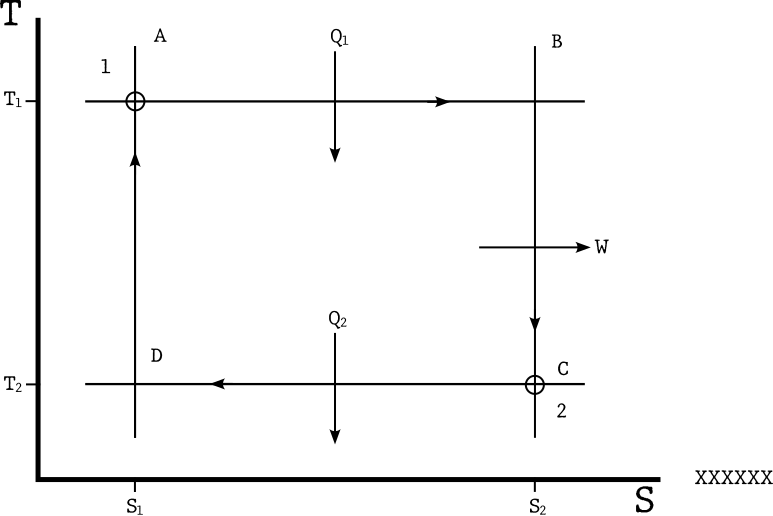
We have designated point A as the term 1 and point B as term 2. These differ in both T and S, The diagram shows four changes of state, two at constant T and two at constant S. The difference between Q1 and Q2 is equal to W, the work output.
Now, we make the following identifications:
A-B: isothermal expansion at T1 1-3-2
B-C; adiabatic expansion at S2 1-2-3
C-D: isothermal compression at T2 2-3-1
D-A: adiabatic compression at S1 2-1-3
From A to B, the gas takes in heat from the source. From B to C the gas cools to T2. From C to B, the gas gives up heat to the sink. From D back to A, the gas warms through adiabatic compression to T1.
We have, therefore, identified the changes involving the extensive parameter S with the forms 2-3-1 and 1-3-2; and the changes invoking the intensive parameter T with the forms 2-1-3 and 1-2-3.
Changes which involve an actual transfer of heat have, in their corresponding forms, the term 3 in the middle place, as the means. Where there is no heat exchange, the term 3 is in the final place. This designates a change in the intensive parameter, T. We must bear in mind the typical formula here:
dQ = T.dS
The forms 3-1-2 and 3-2-1 designate, respectively, the principles of flow and reversed flow; and they must involve both T and S together. Thus, 3-1-2 indicates that the heat transfer involved ends in 2; and there is a ’degradation’ of the energy. 3-2-1 indicates that the heat transfer involved, in this case from 2 to 1, ends in 1; and there is an ’evolution’ of the energy. The two terms 1 and 2 differ in both T and S as shown in the diagram.
Given the three terms we have been dealing with, there is no obvious way to introduce, alongside these terms, a term which conveys the sense of work. Work is implied in the reversal of flow, but not as the W which can enter into thermodynamic calculations. Indeed, at the level of description we have, the all-important distinction between work or useful energy and heat cannot easily be made.
The distinction between work and heat is barely suggested in the forms. Consider the following.
- in the forms 1-3-2 and 2-3-19 the term 3 represents the energy transferred between 1 and 2
- However, in the forms 1-2-3 and 2-1-3, the term 3 represents the energy difference; that is, there is a net gain or loss, due, of course, to the involvement of work;
- In form 1-2-3, the heat gain by 2 is less than the heat loss by 1, the difference being the work output
- In form 2-1-3, the heat gain by 1 is more than the heat loss by 2, the difference being the work input.
- as in the previous forms we had term 3 as the overall difference of energy as output, so in the forms 3-1-2 and 3-2-1 we have the term 3 as the overall difference in input; that is to say, the energy term 3 is what makes the system work in that way; it is not the same as the 3 in the previous forms (necessarily)
Thus, in the forms 1-2-3 and 2-1-3, we have a representation of the conversion between work and heat; whereas, in the forms 3-1-2 and 3-2-1, we have a representation of the ’directing force’ of the mechanism controlling the process which constitutes either a heat engine or a heat pump. It is important to note that 3-1-2 and 3-2-1 both refer to cycles.
Thus, the energy flow which, in its most primitive form was simply the ’from … to’ of spontaneous heat flow reveals ever more sophisticated possibilities until we reach control over the direction of flow.
If we imagine the situation for the forms 1-3-2 and 2-3-1, we have:
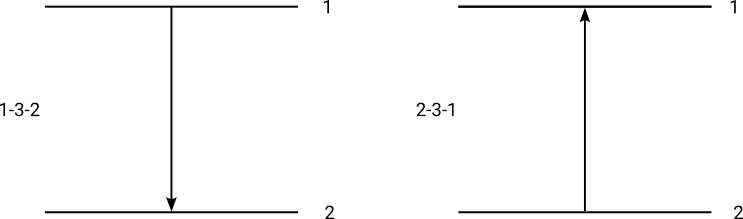
Thus, the working substance brings 1 and 2 together, as represented in the form and we have an energy flow so-to-say at right angles to the heat flow. Note that these forms presuppose the working of the previous two forms.
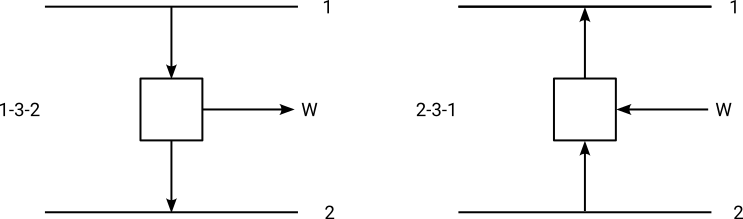
Next, we combine the-se four forms but need to establish the overall direction of energy flow as expressed in heat. This is done in the forms 3-1-2 and 3-2-1 by the precise application of an energy term.
Further, in these forms, the whole system is maintained and can repeat itself. In the first two forms, left to themselves, 1 and 2 would merge together. In the second two forms, left to themselves, the process would come to stop. Only in the third pair of terms do we have 1 and 2 remaining in the same relationship and the process continuing.
Thus, in large, we can come to certain broad conclusions:
(a) Forms 1-3-2 and 2-3-1 will be observable in nature
(b) In certain contexts, it can be arranged that the forms 2-3-1 and 1-2-3 obtain, in which there are results outside of the system defined by (1,2)
(c) The interplay between all four previous forms can be controlled by an intervention or mechanism to maintain an overall flow with definite results. Form 3-1-2 is the intelligent direction of 1-3-2, while form 3-2-1 is the intelligent direction of 2-3-1.
Referring back to our earlier discussion of light transmission, we can suggest that 3-1-2 is exemplified in the TV screen, while 3-2-1 is exemplified in the laser. It is in grasping the underlying character of these forms that technology progresses. However, as we have said before, once we have invented a device, it is usually the case that we can then discover this device already in existence in nature.
The 3-M Equation – a Special Case
If we turn from the observation of natural phenomena which we can find ways to extend and make use of, to the 3-M equation, we come to a situation in which the ’given’ is already intentional. The ’natural’ phenomena we first come across is that of finding solutions. Wherever we look in the human world, we see people coming up with new ways of doings things and ways of doing new things. Our view of this is that there is a Media initiative producing change in the realm of Matter; something that is ordinarily simply regarded as ’creativity’. Whatever the terms we use, the important feature is that something capable of generating information and structure is being brought to bear on the existing state of affairs. How it is brought to bear is, according to the 3-M equation, through Meaning. It is Meaning that enables the impulses of Media to find a relevance in Matter (art to serve technology#. Our ’given’ then, even though ascribed to intentional activity, has a ’natural’ character; because we suppose that Media is as objective as Matter, though in a different way. Media is not personal. So, we find ourselves observing something which, in the ordinary course of affairs, we seem to ’make happen’. More of this later, when we examine thought again. For the moment, we have:
1-3-2 Media-Meaning-Matter
seeing what to do – solutions.
Following our previous analysis, we now look for the reversal of this ‘flow’. The key is in the direction from Matter to Media, which reveals what Matter lacks, or needs.
2-3-1 Matter-Meaning-Media
seeing what is missing – needs
The next steps involve the production of an independent ‘energy’ outside of the coupling of 1 and 2. We have the two cases:
1-2-3 Media-Matter-Meaning
release of a power of doing – ‘magic’
2-1-3 Matter-Media-Meaning
release of a power of seeing – ‘music’
Magic is the ‘making use of’ 1-3-2; while music is the ‘making use of’ 2-1-3. Magic is the power of achieving results through meaning. Music is the power of appreciating Media through Meaning, Both magic and music depend on the control exercised through meaning; i.e. in the forms 3-1-2 and 3-2-1.
The nature of this control is value and there are two types of value -system which can be energized by meaning. Value is meant here in the sense of primary motivation. The two main types we have met before: the via positiva and the via negativa. They may be expressed as follows:
positiva ’and He saw that it was good’
negativa ‘there is none good save the Father’
In the positive way, Media finds expression in Matter; it is joy. In the negative way, Matter reflects Media; it is faith. In the positive way, we enable the known to become illuminated by the unknown; while, in the negative way, we enable the known to give way to the unknown. In the former, there are the joys of creation; and, in the latter, faith in the uncreated.
When we used the terms ’magic’ and ’music’ we were picking up some of Matchett’s later expression of the 3-M equation. Magic, as we said, is the power of doing. Music is the power of hearing. In this respect, the two modes reflect a basic dichotomy in thought itself. The usual tendency in our culture is to regard thinking as instrumental, serving our desires or ends; but, there is another side, which has been deeply discussed by Heidegger, the side in which we see how ’to think’ is the same as ’to thank’. i.e., to recognize the source of itself. The latter kind of thinking does not accomplish anything!
Let us summarize the interpretation of the six forms:
1-3-2 solutions 2-3-1 needs
1-2-3 magic 2-1-3 music
3-1-2 via positive 3-2-1 via negativa
What drives the whole thing? It is the ’flow’ of meaning. This is the natural state of affairs and we could take the form 1-3-2 to be a definition of man. In this, we make connections, we see analogies and so on. The whole tendency is towards improvement, following the ’what if ..? In following this tendency, we come across problems and restrictions, which turn us towards needs. In both 1-3-2 and 2-3-1, we use whatever meaning is at hand. It is in 1-2-3 and 2-1-3 that we generate meaning. These comprise the essence of the formula ’Making Matter plus Media Meaningful’. In them, the ’at-hand’ meaning is put aside or put into parenthesis (epoche) and a direct contact is effected between Matter and Media. Therefore, neither of these is to be felt as ’rational’. In appearance, these forms are easy to effect; by letting Matter and Media stimulate each other without ’interference’, i.e., by prior meaning.
The suspension of meaning generates meaning! This corresponds with the adiabatic expansion or concentration of the gas in thermodynamics. Both ’heat’ and ’meaning’ are made potent by a rapid process which does not give time for exchange with the environment (the ‘environment’ in the case of meaning having to do with memory and social norms). Indeed, in practice it is always the case that magic and music come out of intense and immediate actions.
Behind the capacity to suspend the operation of given meaning is a fundamental attitude: to accept everything or to accept nothing; 3-1-2 or 3-2-1; absolute ’yes’ or absolute ’no’. The two have been well discussed in mystical literature and it is important to regard both of them as forms of love: the first is love of the world and the second is love of God. They are immensely potent and only some deep and mysterious core in our being can be responsible for them. They are the forms which do nothing but through which all things are done. Ultimate values.
It is becoming more and more clear that the six forms of the triad are not of equal value. The forms 1-2-3 and 2-1-3 require a special ’effort’; they are on a different level to the forms 1-3-2 and 2-3-1. In them, the connecting role of the third term is suspended; a kind of vacuum is created into which a new state of the third term comes. In talking of ’vacuum’ here we invoke the following: that there is an intrinsic togetherness of the three terms and when we hold two of them against each other, the third is forced to appear. There are parallels with the dyadic switch. This switch has only two positions, on and off; but the triadic switch has six positions and each position is made by the conjunction of two terms. The important quality of the conjunction is that there is nothing between the two terms conjoined. They are not connected.
The act of conjunction, then, takes place within the field of triadic force – if ’force’ can be the right word, stemming as it does from dyadic considerations.
A quite opposite, but equally valid, way of describing the action is to say that we hold two of the terms apart. This is also a way of saying that we have ’nothing’ between them.
’Triadic force-fields’ are naturally self-completing. We are reminded of that New Age expression: ’We can’t put it together, it is together’. We have reached a radical extension of Heidegger’s ’letting lie together’. The shift of nature taking place between the forms 2-3-1 and 1-3-2, and 2-1-3 and 1-2-3 may also be described as one from extensive to intensive actions. In intensive actions, we have to take levels into account. In the extensive ones, the terms may be regarded as ’side-by- side’; but, in the intensive ones, the terms are ’above-and-below’ and this explains why we had the peculiarities of description such as ’holding apart with nothing between them’(which does not make sense when applied to extensive situations).
The distinction of intensive and extensive was introduced when we discussed the triad of heat flow, speaking of temperature and entropy. In that case, we ascribed the forms 3-1-2 and 3-2-1 to the two cycles which could be performed using the four other forms. It is this which leads us to characterize them as integral, i.e. they refer to the integrated result around the whole cycle, indicating either ’negative’ or ’positive’ control. ’Positive’ control builds up available power (work) or useful energy; while ’negative’ control takes in useful energy. We have said nothing about the how of all this. The ’how’ resides entirely in the third term. We can picture the third term as being ’unconscious’ in 1-3-2 and 2-3-1 and as ’conscious’ in 1-2-3 and 2-1 -3. In the forms 3-1-2 and 3-2-1, it has become understanding. This anthropomorphism is valid in the case of the 3-M equation, where each of the three terms is what it is in awareness. The remarkable feature of the equation is that we have a three-fold model of awareness instead of the more usual two-fold one which distinguishes subject and object, a distinction which ties us to the limited and distorted perspective of cognition. The 3-M equation brings to light our participation in creative becoming and integrates the ’natural’ and the ’artificial’. By emphasizing the aspect of ’making’, it detaches itself from the limitations of cognition. In many respects, it illuminates the meaning of the saying by J. G. Bennett that: Instead of beings which do things, they are doings which be things’. The terms of a triad – and, in particular, the terms of the 3-M equation – are not entities but ’doings’. The naming and understanding of ’doings’ is unfamiliar to us. We are used to distinguishing elements as objects and we derive our usual sense of number from objects.
Thus it is that in the triad (and other systems) we have another sense of number which we are slowly learning. If we persist in thinking of the terms as objects, then it will always be a difficulty that there could be any number of objects; and, then, why three? It is only when we realize that the terms are ’doings’ that we can begin to understand that they must be three. And, then we can learn to ascribe the terms correctly and understand why they appear to change – as objects – from form to form.
Meaning is the relational doing par excellence. Obviously, it is not an object, nor is it a mere ’content’ of the mind. It is active in a peculiar way.
There are only three ways of being active, none of which can operate without the others. However we ’distribute’ them in our mind amongst objects of our experience or categories of thought, there must always be in operation the active, the passive and that ’movement’ which tends towards the equality of value of active and passive. In this respect, we can understand that the triad lies at the foundation of mathematics and the very notion of an equation.
We can also agree with Jung and say that the triad is masculine in so far as it is of doing and thought, will and time.
Reduction of the Six Forms to an Elementary Symbolism
We have postulated that the equi-valued notion of the triad, most often and conveniently represented an triangular form, is projected into the sequential mode, written, represented and thought of as ’in a line’.
We discovered that the linear ’projection’ of the triad conformed with, in one of its six forms, the natural or given phenomenon associated with the triad, in the guise ’from … to’. This was found to be the case whether we were dealing with a phenomenon in nature (such as heat flow) or something from the realm of human intention (such as giving). We then went on to explore the meaning of the other forms of the projection and found: the natural flow,, the counter-flow, the use of these and the control of these. We argued that, although we uncover the phenomena related to the other five forms through intentional work) these other forms, too, will eventually be found ’in nature’; in particular, in the realm of living beings.
In thinking now of what goes on in us concerning the representation of these various forms, we want to draw attention to the interplay between the triangular, two-dimensional, picture and its one-dimensional, linear, projections. The triangle gives us a very different picture to that of the line, or sequence of points. For example, the line suggests change or movement, ’from … to’, whereas the triangle does not. The triangle conveys a static character. If the line is time-like, the triangle is space-like. More than this, the two-dimensional character of the triangle enables us to distinguish between vertical and horizontal aspects; it suggests that there is an ’invisible’ direction – insofar as the reading of the line is concerned – which is orthogonal to the direction of flow represented in the line
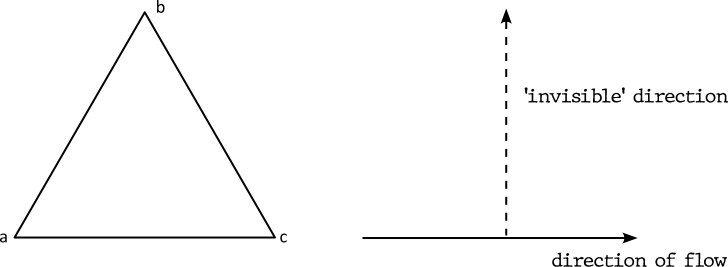
The ‘invisible’ direction suggests that the term which occupies the higher position i§. higher. At the very least, it gives support to the notion of different levels; something that is not indicated at all in the linear projections. It was on the basis of a notion of different levels that we distinguished the forms 1-2-3 and 2-1-3 from the forms 1-3-2 and 2-3-1. However, we also saw that the forms 1-2-3 and 2-1-3 did not involve a flow of the type ‘from . . . to, i.e of something being transferred from one term to another. What they involved was another kind of ‘from . . . to’ such as: ‘from one state or quality to another’. Thus, in the case of heat-flow, we distinguished between isothermal and adiabatic processes. In the case of giving, the forms 1-2-3 and 2-1-3 concern the value of the transaction, rather than the transaction itself (1-3-2 and 2-3-1). As we expressed it before, these two forms distinguish between the cases in which the value of the gift is mainly intended by the donor or by the recipient, respectively. A gift which expresses the intentionality of the recipient is different from one which expresses the intentionality of the donor. This is not a question of what they want, either.
The situation may be illustrated by reference to giving to the Third World by the First. Peasants somewhere can be given e.g. tractors, but these can be seen rusting and abandoned on countless fields all over the world and rarely are they of much ultimate use. It is far more difficult matter to give in such a way that the peasants themselves can advance their own lives. The essence of the form 2-1-3 is that it shows the ‘passive’ term moving towards the ‘active’ state; there is an ‘heating up’. The form 1-2-3, on the other hand, shows the ‘active’ term moving towards the ‘passive’ state; there is a ‘cooling down’. Thus, the gift in 1-2-3 diminishes the first term while the gift in 2-1-3 enhances the second term.
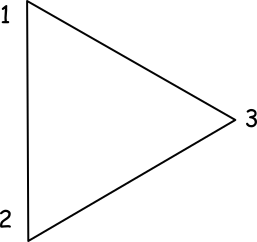
We can conceive of the schematic model behind our thinking of these two forms in the following manner: where the vertical dimension is indicative of level as is implicit in the notion of active and passive. Thus, the form 2-1-3 would mean an evolution of the second term with respect to the first; while the form 1-2-3 would mean an involution of the first term with respect to the second. We talk of involutions and evolutions of the two terms in the sense that they are both identifiable with the third term.
It is important to note that in the case represented as 2-1-3, we cannot have the more usual type of giving, in which there is some kind of dependency of the passive term. In 2-1-3, to exaggerate a little, the recipient is evolving into a donor. This does not mean that the recipient per se becomes the donor and vice versa; it means, rather, that the recipient becomes more like a donor, possibly, that he is able to give to or benefit someone else altogether (e.g. his neighbours, community). The third term has become something truly independent of the other two; it is now akin to a fulcrum, a turning point, another degree of freedom. It is no longer ‘in the line’ connecting the first and the second terms.
In the forms 1-3-2 and 2-3-1, the third term was so-to-say subsumed under the other two; or ‘bracketed’ by them. In the forms 1-2-3 and 2-1-3, the third term reveals an independent status, one that makes it of equal value with the other two. We might then presume that in the forms 3-1-2 and 3-2-1, the third term attains a value which exceeds that of the other two. It appears able to select which of the two forms 1-2-3 and 2-1-3 will determine the potential. In existential situations, this suggests that we have the third term coming from ‘outside’ the field set up between the other two terms. It, then, corresponds to an intervention.
We have a contrast between the vagueness of the words which we can use to designate the character of the third term in this role and the precision of the formalism. In the case of giving, we had to have recourse to something almost mystical or supernatural. In the case of heat transfer, we invoked the thermodynamic engineer. What can we say with respect to our representations?
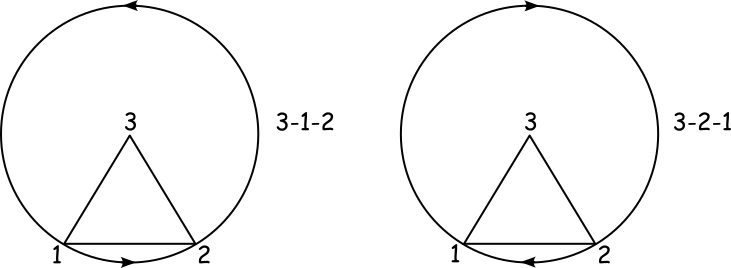
Earlier, we suggested that 3-1-2 was the ‘common principle’ of 1-3-2 and 1-2-3, while 3-2-1 was the ‘common principle’ of 2-3-1 and 2-1-3. We have now to consider what it is in the third term that makes this determination of direction possible.
The third term is ‘setting up’ the possible movement from 1 to 2 or from 2 to 1. In the case of giving, the third term of the gift is not actually being exchanged. We can think of 3-1-2 as signifying the offer of a gift and 3-2-1 as signifying the asking for a gift. The gift, it could be said, exists as an idea. We should note that, in these forms, the terms 1 and 2 appear to have some of the characteristics of each other: to offer means to become receptive, while to ask means to become active. We are exploring far beyond the limits of the men of largesse dispensing gifts to the passive. We are taking into account that the recipient can be as capable and intelligent as the donor! Both are involved in realizing the gift as help, or ,something of true benefit. In the circular or rotational representations, we can ‘see’ that the gift transferred from donor to recipient may be of benefit to the recipient but is, at the same time, of benefit to the donor: the circle referring to 3-1-2 for example, enables us to picture a benefit passing from 1 to 2 and thence back into 1 again. The circle image represents a cycle. A giving implies a receiving; a receiving implies a giving. This is true not only as these are two roles taken up by two people; but, also as these are realized in each of the two people.
The quality of mercy is twice blest
both to him that giveth and he that receiveth
(Merchant of Venice paraphrased)
We find ourselves being led to extend the meaning of these two forms from the bare notion of offer and ask; such that, the nature of the gift itself becomes paramount. Is the gift truly of benefit? Is it a mercy? One asks for mercy. One offers hope. In any case, there is no imposition.
So, in both 3-1-2 and 3-2-1, the gift is unifying the donor and the recipient, rather than dividing them. It is not something lost to the donor and gained to the recipient. It is not something ‘put upon’ the recipient, nor ‘extracted’ from the donor. At the same time, we have a sense in which: 3-1 in rotation invokes 2; and 3-2 in rotation invokes 1. Quite simply, a gift and donor implies a recipient and a gift and recipient implies a donor! These are our two conditions of offer and ask.
The implications of these forms should be studied in more detail. For the moment, we return to the question of an elementary symbolism. This is what we propose.
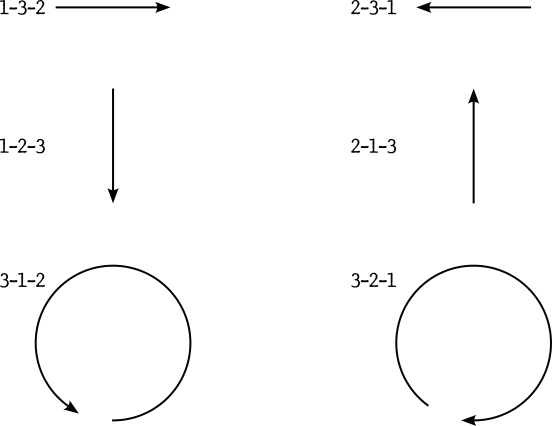
Why is important to have such a symbolism?
Because it conveys the essence of the six forms, taking into account the different character of each of the three terms. For the first time, we have a graphic representation of the meaning of the six forms. In these meanings, we have both the equi-valued status of the terms and their individual status. We have brought closer together the two and one-dimensional representations and produced a hybrid.
Having such a, symbolism enables us to think quickly about any particular form; and that is its function. We do not have to go through a process in order to arrive at the meaning of the six forms: in the symbolism, this meaning is ready to hand.
However, this does not prevent us from exploring in further depth what this meaning might be, Once having formed a symbolism, the symbolism itself ca n be read in a variety of ways, One way we wish to explore now:
The difference between term 1 and term 2, which we have simply mentioned as that between ‘active’ and ‘passive’, implies that, in some sense to be determined; 1 > 2. We start from an inequality, The function of the third term is to redress the inequality, by producing a modified condition such that 1’ = 2’ , This suggests, without explaining in any way, that within one framework, 1 / 2; while, within another, 1 = 2. Framework, or context, is a reference to the role of the third term, which implies a translation between 1 and 2.
The term ‘translation’ may be explained by the following example. Consider the two words ‘think’ and ‘thank’, First of all, these appear as very different. To think appears as something active and originative, while to thank appears as something receptive and dependent, However, both of these derive from the same Old Germanic root and Heidegger has made much of this. We conceive, then, of translating ‘think’ into ‘thank’ and vice versa.
To take another example, that of heat transfer. The articulate situation is that of ‘source’ and ‘sink ‘ , with the former as hot and the latter as cold. However, with the right set-up, this can be reversed as in the heat pump. It is the work-heat cycle that translates in this case. Whether the translation is semantic or technological does not matter; what is important is that it uses the differential between 1 and 2.
Now, we have said that 1 > 2. However, in another sense, 1 < 2. In our case of heat transfer, the temperature of 1 was greater than that of 2 but the entropy of 2 was greater than that of 1. To generalize, this is tantamount to saying that privation is also a positive condition! That the weak can be exploited, even, supports this view, We should think of the present day unintelligent relationship foisted on the underdeveloped countries by the developed ones, in the guise of assistance, which is to gain new markets.
If we were allowed to speak of the ‘purpose’ of the triad, we would say that this is to bring out what it is that the second term has which can contribute in a way that the first term cannot. In the initial phenomena the positive attributes of the second term lie hidden. This should not prevent us, however, from seeing that there cannot be simply a ‘from.,. to’ in one way only: there has also to be a counterflow so that we have an exchange.
Thus, we suppose that the recipient in accepting the gift is taking on something which enables the donor to be a donor. Unless he does this, there is no true giving. Just consider the wealthy parent who gives a sports car to his son, only to have his son kill himself. The second term is not a tabula rasa to be freely written upon, nor an empty box to be filled. A true listener is making something of what he hears, which may be more than what he is being told!
It is very interesting that in the case of giving we find exemplified the relation of to think and to thank. The donor, thinks or conceives of the gift while the recipient thanks or partakes of the gift. It is astonishing that this analogy holds but illustrates the truth and ubiquitousness of the triad.
Thus, we come to understand that in the triad of giving, the gift is that which is of benefit to the donor and to the recipient. The recipient is ‘active’ in making the meaning of the gift what it is. Hence the gift is a means of cooperation or synergy.
If we say that 1 /. 2, and consider 1 and 2 as integers, then the role of the third term may be regarded as (let 1 = a , 2 = b and 3 = c):~
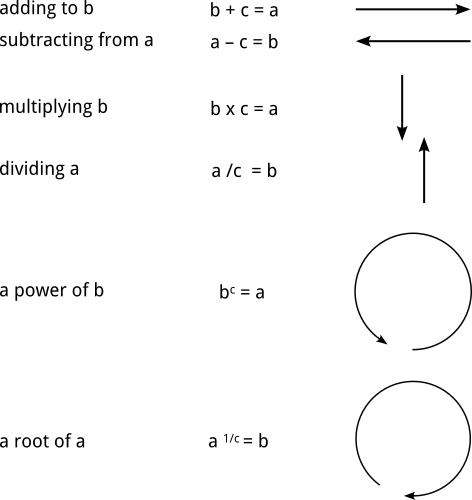
There is no way, arithmetically, in which the numerical value of c can be the same in all cases, Indeed, there will be three different values of c. However, there does seem to be some parallel between our symbolism and this presentation of the operations of arithmetic. What is the point of making this parallel? It is because the operations of arithmetic are immediately apparent to us. The purpose of our search for an elementary symbolism is to find some representation that conveys the essence ‘at a glance’.
The immediacy of meaning of the triad in metaphysics should be the same as that of sex in psychology. We are tempted by the seeming simplicity of the number symbolism to take this as proof of the given and irreducible character of the triad. However, as we have said, the terms of the triad are not numbers and hardly behave as numbers do. If we take the triad as a whole to be represented in some way by the number three, then each of these three cannot properly be regarded as a unit. The triad – treated as some kind of condition or agent – does not ‘add up’ the three terms to make three. There are, at the very best, only analogues between the possible operations of arithmetic and the interplay between the terms.
Number, in the simplistic sense of the counting of units, has very little to do with the triad, or with its terms. When we use number, it is with disregard for what the units of counting are. Mathematics, after all, is a matter of calculated ignorance!
At the very beginning, in dealing with systems, we foreswear such indifference to what things are. We do not begin with neutralized content, such as that befitting number, where it does not matter that we are dealing with apples or people or gradations on a scale. It is, above all, the distinctive character of the terms that concerns us. Analogy can enable us to make use of the contrast we feel between, say, 1 and 0, or between positive and negative numbers, to illuminate the contrast between the first and the second terms of the triad. However, in making use of analogy, we have something that moves in both directions: that is to say, it is our understanding of the triad that enables us to feel the contrasts that we do in the realm of number; at least as much as the converse.
We should also bear in mind that when we elaborate the six forms, we have no automatic guarantee that the terms appearing in any one of the forms are the same as those appearing in any other. In truth, we have been applying some mode of analogy here, too, If we decide to make them the same, then we have created a new meaning of sameness; we have not discovered or derived it. To accommodate this assertion of sameness, we have implied that, of course, the terms may not look the same because we are looking at them differently, from a different point of view: it is a matter of appearance. This is a very important point; in which we have intentionally not regarded ourselves as having some ‘objective consciousness’ capable of surveying the forms from an elevated position, Instead, in respect of the forms, we have regarded ourselves as ‘being on a line with’ them, or taking part in them. If we step outside the ‘line I then we are, according to our reading, in the two-dimensional world of the triad of equi-value in which there are no forms. The forms, then, arise through a limitation of consciousness. And this supports our contention that the differences in the terms e.g. they appear in the different forms is only a question of appearances. However, these appearances count for something!
They are not mere appearances but substantial facts or states of affairs. Following our semi-empirical approach – which takes into account not only the real phenomena of the world but also what is ‘going-on’ in us as we think about these things – we are doing very little else than the following.
- First, we consider that ‘things are connected’. By this we mean that what happens in one thing appears to be linked in some way with what happens in another thing. It is not the case that all things are equally connected. And, when we speak of ‘what happens’ we leave very open the question of what this might consist of: it may amount to a change or movement or to the arising of an internal state or anything at all that might be marked or experienced.
- Second, we think of this connectivity and what it is. We reject the conception of ‘connections’ as some special kind of existence. The reasons for this are various. There are considerations of economy of concepts and there are considerations of the problems ensuing if we force ourselves to account for how two different types of existence can have a mutual reality that does not, in its turn, call for yet another order of ‘connectivity’.
We are required, then, to suppose that a ‘connectivity’ is not different in nature from what is connected. In other words, what connects the changes in two things is the change in another thing. . This ‘other thing’ may not be separate from the two things connected – indeed, this would hardly make sense if it is to sustain what connects them – so we recognize pretty soon that we may not necessarily be dealing with three separate things which can be counted as units.
(Thus, if we have a billiard ball striking another we will want to say that the change in motion of the first is connected to the change in motion of the second; but what we have to consider as their connection concerns what happens in the period when the two balls are in contact with each other, such as whether they lose kinetic energy in heat, or in non-elastic deformation. What is also important is their relative dynamical geometries – is it a glancing blow, for example? So, we also have to take into account the precise alignment of momenta at the moment of impact. All this can be reduced to the reciprocal Newtonian force between the balls,)
- Third, we consider the relation as it now appears: we have a change in one thing which, if taken in conjunction with the change in another (the ‘third’) thing, entails a change in a second thing. We have the sort of thing which, in logical form, we might express as: (p,q) uu r’. In physical terms, we might express it as ‘cause together with means produces effect’. In the realm of intentionality, it would appear as: ‘agent plus communication is meaning.’ This is also the picture we have when we talk of ‘from. . . to’; a very convenient picture in which we suppose that ‘something’ passes from one thing to another thing, so that of necessity the change in the first thing in some way ‘equals’ the change in the second. The qualification (‘in some way’) is needed as we can see from the billiard ball example where, if we imagine one of the balls as made of putty, not even momentum is conserved. Indeed, we are encouraged to think in physical and mathematical terms because the difference between the initial change and the resultant change can be accounted for by the independent contribution of the ‘ connecting’ change.
- Four, having gained the thought that the ‘connecting’ change has an independent character of its own, and is not simply the carrying from one thing to another, we are able to picture the three terms as of equal value. At the very least, each contributes something to the overall effect. What the change is in the second term depends on what the second term is (for example, in the case of colliding balls, what mass it is) as well as what the connecting change is. One thing cannot cause’ a change in another thing without an intermediary condition which affects the outcome. We ask ourselves how far we can take this idea of equal value.
This brings us in front of the major historical attempt: the doctrine of the Trinity. This doctrine has occupied attention for almost two thousand years. We note this as an extreme case, in which not only are we dealing with a special kind of thing – God – but a relation in which the very reality of the terms is bound up. It also prepares the ground for considering other ‘forms’ of the three terms in connection besides that in which it first appears, namely, a change in one term leading through a change in another to a change in what we call by convention the ‘second’ term.
On the one hand, the doctrine of the Trinity leads us to contemplate the co-equal three terms as an ‘eternal’ relation (and has, as its natural symbol, the image of an equilateral triangle). On the other hand, the idea of alternative modes of connectivity – the ‘forms’ – leads us to seek an interpretation for them.
- Five, we have the material of thought for considering two planes of representation, which we have referred to as the two-dimensional (equivalued) and the one-dimensional or linear. We are then led to consider their relation and evolve the notions of ‘projection’ and reduction, The latter notion extends by analogy the principle of different views of the same ‘system’ to views corresponding with different systems (for example, dyads and tetrads), The notion of projection allows us to take into account the different forms stemming from the same relation. We do this by supposing that the different forms correspond with a more limited mode of consciousness than the self-identical equi-valued triad,
However, in so doing , we have introduced a prejudice: one in which the same equi-valued pattern is regarded as necessarily more complete and higher than the different forms, We are also free to regard the different forms as an evolution from the primitive state of equi-value. The prejudice is very strong, however, since in our culture the one is regarded as superior to the many. It may still be a mistake!
We can also regard the equi-valued representation as signifying the ‘relation as a whole’, that is, as encompassing the variety of forms and more besides. There is a strong motive for wanting to have a mode of perception or thought which gives the whole thing all at once instead of in various parts. It is, also, obvious that we cannot ‘add’ the different forms together to make a whole: no, the whole is presumed, This whole has all the characteristics of what we might mean by ‘necessary connection’.
- Six, we consider what the differences between the terms are and whether they hold in all the forms. Our starting point is the notion we began with of change in one thing leading to change in another. It is from this that we acquire nomenclature such as active and passive. However, when we look more closely at the necessary role of the third term, we realize that there is also meaning to the notion that the change in the second term is a reciprocal cause of the transaction. (Thus, a hot body will not lose heat unless a cold body is connected with it.) The notion is almost tautological in the context of necessary connection. However, are led to explore possible physical meanings of the different forms which alter our conception, of what is active and what is passive. To do this, we often take ideas on analogy from the realm of human subjects. Thus, even a slave has wit and will in front of a king with whom he is related
The Search for Possible Models for the Six Forms
The Triad and its six forms are intended not merely as a convenient means of classifying the diverse ways in which we can perceive and understand he same phenomenon. We claim that they are pointing out a deeper way of understanding, one that has been only implicit in previously available language. Certain things have not been noticed, or have been combined with other things in e, loose way, or have been obscured; because we have not had the right linguistic framework. However, to establish this, we are forced to refer to existing means of description, showing that what we are about does not violate our ‘common sense’, while enlarging upon and even transcending this sense.
It is in such a manner that we want to briefly explore ordinary descriptive language; and we will take a familiar example in which we can contrast the bare fact of the transaction described with the variety of its meanings. We will argue that the bare fact is given in the form 1-3-2; but, because no human transaction can take place in a vacuum – and, in particular, because we are immersed in time – the other forms are equally real, or possibly real. It is in the range of possibility, indeed, that gives the transaction its interest and significance. The familiar situation is that of a man giving a woman a kiss. Here – with apologies to Boons and Mill – is how the situation might be described.
- He pressed his lips to hers (1-3-2). She responded with warmth (2-3-1). The kiss was what she had been waiting for (3-1-2). It was why he had brought here to this secluded place (3-2-1 ). His passion mounted and he covered her face with kisses (1-2-3), She felt the intimacy’ of their embrace reveal a secret that she bore (2-1-3),
A kiss has the virtue of something that can be shared in mutual consent, unlike a kick. We have shown the forms corresponding to the modes of description in brackets. These suggest that:
The forms 1-3-2 and 2-3-1 belong to the present
The forms 3-1-2 and 3-2-1 belong to the past (intent)
The forms 1-2-J and 2-1-3 belong to the future (decision)
Thus, time is integral to the range of meaning; the past and the future enabling the situation to be ‘set up’ and ‘to develop’, affording alternative forms of the relation. We can see that what is meant by the verb ‘to kiss’ has a potential of meaning including: to be kissed, to want to kiss and be kissed, to want what comes from a kiss (going to bed, etc,) and so on. In a word, the six forms of the triad show what the action means.
The example also shows something else, a way of picturing the character of the three terms which makes each of them ‘active’ in one sense while preserving their primary relation. In this picture:
the first term is ‘to do’
the second term is ‘to feel’
the third term is ‘to know’
Those forms beginning with term 1 tend to be about action. Those beginning with term 2 tend to be about feeling. Those which begin with term 3 tend to be about knowing. In this picture we have something which corresponds to human nature in general, as manifesting through the triad of doing, feeling and knowing.
Note that, if we in our representations of physical phenomena deny the terms of a relation such characteristics (or their equivalents), then the independent reality of the forms is forfeited.
Thus, if we cling to the notion of inert and passive matter, then it cannot take part in any true
relation. In fact, such an abstraction must be unconnected from the living world of connections.
It can only take part in an intellectual world of pure judgments, in which the connections are
‘only’ mental. However, we have set ourselves against such an approach. Life is everywhere and, in life, the third term is truly independent of the others while being amongst them. Everything serves to connect other things.
Let us take another kind of example from the domain of human life. In this instance, we consider the possible social relations of a man and a woman. Again, out of convention perhaps, we ascribe the men to term 1 and the woman to term 2. Their relationship is the term 3. We find that there are three types of relation:
- that of husband and wife
- that of parent and child
- that of brother and sister and no others
These can be laid out as follows:
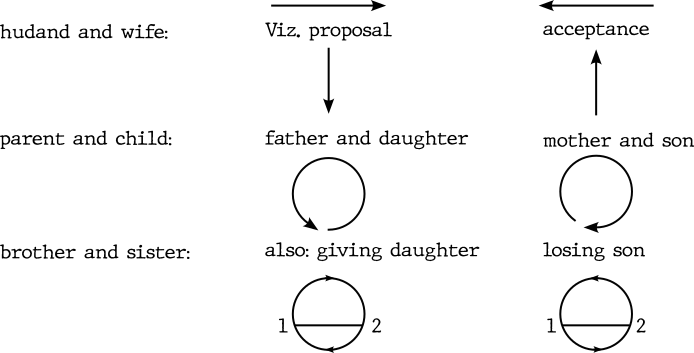
We find a. meaning for the cyclic form of these last two. Thus, the father gains a son, while the mother gains a daughter. We can also see the relevance of the distinction between patriarchal and matriarchal social orders (left and right columns)
We can also note the relevance of taboos in incest, in that there should not be sexual relations (‘marriage’) between parent and child or between brother and sister. All the relations are through marriage. So, the forms we have described are the rules of marriage. The situation of the forms 3-1-2 and 3-2-1 are more complex, For example, taking the brother sister relation, the brother can take the part of father and the sister daughter in the patriarchal family, Maybe, in the matriarchal family, the sister can take the part of mother! Thus, the brother-sister relation is allowed to be like that of father and daughter but is prohibited from being like that of man and wife, On another level, we have brother and sister as equals, as siblings. A man may experience a woman as wife, sister, daughter or mother, but not conjointly, As a third example, we take the case once again of making a gift. This time, we want to examine the different words which we might use in this context and also the different aspects exhibited in different possible descriptions. We begin with the obvious complementarity of:
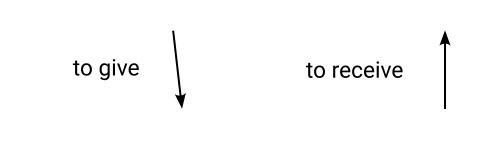
One entails the other; therefore, they already express the relation, Next, we consider alternative words:

Intentionally, these are in contrast with the first pair, insofar as they are more prosaic, factual and limited, Finally, we take two words which are even ‘stronger’ than our first pair, instead of being weaker:

Renunciation implies freedom, the opposite of necessity, We have already indicated the correspondence of these words with the forms by using our symbolism. What is next is to note the character of each of these three pairs of words:
hand over / take : thus
give/ receive : how?
renounce/ need : why?
where we have made a parallel with the case of the kiss, an interesting pattern seems to be emerging, to jump completely ‘off scale’ in this context, we wish to draw attention to the Hindu conception of ultimate reality as: Sat – Chit – Ananda, usually translated as ‘being, consciousness, bliss’. In our view, this Hindu conception is that of the three types of forms of the triad. Here is our set of correspondences:
sat thus
chit why?
ananda how?
We can note how the third term (the ‘gift’) appears in three guises:
as what it is that connects donor and recipient
as the value created by the donor and recipient together
as the motive for the donor or the recipient
The gift is thus fact, value and meaning. It is three-fold. This three-fold character, indeed, is inevitable given the three different positions which it can occupy in a form. It is this condition that enables the other two terms to retain their character in the various forms. We could argue that the three-fold nature of the third term does not destroy its unity, its coherence and identity. It is the ‘seme’ in all the forms, but seen in different ways.
Let us return to the question of words. There exist in our common languages many alternatives which may be used in place of any given word. Why is that? Each alternative provides a different shade of meaning. Let us show this in the case of giving, using our symbolism:
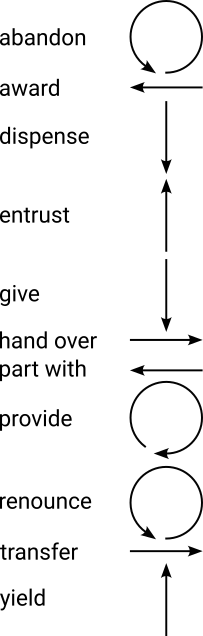
These different words express how the relation is felt in the various forms by the first term. Thus, a single word can express the form of a relation. Here we have the word as a single value, as the result of a number of steps of projection and reduction: (a) projection from 2-d equi-form to linear form (b) reduction to two terms (c) projection from 1-d to 0-d (d) reduction to one term. Can we find equivalences between the common use of words and these stages? Take, for example, the reduction to two terms. This may correspond with the mode of description in which we have, for example, both ‘to give’ and ‘to receive’: corresponding with (a,b) and (b,c) (where, in this case, b is the gift). The phrase ‘provided for his needs’ is a suitable expression for the form 3-1-2 in its reduction (3,1) (1,2); but we notice that the words ‘provide’ and ‘needs’ fit more closely with (3,1) and (3,2), even with the implication:
(3,1) = (3,2)
This example raises something very important, that we skated round in dealing with reduction. The form of reduction of a-b-c as (a,b) – (b,c) is correct if we adhere strictly to one-dimensionality or linear order. However, we will always be aware of the equi-value form of the triangle which affords equal connectivity of every term with every other. What this means is that we are liable to come up with a variety of readings of any one linear form. The example above illustrates the point. Clearly, in ordinary language we are not adhering strictly to any rule of form.
In particular, we have no words to-hand which can enable us to discriminate between the relational mode of the three terms as they are represented in the equi-value form and the mode of the terms in the linear projections. We have to pay close attention to the fact that in the triad per se, it is three terms that form the relation; while in the linear forms, the terms connect with each other in pairs. If we assert that the true relation is of three terms together, then what are to make of the connectivities of the terms taken in pairs? What, for example, does the form 1 – 2 mean? Does it have a different meaning in the form 1-2-3 than it has in the form 3-1-2?
Collision of Balls: the Six Forms in Physics
Examples taken from the physical world have the advantage of not only being something we can easily picture, they have a worked-out language affording a very complete description of what happens and why. In the collision of balls, we take the oncoming ball as the active one (1) and the stationary one as the passive one (2). Somewhere, in what happens when they are temporarily merged into one object, we have the connecting term (3). At this stage, we say no more about this term. But, we recall from our physics that the two balls are characterized by e.g. mass and momentum, which also gives us a measure of kinetic energy. T0 follow through the forms, we are going to adopt this formula of interpretation:
in the form a-b-c we have expressed: the effect of a and b is shown in c
Thus, we are assuming that the term ‘b’ conditions the effect of ‘a’ on ‘c’. It is very important to note that we are asserting that one thing cannot have an effect on another thing without producing some other result. Thus, it is impossible for one ball to have an effect on another without something else happening. Of course, in the ideal, abstract, cases studied in school physics, this is ignored. We ought, therefore, to extend or modify our definition of the meaning of the form a-b-c to read:
THE EFFECT OF A ON B ALSO PRODUCES AN EFFECT ON C
which has the corollary that,
TO HAVE AN EFFECT ON B, A MUST HAVE AN EFFECT ON C
Back to the particular case in question, we need to remember that kinetic energy is conserved only in a perfectly elastic collision. ‘lie are neglecting any effect produced by the surrounding environment, such as the friction of a, surface. We will refer to the third term as the ‘combined state•, Here is our interpretation of the six forms:
|
1-3-2 |
transfer of kinetic energy |
|
|
2-3-1 |
transfer of momentum |
|
|
1-2-3 |
generation of heat & sound |
|
|
2-1-3 |
generation of potential energy |
|
|
3-1-2 |
deformation |
|
|
3-2-1 |
fracture |
It may at first glance appear arbitrary that we have assigned deformation and wear as we have. Why in this way? We are considering 3-1-2 as referring to the condition of plasticity, If we have a ball of dough, for example, hurled at another, then it is the latter which will deform the most. We ascribe 3-2-1 to brittleness, because 1 would suffer the most. These effects are accumulative and, in their turn, affect the working of the other forms.
This may become clearer if we make a jump to e.g. cricket, where we turn 2 into a bat. Many more things come into play, especially spin. We also take into account that a ’valid’ collision as far as the ball is concerned is a miss by the bat! The immediately significant thing, however, is that the wear of the ball is highly important, especially if the bowler wants to use spin.
In making a jump to a game, we have made our terms 1 and 2 into protagonists: the ’ball’ and the ’bat’ are the expressions of people. The intention of the bowler is to make the batsman miss, or lift the ball where it can be caught, or be forced to dampen the energy of the ball. The intention of the batsmen is to hit, not get caught and to use the energy of the ball, against: We would expect the forms to be distributed thus:
Bowler Batsman
A 1-3-2 2-3-1
B 1-2-3 2-1-3
C 3-1-2 3-2-1
Remember that term 3 is the ’combined state’ or the joint action between ball and bat, how they connect indeed!
- in A we have the bowler trying to make the ball hit where he wants it and the batsmen trying to make the ball go where he wants it
- in B we have the bowler trying to make the batsmen miss (and hit the wicket) while the batsman is trying to connect as strongly as he can with the ball
- in C we have the accumulative effects of the bowler trying to dominate the batsman and the batsman trying to dominate the bowler; there is a ’build up’ in 3 which influences taw their strategies and is crucial for control of the game (notice that 3 is shared by the two protagonists)
This parallel we have made between the purely physical collision of two objects and the game-play between bowler and batsman in cricket is very interesting. It points to an important unity between physical and intentional events. Intentional actions make use of physical actions.
Very importantly, the second term is obviously active in intentional actions; and we can see how it is that the second term is ’passive’ only in being in response to the first term (if the bowler does not ball, then the batsman cannot hit!). What we do not have is one term intentional and another not-intentional. What can we melee of a situation in which we have for example, a man (intentional) acting on a material (non-intentional)? Many people would object to regarding the wood worked on by a wood-carver as having some kind of will or purpose of its own. This is right. Like can only deal with like. What we actually have in the case of the wood-carver is something like this:
1 – ’the cut’ an impulse towards the wood
2 – ’the show’ how the wood responds
3 – ’the feel’ the experience of the contact between knife and wood
where all three terms are part of the sensitive and skilled mode of experience and perception of the carver. In other words, the second term is what appears to him, not to anybody else<> Only he can see what is to be seen that matters. Thus, it takes a Michelangelo to see what is hidden in the marble. As the sculptor or carver work, the material reveals. The outsider looking on can only marvel that they knew what was hidden in the material.
So, the wood is not doing anything to the carver out of its own volition; it is responding to his action in a way that he can see. The ’feel’ or understanding that he has may give him the experience of feeling that the wood is coming alive under his hands, or is alive in the very beginning (3-2-1). He – or his hands – know what to do from moment to moment (3-1-2). He stretches the resources of the material to its limits (1-2-3). He enters into what is most appropriate for the material he has to work with (2-1-3). He works towards an end (1-3-2) He sees the form emerge (2-3-1). Such is a relationship. But, there can be no relationship between a man and a piece of wood.
What our examples show is that two things cannot of themselves form a complete relationship. If one thing produces an effect on another, it must also produce some other effect on something else. There must always be a residue of some kind. ’We are drawing nearer to an understand! of the nature of the connectivity between two terms and in what way this differs from the relation of three terms.
We have to add in here that a relation is such that the three terms are equal in the value of their contributions. A true relation does not proceed in one way only. The notion that each term makes a contribution of equal value to the others is also the notion that each makes a contribution that is unique. Thus, to ’read’ the relation means that we have to be able to follow through the triad from each of the three terms.
A relationship is whole, which means it is a world unto itself. Everything proceeding from it enters into it. In Gurdjieff’s language, it is autoegocratic – self-feeding, even self-creating.
Connections
The Number of Connectivities
We might make use of the Platonic model and say that the equi-value form of the triad can be represented as the perfection of the sphere, apparent to us as the circulations around the terms, each turning into the other, and acting as the template for the sequences of effects which make up our actual doings and perceptions. The sphere is the complete three- dimensional form of the triad, the circulations are the two-dimensional forms and the sequences the one-dimensional ones.
Wes have been exploring various ways in which we can read the import of the sequences, Right from the beginning, we had before us two main alternatives:
i) as (a,b),(b,c) where the comma implies direction
ii) as (a,b), c
(there is also the possibility of ; (a,b),(a,c) but, as we shall see, this has little merit).
Let us call the connectivity (a,b) as an effect of a upon b; then, if we adopt the first alternative, we will have to deal with the effect of an effect, or that an effect has an effect on an effect. In the second alternative, an effect has an effect on a term; and this is simpler, further, if we adopt the first alternative then we shall have connectivities (a,b) which occur in both the primary ( a-b-c) and the secondary ( c-a-b) positions: would this mean that it would mean the same in both cases? In the second alternative, this question does not arise. Evidently, the second alternative is much the simpler. However, this alternative does require two different kinds of connectivity, just as the first does, though they are not the same. The connectivity between the two halves of the form has, in both alternative; been considered in the following way:
i) (a,b) = (b,c)
ii) (a,b) = c
We must also remember that when we write a term e.g. ’a’ what we mean in a sequence is the ’action of a’, or ’the contribution of a’, or even the ’change in a’. In other words, tfihe sign of the term signifies the active nature of the term. E.g., when we refer to ’ball’ as a term we mean its energy and direction. The equality sign signifies that the ’second effect’ completes the action and nothing else can happen. It signifies ’the result’. Taking the second alternative, it would mean that there are six connectivities and six results.
Let us consider alternative one. This follows the view that, in a sequence, one of the connectivities is weakened (e.g. in a-b-c, the connectivity a-c). However, this ’weakening’ is of the character of a mediated, connection, in contrast with the unmediated connections (a-b, etc It is not really ’weak’ in contrast to strong.
We will be arguing for the second alternative. This is how we see it.
- the first term in a sequence signifies what quality or type of contribution is in view the same quality or property is considered through the sequence
- the second term signifies how this quality is modified in a crude sense, the primary quality is inhibited or challenged by the nature of the second term
- the first two terms form a ’ contiguity’, a being in the ’same place and time ’ of some kind which contiguity constitutes the presence of the third term
- the primary quality from the first term, modified by the second manifests in the third term in the sequence because this term is the contiguity of the other two terms
Let us take an example from the collision of balls; the sequence 1-2-3.
- the quality is kinetic energy
- this is ’stopped’ by the second stationary ball
- the third term is their conjoint state in impact
- the original kinetic energy manifests as heat
In the sequence 2-1-3, the quality in view stems from the term 2. This quality is of the character of inertia and stillness. Thus, the sequence designates ’what happens’ to this stillness under impact, which is the build up of potential energy in the conjoint state.
However, we can notice that, if we take the sequence 1-3-2, we do have something that corresponds with the first of our alternatives, since the transfer of kinetic energy takes place through the Newtonian ’action and reaction’ of the conjoint state, such that the oncoming ball is braked and the stationary ball is accelerated. Thus, we do have something that fits the reading: (1,3),(3j2). The reason for this is fairly obvious: the term 3 is by its very own nature conjoint.
The last comment leads us to a very interesting position: that the way in which the sequences are to be read depends on what the sequences are. In particular, it depends on the character of the middle term; but, not exclusively. In other words, the sequences cannot be read in a purely formal way without reference to the sequence of terms themselves, which means that the character of the terms must be taken into account.
A SEQUENCE IS TO BE READ ACCORDING TO WHAT IT SAYS
This seemingly obvious statement is made- to draw our attention to the linguistic character of the forms. Even though – as we have tended to emphasize in our use of the word ‘form’ – these have a general and precise character, analogous to that of a mathematical equation, they are expressions of a relationship the character of which relies on how the relationship is constituted. Hence, when we try to consider what e.g. (a,b) means, we have to turn to examples. We have failed to give it a meaning that is not dependent on what a. and b and c are.
However, we have a gone a long way towards saying what a relationship is without regard to what is involved in the relation.
We have found that the role of the third term is critical for the interpretation of the forms. We have, at the very least, to take into account not only the sequential order of the terms but also the position of the third term in them. Thus:
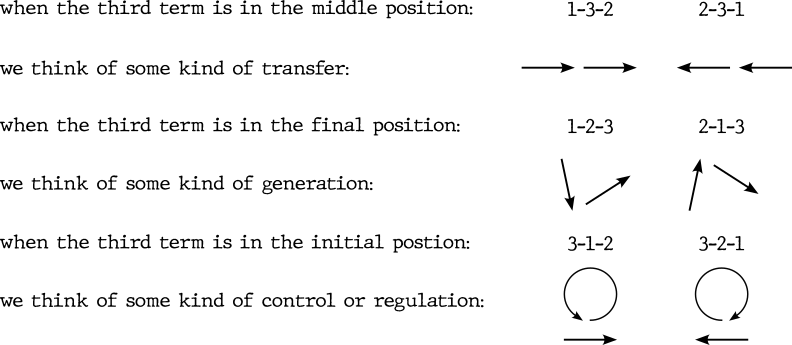
This leads us to another conclusion: not only are we unable to state clearly what (a,b) means without reference to what a and b and c are, we are also unable to understand correctly what the third term is without reference to the way it ‘behaves’ according to the forms. If, for example, we think of the now-familiar case of giving, we would have to agree that our notion of what a gift is, is deeply modified by our study of the forms of giving. Further, we have found that it is possible to interpret the different forms by different examples; but, this then requires that we are able to integrate these different examples into a unitary meaning for the third term. Thus, a gift may be understood as an object, a communication of intentions or even as a spiritual bond; and it is a demanding requirement to see the gift as all of these at once. We conclude, then:
- the forms have to read to provide a unitary meaning for thethird term
- there are three main types, depending on the position of thethird term in them
- there are three main connectivities each of which has two interpretations, which we call the ’subjectivities’
- how these connectivities are to be understood, depends on what they are (thus, they are not of the same type)
Some further comments are needed. Firstly, the word ’subjectivity’ which we used refers to the locus of our identification, or where we look from. Triadic forms have to be read from a point of view which belongs to the relation – hence, from the vantage point of any of the three terms. There are no other paints of view – save, perhaps, that which gives us a view of the relation ’as a whole’, to which the forms co not apply. Secondly, the connectivities can only be understood in a general way if we are able to understand the terms of a triad in a general way.
The Terms of the Triad in General
The triad arises in thought by a quantum leap from the impasse of trying to deal with relatedness by a combination of ’dyadic’ connectivities. Take a common though woefully inadequate picture of communication; sender sends message to receiver. We can attempt to split this so we have the message as sent and the message as received. Once split in this way, we have to explain how the tv/o messages match up. We begin to invoke some regulatory means of exchange (language of a community, etc.) We bring into the picture verification procedures on the part of the receiver and allow that communication is not entirely one-way. We also allow that the content of the message is not merely what is sent but includes the mode of response of the receiver. And so on. What begins to emerge is the possibility of a message that is understood; which requires a two-way process, which can include creative insight and has an intrinsic pattern of meaning shared by sender and receiver. In a word, we struggle towards the forms and change our evaluation of what a ’message’ is. The simplistic two-term model is superseded. However, it is only when we have an insight into the third term which affords us a unitary view that we transcend the ad hoc treatment. It is this ’all at once’ step which we call a quantum leap.
The forms allow us to build up material for understanding the relationship. The example highlights the process of our thinking: we begin with a view in which one term (sender) has something another term (receiver) lacks; this ’something’ is transferred between them in the guise of another term (message). The ’movement’ involved is a primitive one towards equilibrium (zero potential difference between terms 1 and 2). However, in this process, something else is generated: in transmission, what the message is changes. Why? Firstly, because of the recipient. Maybe, the message ^as to be repeated or explained. Secondly, because it is being transmitted. Thus, a thought in someone’s head has to be put into linear sequences to be received serially. Thus, the transmission of the message forces the message to evolve. We use the weighted word ’evolves’ with the assumption that we are dealing with a successful or meaningful communication. Such thinking is invoking the reality of qualitative differences, or value.
But, we may ask, what of the military transmitting unambiguous data? Well, we may imagine a perfectly clear and neutral transmission of data; but, it would constitute a limiting case, an abstraction (parallel to school exercises in physics). Formally, we would have to propose some kind of identity between sender and receiver (the kind of identity striven for in the military).
To contrast with this, we can take the case of a message being transmitted on the behest of the receiver. 2-3-1 is like a query and 1-3-2 an answer. When the receiver is asking, however, ’Do you mean ..?’ he is in mode 2-1-3.
The claim and power of the triad is that all the possible ramifications implied in the given simple-looking transmission can be expressed and understood by means of just three terms. These three terms constitute a coalescence of a diverse range of situations and experiences.
We may begin with two terms and the notion of something passed from one to the other in a bid for equilibrium, but this something, as we look deeper, acquires a life and character of its own and begins to independently affect the interplay between the two terms with which we began evolving into a something from the interplay of 1 and 2.
The third term, then, must be a very special kind of whole. It has its foundations in the two-way process implied in the two forms 1-3-2 and 2-3-1. These depict what is transmitted from 1 to 2 and what is the response of 2 to 1. Both transmissions must modify their ’recipients’. That is why, when we discussed giving, we had to insist that the recipient of the gift had himself something to offer the donor, even if it were only ’gratitude’. The meaning of the gift emerges out of the combination of generosity and gratitude. Similarly, we only have an interesting message if what the sender wants to say and what the recipient wants to hear are independent of each other. The process of unifying these two sides proceeds as indicated in the forms 1-2-3 and 2-1-3. The influence of this unification is indicated in the forms 3-1-2 and 3-2-1. We are dealing, it seems, with a complex evolution.
This is in contrast with the nature of the pure relation as given in the triad itself. At the very least, the pure nature suggests that, in any continuing effective relation, a third term must emerge and stabilize over time. With this word ’must’ we have the implication of necessity; but this is not as problematic as it might seem.
Thus: a relation is to be characterized as that in which the transmission does not eliminate the difference between the two terms between which the 1 transmission’ takes place. Indeed, we must say that the transmission maintains the difference; or, even, enhances it.
Giving is a very interesting example. Imagine that we have a rich man and a poor one. The rich man gives half of his wealth to the poor one. This does not make them equal. The rich man may have knowledge, power and initiative that the poor one lacks; he regains his original wealth while the poor one spends what he has been given. The reverse can happen. Thus, there things which can easily be given (consisting of things) and things which cannot (understanding, attractiveness, etc.). A gift is rarely made without attachments. It can render the recipient dependent on the donor or obligated to him; or, it can be an expression of what is deserved or merited by the recipient. The poor man who becomes richer than his original benefactor ’owes’ his wealth to the donor.
The making of a gift can serve as the resolution of a tension between two people, or the realization of a bare possibility. There is, in its conception, the two visions: 1-2-3 (of the donor) and 2-1-3 (of the recipient). These constitute the potential of the situation as well as the form of its its evolution. Even behind these forms lies the ‘arrangement of circumstances’ making it possible for the gift to he thought of at all. This is prefigured in the forms 3-1-2 and 3-2-1. At the very least, the donor and the recipient must come to know of each other.
We happen to have come across yet another aspect of the division of the six forms into three classes:
actual: 1-3-2 2-3-1
potential: 1-2-3 2-1-3
possible: 3-1-2 3-2-1
In his treatment of the forms, Bennett referred to 3-1-2 as order and 3-2-1 as freedom. This appears now as an obvious polarity within the realm of the possible. Similarly, he characterized 1-2-3 as involution and 2-1-3 as evolution; which has obvious correlation with our discussion of levels and potential. However, in his discussion of 1-3-2 as interaction and 2-3-1 as identity, we have again a kind of polarity: that between the changing and the unchanging aspects. The reference is actuality. It would appear that a decision was made early along the process of ascribing meaning to these forms to divide the forms of the three kinds in this polar way. What we need to recognize is that this division is an attempt to reflect the underlying tension between terms 1 and 2. Thus, 1 is seen as a movement towards the many, while being in its own character of the nature of unity; and 2 is seen as a movement towards unity, while being in its own character of the nature of the many.
This implicit representation has much to commend it. It enables us to comprehend how it is that the two terms are in contrast yet able to enter into a relationship.
We have now an even more serious question to discuss: it is clear that there can be very many interpretations of the forms and, as a consequence, very many interpretations of the nature of the three underlying terms.
It could well be argued that, given such an unbounded range of interpretation, any situation can be made to fit with our theory of the intrinsic three-fold structure, however, it is really misleading to speak of the range as unbounded. All the time, we are referring back to a conception of relatedness that, although we are unable to articulate completely and unambiguously, still hold us within certain bounds. These bounds are, so-to-say, ‘creative limits’. They come into our view when we hold to the three-foldness and intrinsic sense of relation as applying in the real world throughout. It is, indeed, only by the insistence on this ‘throughout’ that we come to the creative insights which can be engendered. The approach leads us to contemplate the nature of things as related. This affords as an insight into everything that we can regard. It is an insight which feeds upon this very ubiquitousness that we work by.
Implicit in it is the assertion that there are not different kinds of entity, taken in abstraction for, we cannot encounter anything except in relation with something else. Thus, to understand how we understand anything, we needs must become conscious of the relatedness in which everything is experienced. The approach asserts that we cannot regard, for example, a thing simply as a thing: we must regard this thing as appearing in relation. Since everything we might conceive of or experience is necessarily involved in relation with other things, this means that, in principle, everything is related to everything else and cannot be understood in isolation.
The terms of the triad are not types of things. We have in the triad a different way of seeing. It would not be inappropriate to regard this ’way of seeing as arising out of a sense of love or God. It is also a way of seeing that regards evolution and life as intrinsic to the nature of things. Indeed, we must assert that the triad is a reflection of the reality of life itself. It is impossible to regard the universe without admitting the role of life in enabling this regard to be possible at all; the evolution of life on the earth has been necessary for our efforts at cognition to be possible. What is discussed in the ‘anthropic principle’ hardly scratches the surface of this remarkable fact.
It is impossible for something to move without influencing something else. The very fact of this influence means that something new is being formed. What we attempt to say in all this is that the character of the terms cannot be fixed as if they were species or kinds of chemical element or fundamental particle. We do have these kinds of categorization, which are critical for our understanding of the world we observe. We want to set over and above all these a more fundamental distinction, made without restriction from the physical nature of what we are dealing with.
It is not surprising to us, for example, that in the pursuit of the ultimate building blocks of matter physicists have engaged as on a process which seems (and is) throwing up more and yet more candidates: just as they seem to reach a neat and orderly consensus of the ultimate particles, they are driven to have recourse to yet more, end create them in their laboratories. The ‘ultimate particles’ in the field of vision of the triad are legion. There are no boundaries on what might be in the flux of relationships.
The triad, then, is a key to understanding creative becoming. It asserts that what we know as physical law within the strict domain of physics is a limiting case, an abstraction; albeit, a powerful and inspiring one. The actuality underlying the triad appears, at first, as slight: simply that one thing influences another. What we have pursued in our investigations, however , has shown that the reality of this influence means much than appears on the Surface. do influence can be one way. The necessary two-way flow engenders an independent ‘term of the relation’ or, as Gurdjieff called it, third force. We have also hinted at how this third force was ‘there’ all along.
The triad gives us more reality than physics can but cannot provide the same kind of knowledge. In a way, the triad is impotent. It cannot be tested. It cannot be turned into a method of discovery. It relies on all that we can discover through existing means. It might appear, then, as parasitic. We like to regard it as that deserving of feeding. For, we need something capable of digesting and turning into life what the factories of thought and the fields of discover produce. To put it crudely, knowledge needs to be eaten to turn into understanding.
Describing the general nature of the terms is, therefore, intrinsically difficult. Every situation will throw up its own kind of terms. We are unable to know in advance what these terms will ’be’; but, we can have some idea of how they will act. The behaviour of the terms is described in the forms. However, we must note the following: the forms as formally expressed (e.g. 1-2-3 or 3-2-1) can suggest that one of them is the opposite of the other, or the other in reverse; but, this is not the case since an action by the first term in the one is of a different kind to that of the first term in the other (thus, the action of 1 in 1-2-3 is quite different from 3 in 3-2-1).
We must already be able to ascribe each of the three elements to a term before we can study the forms, AS we have many times said, we do this mainly through a given understanding of the actual transmission which marks the existence of a relation, i.e.: that one thing influences or changes another. It is this that leads us to draw up tables of possible differences between terms 1 and 2, such as:
|
1 |
2 |
|
active |
passive |
|
donative |
receptive |
|
kinetic |
static |
|
assertive |
negative |
|
expressive |
impressive |
|
source |
sink |
|
intensive |
extensive |
|
potent |
dependent |
|
future |
past |
|
media |
matter |
|
+ |
– |
|
X |
/ |
|
Father |
Son |
The primary over-all gestalt is that of a given whole (but a dynamic one) which is ’unbalanced’ in one way by the first term and then ’unbalanced in a compensatory way by the second term. Thus, e.g. every assertion requires a corresponding negation because assertion distorts the original whole of the understanding. What then of the third term? This arises because the two contributions (from 1 and 2) require a common locus of action, like a pivot around which they can ’move’. There needs to be some communication between the first two terms if they are come into balance. We can regard, if we like, the given whole itself as providing the common locus or means of communication; so that the third term is the appearance of the whole. It is in this sense that we can say that the third term ’already exists’ and is not simply a consequence of the interplay of terms 1 and 2. With the notion of common locus as described by us we can easily understand why the third term can be called ‘neutralizing’ – because it is in the third term that things come into balance again.
Any notion of ‘whole’ is bound to be vague, yet we have made it foundational. We can say, however, that we are not directing our thought towards an object as something that is appearing to us or lying before us. If our concern is an object, then what we are looking towards is the movement which is essential to its life. Thus: any living thing is constantly reaching out beyond itself while, at the same time, being constrained and limited. This is true for its intrinsic growth and for its existence within an ecology. For a more conscious being, there is an equivalent exertion and coercion. All living beings assert themselves and are subject to restriction, which becomes the struggle for survival at the crudest level. The kind of ’whole’ we are concerned with cannot be that of an inert monolith. In a man, we see his ambition and his fears in interplay; he is both free and a slave.
So, we are saying that the ’whole’ we regard is something in the real world of change, flux , growth, struggle and so on. In any whole, there is bound to be an element of increase; which makes it necessary for there to be also an element of decrease, else all becomes unbalanced. It is easily possible to understand this in a rough and ready way when we think of the interplay between things; but, we can also think of it when we are looking towards certain classes of entity, such as human beings. The interplay between things means that the ’wholes’ we are concerned with are more like situations than things, ^elatedness gives a shape to change. A man cannot become wealthy without affecting others in his environment. There cannot be a discovery without experimental work, involving failure. Every new thing that is learnt requires something to be unlearnt. Thus, to gain we must also lose. (It is this, after all, which gives credence to the doctrine of ascetism and renunciation, which claims that real benefit can be obtained only at the cost of elements of life previously held dear).
The notion of ’gain and loss’ makes us think once more of the relation of giving. The same considerations that apply in giving apply also -w-hen to the life of a single person, v/e may not be able to see this easily, but we have an heuristic guide in the forms of the triad. What would it be like to have one element in our dynamism give something to another? Is this not already suggestive of a new vision of will? Why should will always be regarded as a matter of coercion or power? To think of it in terms of giving can be revealing.
We have introduced the topic of will to pave the way towards what we are meaning by the ’whole’ represented in the triad. Such a whole is exemplified by will. Will is not an object. Its treatment as some kind of ‘power’ possessed by people proves a chimera, nothing in the usual concept of free will can accommodate the real conflicts and uncertainties which are an integral part of the way in which the will is. Will, it is supposed, is a power that we employ without being conscious of how it operates; which is absurd. And who is it that ’employs’ this power and by what means?
We have, earlier, introduced along with the triad the notion of time. Time itself is not an object. For us, it arises by the peculiar contrast of past and future that we feel. Time is relational.
Even creativity and its allied manifestations is not an object. There can be no existing thing that brings into existence what has not existed!
It is only logical to assume that creativity entails a connection with the non-existent; which appears in the 3-M equation under the notion of ’making meaning’.
Thus: will, time and the making of meaning are all aspects of relatedness in its most pure form. Let us produce a table of terms taken from these
three supreme examples:
|
1 |
2 |
3 |
||
|
|
|
|
|
|
|
future |
past |
present |
TIME |
|
|
|
|
|
|
How can we claim to ’know’ what any of these terms is? We cannot. We encounter them only in their relatedness. It is however because we encounter them in the same pattern that we have the opportunity of understanding them. This would suggest that there is a triad of understanding. However, the triad of understanding encompasses everything we might understand and should not be summarily encapsulated. This possible diversity of meaning for the terms leads us to reflect that, although we can give a name to any of the terms according to the relation, this should not persuade us that we are dealing with a simple and singular kind of thing. We can put the point in this formulation:
EVERY TERM IN A TRIAD IS A MONAD
while: EVERY TRIAD IS A MONAD
As we have argued elsewhere, there are no simple substances. The only thing that is simple is, in the given context, relatedness itself. But, to repeat, this is not a substance nor is it an entity.
It was along these lines that the Scholastics supposed that there were classes of spiritual entities of simple substance which constituted the forms according to which complex materiality behaved. Since the concept of ’substance’ has shifted so much in the last two thousand years, we cannot use the Scholastic term ourselves. However, we do find that in the ’original wholeness’ of relatedness we do have a true model for the sequences or linear projections which we can experience, perceive and manipulate. As we said ’understanding’ is to place ourselves correctly under the primal relation from which the various forms derive, or are projected.
Every possible ’mechanism of connection’ which we might come across in the course of empirical studies is already subsumed under the notion of relatedness. It is an historical phenomenon that what this mechanism is is perceived differently in different epochs of thought.
We have argued fairly strongly that, in the western world at least, the doctrine of the Trinity has presented human thought with a supreme model. It is to be expected that this model does not provide any means of identifying correctly the way in which anything works. It is, in an essential way, impenetrable; or, a mystery. Indeed, understanding itself is the relation between mystery and fact!
Now, the whole import of supposing that there is, indeed, such a reality as relatedness is tantamount to believing in an order ’above’ that of our given experience. We put the word ’above’ in quotation marks because we are no longer Scholastics, yet have some sympathy for their efforts in certain directions. The triad is not ’above’ the mundane world; rather, it is a core of the mundane world. It is not likely to be something revealed in physics because it has to apply to everything, including what we have no conception of and what we have no understanding of.
We do not have to introduce God to justify our concern with relation; but, we have made it so that relation has mystical overtones. It is our habit of thought to presume that everything comes from something – a primitive form of the intuition of the triad – and so have at the back of our minds some shadowy super-source for such a thing as the ’law of three’. Our only pragmatic answer is to say that the triad is only one kind of primal fact. Its import, nee is that it can easily, or relatively easily, be thought of. As we have suggested, it has become the emblem of thought itself, as in logic, mathematics and the dialectic. And, why is it called ’masculine’? Because it is restless and affords no rest. It. is no accident that all of the terms of the Trinity are masculine.
Man and Life on Earth
We referred once more to the ’masculine’ character of the triad. In reality, this stems from the nature of the first term; and the action of this term is typified by almost everything involving man on this planet, what the first term does is, as we have said, to disturb the given wholeness. However, this is a creative disturbance. It means that the outcome is more than we had at the beginning with the monad. Thus, man on this planet is often felt to be and described as ‘un-natural’, as if acting in contrast with nature. All of us recognize this and Nietzsche once said: ’It is in the nature of man to be un-natural. On this planet, man is the first term, the active force. His action is blinkered, egocentric and capable of destruction; it is motivated by a desire for domination rather than a wish for harmony. Compromise is boring. What is the second force? It is the natural order within which we exist. It is the ’given’ as it now appears ‘in front of’ (not ‘for’ since it is there in its own right) the first term. Between man and nature, the drama of this planet is being played out. It appears that we have little sense of a common locus or third force wherein an existential agreement might be enacted. What little sense we have is often interpreted as an intuition of what might be called ’higher intelligence’ or, even, spirituality. For, we cannot imagine a higher intelligence that does not include both the egocentric creative force of man and the organic unity of nature.
From our discussion of the terms and the forms of the triad, we are able to contemplate the evolution of this intelligence as well as its possible (and hoped for) regulatory effect.
That there is such an intelligence is to be seen as inevitable given the interplay of the human and the biological forces. It is just at this time, when we have the growing importance of genetic engineering, that we can look to examples of the way in which the first term is transmitting something to the second. The thoughts of people are altering the condition of life on Earth. We have to put aside the obvious evidence fax which leads us to call these thoughts deadly if we are to grasp the real hope in the situation. For, if there really is a transmission from 1 to 2, then there can be a transmission from 2 to 1. Maybe, in this epoch, the impending disasters are just such a ’reverse transmission’. It will be through their interplay that these two transmissions make it possible for intelligence to evolve.
This is the first time that we have used the triad to speak of the future and what has yet to be revealed.
Fiction and Actuality
One of the most important inventions of the twentieth century has been the cinema, its main importance is in revealing how the world we see is both a fabrication and a revelation. The triad shows us? right at the beginning, that we are dealing with a relation of worlds or monads which is rarely taken into account by the passive viewer.
There is a striking piece of film which shows Mitterrand walking into the Pantheon alone and meditating by the tombs of great men of French history. Nearly everyone who sees this actually believes that Mitterrand was alone in his walk and meditation. In fact, of course, there were numerous camera men, directors and technicians in attendance. Also, a commentator’s voice was added at a later time and place. We will not pause to consider the editing and possibility of retakes.
The action of filming is an artifice. It plays the role of the first term. The actuality in the ’real world’ plays the role of the second term. We might simply think of this as what is in front of the cameras. What spans these two worlds? Whatever it is, it is focussed in the person of the Director. Let us call him the third term. Thus:
1 – filming 2 – living 3 – directing
will serve as a short hand for the three terms. The forms show themselves fairly easily:
|
1-3-2 |
directing the action |
|
1-2-3 |
creating the actual events which are filmed |
|
3-1-2 |
principle of fiction |
|
2-3-1 |
selection from |
|
2-1-3 |
revealing what is really going on |
|
3-2-1 |
principle of fact |
Interestingly enough, what the public believes it is seeing is represented on the right-hand side, whereas what is likely to be dominant (as in the Mitterrand case) is the left-hand side of things (the side of artifice), what the public tends, to identify with is term 2 as it appears to them, i.e. as it appears according to these forms, in particular 1-3-2.. We must remember how hard it is for most people to make sense of actual newsreel footage without being told what it is supposed to be showing. In watching the film, the viewer is putting himself in the place of the first term but unconsciously: he does not see the first term. In fact, he even imagines that he is seeing the second term directly. That, he never does, What the camera portrays is always a fabrication. It is, of course, possible for a director to draw the viewer’s attention to the relation by, for example, making him aware of the presence of the camera. By what form does he do this?
It will be by the form 2-3-1. To reveal what is really going on in the act of filming requires the form 2-1-3.
The World as both Fabricated and Given
What we call perception is a relation involving artifice. We are ’filming’ the world. We cannot suppose that the world we perceive is the world ’as it is’, not least because our senses are geared in restricted ways, not only according to range and type of information but through modelling and expectation, 3-1-2 is the world of common sense. But, we should not then assume that we are unable to experience the world truthfully, that the world as it is, is out of reach. No, the term of artifice does not subsume the actual world under it (the ’natural’ term). Perception is the connection of artifice and nature. As such, it is an aspect of intelligence. As we have been implying, there can be no intelligence without a union of the artificial and the natural.
To call the working of the brain in respect of perception ’artificial’ may seem strange. The brain is a natural object, a part of a living organism. Yet, we do not encounter this natural object as such when we perceive. We experience its operation. ‘Whether chemical, neurological, computational or whatever, we perceive the brain in its doings. This is a restricted way of talking about the subjectivity of perception. If, for the sake of easy convenience, we regard perception itself as the third term, then we do not have to regard this term as a union of mind (term 1) and matter (term 2).
It does not affect our view if both 1 and 2 are material or are spiritual. Whatever they are, they have to be able to encounter each other in the same independent locus. The ’problem’ of perception arises from how we think through the forms of perception as a relation.
We have in ordinary language pairs of words which show us something important: we ’listen’ and we ’hear’; we ’look’ and we ’see’. The first of each of these pairs is of the form 1-3-2, while the second is of the form 2-3-1. There is ’touch’ and ’feel’. The first is from term 1 while the second is from term 2. Not only is there a ‘consciousness-of’ but also a ‘consciousness-from’. It is not true to say that we (or our brains) are M making perception happen; since it is also true that the natural world gives us our perceptions. The entrenched western-philosophical view of perception as being constituted as cognition is misleading. Nor, is perception an issue of mind or matter. Perception is a relation that is intrinsically indifferent to any category of existential being.
By taking relatedness as fundamental, we already allow ourselves the complementarity of flow between the two terms 1 and 2. However, we ascribe these two flows quite different values or meanings. We do not ’see’ our ’look’: we look, while objects are seen. It would be true to say that, in some sense, things ’make’ us see them. Life is shared with what we perceive.
What happens when we notice something? Something, suddenly, comes into our sphere of perception. It is according to the form 3-2-1.
It is the pure given. We call this ’given’ noticing because it activates the first term. As is obvious, this is quite different from the ’given’ of common philosophy which is taken to mean what is there all the time; and can be correlated only with the form 2-3-1.
With the arising of noticing, we are able to concentrate (2-1-3), i.e. develop a substance of perception which allows us access to what has been revealed. In 2-1-3, we learn to see in a new way. And, what of our left-hand column of forms, the ones dominated by term 1? In these we have the world of perception as governed by our thoughts or concepts.
Thought
In our discussion of the monad, we endeavoured to show that we can never grasp a living whole; though we may participate in it. When it comes to grasping, or thinking, we need to make a jump to the triad. What we see then depends on the ’active force’, or the particular artifice which engenders the relation. In this sense, every triad is a kind of thinking because it is in the nature of thinking to begin with artifice and, through this artifice, come to terms with how things really are, Without artifice, there would be no thought. To put it extremely, thought begins with the unreal to make the real appear.
Real thought brings us into a collision’ with the world and life. It is not , as many would wish, a means of successful advance. Prom the perspective of the active force, the artifice, it is a constant risk because it brings about an effective challenge to what is artificial. To be sure, in actual experience our thinking tends to be repetitive and self-serving. It is a rare thing for thinking to be effective and bring us closer to reality. Nevertheless, in the ’logic’ of the triad we have not only the impress of the active term but also the corresponding response. What we wish to call thinking is the common locus of both the artifice and its response.
Let us regard the whole which is disturbed by the active term as our humanity, our being in the world and in ourselves. Without the disturbance, the whole would remain a part of life on the earth. We would have a kind of peace but be unable to know and understand anything of our situation.
It is misleading to pay much attention to any form in which thinking takes place, or to any motivation which may enter into how we think. All such things are secondary and obscure the essential relation. However, we must realize that the nature of the active force is responsible for eliciting its corresponding relation within the whole. It is not required of us to state whether or not there is but one active force in thought, or several; nor whether there are other active forces in other triads pertaining to the same whole. If we understand the monad, we see how the active force is both one and diverse. It is an absurdity to claim that thinking is just one kind of thing. Yet, it is possible to recognize the type of relation which holds in thinking.
We agree with the common notion that thinking follows what is abstract in contrast with the concrete and particular. We want also to consider that thought is also directive, teleological and determining. It puts limits upon the unlimited diversity of experience. In a word, it is assertive. What does it assert? Not anything besides itself. There is something that claims reality for itself, in itself. What is projecting itself from itself can project upon the world; to seek itself.
In such terms we can tentatively indicate the first term as the active force. Of course, we have not described it or located it anywhere, nor even identified it with any particular part of ourselves or our nature. It is not a part of anything we know. It is the origin of thought.
If, according to our model, we have an active force this will disturb the life of the given monad and give rise to a corresponding compensatory response. It is then given to the third term to be the means of coming into contact of these two, their common locus, that through which the whole may be recreated. We regard the life of the whole as entirely sensitive and not inert. It will not be acted upon by the active term; rather, it will of itself respond. Let us be clear, our studies of the triad have been directed along a path in which we have eschewed the common prejudice of contrasting the intelligence and initiative of man with the non-intelligence and passivity of nature. Man remains a part of life in its total sense. That he is active must mean that all life is active thought: in diverse ways.
It is just this initiative and intelligence of the natural order that is being called forth by the assertiveness of thought. Our statement may appear to fly in the face of current dominant suppositions; we cannot appeal to the mass of general experience but have to adopt a normative stance. The assertiveness of thought is for the sake of what it calls forth from nature.
We are operating very far from the usual considerations of subject, object and knowing. We are hardly concerned with knowing at all. What is before us in thinking is the operation of accelerated becoming; which appears to us, psychologically, as what we tend to call ’creativity’. But we are arguing that creativity is not directly from man.; instead, it is from the response of nature to man. Of course, this ’nature’ is not then to be thought of as outside of or apart from man: the nature which is relevant is in him as much as he is in it.
We find it difficult to give a name to the second term, beyond that of response. We would want to include in it concreteness, diversity and flux; also immediacy and unboundedness. An influence on our conceptions of the second term is the evidence from mathematics, which tells us that in the development of a direction of thought we have come to encompass infinity, fuzziness and chaos. By establishing the logic of rational numbers, we made irrational numbers possible. Thus, the response does not mean crude contradiction; it is more in the nature of a challenge!
In practical terms, our thinking is concerned with putting together what we are habituated to asserting with contrary evidence. Thinking is always new without dislocation from what has been thought.
It is a common psychological observation that ‘thinking always comes from thinking’. Thinking carries with it the two forces of assertion and response, when there is ’thinking about something’ we have the form 1-3-2. What is the meaning of the form 2-3-1? It means ‘thinking I’, i.e. the reciprocal sense of a thinker. This should shed some light on the infamous Cartesian dictum; ’I think therefore I am’.
The form 2-3-1 appears as a reflection of the form 1-3-2. It is as if in a mirror. Assertion seems to entail one who asserts. It is by this that we say ’I’ and not simply assertion. However, according to our model, the activity of thinking carries with it both the active and the receptive terms, together. ’I’ and what I ’think about’ are both constituted by thought. 1-3-2 gives ’the world’ and 2-3-1 gives ’I’.
It is proper to remark that when we have a form a-b-c, then the coupling a-b is ’invisible’ and. the coupling b-c is ’visible’. Our attention has a direction to it, from the ’invisible’ to the ’visible Attention is triadic and works according to the forms, just as phenomena do. Thus it is that by the form 1-3-2 we have ’thinking about things’ and, by the form 2-3-1 we have ’thinking the assertion (or what thinks)’.
It is very important to note that we are not portraying a Cartesian linkage of soul and WE! materiality: term 1 is not the soul, nor is term 2 materiality or ’body’. What we are portraying is the operation of thinking, which entails an initiative and a content. In our model, we go further to give the ’content’ its own kind of initiative and to accord ’initiative’ its own place as a kind of content. The objective is to place ourselves in thinking, that is, in the locus of the third term of the relation. It is by the third term that the other two terms are revealed in relation. They are not revealed, nor ever can be, ’as such’, as objects or entities. Thus, we can make it clear that any thought of where thought ’comes from’ is bound to be speculative as is also any thought of what thinking is applied ’to’.
How does this affect our usual formulation of the basic mode of the triad as ’from … to’? What it does is to hold us to the sense of the prepositions – obviously, themselves of relational character – and not allow us to imagine that we can step outside of the relation and regard from some mysterious vantage point the terms as they might be in isolation. In restricting ourselves in this way, we avoid the misleading dichotomy often entertained between ’things in themselves and things as they are ’experienced by us (in thought and perception)’. We hold to the view that the underlying reality is that of monads, which we come to know through being part of them. ’Being part of’ is the rudimentary sense of relatedness; relatedness in a strong sense then becomes the axis of our understanding, when we stand in the place of the third term. We then realize the first term in the mode of ’from’ and the second term in the mode of ’to’.
It was Brentano who first formulated the nature of consciousness as ‘intentional’, which arises from the character of consciousness as always ’consciousness-of’, This phrase is another form of our expression ’from … to’ though with emphasis on the second preposition ’to’. Brentano’s pioneering studies opened the way for Husserl to explore what we call the ’counter-flow’ through phenomenological reflection and penetrate the aspect of the relation which appears in our formulation in the preposition ’from’.
It is not possible to ‘survey’ the relation . All that is possible is to bring into comparison the appearances of two or more relations which we suppose entertain the ’same’ term. Thus, if we imagine that our thinking is about the world, then there might well be other relations in which the world appears. It is significant, for example, that technology is in many ways independent of science and follows its own relations. It is possible to do things in the world without any corresponding veridical scheme of concepts; technical practice can outrun theory (as is the case at present in the work being done on ’warm’ superconductors). However, this is interesting in that it shows us an example of how the second term can exercise an initiative in our thinking. We can do things which upset our current assertions. This illustrates what we meant by the ’content’ having ’its own kind of initiative’. What we did not mean was that the things we are thinking about start to acquire voices of their own as if they were thinking!
The activeness of the second term arises when we in our thinking give it voices The ’normal’ situation is the contrary: when the first term has power over the second. This has been explored extensively in sociology, though in a different context; for there, studies of how one group of people exercise power over other groups are frequent. Lt is an important finding that, for example, power can be effected by the dominant group removing, consciously or unconsciously the very possibility of conflict over certain issues. Analogous situations are to be found in the domain of thinking, where the assertive term has power over what is thought about.
In his attempt to initiate a counter-flow, Marx invented the notion of the ’dictatorship of the proletariat’ and paved the way for Stalin. The . point is, that attempts at counter-flow turn into other forms of assertive domination. The existence of domination is a fact of life and it is probable that all attempts to change this lead, inevitably to yet other forms of domination. Domination is represented in the forms as 1-2-3, where the pejorative word ’domination’ by the more noble ’mastery’ and recognize that physics, for example, is in this condition, although becoming threatened in the twentieth century by the complex and the uncertain.
So, how is that the second term can be ’given voice’ without creating a further range of domination? How can we think without imposing our assertions? In Gurdjieff’s magnum opus ’All and Everything’ he refers to this possibility as ’reason-of-understanding and says that impulses coming from experience take on the active role, while the established framework of thinking responds to experience receptively. This is in contrast with the ’reason-of- knowing’ in which the mental framework is in the active role. These distinctions of active and receptive refer to the two forms 1-2-3 and 2-1-3 rather than to the terms themselves. We wish to preserve the notion of the passive term being active in its own way, and the active term being receptive in its own way. In other words, we recognize the ’dictatorship of the proletariat’ to be a chimera – dictatorship being incompatible with the state of the workers.
Though it explains nothing, we would like to say that the second term is given voice by an act of will; alternatively, by free attention. The ability to regard experience as it is, without ’thought’ in its usual sense of claiming and ordering experience for its own, is surely the ’wellspring’ of thought? To put it in another way (more biological), thought needs to feed on something and this something must come out of our life. A metaphor is no argument and can only be suggestive. However, let us explain the use of the notion of feeding by referring to Kant ’awoken from his dogmatic slumbers’ by Hume: in our use of the word, Kant fed on
Hume. This highlights what we are at pains to emphasize: that the second term does not turn round and dominate the first, ever; no, the second term can feed into the first. If we look at the form 2-1-3, we see the invisible coupling 2-1 followed by the visible coupling 1-3: it is 2-1 that brings about a change in 1-3. We might call this 1 the ‘assimilation of experience’ – but with the proviso that, this process is more than a maintenance of the first term as it has previously acted; that it is a transformation. 2-1-3 is a process of digestion that changes the eater!’
We should be careful, though, of talking about changes in any of the terms per se. What really changes are the couplings which appear in the forms as the pairs a-b. Thus it is that 2-1-3 has an antecedent in the form 3-2-1. Here we can explicate what we meant by saying that the second term is given voice by an act of free attention. The coupling 3-2 signifies the taking note of what has previously not been thought; it is an insight into something that may prove significant through the process 2-1-3.
We would seem, then, to have a chain of sorts. 2-1-3 is activated by 3-2-1 which, in turn, is activated by 1-3-2. Similarly, 1- 2-3 is activated by 3-2-2 which, in turn, is activated by 2-3-1. We can picture the two chains as ’revolutionary’ and ’conformal’.
The revolutionary chain may be simply illustrated by reference to the growth of ’chaotics’. It was through studies of weather forecasting (amongst other things) that it was noticed that deterministic conditions could give rise to unpredictable results. The assimilation of this through various studies and experiments produced Chaotics as a new science. In such a sequence of events, the initial impulse has all the features of what we might be tempted to call an ’accident’. The full nature of the event, however, is that the accident is noticed and followed up; which is just the unfoldment of the sequence of sequences, 1-3-2, 3-2-1 and 2-1-3. Failure to notice the challenge inherent in the accident is failure to advance in a possible new direction.
2-3-1 is conformal in that it supports the existing schema, even to the point of supporting the notion of a thinking self. From this comes methods as represented in 3-1-2 and hence domination or mastery, as represented in 1-2-3. 2-3-1 is essentially a selective process, wherein the third term ’allows’ only that in agreement with the first term. Hence, it acts as a limitation of possible insight. 2-3-1 is feeding in the limited sense of maintenance – e.g. it puts flesh on the bones of theory.
‘Once we begin to centre ourselves in the third term of thinking, we can well lose sight of the other two terms altogether. Hence it is that de Bono, for example, can. assert (!): ‘The flow (of thought) is entirely passive following the contours of the (memory-) surface. There is no outside agency directing where it should go’. Right – there is no outside agency; wrong – there is an inside agency! de Bono, though trying to centre in thinking adopts an external viewpoint, as if he were looking down upon the process of thought. His memory-surface is the inbuilt structure of accumulated information which provides for and conditions thought. Elsewhere, he quite right] suggests that the drive behind thinking may be emotional but goes no further. The question of emotion is crucial. It is in emotion that we have the sense of identity with what we do. It is in emotion that experience the meaning of being ourselves. Without at all claiming this experience to be a priori valid, or veridical, it is very important. Our very notion of assertion is to be taken in an emotional way.
We are not introducing emotion to ’explain’ something about thought. We hardly know what emotion is or might be. What we surely know is that in thinking we have the feeling of thinking to some purpose, that thinking is associated with a personal goal. Looking down on thinking – which is, in fact, an artifice of thinking itself – we can lose sight of how it feels to think.
The feeling of thought is very much to do with the first term. This feeling always implies a something ‘behind’ thought. And, it is also the case that this feeling is responsible for giving us the sense (at times) that we can generate from ourselves the ideas or thoughts which can reveal the nature of the world. In other words, kb it is in the feeling of thought that we have the raw stuff of the a priori and a belief in the efficacy of reason.
In emotion or feeling, I have the sense of being in contact with what I am and that this contains all that is required to arrive at the reality of things in general. Whole metaphysical systems have evolved from thinking about this sense of feeling of thought. Thus, for example, the ‘1 am’ contains all possible structures of reality. Such systems are found , traditionally, in the East; but, there, too, we have the complimentary view ’which stems from Taoism. In Taoism, the self is a product of nature and what matters is how nature becomes; it is necessary to receive the instruction of nature. In Taoism, thought is a sub-set of experience, so-to-say; and not a superior form of experience.
Power, Domination and Relatedness
There can be no power of one thing or person over another without them having at their disposal something which can effect power. A man tyrannizes his wife through threat and violence. An upper class dominates a lower through financial and political means. In all cases of dominance and power, the one who dominates does not do this directly. We have to explain what we mean by ’directly’. Take the case of the wife-beater: it is not he himself that dominates her but his violence. The dominating class do not themselves get directly involved with the subservient classes but have intermediaries who do it for them, such as the police and other authorities. The ’old men’ of China did not descend into Peking’s square, but sent the army. The ’means of power’ has an existence and life of its own. Most importantly, this ’means’ is where the dictate of the powerful and the response of the weak actually co-exist.
In our classic case of the gift, it is the gift itself which enables the donor to exercise some kind of power, or at least influence, over the recipient. In the more brutal cases, it is important that the means enables the weak to accept the dictate of the strong, even when the means is a callous blow, how often the woman blames herself, excuses the violence or accepts it in place of something even worse?
The day-to-day exercise of power is according to the form 1-3-2. But, this supposes that the third term is already in place. This term has had to have been generated or learnt. It is also the case that it has had to have, been ’made’ out? of the very life of those who are the weak. It is created out of the initiative of the strong, but from the material of the weak, their substance, their ranks. In this sense, torturers are recruited from the ranks of those who are to be tortured. The generation of the means of power is according to the form 1-2-3. Stalin makes his Beria from the people he will tyrannize. The people are made into informers on each other.
What enables all this to happen? On the political scene it seems that there is always some ideology or motive which makes domination possible. People give away their freedom for the sake of an order, as happened in Nazi Germany. There is, already it would seem, some prior agreement between the strong and the weak to make it so. This is the feeling one has about battered wives who seem to have long ago accepted the relation as inevitable. It is according to the form 3-1-2.
3-1-2 sets up the possibility. 1-2-3 generates the means. 1-3-2 exercises the power. We have the hierarchy of:
3-1-2 the possible
1-2-3 the potential
1-3-2 the actual
The Impossible or Unlikely but Real
There is a contrast between the legalities of authority and the legalities of rights. The former are forms of domination, but the latter are forms of the reverse, of liberty. The contradictions within law arise from its practical application in the case of rights. Enforcement of law requires forms of domination. In this sense, there can be consistent ’laws of freedom’; or, they have to operate in the form of double negation: laws which deny the exercise of power to restrict £ freedom (such as that of the Press).
It is one of the staggering facts of social relationships that the weak give support to the strong. When some of those who are weak want to change the situation, they become involved in the acquisition of power themselves, that is, in becoming strong and dominating over some others. This was the case with Lenin, for example, who would brook no alternative initiatives to those of himself within the rudimentary Communist Party. It is also the case that any idea of any of the weak turning round and becoming strong is mythological. Revolutions, by and large, are led and controlled by members of the middle class and not by members of the proletariat. But, there are exceptions, for example, the life and work of Lech Welesa seems to show a man ‘coming out of the oppressed’ to lead. The present success of Solidarity in furthering democracy in Poland is a most unlikely event, but happened.
What is central is that the ’means of power’ can be a two-edged sword. Thus, the industrialization which created a passive proletariat provided for a counter-flow: the concentration of workers, growth of literacy and intensive production were the power-base of the unions. Production, which was a means of tyranny over workers, gave them the tool of the strike. “We touch upon the realm of the counter-flow, according to the form 2-3-1, Thus, too, the army which is often used as a means of power over the people can become a means of overthrowing government (although military coups more often than not result in the military junta taking control for themselves, as in Greece). In very extreme cases, the whole flow is reversed, as when a long-suffering woman takes a knife to her violent husband.
‘What we are exploring now is the possibility of the weak becoming free from domination; in the sense of establishing their own flow of results rather than simply eliminating the given domination and substituting another. This is the domain of the forms: 3-2-1, 2-1-3 and 2-3-1. These are, in practice, unlikely but real. They exert an irreducible influence on events. Take for example the form 2-3-1; how many leaders have been shaped by their own followers? The leader must always in some way obey the implicit dictates of those he appears to dominate.
This is a kind of thing, for which there is a principle in the nature of relatedness and± the triad, does not support the view in which it can be said that the victim of a murder, for instance, ‘makes’ the murder happen, or brings it upon himself. The issue is important. In our view, it is a confusion between the two independent forms 1-3-2 and 2-3-1. They are independent. Both the 1 and the 2 are responsible for the whole event but in their own ways (the two ways being shown in the two forms). People sense that in some way even a victim – the most extreme case of powerlessness and being subject to power from another – has an influence; but, we have at our disposal only the one-dimensional notions of cause and responsibility, etc. The issue is very stark in the case of rape. The crass take it that the woman has brought it on herself by making herself attractive. Then others will argue about whether it is better for her to struggle (for her ’honour’) even to the point of death or be inert; others will even argue that it might be better for her to co-operate fully and turn a painful experience into one with some mutual pleasure. Everyone knows that the basic act is one in which the woman has little control; in spite of the fact that the situation appears to be one in which she is being threatened with genitals which are themselves very vulnerable to violence. All the uncertainties, arguments, different points of view and so on illustrate something important: that in the form 2-3-1 there is graven form a possible kind of influence but one which cannot be turned into any mechanism or procedure. For example, it is very important for the sake of the woman that she be able to see who or what her assailant is; which may require of her extreme courage in a confrontation after the event, When a woman is successful in turning away the violence towards her, she uses words.
Words entail suggestion and she has to find the language that is effective. Once there is conversation between assailant and assailed, the influence can work both ways. But, we must remember the evidence of hostages forming attachments to their violent captors: it does work both ways. It is when the ’powerful’ (or the attacker) comes to express what the ’weak’ (or the attacked) are thinking that we have the strong case of 2-3-1; it does not matter what the powerful believes he is doing. Of course, by ’thinking’ we may mean words and by ’expressing’ we may mean taking action. What is often critically important for the potential victim is to set up communication with the assailant. The victim does not argue against the assailant but suggests other courses of action and satisfaction.
The formal implication of our discussion concerns whether or not we can claim rightly that the term 3 in 1-3-2 and the term 3 in 2-3-1 can be the same. Our answer rests on something we have spoken of earlier: that we do not see the terms as such in the forms, rather it is that we see the couplings (1-3, 2-3, etc.). Thus, the term 3 appears in the initiatory coupling 1-3 in 1-3-2 and in the initiatory coupling 2-3 in 2-3-1. Put crudely, what something ’is’ in a relation depends on who is using it. Thus, 1-3 puts 3 as a means of power; whereas 2-3 puts it as a means of identity. By ’identity’ here we mean the kind of self-assertion which is nor an assertion, the ’activeness’ of the second term. In a word, its being, what it is. 3-2 can be taken as oppression or control. 3-1 is then reform or correction.
We must remember that in the form a-b-c, the first coupling a-b is ’invisible’ while the second, b-c, is ’visible’; or, the first is motivational while the second is an action that expresses motive
The interesting prospect, then, is that the second term can ’assert’ itself only through the same term as the first. This appears to contradict the normal picture of things, where the second term seems to use means of its own to ‘make itself felt’. Thus, as we have mentioned, the threatened victim under a gun may use words. The shift of means is only apparent. Also, where there is a distinction in means for the first and the second terms, this will mean that there are two different relations in conflict. In the single relation, the exercise of power by the first term renders it vulnerable to influence by the second. Where this is not at all possible, we have a limit case of relation, a pure master and slay situation, having the same logical status as the abstractions used in teaching elementary physics.
Let us consider an extreme case of physical dominance – a life-threatening situation – where there is no chance whatsoever of the second having an influence upon the first. What then? Is it the case that there is no content at all corresponding to 2-3-1? No; for the whole form 2-3-1 can be constituted within the second term. Although there is no external result, no physical manifestation, the form 2-3-1 can arise from the second term in what we call an essential mode. That is, both the initial and resulting couplings are ’invisible’ This is as it is when the rape victim is able to bring herself ’to know’ her rapist. This ’knowing’ is an essential mode of 2-3-1′ What she ’knows’ may have the power to ’cure’ the rapist of his rapacity: it is not nothing at all. It is the completely different case from the situation in which a person being assailed turns the gun on the assailant. lt is not fighting back. It is not revolution from the oppressed class of society. Nor is it the modification of the means of control which occurs in gradual social reform.
The pure form of 2-3-1 is forgiveness. The exercise of power needs to be forgiven by those who are subject to control. Even the banal saying which in contemporary culture is found laughable – ’It’s a fair cop’ – exemplifies the point. The exercise of power is given legitimacy by the second term: in particular, moral legitimacy. In this sense, the pure form of 2-3-1 reaches even into the unthinking quiescence of a people in the reign of a tyrant! It is the people who are dominated who can give that domination reality. Lack of this reality means that the regime of power is doomed, sooner or later.
The person in power seeks a mirror. This means that 1-3-2 ’seeks’ a response in 2-3-1. Which means that the second term must be allowed to be free in some way. Nobody can know in advance what this way is. Obviously, if such a way becomes known, then it will be resisted by the people in power. For 1-3-2, 2-3-1 is a reality correction.
It is just this form – and its companions, 2-1-3 and 3-2-1 – that is looked for by certain groups of people in the domain of life on the Earth. Man has to acquire his legitimacy from the life on this planet. He, even though dominant, is not ’allowed’ to do what he likes. The peculiar and unexpected thing is that life appears to be making its response through a counter-threat to human existence as we have known it. The impossible or unlikely thing must inevitably happen, sooner or later. The exercise of power must elicit a response. In the case of human life on Earth, since w life in general has not been given voice, we must find ourselves threatened by destruction. What takes place as almost a matter of course in nations and human societies is being played out on the planet. On Earth, the ’old men’ are in charge and sending in the troops to kill these who protest. These ’old men’ are those distinguished not by age but by a reliance on power and the assumption they make of the self-sufficient veracity of power.
It has been a total mistake to imagine that human exercise of power has represented intelligence, while the response of nature herself has been mechanical. Intelligence activates intelligence. Assertion engenders a reality question. It is even true to say that human ego-centric creativity has stimulated the creativity of the Earth in response.
In the film of the book ’Solaris’ there is depicted a planet covered with a mute though intelligent ocean. All attempts at communication come to nothing. Eventually, a probe constructed out of the brain waves of a scientist is sent down into the ocean. Before that, the ocean has responded in ways to make the scientists mad. Under the probe, the ocean creates islands of meaning. The ocean is intelligent without knowing it or being known in the way that the dominating force knows itself® The ocean of Solaris is life on Earth itself. This life is not known and people do not know how to communicate with it. The destruction and bloody-mindedness that we have seen over the centuries may be viewed, in fact, as a desperate attempt to elicit a response that we can understand.
In many ways, the search for extra-terrestrial intelligence is misguided. We have proven incapable of communicating with the intelligence of the life around us on this planet. This means, in turn, that we have failed to communicate with each other and with ourselves.
For communication requires, at the very least, a harmony of the two forms 1-3-2 and 2-3-1. Man does not know how to listen – which is another way of saying that he does not give voice to reality.
Relation is Relation
There is a saying that ‘every stick has two ends’. The simple picture of a stick is very illuminating. From one perspective, each end is the same as each other. But, if one end is held by somebody and the other is felt by somebody; then these two ends are different. In this elementary image we have everything important about the triad. And, it says something that VB have not so far articulated: that, from the standpoint of the two ends they are different, but from the standpoint of the stick itself they are much the same.
The third term is neutral. Thus, on Earth, man is not ‘evil’ and life ‘good’: if the situation is seen as it is from the standpoint of the third term, which we called higher intelligence.
The underlying notion of the third term is of something independent and indeterminate. It is probably for this reason that Gurdjieff attempted to identify this term with God for, it was important for him to establish God as more than an autocrat, as on the side of Lucifer as much as the angels, with the Gnostics, this became a battle or war between the autocrat or demiurge and the truly Divine One, the axis of Love between Kai and Dyal. The Compassionate One is the God of the third term. The ruthless God ix Jehovah is the first term. Those who suffer everywhere are the second term, the subjects.
If the meaning of the third term is to be established, it is through full acceptance of the necessary contribution of all who suffer, those in the second places those who are with Christ on the Cross. On the cosmic scale, this means humanity itself. On this planet, it means all life which cannot speak. For life is being crucified.
The exercise of power is not an aberration. It is by this that the reality awakens. From assertion and reality arises the truth.