
PART III: THE LIFE-TIME OF CHRIST
I: The Old Canon
THIS MAN was an old theologian, a canon to a cathedral in a small town in Northern France. He had never published any books, or even spoken much; his life had been one of contemplation more than of study even. He had no hair left at all. What impressed me most about him was the very dark green colouring of his skin, as though he had been a bronze of untold antiquity just unearthed. He should have been a priest in some long-drowned temple. Not a high priest—a man in the second rank not quite in the centre either, but a little on the left, in high ceremonial functions, when the Supreme Sacrifice was being celebrated. He was very kind to me and explained to me very kindly that he could not expect a man like me to understand anything at all. But he noticed in me a certain capacity to listen, and tried to give me a little light. Also he was freer with me, both because of my lack of understanding and because of my total lack of connection with anybody he knew. This is what he said—it is quite certain that he will never read it; he reads nothing now and will soon be dead:— People believe that the world was created so many years before Christ. They used to say 4000 B.C. Now they say much more. Some even put the date so far back that they prefer to say that the world has never been created. That is all nonsense. The world was created exactly nine months before the birth of Jesus-Christ. At the very moment of the Virgin Conception of Christ in the Very Holy Virgin Mary. People think that there is a period before Christ and a period after Christ. That is all nonsense. Everything was created in that instant nine months before the birth of Christ.
Of course, after that, things had to be put in order: first of all the Very Holy Virgin, so that mankind could be organised round the Word. The Very Holy Virgin is, if you wish to speak historically—always a false way of speaking, mind you— the first created human being.
You people think that time is something that unrolls itself, beginning at count one, then becomes two, three, four, and so on. That is stupid.
Time begins nine months B.C. And it ends there too. But it makes, so to speak, a lot of noise in all directions: backwards, forwards, all round. That makes you believe that the Jews, the Egyptians, the nummulites, the nebulae, came B.C., that the Roman Emperors, the Kings of France, the Spanish war, came after Christ. Not at all. If you bang a gong, the sound flows in all directions; it does not come from the left, enter the gong, and then flow on to the right.
Thus Creation spread before, after, around Christ, and around every moment of B.C. and every moment of A.D. Can you understand that ?
Everything was in that instant, and everything was unfolded into all possible directions so that you might see it: so that God might see it, in all its details. And it is going on unfolding now: Creation is spreading, ever spreading, into the past as into the future, into space, ever, for ever.
But of course you cannot be expected to understand that. Long studies are necessary, and much goodwill and real right behaviour over ages; and also the love of God is necessary to understand all that.
I can see that you do not understand Jesus-Christ. But it does not matter: you will remember, you have a good memory, and perhaps some day you may understand, by God’s grace.
For instance, the Virgin Birth. That seems incomprehensible to you: you do not see that the Virgin Birth is present everywhere. Yet, when it happens very far from where you are, you admit of it. You admit that once upon a time, in a non-organic milieu, something organic was formed. An amoeba, or what? Don’t you see that that is the Virgin Birth? Out of nothing, something. Out of death, life.
You even go so far as to say that something intervened, some cosmic radiation, something like that: the Holy Spirit, what? You cannot do without the Virgin Birth. Only you feel that if you make it so small that only a microscope can discover it, it will not be noticed: you smuggle it in.
But an error can be put under an optical instrument and magnified or diminished one million times, and remain the same error, logically. But you have not been taught logic. Therefore you swallow without a tremor the Virgin Birth of the ameba but not that of Jesus-Christ. It is the same thing: small or large, life must come into the world from somewhere. And where from, if not from God ?
But you stupid people, you want God to begin with a mini-mum; you think that God is very feeble, so you give him a small job to do at first: an atom, an ameba, a very small thing. Then you think that he will grow up, this God of yours: then he can tackle a worm perhaps, then make a fish, and then a man, when he is grown up at last, your God. when he has learnt his trade properly.
You fools. Can you not see that God, because he is God, he creates, all at once, the maximum. You are making a mistake: the ameba is not the Creator, God Almighty is the Creator. The ameba needs a small job. But God creates, splendidly, Perfection: Jesus-Christ, the World, the Logos, which comprehends the whole world. Perfect. That is God. Time flows out of Christ.
You are trying to insert Christ into time: so you fail, of course. Think of the prophets: they astonish you, those prophets. Don’t you understand? Christ was there; Christ is here; the prophets came after Christ, flowing backwards in time from Christ. Of course they could not understand. Did not Moses tell you that he saw the hinder parts of God? They could see only the back of Christ—the darkness behind him. They were highly excited, but not very clear-sighted. Surely. That is why they were placed before Christ, as you put it. Also they tell you that man was made in the image of God; how could you understand that? You believed that somewhere round 4000 B.C. there lived a sort of Huge Man called Godr who had made a much smaller man in his image. Not at all. Man was made in the image of Jesus-Christ.
Well, you think it out: you will understand in the end that there is only one thing in the world: Jesus-Christ, and all our deformations of Jesus-Christ, of his Will.
Suffering—evil in the world: that disturbs you profoundly because you have not understood that this was the suffering of Christ radiating everywhere. The suffering he took upon himself in order to create the world, so that you might have souls. And as soon as you have to bear the smallest particle of that suffering, you howl.
And despair. Christ’s despair, when he believed that God had forsaken him. He had made himself a man to that point, to that lowest point that he had to believe himself forsaken of the Father: for in that belief is all sin. So he cried: Why? and he died. Of course. What would it have mattered to him to die and to suffer knowing all the time that he was God ? That was too easy. That would not have been Creation: he had to take on all sin and all suffering, and descend so low as to be cut off from the Father altogether—and yet in that state to say: Father, into thy hands I commit my spirit. He had to withdraw entirely from his godhead to create the world, he had to give himself up, in order to create sinners, evil, men, the world. Otherwise, he would have remained God, God only—there would have been no world, no souls, no men.
All the despair of mankind, from end to end of the ages, what is it ever but the re-echoing down the courses of time of this despair of Jesus. Man also, did he always know, that God the Father is there, what merit would man have in his work, in his suffering? How would man prove to God that he loves Him? It would be merely man’s interest to love God, were man sure that God exists. One can only love truly a God whom one does not know for sure to exist. One can love truly only the God that does not exist.
Do you understand that? For those who know that God exists, there is no merit. Their labour is worth nothing, does not help God. But when man decides to risk it, not to demand that God should exist, then man’s work, then man’s love are real, then man helps God, then man adds to God. Then man is free to love God.
The ignorant, the sinners, the downcast: of them is love. Look at me. I am of no use. I am not free to love or not to love God: I know too much.
It is better for men not to know all that; therefore, their ignorance is a blessing of God. It is the ignorance of Jesus on the cross, at the last moment: thus is the world created— Thus the old man went away, apparently perfectly happy in his uselessness. He had his reward. He had no contempt in his heart for me: he envied me my ignorance. I had the impression that he was going back to his subaquean temple. And yet he was absolutely French.
II: The High Official
THE CONCEPTION of Christ as being at the Centre of time implies a capacity in time itself to unfold backwards, since Christ appears to us to have lived sometime from about 0 A.D. to 33 A.D. From the birth or conception or incarnation of Christ to the beginning of the world time flows backwards; from Christ to us it flows forward.
But this is only appearance. In fact we are only conscious of our present time, from which we project our hopes and desires into the future, and our memories and desires into the past. About the future we do not as a rule worry overmuch—although in another sense it is the only thing we worry about. We do not worry about the future in this sense that we plan for it, and take action with a view to shape it, but we generally do not hold that it exists already and that by worrying we could know about it in the present. We hold on the contrary that we can know our past, as far back as the years of infancy. But if Christ is our centre, we must be able to remember at least as far back as Christ. So some men and women have images of past lives, or of past scenes of their lives, accompanied by the feeling that these images are memories in as true a sense as our memories of this life.
Each soul is a drop of Christ’s blood, thrown out into the body, out of the living heart; it is first an arterial drop within the chest, then it becomes, say, a drop within the upper arm; then it gets into the lower arm; then past the wrist and the knuckles into the capillaries, where it is as small a drop as it can be; and it changes colour all the time, and the red drop emerges dark red, then blue, then nearly black, through the veins into the heart again. Say that this drop knows itself each time it goes across a moving articulation in its rapid course; say that, for instance, the two motions, of the blood and of the articulation, produce consciousness and memory; then the drop at the first knuckle will remember the drop at the elbow, or the drop at the shoulder, as far back as the drop from the heart.
So the soul can remember this or that back to Christ the centre. But what of the flow backwards ?
They say—it is a curious thing that we know of history before Christ with some precision about as far before as we are far after. We know now some 2000 years B.C. fairly precisely; back from that we guess—even as we guess our future from our present. Our knowledge of B.C. is only our knowledge of A.D. flung back into an absence of Christ. Thus Plato, in 400 B.C., is only Augustine in 400 A.D., but Augustine without Christ. Thus the absolute Pharaohs of Egypt or despots of Mesopotamia are, in the absence of Christ, the present or coming dictators of Europe after Christ. Thus Mahomet 600 after Christ is, in the Christless world, Zoroaster 600 before Christ. And so on. They say then that a man can see images of himself in different lives as far back as the Centre Christ and then other images of himself in the Christless world behind Christ. And what they say of time they say of space. We think that Christ came in a small planet of a small sun of a small galaxy—because we, being in a small corner of the spiritual world, can only see Christ that way. From an odd corner, sideways, out of a hole in an inconsiderable part of the Universe. As we might see the Sun out of a queer hole—yet the Sun is also there. That drop of Christ’s blood, the soul, when it reaches the black part of the heart after its journey outward, is expulsed again inward this time, into the lungs, to contact with the outer limit, the air, which, by a terrible paradox, seems to be only really inside us, out of the Sun, out of Christ. There it gets purified mysteriously, and is brought back to the heart, and goes again through another cycle to the external limbs. Thus the ancient image of Christ as the Greater Man is justified both ways, in time and in space.
So they say.
But what do they see? How do they see themselves in other lives, back to Christ, and then away back on the other side of life, into the Christless world into where, however, Christ descended during those dark three days in the grave?— This man who spoke to me was a French official who had been brought up in the North of France but from Southern extraction. He was over fifty, very calm and in a highly responsible position. He said to me—One day I woke up singing a song in words I did not understand. I have no ear for music and cannot remember or reproduce a tune. While the tune was so fresh in me that I could feel it, I did my best and sang, or rather delineated it to a daughter of mine who is musical and who put it down. It was a very rapid, very lively tune; much more rapid than the tunes of to-day, and I was singing the song to a lady in the South of France. The words were:
E quand la luno briho a reire
Ande te veire
Din lis els|
and the last two lines varied in each stanza, and became, for instance,
Ande nous veire
Din lis els
The words were all easy to interpret, except the queer sounds brihoareire, and to any accustomed to the French of the South, translated: And when the moon brihoareire, to look at thee, in the eyes—to look at me, in the eyes—to look at each other— in the eyes. But the word brihoareire I could not make sense out of, nor could anyone around me. So I wrote to a friend who lives in Provence and asked him to investigate. And he wrote back and said: the word does not exist now, and I never heard it used; but I discovered by looking into the singers of old in the Provencal that it has existed; in the XVIth century it was used to mean again, and your song means—and when the moon will shine again, I shall look at thee in the eyes; —thou shalt look at me—in the eyes; and so on. So yours can only be some love song that you were singing to some quick guitar tune in the XVIth century.—
Then my official friend said—another time, I woke up in the act of escaping from a great danger. Three officers, armed and dressed as in the XVIth century, were looking for me, to arrest or kill me, in a great hall in a large castle in the South of France. And while they were looking their Prince, Henry of Beam and Navarre, young, came into the hall and asked by whose orders they were there, and for what purpose. And they answered and told him. And I was hiding in the embrasure of a high window behind the Prince, and the Prince knew it. And he said to them: It is because of that woman he is courting. I cancel your order. I shall see to the matter myself. And they went away after saluting.—
And he said—another time, a good bit later, I found myself on a large cart, in the midst of a public square. The cart was stationary and horseless. A brazier was burning on it, in a gridiron basket made roughly in the form of a seat. I was compelled to sit on it. It was not red hot, but burnt me atrociously, so that with a sort of explosion the pain threw me several feet away. But I had to come back to the torture, and, with a force of will that astonished me, I seized the hot iron with my hands and forced myself to sit on it.— And he said:—look at the palms of my hands. In this life, I still carry the marks of the burns.—Dark deep scars were visible in lines under the skin in the palm of his hands.— And he said: thus I know that I have lived and loved and suffered during the religious wars of the XVIth century, and that my memory and my flesh still reproduce the marks of that time.
This man interested me; and remembering the bronze-faced canon, and his views, I tried to find whether pre-Christian visions were obtainable here. So I asked about more ancient lives, and, my enquiries being honest, they were answered.— Once, said he, I was riding steadily, not violently, but for a long period, through an endless forest. I know the forest well and have seen it several times. There were not exactly any roads in it, but clear ways between the trees, covered with sward: sometimes I could see, say, two or three hundred yards each side of me; sometimes only ten or twenty yards; but the runway was continuous, and my horse kept a steady speed on the fairly short grass. I was dressed in the Gaul way, with a sort of trousers and a sort of blouse, and armed with a rather long sword. But I was on no fighting expedition. I was anxious to get on to the end of my journey, which lasted days, with rests at night in solitary huts or small villages in the woods. At the end of this journey, I was seated in a village, with many others, round a huge tree-trunk that had been planed down as a sort of table, and we were drinking.
By me was the king that I had come to seek. He was a young man of twenty or so, dressed in what was, for us, an unusual way: in a blue coat with wide sleeves and blue trousers. He was living in this village in hiding, and the villagers were accustomed to him and friendly, but did not know who he was. I had come to tell him that his enemies were mustering six to ten thousand horsemen in the forests to the South through which I had come; but our own people had gathered some eight hundred faithful men—what was left of his dispersed army; enough for a break through to him if necessary, at least, so we hoped. Now all at once, an old man of sixty, looking exactly like the king, but with an old face, and dressed exactly like the king, in this unusual blue suit, came and sat down in our group. The villagers noticed at once the extraordinary resemblance -and began to talk and whisper at it. I was quite unable to account for this individual and his resemblance to the king. So was the king. At once I took a decision. Were I to say who we were, probably the villagers would be loyal to us, but they were too few to be any use. Now the event would be talked over all over the country, from one village to another, whether I proclaimed the presence of the king, or whether I did not, since this meeting had amazed all witnesses, and we were an inquisitive people and a talkative one, and an incident, like this one, which could not properly be explained, aroused talk in concentric and expanding circles through the forests. Many would see a portent in it, as in a birth of twins. The only thing to do was to leave the village and trust to our horses to outrun the rumour, and get through the gathering enemy. Otherwise, pretty soon, the tale of something unusual would get to the enemy chiefs, who would investigate, on the chance of learning anything. And any investigation by these clever and resolute people would lead to the capture of the king. Thus went my thoughts; the king was very docile, as I was known to him and came accredited from the chiefs of his little band. So I planned the journey back, carrying in my head a rough map of the country and choosing the less dangerous ways. As soon as the king was back, higher people than me would take over responsibilities. So we started, back along a central avenue, on each side of which the well-built, large huts were disposed in parallel ellipsoid curves. I can see them now.— Now this tale was so clear, and the man so sure of himself, yet not explaining what he did not know, that I was moved to ask him:
—How do you know that this was before Christ? And I obtained the extraordinary answer:
—It felt before Christ; a sort of cold feeling, unconnected with the atmosphere; a cold moral feeling, with a draw and a longing in it.—
So I said: But how do you know this was you? Seeing a man does not mean that you are a man. Even feeling inside a man does not mean that you are him.—
He answered me: True. I have also had telepathic experiences seeing what happened very far from where I was, and it happened to others, not to me. But this was me. I know because there is a connection of cause to effect, down to me, between events of that time and events of this present life of mine: mistakes to be cleared up, evaded responsibilities to be faced, knowledge to be gathered, rhythm to be completed.—I pressed him in vain. He admitted that there was a woman in it: the woman of the song, other women, and there had been murder done, and accidents, in several lives; and the settlement was yet to come: that torture on the cart-brazier was only a part of it. The turning-point, he said, because by then the love and the knowledge of Christ had been stronger in him than the love and the knowledge of women.
He was a married man, and had several children; and he was a very good official in an important position; and he had much suffering tobear in this present life. But he understood why, in detail, in each case, knowing the connection with past errors and crimes, and accepting the suffering, offering it to Christ to be made into love. Thus he bore a little of the cross of Christ, and helped, in his way, to create the world.— Now we are crucifying Christ, and it has to be borne. Some of us, all who want to, are helping Christ to bear his cross. My son is being killed. But the salvation and the love are in Christ, and in us also. Thus is the perfect world created: to produce love.
Love is produced by suffering when accepted and offered to Christ. And also there are many pleasures on the way, along-side of the suffering.—
Thus I left him to his destinies. Like the old canon, he was an intensely lonely man, living only with Christ.
III: The Anti-Clerical Peasant
THIS MAN was a peasant of 48 years of age—an irrelevant fact which I happened to be told—living three hundred miles from the home of his parents, though not as a peasant. He had taken up another profession. His father was dead and he was on very bad terms with his mother. He had a wife and four children. He was not particularly educated, but he had read a little.
Most of his knowledge, however, came to him from La Depeche de Toulouse, an excellent journal, with a fairly high standard of culture, and fiercely anti-clerical. The cures, and all priests of all religions, were to this man pure impostors and thieves. He had a vague belief in God, on condition that God should remain carefully inactive, but set no store at all by Jesus-Christ. In the best Depeche de Toulouse style, he held Jesus-Christ to have been a man rather above the ordinary, but not worthy to hold a candle to the leader-writer of the Depeche. Nevertheless, he had some respect for Jesus, largely because Jesus had, somehow and anyhow, become famous—perhaps nearly as famous as Victor Hugo. And celebrity is something one respects. Such were the religious feelings of this man, a sturdy, sincere and thoroughly reliable man, who would have scorned telling a lie unless he could make some money by doing so. His mother was well over seventy, living more than three hundred miles away in a big village, completely alone in what was, to them, a fairly large house: say, some eight rooms on two floors. Prosperous people. This is the tale that this man told me:
‘One night I woke up shouting: Mother, there is Jesus-Christ— Man, Il y a Jesus-Christ. And I saw floating before me in the air, my mother’s face, dreadfully distorted by an expression of unbearable anguish. Her eyes were squinting inwards in a terrifying inhuman way. She had a rope round her neck, and with feeble hands was trying as hard as she could to twist it so as to strangle herself.
‘She heard my shout: there is Jesus-Christ! ‘I heard it at the same time, coming from me. It meant that in life you must never give up; that, however unhappy you may be, yet there is a divine power ever ready to help and restore you. All you have to do is to trust it, and it will give you happiness. Therefore I wanted my mother to desist from her insane attempt to commit suicide and trust to Jesus-Christ, who would heal her despair.
‘She understood this at the same moment as I understood it, and left off twisting that horrible rope; her eyes righted themselves; an expression of calm first, then of happiness, spread over her face. The whole thing ended in perfect quiet joy. ‘Now I did not in the least believe in Jesus-Christ,’ my man added, ‘so why should I have shouted that ? Also I had not given a thought to my mother and her miseries’ for weeks past. So I put the matter out of my mind and never bothered about the matter at all. Yet I remembered it, of course; one cannot forget a thing like that altogether.
‘Four months later, I was in Paris and met my son there. ‘He had been to see his grandmother recently, as we do occasionally, one or other of the family, to keep an eye on her. He told me that several nights before there had been an epidemic of suicides in the village; five or six people had killed themselves in various ways. Having prepared me thus far, my son added that his grandmother had attempted to commit suicide by strangling herself with a rope, that in. fact she even now went about with a bit of rope in her pocket, threatening the neighbours that she would do it yet. But my son thought that now the danger was over and besides the neighbours were keeping an eye on her—and the epidemic of suicides was ended. His view was that her courage had failed her at the last, and that she had been too scared to try again. ‘All this nevertheless upset me pretty considerably, as of course in spite of quarrels I have a deep affection for my mother, so I went to see her and convinced myself that her mood had now changed and that her grievances were not much more than subjects of talks with her village friends. Also the neighbours assured me that she would be all right and that they were watching her and would let me know of any returning symptoms. She was not told of these consultations and remained unaware that I had been apprised of her attempt. I made sure that the time of the attempt coincided with that of my nightmare and shout.’ Now I saw that this man was not really worried about his mother—but that he was really worried about his shout of Jesus-Christ. He looked upon himself as a sort of traitor to the convictions of a lifetime of anti-clericalism. His experience of having seen something a few hundred miles away did not disturb him at all; he took it as an event that had happened, and had to be accepted like that. He really did not feel anything extra-ordinary about it. What to me was the amazing part of his experience—a perfectly clear and witness-proof case of full-blooded telepathy—left him unconcerned. But he was half ashamed and half afraid of his cry about Jesus-Christ, and could not understand his own reaction at all.
So I asked him if his parents were religious. He was quite sure that neither his father nor his mother had at all believed in Jesus-Christ. He explained to me that they came from a village in the Pyrenees, which he named, and which I happened to know, in which people had never been religious. The church in the valley was too far from them; the village in the mountain was too far for the priest. In fact, as I knew, they were a pretty set of sturdy savages, very decent in their way of living, and kindly as a rule. Their village was just too far from civilisation. If that was so now, it must have been worse in the past. These people had never been converted properly to Christianity at all. The Third Republic forced them to send their children to school, and I should not be surprised if it were found a fact that many of < them, later in life, heard first of Jesus-Christ through the attacks made on him by the Depeche de Toulouse. The Third Republic having taught them how to read and how to vote, saw to it that the Depeche reached them so that they should vote properly. So I failed to trace any heredity that could have handed on to this man any deep knowledge of Jesus-Christ, any unconscious reliance on him. This son of the mountains was clear of Jesus-Christ, both consciously and unconsciously, and after all my questioning, I remained as astonished at his tale as he obviously was himself.
So I came back to the telepathy and asked had he ever come across other similar cases or experienced any himself. This did not interest him. He said that was all superstition, and he did not believe in it. This puzzled me considerably, since the experience he had related had been fully witnessed by several persons, being, in fact, part of events of public notoriety. How could he say he did not believe in it, since it had happened to himself? He could not make himself quite clear. First of all, he said, of course it had happened; but that did not matter; he had taken no notice of it at all. Many illiterate peasants had experiences of that sort, and that was well known; but no one took any notice of those happenings at all—that was the proper way to behave. If not, you would soon be going dotty. For instance, he knew another man who, like himself, was living away from his parents, and who had a bad nightmare every time his mother, miles and miles away, had a heart attack. The old lady had had heart attacks for years. So her son would have been driven mad, had he taken any notice. He just got used to his nightmares and left it at that: his mother was well looked after anyway. That was all superstition, and all educated people just laughed at it. To prove what nonsense it all was, he told me another story: a friend of his, whose father was dead, had had a most impressive dream, that this father had fallen down on the road outside their house and broken his leg. In the morning, the man told his wife and neighbours, and it seemed so absurd to them, a dead man breaking his leg. Then, the next day, they heard that it was the man’s father-in-law who had broken his leg, being very old, on getting out of bed. And the old man died, too, pneumonia having intervened. Now what was the good of all that? You could not rely upon it at all—things happening to one person were put on to another, it was all a great mixup. It was all sheer superstition, not to be encouraged.
The words he used ‘not to be encouraged’ gave me a clue. The man did not deny the facts. When he said he did not believe in it, he did not mean such facts did not occur: he knew they did, and everybody knew they did. But first of all, he was not at all frightened: the facts seemed to him natural, since they happened every day. In fact, they were so natural that they were not important. The old women of the countryside, for instance, always knew when their daughters were being confined, and how the baby fared. Very nice for them, but what did it matter? The thing was largely connected with women: his old mother had appeared to him; it was his friend’s wife’s father who had broken his leg. Mostly also, with that exception perhaps, the thing was connected with old women. Even the old women were not frightened at silly things like that.
Then he knew that no educated persons believed in ‘things like that.’ Just think of what La Depeche de Toulouse would say to a tale like his. They might even print it, as an example of peasant stupidity. He was beginning to feel sorry he had told me. Trivial happenings, not to be encouraged. He did not believe in them. They might occur as often as they liked, they were to be put aside, a subject for the chatter of old women. Not to be encouraged. Why had he told me? Because of the intervention of Jesus-Christ.
That worried him. Why should he, he, of all men, have brought Jesus-Christ into it? He did not believe in Jesus-Christ; and no one in his family ever had believed in anything. I was left wondering. It seemed to me that some ancient wisdom, greater than any we have to-day, had become blurred and lost. This man’s intellect could not cope with the facts, therefore with a quiet and effective force of will he put the facts aside. But I felt that in him lived still, in spite of himself, some in¬herited ability to see things as we no longer see them. And all the peasantry round him had first been taught by the priests to discard their ancient intuitions; and then they had been taught by the anti-clericals of the Third Republic to discard the priests. Their newly acquired ignorance they thought was enlightenment. So they left the most vital experiences to the chatter of old women. This man had actually seen Jesus-Christ, and he had refused to believe it. This man had actually had an experience which shattered the whole science of to-day, and he just refused to take any notice of it. And a whole nation of dumb peasants all round was just in the same state. The things of the spirit were sinking into a bog, and only a few bubbles occasionally appeared to reveal the tragedy beneath the surface.
Then I remembered the dark-faced old priest, and the official who knew of the circulation of the Holy Blood. They came from this people, and they knew and kept up the ancient intuitions. The Spirit was not dead yet; but each man could only hold so much of it—very little as a rule—and even then mostly each man refused to accept it. Mostly they could no longer see the direct act of God interfering into the zone of human existence. And yet some still did see it.
IV: The Negro and the Bishop
A BLACK man—not so black, either, more like ivory that is not very white—came to sell me ivory curios. He said he made them himself. All my friends told me this was not likely; but then some of them saw him and said he probably did—he was not a Hausa, he was not a trader; he was willing to do work on instructions received. The work never quite tallied with the instructions received. He came to see me several times, although I bought very little from him. The English authorities had allowed me to take ten pounds in all out of England. The ivory man did not seem to mind, and Masamba, my head boy, stated once at breakfast that the ivory man was a great friend of his, and very wise. This was on the Congo river, in 1941. One day the ivory man was introduced by Masamba while I was having breakfast. He showed me some ebony busts, of which I bought two for a very fair daughter I have, who adores black things. They were really hideous, according to all our standards, but wonderfully realistic, and perhaps great art, as great art goes nowadays. He said that one was male and one female. I could not tell. So I asked which was which. Masamba was shocked at my stupidity, but enlightened me (he thought) by saying: ‘Of course the pretty one is the female.’ I looked, and looked again, and said: ‘Oh! of course.’ But yet I could not tell which: to me their hideousness was perfect in both cases, and it would have seemed invidious to distinguish between them. So I left it at that, hoping my daughter would know. One day Masamba said to me: ‘The ivory man has had a dream about you, a dream connected with ivory. He does not dare to tell you about it. But I think perhaps it would interest you.’ I thought this was a dodge to sell me more ivory, but Masamba said no; business was over now, and the ivory man was very wise. Besides, would I look at him—he was not really a black man. He came from another race altogether; not a white race, either.
I suggested had he a Chinese strain? For I had noticed some Mongolian features about, even among villagers. But Masamba said no: the ivory man belonged to a much older and wiser race, connected with ivory and dreams—-not black, not white, not yellow, but very wise. A little tired of Masamba’s wisdom, I said, all right, let him come.
He came, then, as a visitor, and I asked him to sit down. This was apparently a breach of etiquette, for he said he would be ‘shamed’—’honteux’ was his word. In the end, on Masamba explaining my good faith, the ivory man sat on the floor, and Masamba remained standing. Sitting on the floor is not sitting down. They both spoke atrocious French, but understandable once you got used to it. Points were made perfectly clear really. So what he said, translated and simplified and put in order, came to this. He, in a dream, had seen me. I was profoundly asleep. Several thousand years asleep, he said.
Here I interrupted him, for the first of many times. ‘What does it mean, several thousand years asleep? Had I been asleep for several thousand years?’
‘No,’ he said, ‘but in sleep you can go to a great distance; if you sleep deeply your spirit can travel several thousand miles or many thousand years; it is the same.’
Therefore I had been asleep to a depth of several thousand years. Now in that sleep some very ancient spirits had come to visit me. I interrupted again. Did that mean that this happened several thousand years ago ? I thought I had had a brain-wave. No, he said patiently. It happened now. So I was baffled and listened again.
The ancient spirits were white on black. They belonged to his race. What did that mean, white on black ? Here he unexpectedly produced from some pocket two pieces of ivory sculpture stuck on pieces of dark brown wood, not ebony. So I thought: After all, this is business. But he surprised me again, and I could see Masamba was grinning. The ivory man said: ‘These are now yours. The spirits give them to you, you must not offer to pay me for them.’ So I was baffled again. Now it seems that these spirits, ivory white on black, came quite near to me; just to have a good look at me, and make a pact with me.
What pact? He did not know, and waved my interruptions aside somewhat impatiently, but not impertinently. I had had a good look at them too, and they had floated away again, one by one, changing their faces as they drifted off. That was very important, their faces had changed in outline, while I was watching them receding, but always they were ivory white on black, like the sculptures.
I was not frightened—I was profoundly astonished, because I had never, even in my deepest sleep, seen spirits as old, and I had made a pact with them. As each one went by I had said, in French: ‘Ave Maria, Je vous salue Marie.’ That was the pact. I am not known, even to myself, as a particularly devout Christian. So I asked the ivory man: ‘Why should I say Ave Maria to ivory spirits? Was I praying to them? or to be protected from them? How is that a pact?’ He said: ‘Now what I say was not in the dream. It is only what I say. But I know about dreams.” Masamba chimed in again: ‘He knows about dreams. He is very wise. He is very old.’ And Masamba grinned. The ivory man did not seem to be particularly old. Thirty or so, I would have said. However, I did not raise the point, but said: ‘Go on, tell me.’ So the ivory man said: ‘The pact was this. You are a great white.’ (I learnt later that un grand blanc means a white man from France, a man who is superior to the whites in Africa, such as a minister, an inspector, a metropolitan official higher in the hierarchy than colonials.) ‘You must teach Christianity to the ancient spirits, who were here before the negroes.’ ‘How?’ said I.
‘By teaching it to the negroes; then the ancient spirits can see it in the minds of the negroes, and learn.’ ‘How is that a pact?’ I said. ‘What do I get?’
‘In exchange the ancient spirits and the negroes of to-day will help you against your enemies. They will fight for de Gaulle. They came from many thousand years to look into your mind to see what Christianity was; to see if they wanted it. So you said Ave Maria to them. So they saw that it was good. So they made this pact with you. That is why their faces changed as they went away. Christianity will change them.’
Here Masamba grinned again, and interrupted again and said: ‘I told you so; he is very wise; he is very old.’
Masamba was grinning practically all the time. I came to think this was his natural state, and not an expression of opinion. When by chance he was serious, that must have been an expression of opinion.
Still this matter disturbed me. ‘How do you know,’ I asked the ivory man, ‘that I accepted this pact?’
‘Because you said Ave Maria,’ he said, and I could get no further in that direction.
So I asked him: ‘Of course, you are a Christian? Who taught you?’ He answered: ‘No one, I have always been a Christian. I know more about Christ than the bishop with his long beard. I found it out by myself, in my dreams, as I found out about you.’ Of course this was irresistible, so I said: ‘What do you know of Christ that the bishop does not know?’ So he told me only too willingly.
‘I met a man at the foot of a big waterfall.’ ‘Where?’ I said.
‘In a dream,’ he said. ‘This man was on a horse. So was I. We waited a long while, and then we jumped into the pool at the foot of the waterfall. Then we were two fishes, with big round heads and small tails, like two tears that drop, only made of light. So we got out of the water, but underneath the water, under the earth, in the light. Then there were many hundreds, or thousands, of others. But we fell faster and passed them all. Then we saw the tops of trees, like a forest from a high mountain. But we fell through them, and they had no stems. Between the tops and the roots there was nothing but light, a cloud of light. Then we passed the roots and went through the earth, and the earth became rock, but we went on. Then the rocks became coloured like the rainbow, and we were going down through the rainbow. Then we saw that the rainbow was the head of God, who was sitting in the centre of the world. God was sitting, very sad. Christ was dead, and His body, all clothed in white and very stiff and straight, was stretched across God’s knees. Then all at once we saw the dead stiff Christ begin to turn from left to right on God’s knees, like a gate swinging. And it banged against something that we could not see, that stopped it, and, like a gate that will not shut, it banged three or four times, and then swung back again as it was at first. Then all was quiet and the time of the Resurrection came. The Christ sat up slowly and beautifully by the right hand of God, and God was glad, and God disappeared—there was only Christ, sitting in the centre of the world with the rainbow round His head. He held the Cross in His right hand. On the Cross was the image of Christ suffering.
‘Suddenly a wild beast, a leopard or a panther, sprang at the Christ on the Cross, and tore it down. It was terrible. The body came down, only the nails held it by the feet. Some terrible people came and took it away, and skinned the leopard and nailed his skin on the cross and worshipped the leopard. All the time the Christ was sitting on the throne in the centre of the world, with the rainbow round His head, looking on unmoved while all this was going on on the Cross He was holding in His right hand. Then some good people came, with a ladder. They took off the leopard’s skin, with pincers, pulling out the nails, standing on the top of the ladder. Then they nailed a white lamb’s skin on the Cross, where the leopard’s skin had been worshipped by the bad men. Then Christ was pleased. But all the time He was sitting in the centre of the world, with the rainbow round His head, holding the Cross in His right hand, taking notice of what men did with the Cross, but doing nothing.
‘So the other man and I, who had been together at the waterfall, were very happy.
‘Now do you think the bishop knows all this?’ said the ivory man. And I had to admit that I believed the bishop did not.
Masamba was still grinning. He had won. Then the ivory man added, as an afterthought: ‘While the Christ was trying to sit up to take His place at the right hand of God, there came out of His body several little Christs, all white and stiff, that went away floating in the air to all parts of the world. Those are all the wrong religions of the world. Perhaps the bishop has one of them. And the Christ hanging stiff and dead like a gate on the wrong side, that was another wrong religion, too.’
Masamba no longer grinned. I did not dare to grin myself. I never saw that ivory man again, except perhaps in my dreams. I brought back as very precious objects the two pieces of ivory stuck on black wood. They are two faces—and here again I cannot tell which is male and which is female.
I never dared to ask Masamba. I never dared to tell the bishop, either. So now I hope he will read this book.
V: The Professor
THIS MAN was a University Professor in a small town in the South of France. I knew him intimately; he liked me and trusted me enough to try and teach me something. By career he was a philologist of world-wide repute in his intellectual circle, having proved that there was a common layer of vocabulary, mostly in the nouns of numerals, between the Semitic and the Indo-European languages. He belonged to the Third Order of the Franciscans, and really he was a saint. Students never went to his lectures when they could possibly help it. He was well over fifty when he told me of the nine visions, which had come to him over many years.
I
First there is a threshold. You pass over into an abstract world. There remains only a line: a straight line, immutable, perfectly serene, holding the whole of consciousness. Above rhythm and desire, the will subsists, holding intellect and feeling, willing also the turmoil and violence of desire and action—all things exist only in so far as they are thus willed, participating in the straight line. The smallest things are as important as the greatest. Motion ceases. The fear of cessation ceases.
II
Desire rises, reaches a climax, collapses. Then it rises again to a new climax, and another collapse. In time it reaches a high level line, coinciding for a while with the abstract line of the first vision. But again it collapses, and so on for ever.
III
I woke up at dawn. There was an impossible light over the mind and the spirit, a great calm. Something in me was saying: look at things from a sufficient height. Physically, I could see everything—but all details had disappeared—and everything was detail. There was no content to the vision. Perfect trust.
These are the first three visions: the abstract visions of God. Here the Buddhists stop. But then comes a second threshold: on to the concrete visions of God: the three middle visions.
IV
God takes his pleasure in creatures that suffer and sin and are ignorant of him. How could we prove to him that we love him— how could we really love him—had we not to go through suffering and death to reach him ?
He beckons to us: a slight sign; we are not forced to obey: we are free.
We must go, even if we think that perhaps God will not be there.
‘My God, why hast thou forsaken me?’ Christ was at the meeting place, and found God was not.
Thus woman gives herself to man: not knowing what will happen, casting all upon the future. Shall God have less honour than man has from woman?
We must give up to him even our hopes, not knowing whether he will give them back to us.
But for death, suffering, ignorance, God would have no joy of us”: of our springing towards him.
Those who know can give God no joy: except perhaps by complete submission. But those who do not know that God exists and yet rush towards God: they give joy. Those who do more than they are forced to do. Those that bear suffering, not knowing of any reward to come: those transform suffering into love.
Happy those who have not seen, and believed. Happy those who have not believed and yet endured. Those who, not knowing of God, have yet willed him to be— have risked their existence so that God should be, not knowing of the result.
V
Again I woke up at dawn, and my soul was spread out before me, stretching as far as God, divided into many zones. I could not see them all, rather I could touch them, through an extended kind of sense of touch.
First a zone of forgetfulness, difficult to cross on awakening, or on coming back. This, once broken, allows memory to flow. On going to sleep you cross it; on coming back it closes behind you, or misshapes your memories, gradually blurring them, or cutting them out like a door shutting.
Then a zone of sexual images, where dwells Lilith.
Then a zone of all the petty troubles of the day, small affairs, small illnesses, and the permanent illness behind. All the many demons of Babylonia and Egypt.
Then a zone of the body: the great physiological functions, calm, powerful, in repose—beyond the illness zone. The Gods of classical Greece.
Then a zone of memory in the body, of this our life, in every detail, but at once merging into a zone of memory of other lives in the flesh, of memory of numerous reincarnations. The soul, stretching into the past, also comprehends space. Then a zone of joy and suffering mixed in equilibrium, as in the Passion of Christ, beyond the world.
Then a zone of judgment and of decisions, beyond existence. Then a zone of abstract calm.
Then the Father. But then you wake up. Christ is the Only One who possesses all the zones.
The man added, speaking of this vision—when I had it, I did not believe in Christ, any more than in the Babylonian gods. I saw them, but I did not believe in them. I did not believe really even in God: only in the abstract God, the Buddhist being, of the first three visions.
VI
Again one day, later, I woke up at dawn, in a state of complete certainty, looking at the vision. In my moment of waking, it was simultaneous, I saw it all in one instant. But, being awake, it took me half an hour to look at all the parts of it, which were fading away against my will. Then I fell asleep again and on waking, remembered I had had a vision, but very little else. On concentrating, a sentence came back to me: ‘all the details related of Jesus are divine.’ Leading up from that, I recalled the vision till I had it in my memory as complete as I had been able to catch it. This is what I found, in fragments: —the perfect soul ceases, except in the keeping of the memory of God.
—God is the only one who suffers, who loves, who feels; we think we do, but we are only effective parts of him doing it;
—Why does God undergo all this? to take his pleasure with the souls of the saints, of those who trusted him through ignorance and suffering; who abandoned their selves to love him without hope of any reward, just for the love at the moment of loving, even were eternity to be empty, or tormented. —reincarnation: God cannot be reached by us in one life; we are too imperfect; we are of no use to God as we are; many more lives must reshape us, form us to his liking, through much suffering, through much love, through many deaths. We only learn through death: nothing else really impresses our memory. So we must die many times, until we know all we have to know to be of any use—and we must also learn to die in joy. —God is a God of details; of every detail he is aware; in every detail he is active. In politics, in wars, in psychology—this is evident, childish even; the contrary would be unconceivable. —All details that are related of the life of Christ are divine. The man added, speaking of this vision: even now I did not believe that Christ was God. I simply looked upon Him as a Man glorified, perhaps by God, but more likely by Mankind. Yet, I saw all this, not believing. Only it impressed itself—with difficulty—on my memory. I did not understand until later; I did not accept until later still. I am a very obdurate mind. Yet I had passed by this time, through these experiences, from the vision of the abstract to the vision of the concrete God: the God that dwells in details as well as in the whole. The God of the Jews and the Mahommedans. From the God or no God of the Buddhists, who are still much further outwards. My mind had seen further than that, but had only accepted that. Christ I had seen but refused; but I had been unwillingly carried as far as accepting God, no longer only as an abstract power, but as a concrete personality.
Such were the three middle visions: of the concrete God. The last three brought me to the personal human God: Christ dragged me reluctant, but powerless to resist, on to the last vision. In this there was a great blessing for me: I can now always remember that all was done against my will, against my protesting mind, in spite of my absence of conscious feelings. Therefore I am sure that I have had nothing to do with this; I have not wished or manufactured it. I have been the victim of objective perception. As a witness I am unimpeachable: I was steadily resisting with all my powers. Now I need not say merely that I believe or hope; I can say that I know.
VII
Now I saw the truth of the Virgin Birth. This is the most difficult of all to explain decently, because it is a physiological thing. But I had long observed in my flesh that desire unrelieved, and kept tense in the flesh for a long time, transformed itself into ideas and visions. It was not the cause of the visions, but it was the physical instrument that carried the spirit to the vision. Now I saw that the desire of the world, unsatisfied because of the Virginity, was the vehicle on which Christ could come into flesh. Just as sexual desire unappeased creates ideas, the sexual desire of the world, concentrated but not satisfied in the Virgin, created Christ: God made flesh.
I knew that this vision was true: it was not a mere idea, because the fear of death was upon me when I had it. Without death and the fear of death we could not be sure of the truth of any idea. But with death and the fear of death we are sure of the truth: only the truth resists death and the fear of death. The man added, speaking of this vision: now I gave in. I told my mind to be quiet and cease from troubling, that this was a fact and that I had seen it. This is perhaps the only little bit of merit I may claim.
But later, in the last vision, I found that this vision was true, but seen by me upside down: in this also is a proof, because the error made sincerely by the witness proves the reality of the event which the witness has not quite understood, and therefore has not invented. My error was this: that it was not the desire of the world in the Virgin that created Christ, but the other way: it was Christ incarnating in the Virgin that created the desire of the world.
In this vision I also saw that the Virgin Birth and the Resurrection were the same thing: the passing from nothingness to the maximum of life, the creative act of God, who explodes into the Maximum in one instant, out of all time. And God must create the maximum spontaneously: the Incarnation and the Resurrection are two phases of creation seen by us separately; and they are linked by the Passion, the Suffering and the Death; and the three, Incarnation, Passion, Death, are the same thing: the Creative Act. This I saw then, and accept, but did not understand. I came to understanding only with the last vision of all.
VIII
Then one night I woke up and I was saying out aloud: Yes, Lord, for eternity.
I had seen Christ, and pledged myself to him, and waked up in time to hear myself take the pledge. Awake, I could not see the Christ, but he was there, in the darkness of my sleep, separated only by the thinness of that instant; and I had been given the privilege to hear my pledge as Christ received it.
IX
Here, I, the author, interrupted the man, and told him: I know; the old canon has told me: It is Jesus, the Christ, that creates the world.
VI: The Old King
THEN I went back to my high official, who, surely, must have been that Nicodemus who talked with the Lord in the night, and who was told: You must be born again. A secret he did not understand then as the holy text proves, but which he had now interpreted, in the ancient spirit of his people as a veiled reference to reincarnation, since the Masters of Israel, the Cabalists, taught reincarnation, and Jesus expressed legitimate surprise that one of them should not know of it.
Anyway, he was the most amenable to reason, in a crowd where reason was very much at a discount: treated, in fact, as a servant that is made to do the necessary house work while the masters have visions.
I wanted to question him about suffering, many hints having come my way so far, but not enough. But he started again on re-incarnation, his favourite topic. I led him to mine in due time. He said: This happened in Phrygia.
I was holding a young girl’s hand, and running. We were on the platform in front of a Greek temple of the usual style, columns with a triangular front on. We ran a few yards straight ahead. We did not know the place at all. Suddenly the girl let go of my hand and ran on alone, while I stopped one moment; she jumped one step on to a slightly lower level and ran straight on. She was very short-sighted, although beautiful and strong. Some ten yards further out there was a sheer drop of forty feet, the temple having been built on a very high masoned platform, no doubt to make it safe from armed assault on that side. The girl did not realise the position, and thought she had in front of her just one step like the one she had just jumped. So she hurled herself joy-fully into a shattered death.
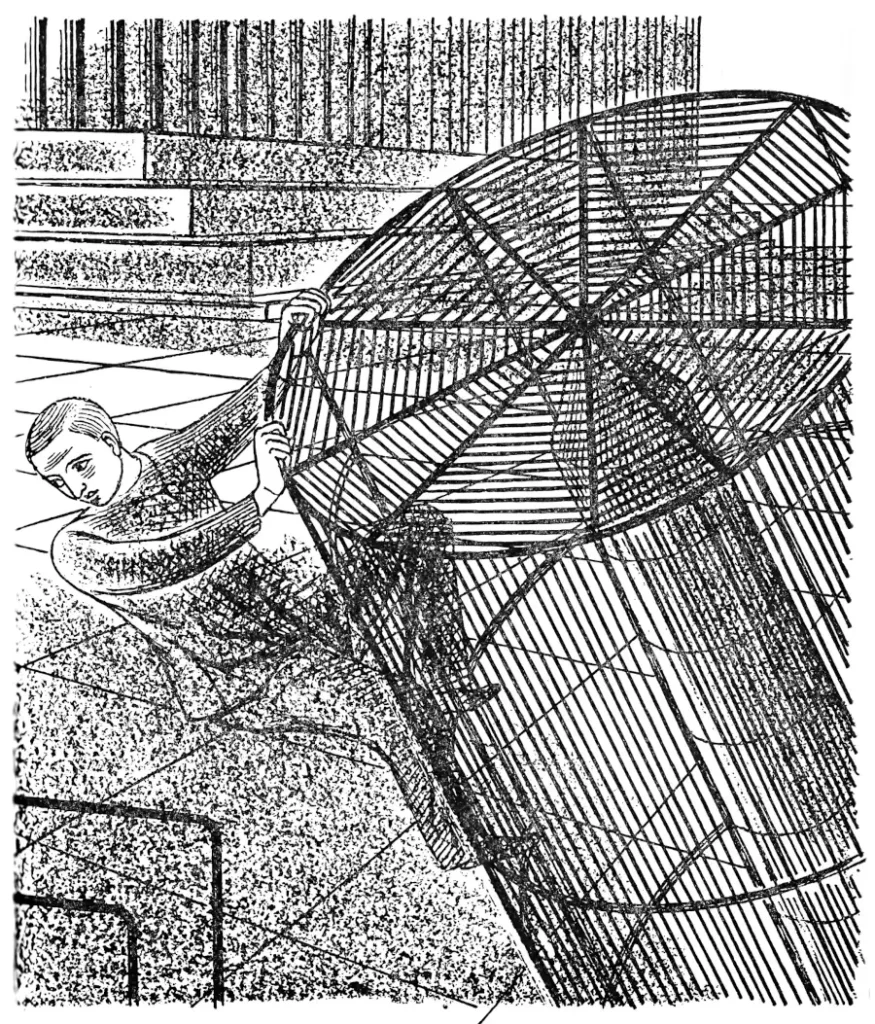
Why I had stopped when she let go of my hand I did not know. I realised the calamity at once, and started running along the temple front to my right, to find an issue to the ground level, and there was only a queer structure apparently made of bronze, rising to some twenty feet. It consisted of a series of circles some ten feet in diameter, a few feet one above the other, and held by upright bronze ladders, of which only one was accessible from my side.
Thinking that this was some unusual way out, invented again to protect the temple, I climbed the ladder, hoping to come down to the ground on the other side. But as I came to the top, some mechanism was set in motion by my weight, and the whole structure, with me on top, started oscillating from back to front, relatively to the temple front. As it inclined towards the temple side, I perceived that at its lowest angle it came within reach of two rails so placed, vertically and horizontally, that the second could be seized if the first was missed. Then one could slide down to the ground. There was no other way out. But I also perceived that this led inside the temple grounds and that a very high wall separated them from the outside and the place where the girl now lay dead and mangled.
So I remained on the oscillating tower, in extreme agony, and the vision went out.
Now do not tell me this was a feat of my imagination: I should then have to tell you that you are talking nonsense. I can tell, having had much more experience than you of the ways of the imagination, that this was just a plain memory of a distant past. Imagination does not work that way at all. A man with experience of the spirit can tell the feel of a vision, as clearly as you can tell a photograph of a real scene from a made-up drawing. Listen further. One year later I was reading in Plutarch a chapter I had never read or had in my hands or house before. Do you know the story of Kamma, a Gallic princess in a temple in Asia Minor, during the three-century-long adventure of the Gauls in what came to be called Galatia ?
Kamma’s husband, Sinotus, was killed by his overlord, Sinorix, who wanted Kamma. The Princess, known by her munificence to the local temple of Diana, became one of the head-priestesses there, finding sanctuary. But her relatives, and even the temple people, pressed her to give in. Sinorix had only sinned through love of her. In due time, she gave in, and, before the altar of Diana, wed Sinorix, giving him a poisoned cup of which she first drank a little less than half. So he died first, and she died laughing on hearing that he was dead. They had put him into a litter to take him home, and he died oscillating.
As I read this, from the opening sentence I knew that this was the key to my vision. In our following reincarnation we had paid for this—for Kamma was not innocent of love for Sinorix, a thing Plutarch did not know. So the accident was Kamma having to kill herself again, unwillingly this time, and to be separated from her lover—who was again left oscillating.
After reading a few sentences of Plutarch, I knew the end, put the book aside, and worked out the end of that story from my own memory. Then I read on, and I was right.
Probably the murder of Sinotus took place round 200 B.C., and the accident to re-born Kamnia and me some 70 B.C. during the Mithridates wars, which crushed the Gaul power, Kamma and I, running from the enemy through an unknown and deserted temple, came upon our fate.
Thus repetition and completion are interwoven, leading on to higher planes of the spirit. For I may as well tell you that this was worked out further by the lady of the song in the XVIth century, when her lover escaped the law only for a later torture, as I have related to you. And also the conclusion, as I hope, is being reached in our present calamities.
The vision was, in fact, on the 2jth of December, 1938, had I but known it, and there are those who would have known it, a prophecy of this war of 1940 and of the ending of it, seen two years before it happened.
The rhythm of some private calamities I have undergone awoke the memory of that rhythm of that private calamity to Kamma and me long ago; and the vision came back to memory because the calamity to the Gauls at the time of the Mithridates wars was also on the same rhythm as the calamity to France now, and, magnified, on the same rhythm as the Kamma episode. Private and national catastrophe ran similarly: the confident rush of a beautiful short-sighted being, the jump into the abyss, the terrifically quick shattering, the unavailing efforts of the friend, who, having hesitated too long, wishing to help, is left oscillating in the air, powerless.
Even thus were England and France brought to their fate. But there will be other reincarnations. I do not see how intelligent people can face the world if they do not know that. Stupid people can, though.
Also perhaps Kamma was not dead, only broken. I do not know. He said: Read the New Testament. Everything is there. If you read it carefully, keeping your own destiny in mind, you will find yourself in it. John says that all the world could not contain the books that would relate what Christ said. Of course not: since even all future worlds are implied in the New Testament. For instance, you were one of those two disciples that went to fetch the colt on which Christ was to ride to triumph and to death. Perhaps I was the other, and that is why we are now talking, as we talked then, on the way. Remember my dream of the hidden king: I was on a similar job then. Fetching the young king was the same thing as fetching the young ass. But you, an author of books, are the leader of the donkey that is to carry Christ. The donkey did not know Christ, but carried him; so your books: books of ignorance, of course, but they carry Christ. You only lead them.
You suggest I was Nicodemus—It might be that he was that second disciple.
What did I do during the Passion ?
Remember that all men are at the Passion; all men help to crucify Christ, actively, passively, or in sympathy with Christ. All the traitors of the world, all the officials of the world, all the saints of the world. You and I, we were there with the others. This trick we have in talking of time is so deceptive. We are there, now. Our real life is that eternal drama, which radiates action, suffering and love throughout the world. What we think we are now, or have been in other lives, that is only a series of deformations that, dreamerlike, we inflict again and again on our true version of ourselves: we call that going down theages. Like a man who might be hungry in his sleep, and dream successively that he is a cat chasing a mouse, or a lover wooing a girl or a soldier killing his foe, or a tiger eating a man, and so on. Really, he is only a hungry man asleep and dreaming, as he finds when he wakes up.
When we wake up, we are round Christ in the New Testament. Why Christ suffered all that ? Take and eat, this is my flesh. Try and see this: suffering and joy are the same thing seen from different sides, like B.C. and A.D. Remember that in the animal species maternal love comes only to the females that bear their young in pain. The others do not care. Woman is the female that suffers most and loves most.
But God suffers the maximum and loves the maximum. Creating the world means that God separates suffering from joy, in himself: thus he has the Incarnation, the utmost joy of God, and the Resurrection, the utmost triumph—but he also has the Passion, the utter desolation of absolute suffering. All men, all creatures, are fragments of both God’s suffering and God’s joy, liberated to do their own will. Their birth out of God is the Crucifixion: the suffering of Birthgiving by God. Inasmuch as we are born, we must then participate in both the Suffering and the Joy. Only in our own selfishness—without which we could not exist—we try and separate the two, so as to avoid the suffering and have only the joy.
Hence our many lives. Whenever we can, we reject the suffering of our birth into another life. But we must meet it some time. Because only when we meet it, at first most unwillingly, then after many times with understanding; when we have died first in suffering or in terror many times, then in peace several times, then in joy at last, then we are fit company for God. We have again transformed the suffering into love: into the love of God, into the love of our neighbours. We have reached again the equilibrium of all the forces—for a time.
That is why also we do not know too much: if all men knew all this, then their sufferings would be transformed only into selfishness : who would not suffer a little for an eternity of bliss ? Suffering and sacrifice would be hypocrisy. God would find no love in mankind: no love from mankind, no love for mankind. He would not have created the world. He would not be God. That is why knowledge is given only to those who have in the past, in many past lives, suffered and died in ignorance but with all the force of their goodwill. Those reap knowledge and joy: for they have added to God’s creation. From their suffering they have made love.
That is why it is of no use to tell this to mankind: they will not believe it, because they cannot believe it; it is not attuned to the present state of their destiny. Men do not learn through their minds, but only through their many joys, many sufferings, many deaths. Men learn only when they have been shaped by life and death into receptivity. But one by one they will learn, and realise their identity with Christ, reaching his heart, being purified, and then starting again on another round, willingly, to help Christ to bear his cross, to help Jesus to create more worlds, into space, into the past, into the future: eternally widening the divine circulation through all the possible degrees of ignorance and suffering and gradual enlightenment and bliss: which are all four found mixed in everything. But ever Jesus, the Man who came to earth, and had a Virgin for a mother, is the pulsating Centre, in his Death of which are our many deaths, in his Resurrection, of which are our many resurrections. Since the fragments of the One must be the Many.
VII: The Enemy
I MET yet another man. This one was in England, though French. He was deeply religious and submissive and full of good will. He was lying down resting on a low bed. Suddenly he leaned on his right side, and he saw on the carpeted floor, two feet away from his own face, a small man about the size of a human fist, nearly naked, yet harnessed with a precise panoply of war, like a huge insect surrounded by tentacles. This small man had in him a concentrated power that gave his flesh a redoubtable density, as though it were a jelly of dynamite.
He took no notice at all of my friend, who had all his time—all time—to stare at him. There was no aggressiveness. The tremendous spirit was not in action—not towards my friend anyway—no hostility; he was just about his lawful occasions, doing nothing special.
But my friend felt, and knew: this was the spirit of anger, the profound force of cruelty, which could be released in explosion, and immediately fill the heart, fill the world, and wreck it. If it were given power and occasion. Where was the power? In the human heart. My friend felt, and knew: were he to accept this, which was projected from his own heart, anger—then the terrible little power would occupy him entirely. Were other men to accept also, then a. God, one of the terrible gods of the heathen, one of the terrible devils of the Christians, would be unleashed out of nothingness, out of the black force of many human hearts. Thus the old gods had been created: Marduk and Osiris, and Shiva: created to be seen, to be felt, to be followed, to be obeyed, to be broken by. War, love, greed, pride, the seven deadly ones. He had seen anger. No doubt the others were near, ready to spring into existence, into physical existence as well as spiritual, were they given the power and the occasion. They were the powers in man that separate him from God.
They were the torturers of Christ, necessary also to the Creation of the World. What was to be done? through the centuries. My friend leant over, and opened his heart, and offered hospitality to the evil spirit, into his own heart; putting aside fear, he offered love; and the evil little spirit, instead of growing and exploding, dissolved and went back into the human heart he had come from, and all his dreadful force was mingled into the great force of Christ flowing through the heart, and made it even greater.