DENIS SAURAT
Death and the Dreamer – Part 1
WITH
DRAWINGS BY EDWARD BAWDEN
WESTHOUSE London 1946
DEATH AND THE DREAMER
A Preliminary Note
Every detail in this book is true; some slight modifications only have been found necessary in order to avoid embarrassment to persons now living; but only in Part III; and only circumstances of no importance philosophically have been altered. Dreams, transmissions of thought, predictions and similar phenomena have been reported exactly as they occurred; only personal details have been sometimes changed. The dates given are in every case correct. This series of tales is thus in fact a narrative of the inner development of one man. After Part I : Peasant Fears, in which the problems are set, in Part II : The Heart’s Nightmares, it is seen that it is through fear that souls communicate.
Part III, The Life-time of Christ, shows the deliverance from fear; and therefore from time and space.
Time past and Time future revolve round Christ, and in Part IV, High Dreams, the man conquers both. Yet all this is but a preparation to that moment on Earth when, in physical calamity, and in the maximum of pain (The Bomb Part V) fear is truly overcome, though only for a moment.
It is difficult to conceive of the strange arrangement of things in time. A bomb that fell in London in 1944 has backward repercussions in the vision of a gigantic insect in 1942, in the death of a peasant in 1936, in the dreams of a child in 1900, in a tale from Plutarch in the ancient world. All leads to the seismic shock of 1939-1945, and also to the shocks still to come, implicit in the past.
But we understand only after the event, in spite of the innumerable pointers of destiny; for the whole world holds together from the inside, but we place ourselves outside to look at it.
PART 1: PEASANT FEARS
Characters
THE FATHER, born in 1865, at 1’Ayrolle, a hamlet of ten houses in the eastern part of the Pyrenees (Ariege). Came to T—, a small town of 3,000 inhabitants, amongst the hills of the Ardennes, in 1896, owing to his wife inheriting a small property there. Died at T— in 1936.
THE MOTHER, born at 1’Ayrolle in 1868, came to T— in 1896.
THE AUNT (from whom the property came): aunt of the Mother, died in 1896.
THE DAUGHTER, born at T— in 1897, died during the German occupation in 191$.
THE SON, born at Toulouse in 1890, himself has a son and daughters.
The Scene
AT T—, in 1936, during the week following the death of the Father.
Throughout the colloquy between the mother and the son, the question in debate is whether the father still exists, and what sort of existence may still be his; the question for the son is how we come by our ideas of death.
The Closing of the Eyes
THE MOTHER : All country folk know, if the dying close their eyes themselves, and you don’t have to do it for them, it means they are at peace.
When they keep their eyes open, that means they’re not happy, and they’ll come and fetch someone to keep them company.
That’s why it’s best to close their eyes as soon as they die, before they know it. Then they do not come back.
But I—I wanted him to come back for me—I wanted to go with him: and now he has closed his eyes himself. He loved me too much; he never wanted me hurt: forbade me even to go out into the yard when it was cold.
Oh, come back and fetch me. I’ll be so good to you, better than ever I was.
You never left me before; don’t, don’t leave me now here alone. We have been together all the way, how can I go on now; however shall I be able to die without you: there’s that last bit to travel, how can I face it alone. You have been with me always, you ought to have waited for me; oh, come back and take me with you!
But no, I know he won’t come: he loved me too much on earth.
Cats
(The Father is laid out on the bed ready for the coffin and the last vigil.)
THE MOTHER: We must be careful to keep the windows well shut. If we don’t the cats will come in. That’s why I never could endure cats.
If you’re not careful, when the dead are alone, the cats come and eat their faces: it’s just fresh meat to them.
They caught the cat at it in Toulouse, and they killed her and put her in the coffin with the body.
Touching the Dead
THE MOTHER (to the Son): You must let your daughter see him dead: else he might come and look for her. The mountain folk, they bring the children and make them touch the dead body, so that he shan’t come and look for them. But there— that’s their stupidity. You mustn’t touch the dead, because where you do, the flesh turns black.
It’s enough if the children see them, to show that they love them, that they’re not afraid of them; and then the dead are satisfied. The dead don’t like you to be afraid of them.
But of course she must go to the cemetery, or he might come back for her.
Quarrels
THE MOTHER (to the Son): The children used to think we were quarrelling about this, that, or the other. Little they knew!While the mouth speaks this or that, it is the heart that rages. It is the heart that kills you.
We were both unhappy, because our daughter was dead and you had gone.
Then each would accuse the other of anything, to make the other suffer. When one suffers, one always wants to make the other suffer, and the more miserable one is, the more one wants him to suffer too.
And, you know, the wicked things you say, they hurt you more than they hurt the other.
Poor man, how miserable I made him with my wicked tongue! I deserved it cut out, my wicked tongue.
And he too, sulky and revengeful, he would say anything he could think of in revenge at me. Poor man, he would call me puto, and well he knew that it wasn’t true, and it hurt him more than me. It rather amused me to hear him say that, but it made him unhappy—because he knew it was not true—he was trying to make me angry.
And then I’d say to him, ‘Now you’re sulking,’ and he’d stop sulking.
And I’d say ‘You hot-head,’ but I was the hot-head really.
Insults
THE MOTHER: You know so-and-so, she too has lost her husband, and also from a stroke. Nearly dead, he was, and they made him swallow some medicine, and he rallied and cried out: ‘You filth, oh you bitch, you’ve poisoned me!’
She: Oh, you still speak! And I thought you were dead: oh swear at me as much as you will, I’m so happy; insult me as much as you like.
A Swine of a Heart
THE MOTHER : A swine of a heart I’ve got, to hold out still, and I was hoping it would break: and it is his that broke.
Cicero
THE MOTHER: Oh, I have sung him the four catarinas, time and time again!
THE SON : Why, what is that, the four catarinas ?
THE MOTHER: That’s what they say in the countryside when one has been swearing at someone. That one sang him the four catarinas.
THE SON (to himself): The four Catiline orations of Cicero. Even now, after nearly two thousand years, they are still proverbial among the Pyrenees. And one sings them, too; the intonation of the Latin still haunts the ear of the peasants of Gaul.
Politeness
THE MOTHER: You know, so-and-so, before he croaked— Or rather, passed away—since he never did me any harm, I shouldn’t say croaked—one ought to be polite to those who’ve never done one any harm. …
THE MOTHER (to the Grandson): Take this money and go and get some bread; it’s gone up a penny. Everything’s going up, nothing goes down. It’s only your poor grandfather who’s going down.
Thieves and Murderers
THE MOTHER : So-and-so—I don’t think he’s thief enough to be called a thief; he might take a chicken or an apple, but he wouldn’t steal a cow or a tree.
Another: You know, he’s a thief and has killed a man; but he’s good at heart; he’s never really wronged anyone; you know, there’s a difference.
Calamities
THE MOTHER: I am the one for calamities; nothing else is worth taking notice of. Whenever things went successfully— well—there it was, I thought no more about it.
Happiness is nothing, really.
Esquicha la vido—Wear and tear. Wear it away, tear it away. That is all there is to life.
The Father’s Illness
THE MOTHER: How dirty things had got in that little front room, and how we longed to be in clean things!
Of course, we had kept all the best linen to die in.
At least we wanted those who laid us out to find us clean.
I said to him: ‘Will you have the strength to go as far as the end of the passage?’
‘Aye, you’ll help me a bit and I’ll lean against the wall.’
And so we went along together, though I was as ill as he was, without a light, in the pitch dark, right along the passage: for I wanted to put him in the big room at the back, nice and clean. Poor thing, he fell down, and I put myself forward and he fell on me, and we lay there minutes without moving, dead-like, in the dark.
Presently I got my courage back.
‘Are you dead?’
‘No,’ he said.
Then I took heart again. If he hadn’t answered, I’d have lain there and died of sheer wretchedness, there under him: but to hear him say No gave me courage a little, and I stirred myself and drew my body from under him very gently so as not to hurt him.
After that, I got him on his feet more or less, and we went on, and he fell three or four times more. What a relief it was when I got him settled in the good bed, in the big back room, and when I’d lit the stove and settled myself in the good arm-chair. And then, in the morning, towards three o’clock, he had the stroke.
Jealousy
THE MOTHER: That anyone else should have put anything to his mouth, I could never have borne it.
Nor that anyone should touch him.
The doctor, of course, I had to let him, but the others, no, I couldn’t have borne it.
Doctors don’t count.
In my Aunt’s Days
THE MOTHER : In the days when my aunt was alive, I used to go into Belgium to buy the bread because it was a halfpenny cheaper in Belgium. It took two hours to go and two hours to come back. And my aunt made me walk it barefoot, for otherwise it would have used up more than a halfpennyworth of shoe-leather, so she said.
(To the Son): She used to tell me that with one walnut you had enough nourishment for four days.
A quarter of a walnut a day, she would say, is plenty to nourish a child of your age.
She was a clever woman, my aunt: she had been a midwife: she didn’t know how to read or write, but her husband was a ranger and had taught her a little.
But she was very clever: they had given her medals for vaccination, she had vaccinated so many people in these parts. But I, I was afraid that with only a quarter of a walnut a day your bowels might grow too small, and so I fed you well; and I gave you a penny a day to go and buy yourself a brioche. And the baker, he came to me and said, ‘Do you know, Madam, that your little boy is stealing money from you? Every day he comes to me to buy a brioche.’ The fool, he had never heard of a thing like that. As if I would have let myself be robbed of money. Still, it was honest of him to come and tell me.
The War in Spain
MY AUNT, she had married a ranger, on the Spanish frontier; that was a good situation he had.
But one day, when there was a war in Spain, as there is to-day, her man, who was armed, arrested ten Spaniards, and they were, armed and they were trying to pass over into Spain to go and fight the other Spaniards.
But these men, they hadn’t dared to kill him, because he was French. So he had arrested them and led them to the guard-house, and all of them were put in prison.
Then his chiefs, in the Government, thought it over, and they saw that if they left this ranger there, one day they would find him dead with a knife in his stomach because Spaniards always remember and always get their man, and they know how to use their knives.
So these Government people, they thought where could they send him away from Spain as far as possible. And they found him a job as ranger on the frontier of Belgium, where there aren’t any Spaniards.
That is how we came to be here; because when the aunt was. a widow, and alone, she sent for me to take care of her. And the King of Spain, he gave him a medal for it; it’s still up in the loft, in a box, with a paper about it that he had framed. You can find it there, if you like.
The Pyrenees in the Nineteenth Century
THE MOTHER (to the Son): You know, when I was little, no one up in the mountains had ever seen white bread, nor wine. The first man who ever had a barrel of wine brought up was the postman, who lived on the road half-way up to the village, and had a bicycle. But much use it was to him, his bicycle, for coming up the mountain!
Every woman there baked the bread herself: and good black bread it was, very nourishing, very hard, and it kept a long time.
They took the wool of the sheep to Serres, when they had spun it at home; there was a factory there, where they made cloth. You gave them so much of the wool and out of the rest they made you a piece of cloth: and then the women made trousers and coats for the men, and skirts and bodices for themselves: the men knew how to make wooden clogs, and we lived that way. What did we have to eat?
Chiefly potatoes, cabbage and beans: and we would kill a pig or a goose, and that lasted a long time. The salted fat made good soup—and the flesh we cured; we made good soup of it all mixed together, potatoes, cabbage and pork. Carrots, chervil, leeks—we knew nothing of those; those are not mountain plants.
But we had plenty of fruit in season, apples and nuts which do you good and can be kept.
And then, of course, we had cows; all the milk you wanted; and they made good fresh cheese, as much as you would wish for; and how the children loved it!
We used to go to the market at Foix, that was half a day’s walk: there we sold eggs, chickens and milk, sometimes a pig or a cow that we had to spare: then we came back again at night.
Sometimes we brought back a lot of money. We hid it in the houses; five-franc pieces and pieces of gold. Everybody had money.
But no one ever spent it. They kept it for later on, in case anything should happen.
If you wanted to buy land, for instance. Sometimes one wanted some land of a neighbour’s.
But there was no need to buy land. The mountain belonged to us. Whoever wanted to make himself a field, he would choose a good place, cut down the trees, pull up the roots, and then he would work the land: or he would sow grass seed and make a meadow.
A young man who had nothing, because his parents were poor or he had too many brothers—he would go and make himself a field and would get married, and then they would fetch the mason to direct them, and everyone would help to build the house.
So there was land for everybody, and we used to say to idlers: ‘Agez pos poou que terra te manquo !’ (‘Don’t be afraid; you’ll not run short of land!’)
Calamities
THE MOTHER: My mother-in-law—no woman ever had a mother-in-law like mine.
She made me cover my face with a cloth when I was giving the breast to the baby, so that it shouldn’t get to know me: and I wasn’t allowed to speak while I was near it.
You see, I had to go and work with the men. The child would have cried when I was away if it had loved me, so it mustn’t be allowed to love me or even to know me.
And then they let it catch cold, and it died when it was seven months old.
Snakes – and a Camel
THE MOTHER: When I was young they sent me to Ax-les-Thermes, and there the roads were black with snakes: but you were taught not to be afraid of them: you took care to tread on their heads, and then they coiled round your ankle and died. But you had to make no mistake. If you trod on their tails, then they bit you.
Still, that wasn’t very dangerous. There were doctors all over the town, and they had little knives ready in their pockets; and they would cut out that bit of flesh, and you didn’t die. My father, when he was young, was a miner in Spain, over towards Barcelona. Once he saw, he told us, a snake as thick as a tree and as long as a house. On the road! And then an animal came along, a huge thing with a big hump, you know, what they call a camel. A man was leading it with a rope. And when the camel saw the snake, it jumped on it with all four feet. A camel is bigger than a horse, and heavier, because of the hump. And it just trampled the snake to death, on the spot. The men were helpless; they simply did not know what to do about it.
The Law
THE MOTHER: Once, I had come back from Toulouse with five hundred francs that we had saved, he and I, penny by penny; and in the middle of the night I heard my mother outside my window, crying fit to break her heart.
‘What’s the matter, Mother?’
‘Ah, my poor girl, that I should have to die. I’ve a law-suit with the family of that swine, your father, who married me when I was fifteen and he was penniless-—and now they’ve gone to law with me and I’ve got to pay five hundred francs. I shall have to sell land to find them, those five hundred francs. And I don’t want to sell the land.
‘I’d rather kill myself; I’m going to throw myself in the river. I haven’t five hundred francs and I don’t want to sell the land. I’ll throw myself into the river.’
Then I cried too: to kill oneself for five hundred francs. I didn’t want it to be said that my mother killed herself for five hundred francs, and I having the money all the time.
So I gave her the five hundred francs that we had scraped together halfpenny by halfpenny, my man and I.
And he, poor man, never said a word to me about it. He loved me too much.
Incompatibles
THE SON (to himself): Many a time, there is no possible compromise.
To the father and mother, it seems that the children have abandoned them. To the children, that is normal and necessary. It is even the result of the father’s and the mother’s love for the children.
What the mother calls ‘your father’s glory’—his ambition. No common point of view between the generations. Nor between France and Germany, or between France and England. The rational position imagined by intellectuals does not exist. Even the theory of it cannot be definitely thought out. In practice, force decides—or cunning. The intellectual is thinking in a vacuum; his rational idea corresponds to no reality. Reality is less rational than intelligence. Problems exist that are without solutions, a situation which the intellectual cannot understand. Thus, these two people could not come to an understanding with their children: no ground existed for such an understanding.
They could not agree between themselves, because of the father’s ‘glory,’ which made him continually do things that the mother could not approve—such as sending the son or daughter far away from them, to school. The mother gave in, because it is the man who takes decisions on behalf of the world without and of necessity: but in her heart she did not yield, she blamed the father for all their misfortunes, which would not have happened if the children had been kept at home.
Incompatibles – the Cure
THE CURE: The Good God was obliged to issue a commandment that children should love their parents. It is not natural for children to love their parents. But the Good God pronounced no commandment that parents should love their children; no commandment was needed. It is natural; it is an instinct. That is why parents and children can never agree.
The Dead
THE MOTHER: A man went out one night to relieve himself. His wife had been dead three days. In our villages, you know, there are no closets, you go outside, and at night you are afraid. You take a child with you, or a dog, or even the donkey, any living thing that keeps vou company.
Because, at bottom, it’s the dead you are afraid of in the dark. So that anything living, even a donkey, is a protection. But this man wasn’t afraid; and he loved his wife very much. So he was weeping, all crumpled up in the dark. And weeping, he prayed, saying softly to the dead woman: ‘Come, oh come back to me.’
And all at once he heard a great shout a long way off: it was the voice of his dead wife, and she shouted: ‘Arribi!’ That’s our word for ‘I’m coming.’
He stopped, he listened, and he heard it again, nearer: ‘Arribi!’
All at once he was seized with a mad fear; he pulled up his trousers and began to run towards the house; behind him someone was running faster and faster, and he got to the door just in time, shut the door, drew the bolt and collapsed as if dead, just inside the door.
He came to himself the next morning, and there was the mark of a hand on the door, as if it had been branded on with fire.
All the village saw it.
The Dead: Terror, Disgust, Hope
THE SON (to himself): The greatest bother to easily frightened peasants, and especially to their women folk, is the fact that their peasant modesty compels them to relieve themselves out of doors at night; and the fear of the dark is the fear of the dead. Whence arise strange associations: those whose love is stronger than their fear go and seek the dead at the usual places at midnight. Just there they feel is the best chance of seeing them again.
And their love is often stronger than their fear. Malinowski tells how the Trobrianders of the Pacific dig up the dead father after several weeks, open the decomposing leg and suck the marrow of the tibia, to their own great disgust and sometimes to their hurt.
In the great terror lies the great hope.
THE MOTHER: Your sister—-how many times have I not run in the middle of the night to the bottom of the garden. I, who never dared to go there alone. It seemed to me that I should just catch her there, that I might see her again.
But always it seemed to me that she had just gone, that next time I should catch her.
Or I would run at midnight to the cemetery to see if she came there. There was a German post on the way there, and the Germans, they thought I was mad.
Then a German soldier would come with me with his gun and his bayonet fixed, and we both looked through the cemetery railings, and I would call to her. But she never came.
The Three Days of the Illness
THE MOTHER: We had made such plans for being happy in our old age.
But the Good God, He made another plan, and He was quicker than we were. It lasted three days, His plan.
Calamities: The War
MOTHER: They were looking for gold. The German adjutant, he put a revolver to my forehead. I made a grab at that revolver and sent it right along the flag-stones of the path into the middle of the garden.
‘Madam, you’re mad,’ he said to me.
‘Yes, I am; but if I wasn’t, you’d make me go mad.’
But I knew his revolver wasn’t loaded: it was forbidden them to have bullets in their revolvers when searching houses.
Not that I cared, anyway. My daughter was dead; I wanted him to kill me.
The War: The German Corporal
The mother tells the story
The Corporal : You’ll do as I tell you.
I: No, I will not.
He: I shall make you.
I: Then it’s a fight, and when two fight, you never know which will be killed.
He : But you’ve no weapons.
I: You’ve stolen my revolver, thieves that you are, but you’ve left the best weapon of all—and here it is. (I pulled out the axe from behind the door and held it under his nose.)
And your pistol, it isn’t loaded, I know that you’re not allowed to have it loaded. Off with you. You’ve got a good-looking head, but I’ll make it into two heads if you don’t go. Get out! And he got out. So they had me up for a court martial; and then I said to the commandant:
Aren’t you ashamed to come here and make war on old women. Go to the front; there you’ll find your equals who’ll know how to deal with you.
He: Madame, you must submit. The country is conquered.
I: No, sir, it isn’t conquered; it is invaded but not conquered. You found no one here to defend it. But they are defending it down there, at the front. When you have beaten them the country will be conquered, but not before. Then why are you here ? Go and fight with the armed men, and leave us alone. We are miserable enough already.
And they gave me eight days in prison.
The Court Martial
THE MOTHER: And I told them:
‘Your corporal, I know that sort. In our country too there are blackguards who sleep under the bridges in Paris. ‘You have rounded up all the blackguards of Germany and brought them here to rob and bully. The honest men of Germany wouldn’t take on that kind of job.
‘The honest ones of the Germans are at the front, they’re fighting honestly against their equals; they don’t make war on old women.
‘And your corporal, if he comes to my house again, or I find him in my way, I’ll make him into two, your good-looking blackguard; there’ll be two good-looking blackguards for you then.
‘You can kill me if you like, that’ll do me a great service, for I’m too unhappy to live and I cannot kill myself; I’ve tried to, but I can’t; my daughter is dead.’ And I began to rave like a mad woman.
But they only gave me eight days in prison: and when I came out, the corporal had gone.
The Hidden Revolver
THE MOTHER: You know, the Germans, they were not bad. They used to look at you with their round, intelligent eyes, and it wasn’t wise to try and fool them. The soldiers were just like us—they used to help us against the swine at the Kommandantur, whom they looked upon as just slackers with soft jobs.
When I had one of them in the house, a soldier from the front, he helped me against the police. They hated the military police as much as we did.
He had his mess-tin full of black coffee on the table: and he said to me:—’Madame, a search again. If you’ve anything to hide, give it me!’
Once he put ten gold pieces in the coffee in his mess-tin; the police were looking everywhere for gold.
But that was forbidden them, to touch anything that belonged to a soldier. The soldier, he said to me:—’Do not worry, Madame, if he touches my mess-tin, that swine from the Kommandantur, I’ll knock him down: and, you know, all my comrades will back me; don’t you worry.’
The German soldiers billeted on us, they stood by us.
And when they found your father’s revolver, by good luck there weren’t any cartridges in it, but they took your father away. Fortunately, we had a soldier billeted on us then, and when your father had gone with the police, the soldier said to me:—
‘Madame, trust me, and we’ll get him out of this; but they are coming again. Now, you’ve got some cartridges. If they find the cartridges he will be shot, or sent to a concentration camp at least. Trust me, madame; show me the cartridges. I’ll save him for you.’
I looked at him, and saw that he was honest, so I showed him where the cartridges were, in a hole under a heap of wood in the old tool-shed. He took them and pulled out the lead with a pair of pliers and threw the powder into the well, and the Iead—there was a fire in the stove, so he threw the bullets in and piled on wood till they were melted, and you couldn’t see what they had been. Then he put the copper cases in his pocket, and at night went out and threw them in the pond. The police found nothing. Ten times they looked into that hole where the cartridges had been.
The War: Rape
THE MOTHER: And once, there was a German soldier who had raped a girl on the Belgian frontier; and all the other soldiers set upon him. They shut him up in a room in the estaminet, all privates; there wasn’t even a corporal; and stretched him naked on the table, and all the soldiers filed past him with their belts off, and each one gave him three blows with the belt as hard as ever they could. After that, the girls were left alone.
The War: The Young Lieutenant
THE SON (to the Mother): I knew a young Breton lieutenant, who might be about nineteen, in command of his section, and they had taken some prisoners—a hundred or so. Presently the Germans came back, and were about to take the lot. Then the boy sent two of his men towards the rear with ten of the German prisoners to try to save them, but he couldn’t spare more than two men.
As soon as they were gone, he said to his soldiers, ‘Kill all the Germans; all of us here are going to be killed.’ So they killed all the other Germans excepting only the ten who had gone away with the two Frenchmen. And the Germans attacked.
Soon the Germans had either killed or taken all of them, even the two Frenchmen and their ten prisoners, and that was how the whole thing came out. If he had not tried to save those ten, he wouldn’t have been found out. And by then, his own leg had been carried off by a shell exploding. The German officer said to him: After what you’ve done, you don’t expect us to nurse you, do you? So he had him put into a shell-hole, to let him bleed to death. Then those Germans continued their advance, and some others came by who knew nothing of what had happened. They found the French officer not yet dead in his shell-hole, and dressed his wound and had him taken away. But the report of the first German officer followed him up, and they court-martialled him, that little Breton lieutenant with one leg missing—they had tended him well, without favour though, like a soldier, not like an officer. And the court martial gave judgment in his favour: it was no fault for a soldier to do what he had done: he had even saved ten. Later on, they exchanged him through Switzerland.
Reincarnation
THE MOTHER: In the countryside they have a saying: — Efan perdut al cap de 1’an efan rebengut.
A child that dies returns at the end of a year. That’s why you were called after your brother who died the year before
Dreams and Reincarnations
THE MOTHER (to the Son): When your daughter came into the world, I knew it. I dreamt a dream, at the very same time, and woke with a loud cry that woke up your father, and we looked at the clock: you could ask him about it, only he’s dead. And then you wrote and you told us the time, and it was the same.
It was my own daughter, your sister who died, who came in my dream and said to me:—
‘Mother, you don’t want any more children, and I want to come back into the world because I have been unhappy, and now I want to be happy.
‘Mother, if you wanted me I would come back, but you don’t want any more children; you’ve been too unhappy in your children.
‘So now I am going to go into the body of a strange woman, my brother’s wife, and I’ll be his daughter since I can’t be yours. But I don’t want to do it unless you give me permission. Tell me quickly, there’s only a few minutes left; if you say no, the child will come dead; if you say yes, it will be me and it will live; and I want to live, I want to be happy. O speak quickly!’
Then I shouted Go! Go! so loudly that I woke your father and awoke myself.
And then you wrote to say she was born at that very time, and she came with the cord wound tightly round her neck, but the doctor saw it directly and slipped his finger under and unwound it. But for that the child would have suffocated.
If I had not shouted ‘Go!’ it would have been too late.
Dreams of the Son in Childhood
Dreams frequently repeated from about 8 years of age onwards, ceasing towards 11 years of age
The Mountain
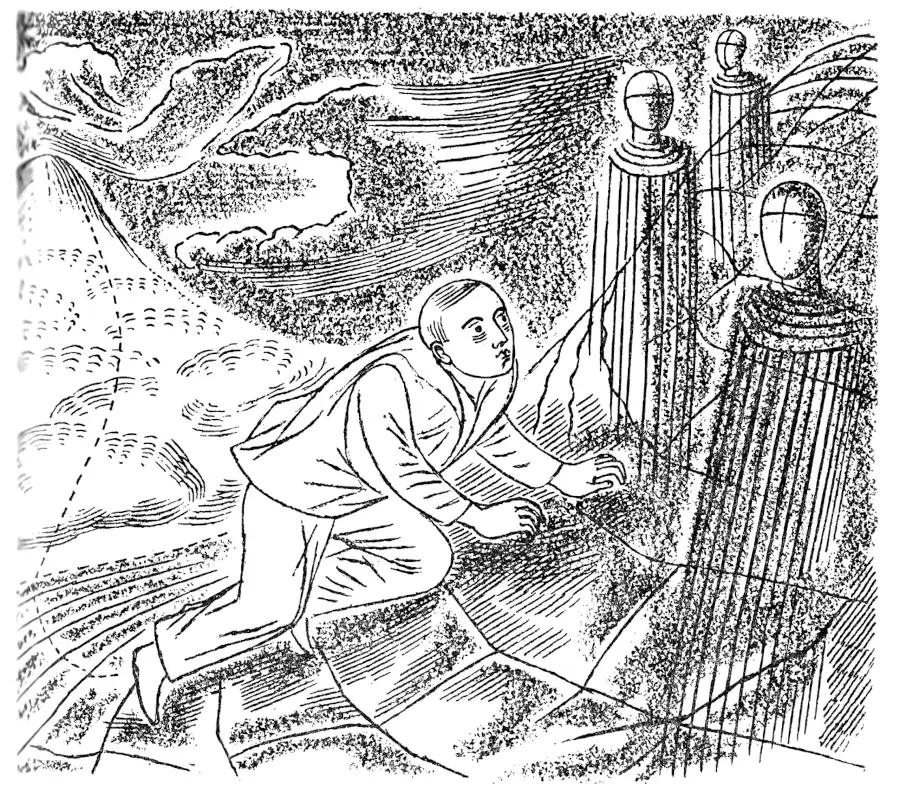
A MOUNTAIN, neither precipitous nor rocky, but which one climbs slowly for a very long time. Who is this ‘one’? Not I especially, but I can feel this ‘one’ climbing. A long convex curve, fairly regular in form. The air grows more and more invigorating, colder and colder. More rarefied but more pure. Anguish: can one continue the climb? There is no physical discomfort; on the contrary, a sense of well-being and of strength; the higher one mounts the closer to the ground one clings, on all fours, although there are no precipices or even any rocks; only grass, rather sparse and short, then snow, and then bare rock, but above all wind, wind blowing more and more powerfully. It is against the wind that one is advancing, and one comes to a very slightly descending slope before again facing the great ascending curve; no cause for disappointment; one knew this beforehand.
The wind is stronger and stronger. One climbs for hours certainly, perhaps for years.
One reaches the summit of the curve, and there one feels the terror of a vast precipice, overlooking a whole continent, millions of feet below: one is clinging to the summit of the curve, flat on the stomach. There is no immediate danger; the precipice is far enough off, beyond a decline of not too steep a curve. The terror is in the imagination rather than fear or danger of a fall. That is to the left.
To the right the mountain descends in a curve, but slightly, for some hundred feet only; then another mountain rises powerfully, separated from the first by a saddle some hundred loot from the first summit; the saddle on one side must abut on the precipice, and on the other descend towards an invisible but inevitable plain.
One seems to have reached the limit of one’s strength, the force of the wind is at its maximum; yet one descends slowly to the saddle; then climbs again on the other side to the height already attained, and there one is seized with a deeply blissful resolution to renounce all, to risk all, and one proceeds up the new slope with triumphant pride. Or perhaps, instead of the saddle between the two mountains, there is nothing. Not an empty space into which one might fall, but just nothing. It depends upon the resolution of the climber, whether he can pass to the second slope. There is no obstacle but the wind, and the wind is not dangerous: powerful as it is, it threatens neither to carry one away nor overthrow one: it only measures the strength of one’s advance.
The climber goes over to the second slope, across this nothing, which is not a precipice nor a possible fall: which is nothing but a change of plane, involving no risk but only a decision to be taken.
Upon the second summit—pride.
Sometimes beings, totally unknown, rare and different from the climber, are met upon the second slope. One is wholly at their mercy. They are not menacing: welcoming rather, and are related to a race which peoples the continent at the foot of the precipice to the left. They come from there, and send back messengers thither.
Sometimes one goes back again all the way to the base of the first mountain, to seek other beings one wants; then one comes again in a few hours, leading them to the inhabitants of the second mountain, after having persuaded the newcomers that the gap of nothingness can be passed.
The Sphere
A SPHERE, mathematically perfect and polished, moving by its own force in a straight course through a space apparently unlimited, in a milky light.
Then there appears, above, below, to right and to left, certain limits: a feeling of joy, as of a beginning of achievement. Slowly these limits join to form a sort of vast funnel narrowing very gradually, into which the sphere proceeds with joy, still surrounded by very ample space.
Then the sides come nearer together, gradually, irresistibly: joy mounts higher, and anxiety develops simultaneously and, as it were, parallel with it, without any shocks. It is seen that the funnel will necessarily become too narrow, and what then ? But the rate of diminution is slow, the fatal moment very far off. The light decreases, still milky but darkening. The movement goes on, the joy and the fear growing in pro-portion as the sides come together: it goes on thus for hours, for life-times, eternally.
At last the maximum is reached. The funnel has narrowed at last to the exact measure of the sphere: both anguish and pleasure are at their maximum.
An eternal moment: the sphere and the limits are one. The funnel is a cylinder identical with the sphere. Then, deliverance. The sphere has not passed through, but it is not crushed.
Movement continues in the same direction, in the same light. The sphere is clothed with the canal, and an infinite relief appears in the system thus constituted. Fear ends. Joy spreads itself in a kind of gentle explosion, flowing away in every direction.
Peace. The light vanishes, but is not replaced by darkness. Possibly the walls have yielded. Perhaps the sphere is adapting itself to the narrowing of the canal. But rather, the whole is transferred into a different world, in which the opposition between the sphere and the walls no longer exists. Perhaps not exactly into another world but into an atmosphere of tranquil pleasure.
The anguish of knowing what is about to happen gives place to the desire, of knowing what has happened, and then fear is resolved in endless tranquillity.
The Stairway
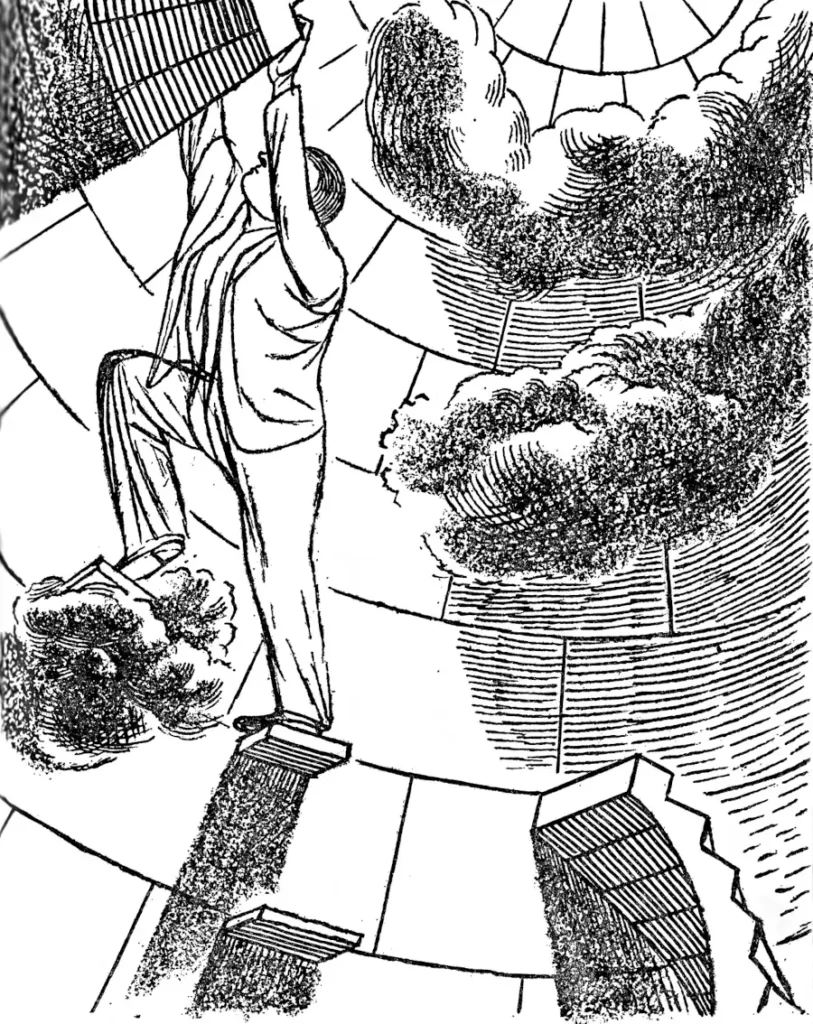
I AM mounting a stairway without a baluster against the inside of the wall of a round tower. The stairway is fairly wide; no feeling of fear; no danger; I can hug the wall and leave between myself and the void a very great length, laterally, on each stair. Dark: but light enough to guide oneself without apprehension. I mount fairly fast, and easily, without loss of breath. The breadth of the stairway lessens; but still no feeling of fear. The well of the stairway is getting deeper and deeper, my feet are nearer and nearer to the abyss as the stairway narrows. Still no feeling of fear.
The stairway ends abruptly, with a last step just wide enough for me to stand upon; no feeling of danger. Looking attentively in front of me, I see that the stairway goes on, on the other side of a void, at four or five lengths of the body, as though a landing four or five times the length of a man had once been there, or perhaps a now non-existent room; the stairs recommencing from the further side. Looking along the wall still more carefully, I see several stones jutting out here and there from the wall, below the level upon which I stand, without apparent order, but at first descending slightly and then reascending; others, irregularly, at my level. I stretch out a foot to the first of these lower stones; it is firm and will easily bear my weight. With the hand I reach for another stone higher up; and feel firm, not even too closely cramped against the wall. I see that, steadying myself by holding to the stones above and passing from one to the other of the stones below, I can get over to the stairway opposite. No fear. No uneasiness even. The decision once taken is carried out without difficulty; and, after several minutes of concentrated duration, at once very long—eternal—and normal, I reach the first step, very wide and comfortable, of the continuing stairway. Once up there, I look back at the void and the space just traversed. I am seized with fear, retrospectively. How was I able to do that? And with profound joy to have done it, for the question of returning does not arise, I go forward, trembling with fear and joy, easily to mount the stairway up to the summit of the tower, where everything is resolved.
The Countess: the Little Girl
Dreamt by the Son at forty years of age, once only
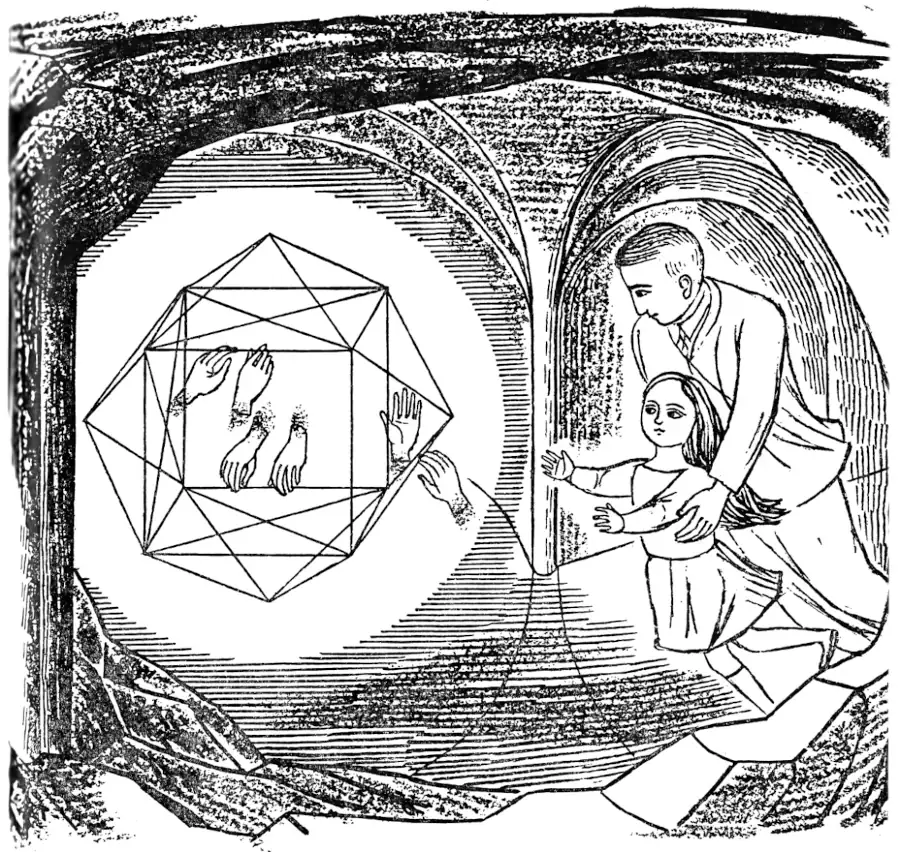
THE COUNTESS used to disappear from time to time. In the country, she was suspected of some unknown and evil work; one day she is followed by the dreamer.
She is tracked into a very deep and narrow hole: the dreamer, in a state of anguish, but without difficulty, follows her, descending into a perfectly vertical shaft.
At last, at the bottom of the pit, a world of light: in a lofty cave, illumined by its own atmosphere only, peace emanates from everything. Numerous inhabitants, all happy. Here the Countess is carrying on an admirable work, not specified but perfect. The dreamer has lost sight of her since his entry into the narrow pit, and on his arrival below, in his ecstasy, he sees her no more, does not even hear of her: she is too great a lady; he is only an anonymous spectator. All around him is agitation, organization, a reception. A little girl, whom he remembers having seen above in the terrestrial world, appears in the midst of strangers. This little girl had no existence in the former part of the dream: she only appears here, but awakens a very confident feeling in the dreamer that he has seen her before and knows her very well. She is very shy and walks awkwardly with mechanical movements as though she were made of wood. He calls to her and caresses her; she seems pleased, loses her shyness, improves in her walk. Her gestures become easier. She is very dear to him, and he is very happy.
The Guide
Dreamt by the Son at forty-five years of age, once only
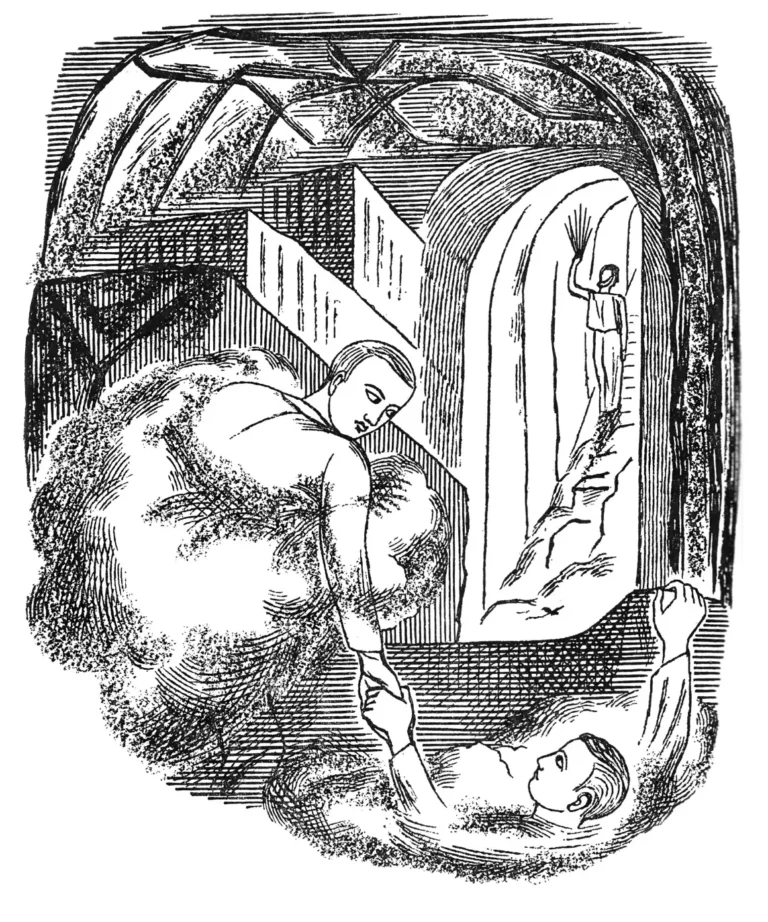
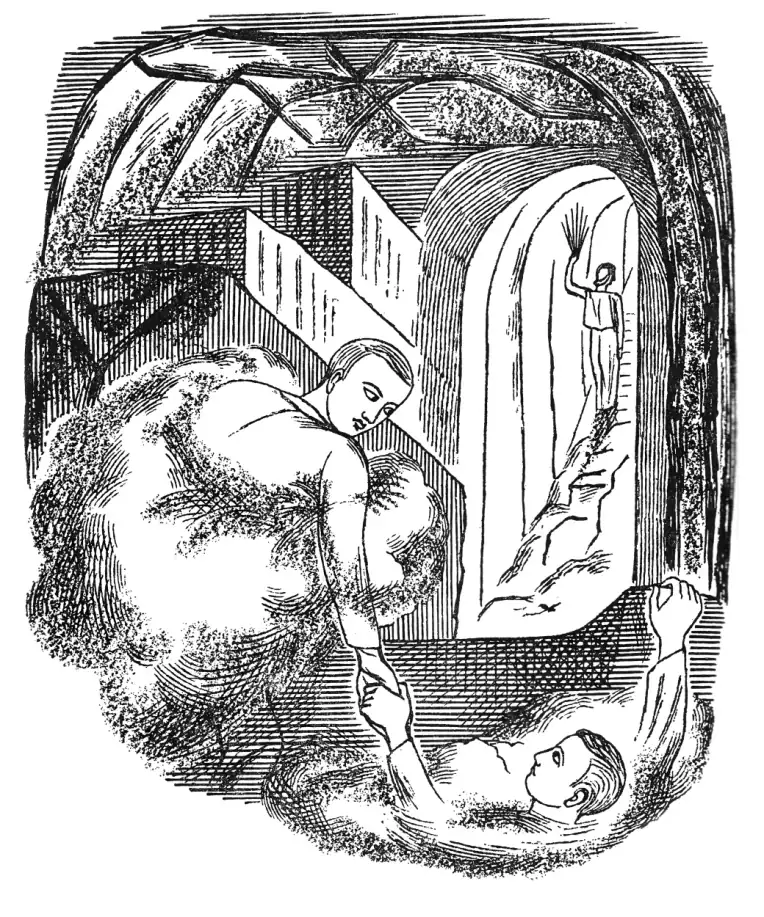
A WELL-LIT cavern; the dreamer and a friend are descending a wide passage, obstructed by great stones and rubbish, earth, shingle, sand. They are seeking a way out. A feeling of compulsion, of the necessity of the search, its success being doubtful but possible. Somewhat distantly appears, very distinctly, a human form, enveloped in robes, and at first motionless. The dreamer and his friend continue to descend and approach this figure, without any emotion. They perceive at last that the figure is on the other side of an open space from which several passages radiate in different directions, some ascending and others descending.
The figure is a little way onward in one of the ascending passages, and is already at a higher level, so that in order to reach it one must scale a block of stone, in shape like the step of a stairway but higher than a man. A feeling that this is the guide to follow. Certitude.
The two companions address themselves to the climbing of this high boulder, each aiding the other. Reaching its summit, they see the figure has meanwhile gone higher up, into a passage now obscure, and is holding a lamp: turned towards them, awaiting them. They continue to go on and up, with great and growing difficulties. The figure always waits for them a little further on, but never allows them to approach it. Consultation between the two companions: Is the guide friendly or inimical? Is he leading us to disaster? Then, suddenly, their joint decision: It matters not; catastrophe is the same thing as success, we must follow. Immense happiness at this decision. The figure allows them to approach nearer: they feel it to be benevolent in the midst of a danger which is terrible but without importance. Acceptance of death, death being triumph. All three closer together, the guide still veiled, continue to scale the boulders and to ascend the passage, and all three are happy.
The Life Beyond
Dialogue. The Son, the Mother
THE MOTHER: Then, what do you believe, yourself? That he is in heaven? That he is here? Where is he? THE SON: I believe that something remains. Each time his eyes became clear again, he was the same, and spoke in his usual way, he understood everything; right to the end the whole of him was present.
THE MOTHER: Where is it? Where is he now, then?
THE SON: That is what one calls God. In your mind there remains always everything you have ever seen. You may remember it more or less, but it is always there. If nothing remained, you would have no mind.
THE MOTHER : I know; I remember everything always. THE SON: Well, God is that which remembers all things. I believe that all we have been, from birth until death, is preserved entire and living in the clear mind of God. And when you die, you will find again all that you have known of him since the beginning. God remembers everything, and when one is dead one is God.
THE MOTHER: Then you do not believe that he is going on existing, all unhappy, somewhere else ?
THE SON: No, he is in God, all of him present together in God’s mind, all that he has done or thought from his birth to his death. After his death it is no longer he, it is God. THE MOTHER: I understand. You find again all you ever were. All the evil, too, so that is hell. The happiness that you have known and find again—that is heaven. But what if you have forgiven one another?
THE SON: That counts at the moment of forgiveness and after: and it softens the memory of evil. THE MOTHER: Yes, it must be that something remains: and therefore everything must remain; for God, at our birth, makes something happen, someone to be, where there was nothing before: it is much easier for him to preserve something that already is. He preserves everything. And of necessity there must be the Good God, otherwise there would be nothing. If there remained nothing, there would never be or have been anything. Since there is something, there is God, who has made everything and preserves everything for ever.
The End of Fear
THE MOTHER (two days after the Father’s death): And to think that now I feel no more fear of the dead! I, who all my life was afraid of them in the dark! And my poor daughter; I was so frightened of her, though I longed above all to see her again and ran everywhere I could think of at midnight to find her wherever I thought she might be! I was near to dying of fear as I ran, yet I wanted so much to see her that I galloped in spite of the fear—and even it was the fear that made me gallop, And now I walk about everywhere in the middle of the night and no longer feel any fear at all of the dead. Because he—he protected me, always.
I have now a protector among the dead. A powerful protector. Now I shall get on better, there’s no looking after him of a night any more. He no longer needs me, he is just rotting away. It is strange! Now I want to live. I thought to myself I was sure to die because I didn’t want to live: and now it seems to me that I want to live.
Death—you know, that is what nobody wants. THE SON (to himself): Without that ending, they would not have known how much they loved one another, neither she nor he. Now they have known it perfectly. The presence of death has caused them to gather together all their strength, and they were not frightened, they triumphed over death in themselves, their strength proved greater than their fear of death. The Mother confronted the approaching death with all her forces, without knowing at first that it was death, but right to the end without hesitation or any doubt of her own powers. Moreover, their love revealed itself as stronger than their innumerable hatreds for each other.
Without suffering and death, one learns nothing. We should not know the difference between the visions of the intellect and the facts.
Only those ideas are acceptable that hold through suffering and death.
When the intellect intervenes, the idea is finished. Intelligence consists in halting at the brink of the ditch one has to jump.
Indeed, logically, when one comes to an empty space, one ought to halt.
But life is that which leaps.
Intelligence is cowardice.
The one quality is courage: one attains to truth, as to life, by courage only. Courage to see all the risk, and jump.