
PART II THE HEARTS NIGHTMARES
I: The Dead Father has to be Looked After
THE FATHER’S death was in November, 1936.
On February the 7th, 1937, at about 5 a.m., the son had a dream of a very exceptional quality: he was beginning to know about dreams.
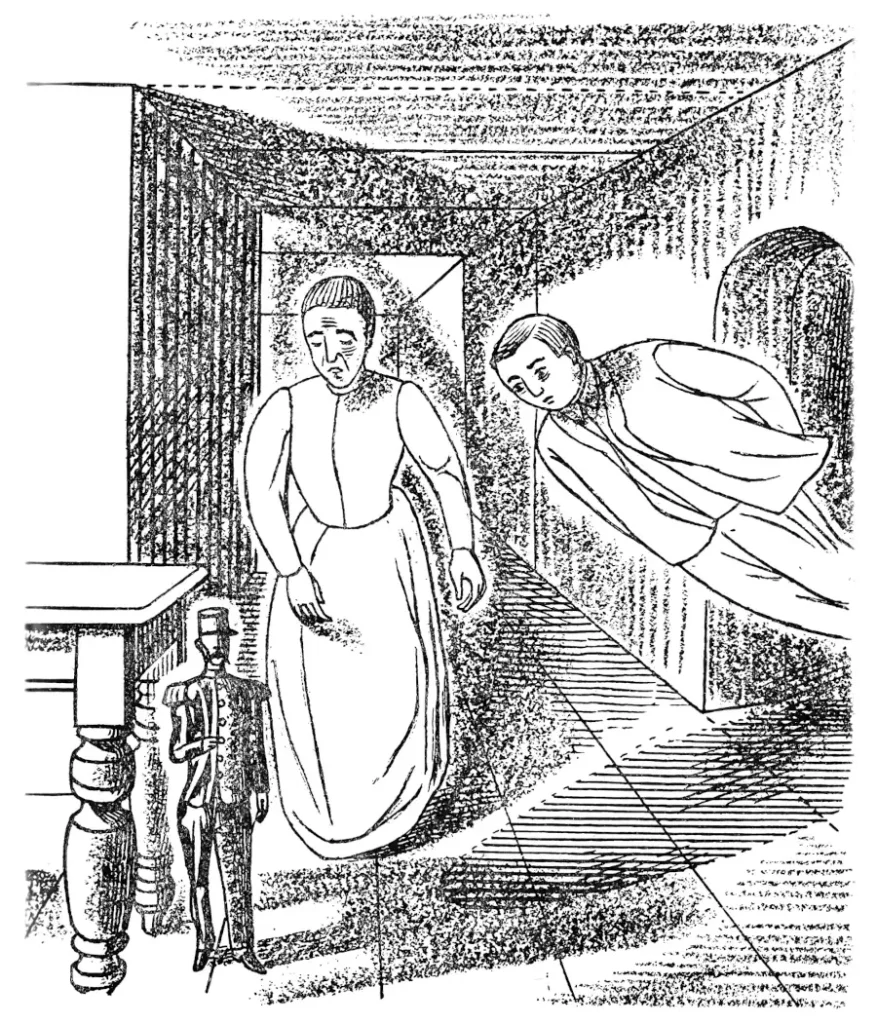
The dead father was, with the mother and the son, in the kitchen of their house. But the father was only as big as a child of three; his head just reached the height of the table. He was dressed in a small semi-military uniform, such as could still be bought in those days to amuse children.
On his face there was an expression of absolute indifference.
There he was, holding himself up perfectly straight, motionless, not one feeling legible on his stiffened face, quite small, three feet high. He was dead, and he had come to stand at the family table; not as a dead man who comes partly alive in order to revisit his own, but as a dead being, become small, impassible, indifferent, non-existent truly. Dead.
The mother and the son looked at him, without any kind of fear, with love, with concern. What could they do for him? He had not come either to threaten or demand or beg. He was there; nothing more. Quite small, though well proportioned as a man, not as a child; three feet high; dead; indifferent. Those precise points penetrated clearly into the understanding both of mother and son.
Looking at him with great attention, they became aware, nearly at once, of another strange thing: dead though he was, indifferent though he was, the left-hand side of his body was strong, full of substance, proportioned as in life. This was apparent on the left-hand side of his face, on his left hand, and even under the stiff cloth of his uniform, well filled on that side. But the right side of him, on the contrary, was dry, parchment-like, nearly scale-like, and so wasted that the skin seemed stuck on the plain bones. This could be seen on the right part of his face; his right hand; and the small uniform, so well filled on the left, was half empty on the right, as though hanging on a skeleton.
But the small dead man did not move; did not look even. He was there, standing by the table, waiting, with a sort of eternal quality in his waiting, in his presence. All at once, the mother stood up and said: But he is very ill; he must be looked after, immediately.
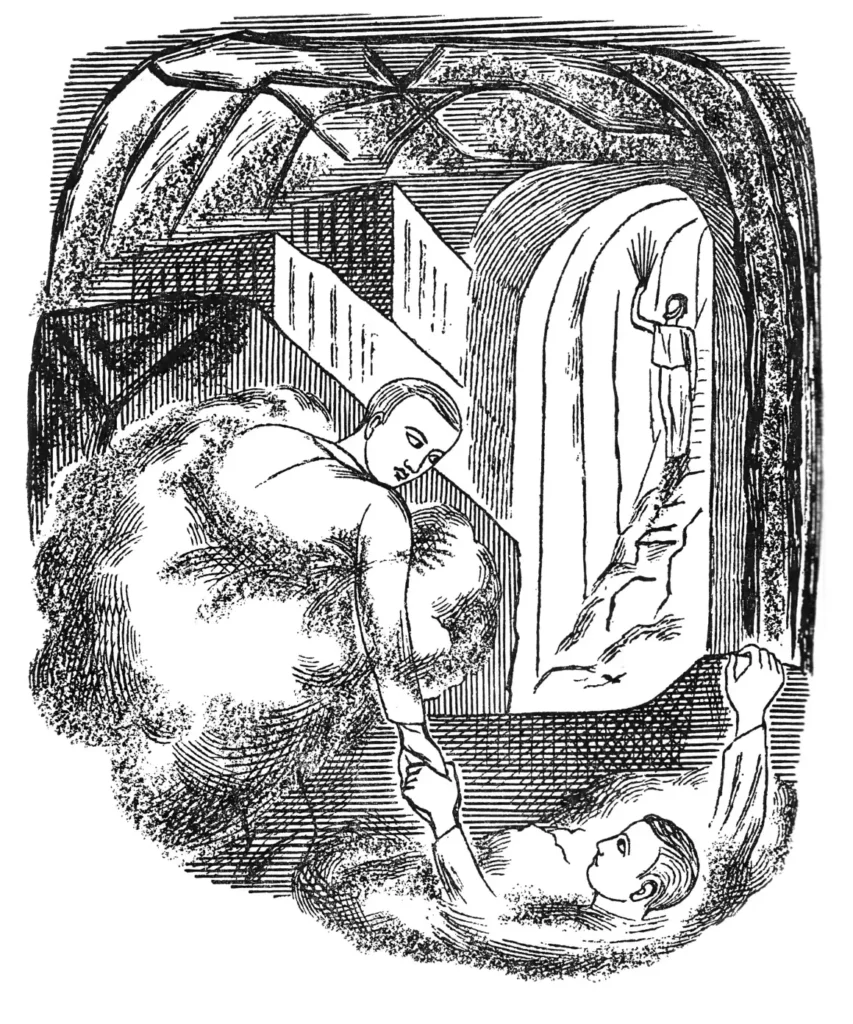
Then she bent down, took hold of him, who remained small and docile in the grown-up motherly arms, and carried him on to a bed in the next room. There was a fire in there. The son understood what was to be done, and started rubbing the dried-up side up and down with a piece of flannel, white and thick, that somehow he found in his hand. Then, in one instant, the dream was over; the son woke up feeling neither horror nor fear, but in amazement. For a few seconds, he went over all the details, registering them in his memory, and then he went to sleep again, to awake at his usual hour.
II: The Father is Cured
TWO DAYS later, at the same hour, at the same place, three hundred miles from the village where the mother was, in London, the father came into a second dream. Again in the kitchen, dressed as the first time, but quite cured. The same height, that of a three-year-old, the same indifference, as though eternal. There he was. The mother and the son were looking at him with deep affection, trying to understand, ready for anything.
The small uniform was equally well filled on the right as on the left. The flesh on the face was homogeneous on both sides. The flesh could not be called healthy since it was dead; that could be clearly seen. But it was no longer dried up and shrunken anywhere. It covered the bones to the normal thickness of living flesh on a living skeleton—again, the proportions of a man, not of a child.
Mother and son felt happy. They had healed the little dead man and now there he was, perfectly indifferent, but perfectly sound in his death. No gratitude, no feeling whatever could be read on his face. There he was. All was well.
Once again the son awoke; then, after a few instants, went to sleep again, to awake again, still amazed, at his usual hour.
III: The Stranger comes to kill the Father
DECEMBER THE seventh, 1938. The foregoing summer the son had taken his family to spend two months in the village, to look after the mother, whose health was not very good, cheer her up, let her have the children for a while. Then had come the separation, as every year: the old woman alone in her house for the hard winter of North Eastern France; the son at his work in London: the mother refused with the utmost determination to come and live with the family. On that morning—December the 7th—long before the late dawn, the son had yet a stranger dream. The two parallel dreams of the father, first curiously ill though dead, then cured though dead, had been repeated several times, the cure dream following the disintegration dream within two or three days. But this was a completely different dream. A perfectly unknown stranger had installed himself in the kitchen. A rather large man, in good health, fairly young. He was talking, in a friendly way, to the mother and the son, putting to them this extraordinary proposal that they were to kill the father when the father came back. The father was out, alive and well, this dream being placed in a period previous to that of the earlier dreams. The mother and the son felt no surprise and were inclined to agree. This murder seemed to be the obvious solution to some otherwise insoluble problem. What problem? That was not apparent in the dream: but the problem was there, and so well known that there was no need to be conscious of what it was. Then the father came back. He was in a gay mood, pleased to be home again, strong and quiet. The stranger was introduced, and after some conversation about insignificant matters, he said to the father: Could you lend me your pocket-knife ?
Adding some explanation that was not perceived in the dream, but of this kind: A small stone has got into the sole of my shoe, I want to prise it out.
The father took his knife from his pocket, opened it. He was particularly careful of that knife, which he sharpened regularly, as he used it to kill and skin rabbits.
He held out the opened knife, the bright blade reflecting the light, and the stranger put out his hand to take it. The mother was now behind the stranger, who was standing up, and the son was behind the father. At the moment when the knife was going to change hands, the mother all at once threw her arms round the stranger, pinning his arms to his body, and, simultaneously, the son pulled back the father’s arm to prevent him from giving the knife into the stranger’s hand; and the mother and the son cried out together—He wants to kill you! Then the whole scene disappeared. This dream was not repeated.
IV: The Steeple
ON THE 23rd of February, 1939, this series of dreams culminated in a final tableau which explained the series. The village church was clearly seen. An enormous church built on the ordinary rather ugly scheme of ordinary village churches in this region.
The steeple was very high, built up as a very elongated pyramid on a large square tower, against one of whose blank walls the children used to play ball: no boy, or man, could send a ball up high enough to reach beyond the tower wall to the base of the pyramid.
That morning the village was empty. The solitary church dominated the village and the dream.
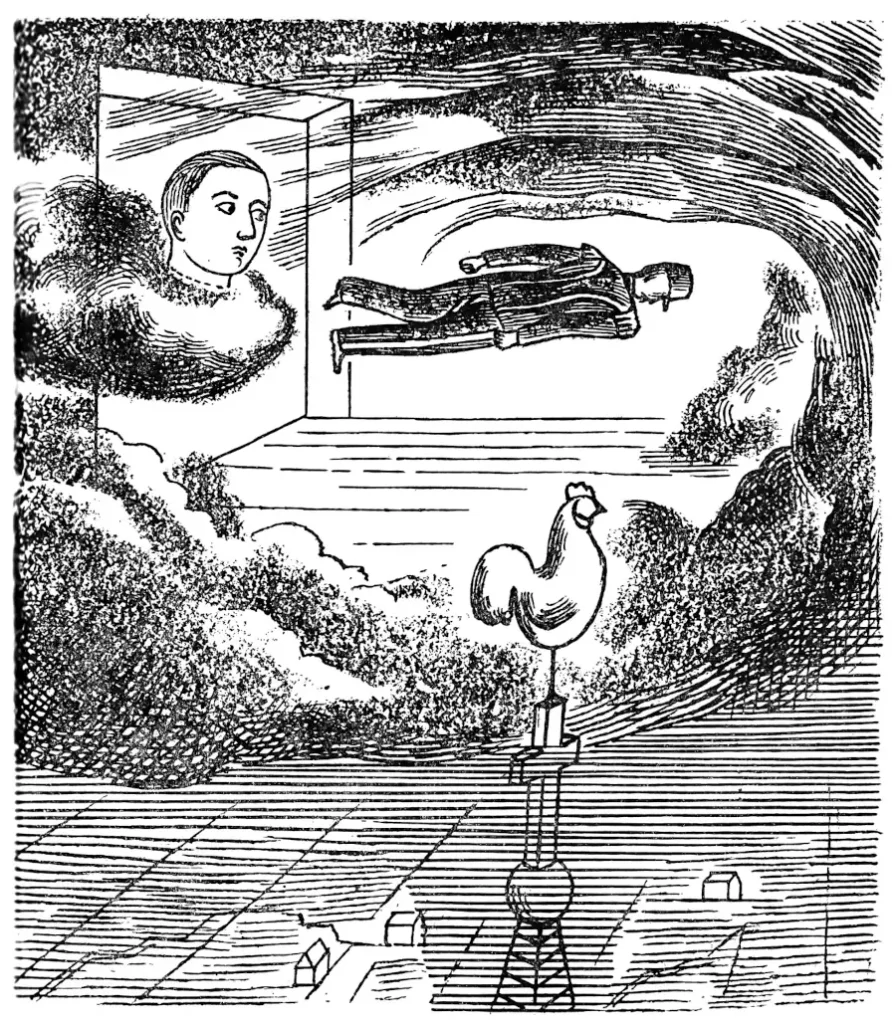
Yet, above the cross that surmounted the steeple, above the golden cock that stood on the cross, as on most village spires, something quite unusual was happening.
A few yards above the cock, the small dead child-sized body of the father, as seen in the early dreams two years before, was revolving slowly in the air, on its longitudinal axis. The dreamer could see it plainly, and felt with some satisfaction that the little dead body was undamaged: the right-hand side and the left-hand side “were clearly seen in turn and both were sound. This lasted for quite a long while, and registered deeply in the mind of the dreamer. No feeling whatsoever went with it. Then the dreamer woke up, and in his waking consciousness came up at once a sentence that was habitual to his mother, and which he had never heard anyone else use. And that sentence was the key of the vision.
Embouya boula. Embouya boula al desus del cloche de la gleiso. Envoyer voler. Envoyer voler au dessus du clocher de l’eglise. Send him flying. Flying above the spire of the church. Except that ‘boula’ in the Pyrenees dialect the mother used has a double meaning, to fly, and to roll.
To send someone flying means, of course, to get rid of them; to be so completely indifferent to them that you send them away at full speed. And as in this village the mother lived opposite the church, the maximum of indifference was to her to send some one flying not only on the ground, but into the air, high above the church, higher than the children at play could ever send their ball: higher even than the cock on the cross of the steeple.
And now the dead father had been sent flying thus high; flying and revolving above the cock. Who had sent him flying?
The son, of course. The mother, from three hundred miles away, was accusing the son of absolute indifference. Indifference to what?
To the father? The father was dead; the mother knew too well that the son was not indifferent to the dead father. In her mind the relationship father-son was sacred, far more sacred than the relationship mother-son—she was from the oldest race in France, from the mountain race of the Pyrenees, where the male ancestral worship is the basis of life, as with the Romans. Then the whole explanation jumped into the light. That was not the father dead already, who had died again, though only a second half-death, in the early dreams. That was not the father whom a stranger had tried to kill. That was not the father that had been sent flying in total indifference.
The father was dead already, and safe, indifferent. The mother was the subject of the visions. Then the working out of the vision was easy. The son had noted the dates of the nightmares. On his next visit to the mother, he got hold of the doctor’s bills, and found that in each case, on seven different occasions, the dates of the nightmares were the dates of the heart attacks which periodically brought the mother—as she thought—to death’s door, but from which she recovered after two or three days.
When she was in good health she was determined not to go and live with her son, wishing to remain quite independent. But in the anguish of the attack, she sent out an appeal for help. Only she felt: he will not come. What am I—a woman—a mere mother—not much, in the Pyrenees, down a thousand generations for whom life had been very hard. However much he cherishes his mother in his heart, a man has other duties: his work, his children. But no duty is above the duty to one’s father: that causes one to put aside all other duties. Therefore send out the appeal that the father is in need, and the son will come. He had come when the father had died. He would come again.
But the son, receiving the message, knew that the father was dead. Therefore he did not receive a vision of the dying father, but distorted it into a vision of the father dead already, and indifferent, but yet in a strange way in danger again, and needing him.
The son’s nightmares were compounded of the mother’s message—not exactly a lie, but rather a wishful: ‘for his father he would come’—with the son’s knowledge that the father was dead. Yet deeper down the son knew better, and he helped: in his helping action, in spite of his prima facie uselessness, since the father was dead, he came to the rescue of the mother really, under the double distortions: the distortion of the mother’s need put on to the father; the second distortion of the son’s knowledge, partly, but only partly, correcting the mother’s picture by adding to it the fact that the father was dead; yet acting on the spirit of the appeal, and giving help. This had happened seven times: communication indubitable. What about the stranger who wanted to kill the father? The son discovered that on the date of that vision, during a heart attack, a new doctor, some locum tenens, had come in; the mother had refused to trust this stranger, feeling: he will kill me. The image transmitted to the son had shown this feeling and refusal transferred on the father again. Mother and son had stopped the stranger—from killing the father?—no, from doctoring the scared mother. But this time the mother had felt she could get cured by herself, and the son, taken unawares, had transferred the appeal on to the living father, since the appeal was not that he should come but merely a refusal to have the doctor; and the son was not necessary for that; therefore he did not have to register the protest that the father was dead already.
The final vision was simple: the mother had now reached the end of her forces, and was accusing the son of total indifference —hence the image of the father revolving above the cock on the spire.
Therefore only one thing remained: to fetch her, willing or not, and bring her to London to be properly looked after. This was done; and the nightmares ceased.