
PART IV: HIGH DREAMS
1: The Old Man and the Marble Forms
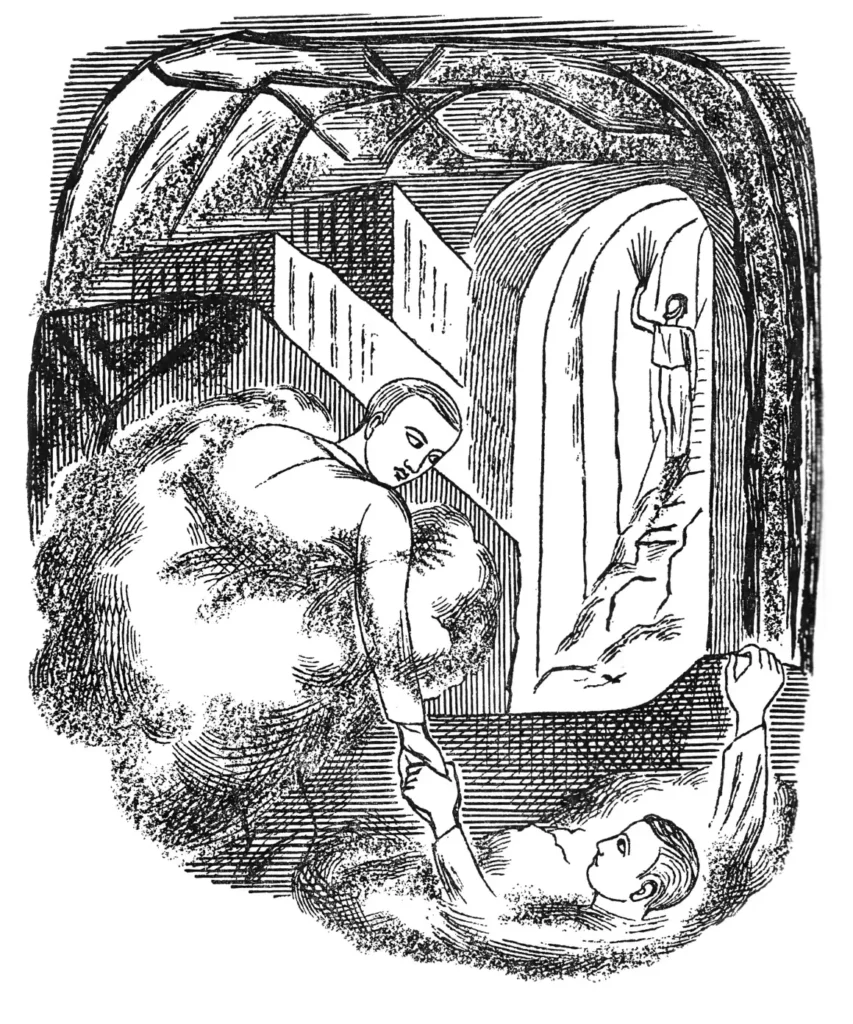
A STONE hut by the roadside in the middle of a forest. The hut was rather large, twenty feet by twenty-five; the stones were roughly squared, more or less cemented, solid but primitive. The weak point was the door; the boards were disjointed and half rotted, and just held together. Really the door did not close; any strong blow from the outside would open it.
Past the door, on the road, an unending German convoy was going by. Spring, 1942. Cars, light tanks, armoured cars, artillery of all kinds, lorryfull after lorryfull of infantry, everything imagination has contrived.
The man who lived in the hut was looking on, watching the procession. His heart was quiet and full of courage, but he could do nothing but stay there and watch. That was much as it was. He knew that behind him, behind the trees and bushes, a bow-man from the olden times was in hiding, a kind of English outlaw from Robin Hood’s following who, occasionally, from cover, pierced through with an arrow one of the German soldiers that sat on the back seat of some vehicle. The Germans had no time to stop and hunt for him.
This lasted for a long time; so long as to seem permanent. At last—this was expected—in the column there appeared a peasant’s cart, drawn by a mule, keeping pace without much difficulty with the slow tanks and lorries.
An old man dressed in a marshal’s uniform was sitting on the front seat, driving. The small two-wheeled cart was loaded with odd pieces of furniture: a table, a plank bed, a small cupboard, two chairs; a poor man’s furniture, that can be taken away on a cart to escape from an invasion. On the back seat, a little girl, ten or twelve years old, very pretty, dressed as a peasant child, but warmly, was sitting rather comfortably, looking back to-wards the end of the convoy; apparently waiting for something, not even anxious or startled.
The man in the hut looked at them for a long time; on the straight road, he could keep them in sight for a long reach. The man thought: I hope the bowman will not shoot at those. But nothing happened.
The bowman, somehow, had got into the hut; not through the door; perhaps through some hole at the back. He said nothing but sat in a corner. Both men were thinking: the little girl will not be shot at. Even the Germans on the following vehicles had seemed to look at her with some sympathy, as a rather tired bull might look at a sheep at the other end of his meadow. Then, all at once, a huge horseman stopped outside the hut. The German column had disappeared. The gigantic and menacing soldier got off his colossal horse, stood at the open door—which hardly hung on its hinges—and looked into the hut, as though wondering: ‘What can I do with this ?’ The man in the hut went forward to meet the horseman, and meet what was to happen. Then, all at once again, the huge horseman was, apparently, obliterated. A ray of dark purple light, of which each particle was vibrating with an intensity that could just still be perceived, although on the verge of non-perception, came down between the horseman and the man of the hut. The horseman was no longer seen.
The man said: ‘I am ready.’
The purple ray was practically vertical, but not quite, leaning perhaps a foot towards the right at the top of its visibility, the base touching the beaten earthen floor of the hut.
As soon as the man said: ‘I am ready,’ the base of the purple ray lifted itself from the floor, then left the hut, the forest, the Earth, the solar system, the Milky Way, the world—at least this world.
The man of the hut went with the purple ray.
The colossal horseman went on looking into the hut, which now appeared empty, as he could not see the English bowman, who had not moved from his corner, from where he could have shot the horseman through the heart, his arrow being ready on the bowstring.
But the man in the ray had long ceased to see them. An empty interval.
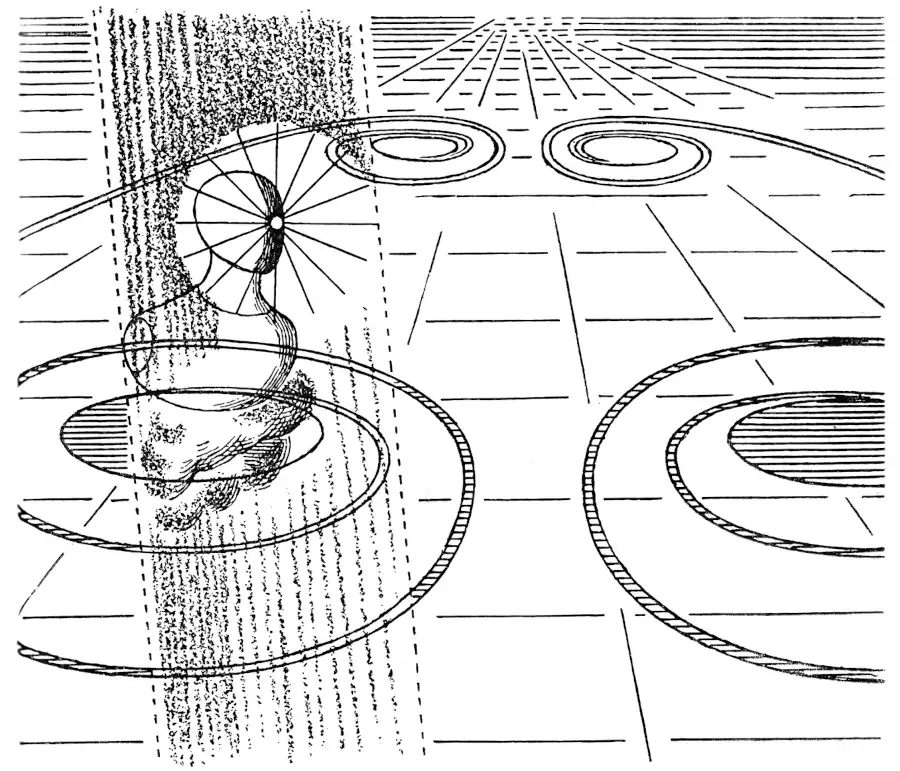
Then the man was looking at a completely non-human landscape; non-cosmic even. The man himself was now quite small, nearly non-existent, yet eternal: he was now one of the vibrating particles of the purple ray, which, naturally, he could not now see. He was looking at some great parallel lines curved in an inconceivably elegant form, running, not out of sight, but as far as the man could see, and then curving back, perfectly defined, never lost sight of, coming back in simple arabesques, curving inward, ending inside their own orbits in enormous commas and marks of interrogation.
The man could see that the interval between the parallel lines was not empty, but formed from a white hard substance, of which on the earth white marble is a figuration within human comprehension. His enraptured mind followed the immense marble roads that curved with grace and power as far as his perception went, without useless complications, curving back just at the limit of perception, coming back into the centre of the vision, on to the perfect circle which ends the interrogation mark. A huge system of marble roads stretched thus to the right, another to the left, the two immense curves facing inward to each other, bound, though not touching, through the harmonious proportions of the whole.
Then the Man-Particle of purple light saw, gradually, that this marble was a living and vibrating substance. Without in any way interfering with their perfect alignment, the great marble roads were vibrating, rather slowly, with grace and majesty, in harmony; like sounds on earth vibrate harmoniously within an orchestral symphony in which everything is in order and in motion.
The man was just looking on.
From the purple ray that he could not see because he was a part of it, through a sort of pressure that came from the whole ray, the thought was forming upon him, very clearly and unavoidably transmitted and forced upon him:
—these are worlds that are achieving existence and consciousness; their vibrating is the beginning of their self-consciousness as worlds; one must be very high to see this; few beings have ever seen it; the soul must be completely away from the body to see this.
2: The Pyramid
THE YOUNG man—eighteen?—was standing on a rather narrow platform that stretched at some length right and left, then turning away at right angles—say, twenty yards from where he was.
In front of him, a rather long and narrow table, at which three women were sitting watching him. Behind them, the inclined side of a pyramid rising to a hundred feet or more, quite smooth, although the angles he could see, to the right and to the left, were somewhat blunted by the passing of years—or of centuries. A small door behind the women.
Before taking a good look at the women, the young man cast a glance downward, right and left, and saw that they were nearly at the top of a huge pyramid, of which the slopes spread below him, in big stone steps of three feet in height, going down perhaps for five hundred yards to an immense plain, visible but indistinct.
He brought his eyes and his attention back to the three women sitting in front of him; with a mixture of severity and sympathy they were considering his case. The woman at the centre was perhaps fifty; not fifty as a woman who has lived fifty times twelve months since she was born as a baby girl, but a woman who had always been, and would always be, fifty. She was, in her way, beautiful, without a trace of degradation or heaviness; the flesh was full, the curves harmonious and nowhere excessive; a tall woman, it could be seen even when she was sitting. Her eyes seemed to reflect all there was to see; not penetrating, rather receiving; a half-smile on her face: half severity, half sympathy.
On her left sat a woman who inclined more to sympathy. On her right, one inclined more to severity, though sympathetic still.
The woman in the middle had the true equilibrium: wisdom coming from experience but tempered by kindness. The woman on the left of the tribunal was the youngest: twenty-five perhaps. Slender but tall, with strong and elegant muscles. Her face was full of hope and enterprise. She was ready to accept the risks of her kindness.
The third woman might be thirty-five. Her kindness was harsher. She was looking into the future to see what the results of present kindness were to be; she held back kindness, as a driver of horses holds back impulsive horses to force them into the proper road at the proper speed.
The young man—eighteen ?—became aware at last (this was the last element in the picture) of a young woman of his own age, or perhaps slightly older, standing next to him, straight and firm, perfect in bodily form but rather plain, though pleasant, of face. In her face could be read a potential wisdom, of which the two elements, severity and kindness, had not yet developed. The face would become beautiful later, if the woman succeeded; or else would fade into calm, joyless old age. The love in the woman had not been freed yet. She was watching both the young man and the tribunal, attentively, but with no expression except of good will.
The sitting was over. Decisions had been taken. The youngest of the women judges stood up, threw a very simple cloak over her shoulders, and came towards the surprised young couple. Then facing outwards, towards the descending slope, the girl took in her right hand the young man’s left hand, and both looked at the descent for a moment, by the side of the unexpected com¬panion now changed from a judge into a comrade. The other two judges remained sitting, watching in silence; the three young people now had their backs to the table. Then, all at once, the man took a great decision, and, pressing strongly the girl’s hand and taking her along as he would a bride, jumped lightly on the step below; and both began jumping from step to step, joyfully, more and more joyfully as they descended. The two women judges, the more severe and the kinder, were smiling now, sitting relaxed, as the young man could see by a last glance over his shoulder, before he lost sight of them at the third jump.
The youngest judge, the enterprising one, was jumping by the side of the young couple, independently but in harmony, evidently joyful too.
Half-way down, the young man, looking below him, became aware that the steps ceased some twenty yards lower down. The slope continued as a plain straight hillside made of some kind of cement.
He understood at once what was to be done, and glanced at the two women; the girl, whose hand he was holding, knew at once; the other had always known. Then, at the last step, taking their slight jump, they inclined the feet forward so as to have the toes slightly downwards and strike the slope with the whole foot, toes, plant and heel, at once, whereas before they had landed on the toes and the first supple joints of the foot, lowering then the heel to the ground before jumping again. Now the surface of the pyramid received the whole foot at once, and it was that surface, made of some sort of elastic substance, which yielded slightly under the foot.
The man looked at the two women again after three or four jumps and received a reassuring smile. Things were going well. But now the length of each jump, which had been determined before by the height and width of each step, was left to the discretion of the leader and the young man calculated each jump, holding his bride by the hand.
The other young woman, at a slight distance, regulated her efforts on theirs, in friendly concord. Thus they reached the bottom of the pyramid. A last effort was then to be made: a kind of ditch of no great depth or no great width ran right along the base, and it was necessary not to jump into it. Necessary but easy. The three took a last jump and landed at last on the firm elastic earth, the earth of the Earth now, that stretched before them infinitely, with slight undulations, covered with short familiar grass.
After a hundred yards or so, the young woman, graciously and gracefully, bowed to the couple to say goodbye, then turned to the north-east, leaving them. They stood looking at her for a few minutes, then turned south, still holding hands, and went joyfully towards the sun.
The young man’s last external thought was that the woman-judge, going north-east, would have to go along the face of the pyramid before she could take her true direction, and therefore go east for a while, or at least east-north-east to the angle. Then he looked at his bride.
3. Children on the Staircase
AN IMMENSE hall, as of a palace, or a prison, or a school. A desert of polished and dangerous marble, black, with white designs.
On the back wall, an immense staircase, four flights separated by long landings; the whole four flights and the three landings all planted against the one interminable wall—out of all propor¬tion or necessity. A long file of children, two by two, or three by three, or even sometimes four by four, holding hands, waiting, the whole length of the hall.
Never has an architect on earth put four flights of stairs, and three long landings, against the same straight wall. Therefore, duplicating this impossible staircase, there was another, zig-zagging upwards so that at the first landing one could go to the right, up to the second floor instead of going on upwards to the left; then on the second floor one could go left again upwards, and so on. But some kink in mathematical space brought it about that the top of the zig-zagging staircase and the top of the longitudinal staircase reached the last floor at the same spot. As though the top of the hall had been folded back upon itself, and the two upper exits, which should have been some eighty yards apart, were actually one.
The children were to go up to the last floor. Why? No one knew.
The stairs had no railings. The children went up and up alongside of a sheer drop that grew deeper with each step; and the children had no protection against a fall. But the brave little things, holding hands by two, or threes, or fours, went up unperturbed, and there were no accidents. At the top they came to a much greater difficulty.
The steps were built at right angles against the wall, so the last step of all abutted on the empty air, touching the last floor only on the right at one point, and even there, twelve inches below the platform. Had a child gone straight on, he would therefore have fallen down the whole height of the four flights. So, when reaching this last step, each child had to turn to the right, and then pass on to the final landing, leaving the abyss on his left. But at this point a wall built on the last floor abutted just in front of the child. To reach the large platform the child had to reach his foot diagonally across the abyss, and put his left foot on the landing while his right foot was still on the last step of the fantastic staircase, twelve inches lower. Therefore, at one moment, the child had his right foot on the last step of the stairs, his left foot on the landing that was perpendicular to this last step but twelve inches higher, and some thirty or forty yards of empty air between his little legs! Besides, the child had to leave enough room between his left foot and the wall to put down his right foot and so come up on the platform. The slightest mistake in balancing threw the child down. Passing into the higher world was effected by a clever little gymnastic trick: the left foot twelve inches to the left on the edge of the upper floor, the body bending forward on the left leg, then a jerk upwards to put the right foot by the side of the left in the interval between the left foot and the obstructing wall on the right.
But all those merry little souls knew the manoeuvre admirably and, light and careless, each one swung round to the right on the last step, with complete disregard of the abyss on the left, jumped slightly and lightly up and across, on to the top floor. There each one threw himself vivaciously into the upper world and began to run and play with his fellows in the huge free space. No awkwardness, no fear hampered the little things, inured to abysses and death.
For this final point where the last stair touched the upper world and the abyss, was death. Death, which men fear so much; not children, nor animals.
Now, the last six or seven children were reaching this last step; all went across lightly, except the last.
The last child, suddenly, made an astonishing being come out of his small body: a being made up of six black lines: two for legs, one for the body, two for arms, a smaller one for the head. An abstraction of a man made up of black matchsticks: a drawing on a wall by a school-child.
This small schematic and abstract being was extremely agile and took his position in the abysmal angle, one black matchstick of a leg on the last step, the other on the landing, blocking the possibility of a jump, obliging the child to stay on the stairs. Then the child began running to the left, then to the right on the step, as though to dodge the matchstick abstraction. But the thin replica, with exactly the same agility, moved as the child moved, keeping in front of the child, who thus could not even have thrown himself into the abyss.
All at once, the child ceased running; at one of his turns, he had seen that another long line of children was beginning the ascent of the stairs. The child put his back against the wall to watch; the black abstraction made of six black matchsticks kept his stand above the abyss; and both were now looking at the mounting generations.
4. Elytreans
THE MAN was watching. His eyes were mounting guard carefully over a large empty space, into which, gradually, came an amazing being.
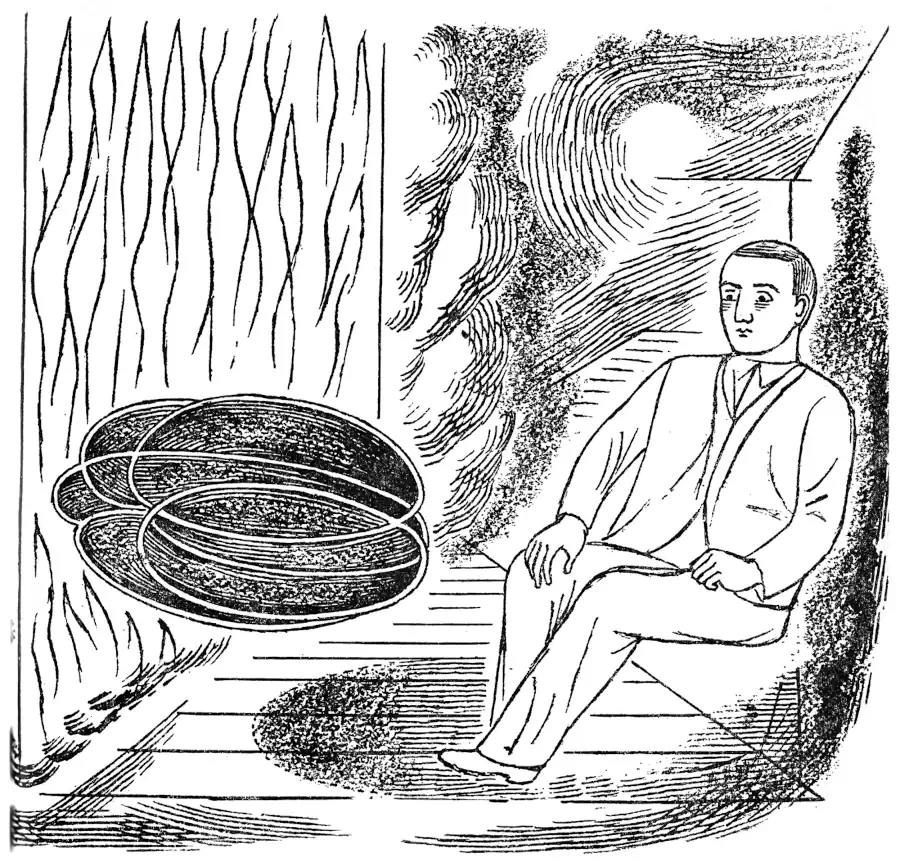
Three feet high; three feet wide. No thickness that could be assessed from any distance: perhaps one-third of an inch. Five large shells meeting at the centre, like the wing sheaths of an inset—the elytra, meeting on the insect’s body. But not in pairs here: five meeting at one centre; no membranes, no insect body, no coherent point. Yet very solidly joined, imbricating at their base. Hard elytra, wing sheaths without wings, without body, or legs, or head; only the nearly fictitious thickness of the tough elytron.
This being came nearer to the man, without apparently using any means of motion, legless, the five elytra remaining motionless. It merely came nearer, with an abstract sort of motion.
It had been ten yards away; now it was five; next, two yards away. It was watching the man. The man was watching it through his two eyes and his brain. The elytrean was watching the man through its hard shining substance—no eyes, no feelers, no legs, no filaments, no body. Watching through its third of an inch thickness, or less, through the elegant curves of its shells, through its ovals one foot wide, one and a half feet long. The man could see very clearly the five shells that somehow were joined in the centre of that being, curved slightly towards the back, rather like immense oyster shells of slight depth only, but black outside as inside.
Black, shining, lacquered. A quality of living substance in the lacquer. Perhaps it was through the lacquer on the shell that this being could feel, see? think? The man could not conceive how, but he knew that the elytrean was observing him with great attention; he felt that he, the man, was as incomprehensible to the elytrean as the elytrean was to a mind carried in a human body.
Suddenly, behind the black lacquer of this being, appeared a large wall of flame; a big vertical square fifteen feet high, from which there radiated as far as the man a kind of gentle warmth that carried no menace at all.
The elytrean seemed to concentrate in its motionlessness, its hard black thrown into relief against the flame wall; then, all at once, without transition or motion, it was in the fire, as though reintegrated into its own place; the hard lacquered black became transparent, then pink, then red on the flame, then golden, then silvery; the yellow flame also became silvery, and the elytrean dissolved in it, silver into silver; then the whole faded away and disappeared.
The man’s eyes were again exercised in vain: there was nothing to be seen within their reach.
Time passed. The man lived, came and went, attended to his work, to his wife and children; then, later, a day came, a moment when he found himself in the same place, perhaps at the same moment when he had seen the elytrean.
As the first time, there was nothing to look at. Then gradually a new being came into the man’s field of vision, obviously an elytrean, too, but a completely different one. The first must have gone home, to warn his fellows, caution them, explain that he had seen a man, or at least discovered a man, had been unable to make anything out of him; and then this one had been sent, this second elytrean, better equipped for research.
This one had long legs, some three feet long, very flexible, made up of eight or ten articulated thin pieces each; eight or ten legs: the man was unable to count them, for this one moved quickly. A centre shell, as large as the hand, partly circular, partly oblong or trapezoid, a mixture of several kinds of geometry. The thing remained for one instant motionless in front of the man, and some sort of communication took place.
The man thought: it knows, it perceives less of me than I do of it; it comes to inquire, to inform its fellows; let it proceed.
At that moment of the man’s thought, as though it had under-stood that the man consented, the elytrean, in one jump, was on theman. Its weight was as nothing. The man did not move, kept his heart, his mind, his body, unperturbed. With infinite delicacy, the long tentacles went over the whole body of the man, most gently over his face, curved to feel the back of his head, went by at one millimetre from the surface of his eyes, penetrated slightly into his ears, without even tickling him, or disturbing him, gliding over his skin under his garments without pulling on one of his hairs, going over the whole topography of his body; curling round his fingers and his toes, pushing an articulate point which he could barely feel between his foot and his shoe under the plant.
The man could feel directly the marvellous sensitiveness and delicacy of this being, who wanted to cause him neither the slightest discomfort nor the slightest displeasure; the man could not but admire the amazing intelligence of the elytrean, far higher than human intelligence, since the elytrean was taking the most minute measurements without in any way offending the terrestrial organism; whereas the man did not dare to move his hand for fear of interfering with some articulation of the great insect. The man thought: It understands my body much better than I can ever understand its body. It has a much better starting-point to understand me than I have to understand it.
Then, with a sort of inter-cosmic courtesy, the elytrean, with-drawing its long legs, stood again in front of the man, stretching its legs to their utmost in all directions, its eight or ten or twelve tentacles—the man was still unable to count them: he felt inferior intellectually. The creature, standing before him on two of its tentacles, radiating in all directions, moved all its articulations, as though to enable the man to understand the working of an elytrean body as it had itself understood the working of the human body.
By a kind of supreme salutation, it even raised its two legs from the ground, apparently giving up all means of physical support, and remained suspended in the air; then, all at once, it gathered all its tentacles together at the centre, and disappeared.
But the man was remembering the first elytrean which had neither tentacles nor body, and had disappeared into a wall of flame.
The man could understand nothing of those two, except on the highest spiritual plane: they had come in good will, and he had received them in good will.
So the man felt happy. What better basis could even intellect have found, on which to build an inconceivable future?