
DENIS SAURAT
Death and the Dreamer – Part 5
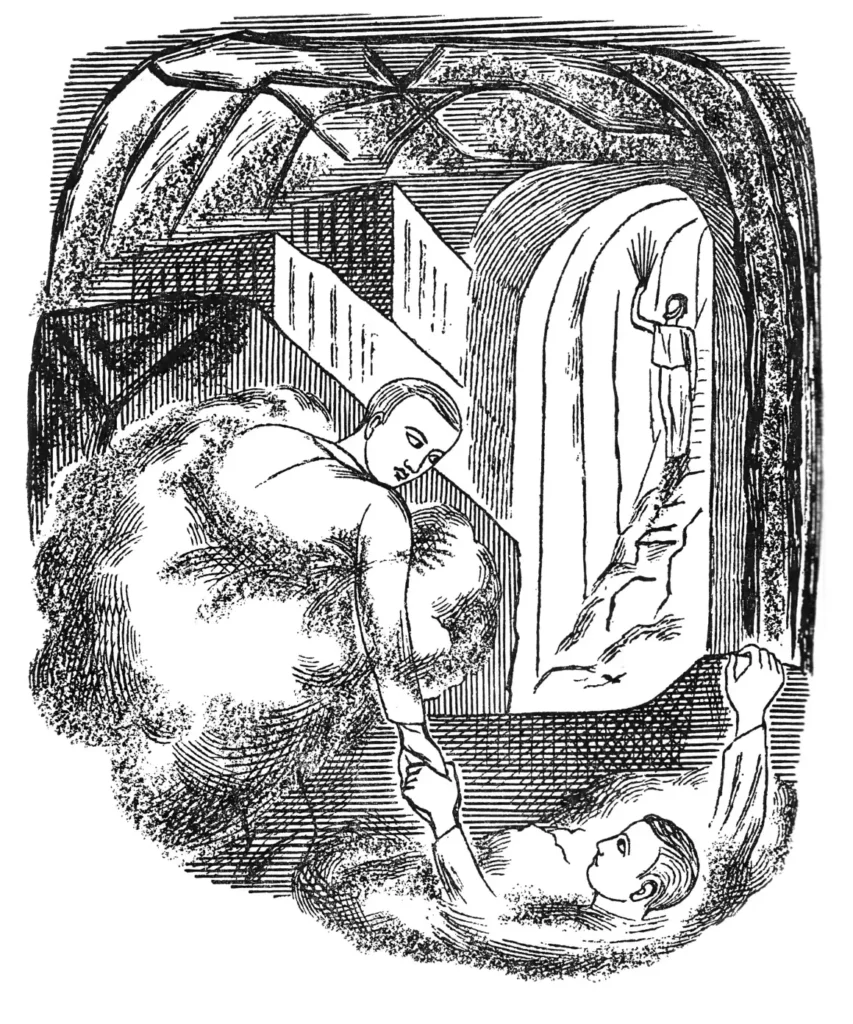
WITH
DRAWINGS BY EDWARD BAWDEN
WESTHOUSE London 1946
DEATH AND THE DREAMER
PART V. THE BOMB
I: The Bomb
THE FLYING bomb was approaching from the south-east with such a direct and growing intensity of sound that he felt that he was in the due line. So he rose from his chair at his desk near the window, crossed the room, and went and stood in the passage outside, with still a room between him and the street, under an arch of masonry: the architect had said that on the ground floor that was the most protected spot.
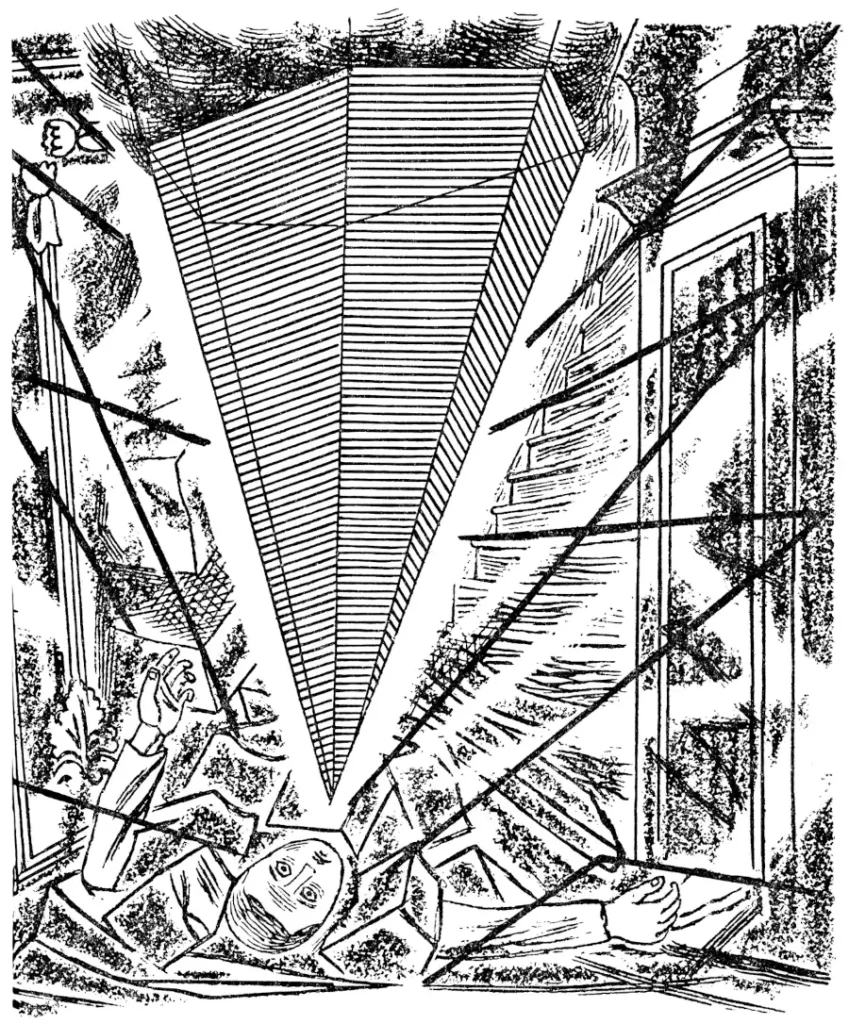
With the lightning rapidity of thought, which yet knows itself before it expresses itself, there came into his mind a sentence that was going to be: ‘ How fortunate that my wife and children are away!’ But at the syllable wi (‘How fortunate that my wi . .’) without even the sound fe realized in the brain, he found he was pulling his leg from under a very heavy stone which had pinned it on to a bed of pulverized plaster. The leg would not come away—yet it did not hurt; it did not feel broken. The stone had pressed it into the pulverized plaster and equalized the supporting surface.
Instantaneously. Between the two moments of time that separate in the brain the sound wi from the sound fe in the word wife, the whole house, instantaneously, had fallen and piled itself on him. His glasses had been taken off his face. He could see and feel that some wood had been pressed at an angle against a wall and his body was under the angle, though his left leg was under the heavy stone. He tried to bring his right arm over—he was lying one-quarter on the left side, and as his hand went to his face he felt and saw blood running from it—but he could not reach the stone.
His breathing was normal. There was no dust.
There was no sound.
Everything had settled soundlessly and dustlessly on to him.
The bomb had exploded in the street some twenty feet from where he stood, and created instantaneously an airless crater into which—soundlessly, since there was no air to vibrate; dustlessly, since there was no air to hold up the particles—the whole house had settled.
So instantaneous was the event that the stone that had smashed to fragments the fourth metacarpal in his hand had been quicker than nerve registration, so he felt no pain whatever. But the wound was filled with pulverized glass.
The house materials had fallen in order of precedence, all at the same speed, since there was no resisting air: first the plaster off the walls and the glass off the windows, then the wood of the floor, then the stones. Yet under the bomb deviation most of the house had fallen diagonally from top north-west to bottom south-east, and he had been carried along with the flow of materials some two yards from under his arch. But the arch had stood, as the architect had said, and saved him from most of the staircase that had come down on it. It was one of the stairs’ stone steps that was on his leg. The house had taken the shock of the explosion, and saved him by falling on him, protecting him from the dissolvent power of the bomb, which in bursting pulled on all joints to dissociate all things: stone from stone, air from air, particle of plaster and glass from the next particle of plaster and glass, foot from foreleg, foreleg from leg, leg from hip, arm from shoulder, living cell from living cell. But the stones of the house had broken the pull. Even so it took months before the joints were brought back into proper contacts, and for the rest of his life he felt gingerly about movements of the limbs. This state of suspension in a planet that was no longer the kindly earth where air is a padding to all things, this state of eternal decision of the instant, did not last long enough to interrupt thought or breathing.
The catastrophe had inserted itself between two instants, revealing that our course of time is a jump from summit to summit, leaving, between one moment and the next that we count, a tremendous valley in which anything, any event, however cosmic, had sufficient length to take place. An infinite abyss separates any two instants of ours, and all this had taken place in one of those infinite abysses.
When the air returned and sound returned, the first thing he heard was the rush of many feet on the flagged path of the garden south of the house. The first feeling that emerged in him was exaltation and pride in being French: those were the French airmen from the buildings across the garden, rushing to help with the semi-instantaneous energy of brave men throwing themselves upon an enemy, into a dangerous battle. For by now the rest of the house was falling normally about, with air and dust and resistance, and the young men were risking their lives coming to rescue him.
The first to arrive shouted out: ‘Anyone there? Anyone there?’ It took him a second to understand that this was addressed to him. Then he shouted: ‘This way! This way! Be careful; don’t step on that stone, my leg is under it.’ Then they surrounded the heap. They told him later that his bald skull was with the other stones, but half of it was white with powdered plaster and undistinguishable; the other half, however, was bleeding, and the picture of red and plaster gave them a precise spot round which to work. In a moment, shouting ‘All right! We understand!’ several of them were at the stone, trying to lift it, while another had him under the arms and was pulling him out. The stone slipped their hands once, but did not hurt him in the beneficial plaster, and at their next pull together he was out.
Then a young Hercules gathered him up in his arms and he was carried away to the Infirmary of the French Air Force across the garden. There the doctors took possession.
II: Princess Beatrice
HE SAID to the military surgeon: ‘but I don’t feel any pain.’ The surgeon answered: ‘Don’t worry about that, you will feel plenty presently.’
There, stretched on the table, while they were injecting various things into him, he made his first discovery about surgeons. Their sharpest and most important weapon, their most protective shield too, is not the keen knife or the swathing aseptic white cloths or mask, but their sense of humour. They are so used to seeing people worry about futile or non-existent things—they are so used to seeing people not worry about essential things—indeed, to seeing people totally unaware of the really important facts—that surgeons see suffering as natural, a joke that can go too far and that has to be stopped at some point. But a joke. ‘You will feel plenty presently. Don’t worry about that,’ this one had said, kindly. Surgeons, thought the man on the table, are not human beings really; they are archangels in training for their future work in the next world, when God will give them the most dreadful things to do to men in order to save men: organize typhoons and earthquakes, and wrecks and volcanic eruptions, and snatch up men’s souls out of conflagrations; men’s souls that would otherwise refuse to come, being in love with the world. Cruelty and a sense of humour and kindness. But then, they took him away, to a better and bigger hospital. As they took him out of the ambulance on his stretcher, he felt that the supervising matron, being a woman, might take his part, and tried for a last time to escape, and said artfully: ‘I do not think there is much wrong with me; you are giving yourselves unnecessary trouble.’
But the matron seemed concerned about something else, and did not say anything, and a minute later, the great surgeon this time, barely casting a glance at the man’s head and at his hand, which he took up for a second, just mentioned, as though casually, ‘operating theatre,’ and passed on. Then the man felt he had done his duty and protested enough. Let them do what they liked. The responsibility was theirs.
When he woke up again, having been in some enchanted world with white archangels doing things, and chariots that took you about, and no effort whatever required of one, he saw a queer thing: the great surgeon, whom he clearly recognised, though he had not seen him really, was actually skipping about, practically dancing round the bed, a sort of savage gleeful ritual dance, like a Red Indian medicine-man, only very elegant and joyful and clean, and saying fervently: ‘Man! but you are a miracle!’
Suddenly, as though a lantern side had come down that instant, the man understood that this was two days later; that this was the second operation, and he remembered that after the first, two days ago—but where had those two days gone ?—the same surgeon had said kindly yet teasingly:
‘You did not even know when you went to sleep, did you?’ He had not. Obviously they had done things to him while he was away.
Now his right forearm was in plaster. A lovely huge semi-gauntlet, as firm as the whole world, went up to nearly his elbow, but the fingers were comfortably curled round a nice roll of plaster in the palm of the hand, and he could move them a little and the surgeon said:
‘That’s right. Hang on to the plaster in your palm, pull your fingers up on it. In three months you will have the full use of your hand again.’
For the first time he was hit mentally: three months! What was that? The surgeon disappeared, still grinning. He had enjoyed himself. He must be amazingly clever, in some way unknown to the patient, in some other world, where three months did not matter.
He was quite happy. There was no pain—perfect comfort.
Time ceased: there was no effort.
Then pain came. A little pain. A worry rather. Where was it ? His leg ? His left leg ? His head ? His hand perhaps ? Let us consider that hand, in the plaster—lift it a little—no, it was not in the hand, yet the hand was the wounded part.
Then it became clearer. It was in the joints. What was wrong with the joints ? He bent his knees a little in the bed—then moved his hip joints, then his elbows; then he shrugged his shoulders, then he moved his fingers. All that worked. None of it hurt. It did not matter if he moved or not—but all the joints ached, a little, all the time.
He felt very proud. Was this pain? He could bear that. Nothing much. What had the military man said?—Plenty presently ? Perhaps he did not know. How could he? That military man had never been inside a suffering body, he had only looked at suffering bodies from the outside: even when his knife had been deep in somewhere, the military surgeon was still on the other side of things, not in, on the suffering soul’s side.
A clear pain; let us consider that pain. No frayed edges, but running straight, like a rivulet of clear water in a rocky bed: a clear distinction between the clear water and the clear rock; the clear running water; the clear immobile rock. The pain flowing freely, easily, the rest of the soul immobile, imperturbed, looking on.
Time had disappeared. There was only the flowing pain, simple, rather beautiful to look at, and the soul looking on.
He went to sleep; he found he could allow this running pain to run on through his sleep, and take no notice of it; the exultant soul taking her rest just in herself, watching over the body, but at peace. The body was at peace in its clean suffering. Or was it the soul that suffered a little and the body that slept ? The two did not seem so distinct now. Was it the next morning? The pain had overflowed its banks, and was spreading over. Perhaps one should not go to sleep, but keep watch. A nurse was bending over him, asking—How do you feel now ? Urging—Drink this.
He drank something. He was looking at the nurse. He could see the nurse had no sense of humour at all; she was bravely, mechanically pretending she had one, to imitate the surgeons; but she had seen too much; she had been inside the suffering souls, not with the surgeon’s knife outside. He went to sleep again.
But now the pain came. Was it the next morning again? or the middle of the night ? What had the military man said? Do not worry about that? about what? why should there be military men? Why should there be wars? He groaned, not at the pain, but at wars. The nurse—or was it another? This was definitely not the next morning, but night. What night?—the nurse was bending over him again, putting a tablet in his mouth—two tablets: urging him—drink this-—he drank this. The pain receded. He went to sleep again.
The next morning—was it the next morning?—some morning, anyhow, a morning—he woke up feeling just possible. His joints did ache, but not so much. He looked round. Yet another nurse. Was it another? His glasses had disappeared in that wreckage. It did not matter at all. What was the use of glasses? They were not needed to look at pain. Pain was quite evident without glasses. Now pain was less. But he did not feel proud any more. He looked at the nurse as at an ally —and the two pills. While there were nurses and pills something could still go on—the body? the soul ? He was drowsing off again.
The nurse said kindly: have a cup of tea.
He never drank tea—but he understood that the nurse would never see that; perhaps take such statement as a symptom of delirium—then do something. Better drink the tea, and thank her.
She washed his head gently—there seemed to be a lot of clotted blood; but he was not interested. He could feel he had a beard’s growth, but he was not interested. What would his wife say? Perhaps she would understand. He drowsed off again.
The nurse said kindly: have a cup of tea.
Then the nurse said kindly: Would you like to get up? It would be good for you. So his pride came back a little, timidly—he was not so bad as all that.
His joints ached less when he was walking about. So he called on all his neighbours in the ward. They all welcomed him, looked at him with interest.
The one next to him on the left had been in the house next door. There had been four men working in an office on the first floor. Two were killed. This one had an arm broken in many places.
There was a charming man walking about all the time, taking innumerable cups of tea to all those that could not get up. He was the librarian of the cathedral library. A slightly earlier bomb had put one of his eyes out. They were operating on him regularly.
Then there were some strange beings, who had actually not been hit by bombs—they were just ill: an appendicitis, an ulcer of the stomach, and so on. A hernia. Totally irrelevant things. They all were rather apologetic, but what could they do? The day passed. But he formed a league with yet another man whose hand had been smashed in a car accident: they both found they suffered less when walking about, or when at least sitting up. They would not go to bed at night, but sleep a little in armchairs; bed was the place of torture. What would the sister say? But they were not afraid of a mere sister; they were grown men. An industrialist, a professor, a librarian (he sympathized, but you could see he knew better all the time); they would resist.
They went to bed with two pills each; even the librarian seemed to have one. The man with the broken arm gave no trouble.
But then the battle was joined in earnest. Nurse or no nurse, pills or no pills; all that made no difference any more. They put a big hoop under his top bed-clothes so that there should be no pressure on his legs, and there, in the cavern under the hoop, the battle was fought out. On one side, the pain; on the other side, the soul; in the middle, the body, the battlefield. The body did not feel the pain; the body was the battlefield. The soul could at any time have gone away, abandoned the body, and not felt the pain any more. But the soul did not want to abandon the body. It was necessary to stay there, and fight off the pain.
The pain came in small waves, hit the joints fairly, and then broke, and spread along the bones. The soul could understand the object of that movement: fill the joints with pain, then overflow into the bones, and fill the bones gradually with pain. Each time the evil flux collapsed, a little of it remained along the bone—the joints were full already. The next time, a little more pain accumulated along the bones; the time after still a little more.
The soul took her stand bravely along the bones, covering simultaneously every bone in the body, and driving back the pain as much as it could each time. The pain flew back into the joints, and even there receded under the will-power. But each time a little more staid, glistening, even behind the soul’s counter-attack.
The tempo increased—the switch of the waves, back and forth —became quicker. The movement of the soul became a vibration. Then all the bones were in a quiet lake of complete pain. The maximum. Then a flash of lightning came into the soul, the work was done. The bath of pain had washed all the bones clean—clean of disease, clean of broken cells, clean of rubbish. As a dirty object plunged into some powerful chemical, then drawn out white and healthy, the whole skeleton inside the living flesh was clean and strong, emerging. In the flash of lightning, the soul understood that it was herself, the soul, that had been bathing the body in pain. The body did not feel the pain; the work was done, the soul could now withdraw, leave the bones to dry; the battlefield was won.
So, in a flash of lightning, the tremendous cataract of pain opened, rent in two in its maximum effort.
The soul passed through the opening, into an instantaneous world of complete joy. At its maximum, the total pain had become instantaneously total joy. A cataract of sheer physical pleasure descended, being the other side of the cataract of pain, and the soul had won through. Pain ceased. The body was completely neutral. The soul, in full possession, dominated the world, ceased to be itself. God had stretched his hand and taken it up.
All was perfect.
Four and five and six times, this battle was fought over again. Every time the soul won through into joy.
Then on the tenth day or so after the wounding, God again withdrew himself: the soul was now strong enough to finish the campaign and cure the body.
Later, the man left the Princess Beatrice Hospital, and went to live for two months by the sea with his wife and his children, who had borne much more than he: for at any time he had never been anxious; whereas they had been anxious all the time.