
A NOTEBOOK ON THINKING IN THE SIX TRIADIC FORMS
Anthony Blake
These notes were part of my work devoted to explicating some of the ideas of John Bennett on what he called systematics. This methodology was based on the concept of multi-term systems which he defined as sets of independent but mutually relevant terms the natures of which were defined by the number of their terms. Bennett drew on the work of Gurdjieff which was based largely on the triad or three term system and the heptad of seven term system but which Bennett expanded to accord significance to any number.
My concern was to find or create actual examples or case studies illustrating the method of treating number as the basis of a progressive structuring of experience. One of my projects was the running of annual gatherings from 2000 onwards, some of which generated reports of using the method and allied subjects such as LVT (LogoVisalTechnology). Some of this material will be made available on this web site.
Another effort I worked on was called the Compendium. This was a collation of links to thinkers who I judged were occupied with the same terms and issues that underpinned systematics. I hope to restore the substance of this text which runs to 250 pages.
Before the series of Gatherings, I spent some time on writing a notebook particularly focused on Bennett’s idea of six basic forms of the triad, which he had elaborated in Volume 2 of his magnum opus The Dramatic Universe. I wanted to find concrete examples of these triadic forms. The notebook is a record of what unfolded. I followed threads as they emerged. In recent years I wondered what to do with the notebook. I felt that there was nothing comparable I knew of. My judgment was that people had taken up the idea of a three term system, say ABC as an integral group, being unfolded into six linear combinations: ABC, ACB, BCA, etc. in a rather piecemeal way without looking much into how we could read the meaning of such linear combinations.
I decided to scan my manuscript which I did and then of course had to correct what OCR software generated. Unfortunately, I lost the original m/s so could not edit the text completely. But I decided to go ahead and make it available ‘warts and all’! I recommend to readers that they dip into the text to find something that interests them and then go from there. Some will of course be brave enough to read through the text in sequence. I rather like that possibility. Inwriting the notebook, I followed my thinking as it arose from engaging in the task. I did not go the way of treating my notes as just that – notes – because I wanted to invite the reader into going along with me in his or her own thinking.
September 2026
THINKING IN TRIADS
Contents
Relatedness
1 Relatedness
2 The Trinity
3 Formalism
4 Interpretation of the Vector-Product Model
5 Reading the Forms
6 Language
7 Words and Forms
8 Goethe’s Colour Theory
9 Lateral Thinking
10 Will
11 Energy
12 Systems
13 Note on the Tetradic Implication of the Table of Forms (p.4)
The Triad and its Workings
14 The 3-M Equation of E. Matchett
15 The Isaac and O’Connor Model of Relations.
16 Comparison with the trinity
17 The Sequence of Terms
18 Redundancy
19 The Natures of the Impulses
20 Independence of the Terms
21 Do the Terms of the Triad Change Through its Workings?
22 Hegel
23 The Bennett Terminology
24 The Significance of the Starting Point
25 Interim Summary
Part 2
The Third Term
26 Further Rationale for the Sequencing of Terms -Bodies, Space and Time
27 Analysis of the Terms of the 3—M Equation
28 Considerations from Nature
29 The Nature of the Confrontation between the Media and the Matter Terms
30 Some Interpretations of the Third Term
31 Confrontation between the Third Term and the other Terms
The Six Forms
32 Interpretations of the other two forms of the Triad
33 The Six Forms
34 Intervention and Control
35 The Significance of the Present Moment
36 Man
37 Sameness, Difference and the Arising of Meaning
38 Sameness, Difference and the Geometry of Subjective Relation
Creation
39 The Form of Subjective Relation
40 ‘He’ and the Gaze
41 The Other Two Types of Combination
42 The Question of Will as a Cause
43 The Creation of Will
44 Will as the Connection of Connections
45 Will is Articulate
46 The Forms of Willing and Feeling
47 The Relation between the Terms and the Character of the Whole Triad
Third Force
48 Characteristics of the Third Term of the Triad
49 The Present Moment
50 Representation of the Act of the Third Force
51 ‘Horizontal’ and ‘Vertical’ Transitions and the Third Force
52 Tentative Suggestions concerning the Physical Nature of the Third Force
Part 3
The Monad
53 The Monad
54 The Monad as the True Beginning
56 The Monad and the Secret of Life
57 Nations
58 Assimilation and the Unity of Life
59 The Material Question
60 ‘Countless’ Singulars
The Dyad
61 The Dyad
62 ‘I say merely either/or’ (Soren Kierkegaard, ‘The “Or”‘)
63 Codification of Choice
64 Whitehead, Relatedness and the Monad
65 The Significance of Revelation
66 From the Bible
67 Complementarity
Transition to the Triad
68 Consequences of Making Symmetry in Representing the Act of choice
69 The Mode of Temporality and the Mode of Temperance
70 Translation of XOR and AND into the Six Forms of the Triad
71 Cause and Relation
Time and Relation
72 The Thought of the Thought
73 How is Friendship Possible?
74 The Transfinite and the Six Forms
75 The ‘Limits’ of Relatedness
76 The Sense and Meaning of ‘Past’ and ‘Future’
77 The Action in the Present
78 The Two Faces of Time
79 Relevance of the 3-M Equation
80 Back to the Future
Part 4
Transition to the Tetrad
81 Three plus One equals Four
82 Approximate Derivation of the Terms of the Tetrad from those of the Triad
83 Four Terms
Logic of Systems
84 The Formal ‘Logic’ of Arrangements of a System
85 Note on the Formal Structure of Interpreting Triadic Forms
86 Note on the Formalism of the Monad
87 What Makes a Term of a System?
88 The Derivation of Terms According to Number
89 A Further Note on the Projection and Reduction of the Triad
The Tetrad
90 Heidegger, Being and the Tetrad
91 The Sameness of the Tetrad
92 How the Systems Are
93 The Triad as Will and the Tetrad as Consciousness
The Six Forms
94 Phenomena of Light: Example of the Six Forms
95 Significance of Giving: Example of the Six Forms
96 Heat Transfer and the Six Forms of the Triad
97 The 3-M Equation — a Special Case
98 Reduction of the Six Forms to an Elementary Symbolism
99 The Search for Possible Models for the Six Forms
100 Collision of Balls: the Six Forms in Physics
Connections
101 The Number of Connectivities
102 The Terms of the Triad in General
103 Man and Life on Earth
104 Fiction and Actuality
105 The World as Fabricated and Given
106 Thought
107 Power, Domination and Relatedness
108 The Impossible or Unlikely but Real
109 Relation is Relation
Part 5
Models of the Six Forms
110 An Elementary Model of the Six Forms from Geometry
111 Commentary or the Elementary Model
112 Why Three?
113 The ‘Cybernetic’ Model of the Six Forms
114 Media in the 3-M Equation
115 The Form of Three
116 Comparison is
117 The Forms of the Forms of Three
118 The Flow Model
119 Semantics
120 Extension of Meaning
121 Summary Statement of the Six Forms
122 Reflections on the Enneagram and the Six Forms
123 The Two Forms of Transposition
124 Forms of Formation
125 Some Explanations of the Forms of Formation
126 The Six Implications of the 3-M Equation
127 The Inner and Outer Octaves
128 Creation According to G – An Interpretive Sketch
129 A Crude Note on Questions
130 The Partial Views
131 The Translations
132 The Essential World
133 Materiality and Spirituality
Part 6
Tetrad
134 Transition from Triad to Tetrad in Respect of Space
135 Thought
136 Model of the 3-M Equation
137 Is Relatedness Reducible to a Formula of Three Terms?
138 The Relevance of Form for Reality
THE TRIAD
An examination of the genesis of the three-term system, beginning with the concept of relatedness and taking as its model the Trinity as defined in Christian doctrine. A quasi-formalism is worked out which incorporates all the necessary properties. Applications of this formalism are made, showing how it is possible to develop a systematic way of investigating relatedness in a given situation.
Relatedness
Relatedness
Relatedness and relationship are usually associated with similarity and kinship: the elements are of the ‘same flesh’ so-to-speak and also ‘the same while different’. The elements cannot be of different kinds or natures, nor can they be identical in all respects. Such considerations enable us to state:
RELATEDNESS IS SAMENESS IN DIFFERENCE.
Difference requires at least two terms. To have relatedness, then, requires at least one additional element: this is tantamount to another degree of freedom, rather than another ‘thing’; and we can already appreciate that any two of the elements forming a relatedness themselves express degrees of freedom rather than stand apart as things.
The usual, but imperfect, notion of relatedness supposes that we have two elements which are different from each other and a third in which they are the same or, with respect to which, they are the same. The former notion is: there is something in which the two elements are identical (this would amount to the intersection of two sets). The latter notion is that the third element stands ‘between’ the other two, forming a ratio between them, i.e. rendering them mutually intelligible.
The inherent limitation of even this latter idea is that the third element must, in turn, be brought into relatedness with the other two elements. It is proposed here that in perfect relatedness each of the three elements serves to relate – i.e. bring about a sameness in difference – the other two. The three terms should have co-equal status while preserving their distinctive characters: we must neither dissolve the three terms into simple equality nor ascribe ‘responsibility’ for their relatedness to one of the three terms above the other two. However, this does not necessarily mean that we cannot take one of the three elements as primary in seeking definitions of the other two: we have to begin somewhere! But, it should be the case that any of the three can be taken as starting point.
The Trinity
In struggling with the contradictions inherent in the doctrine of the divinity of Christ and also in seeking to establish the universe (the creation) as not outside of or different from God while rejecting pantheism, a quantum leap of understanding was made which emerged in the doctrine of the Trinity: God the Father, God the Son and God the Holy Ghost. The whole bent of this work was towards overcoming dualism while rejecting the monism which would deny that Christ was both distinct from and one with God. Thus, the Trinity was designed to go beyond: Monism, Dualism and Pantheism (or, indiscriminate pluralism). In recent centuries, this stupendous achievement has been neglected, much to the detriment of our understanding of God and the world and the ramifications of this in such areas as scientific advance. The term TRIAD was first used by Athanasius (4th c.) to designate the co-equal and co-eval nature of the three persons of the Trinity. For centuries, scholars discussed whether or not the Trinity was accessible to human understanding; we should note that there is a recurrent theme that relatedness is not something that is fully apparent to us as a clear idea or perception but requires, for its understanding, a special act of reflection or even a ‘supernatural’ (i.e. not common) intuition. We do not ‘see’ relations; our seeing is an aspect of relations: this is something that even Whitehead was not clear about, who took access to relations for granted.
In Anselm, the strong sense of relatedness we are working with was clearly stated: the three elements are one and in each one of which the other two are contained. In the Creed, it is stated that the Holy Ghost ‘proceeds’ from the Father and the Son together; but it is also the case that the Holy Ghost is the communion or mutual love of the Father and Son. Thus, the containment of each pair of elements in the third is also the production of the third through the union or mutual operation of the other two. In Erigena, it is said that: the Father wills, the Son does and the Spirit perfects. Without access to detailed material on these early doctrines it is, nevertheless, possible, and important to suppose that the Trinity embodies our deepest intuitions of Will. More concretely, we shall suppose that each of the three elements is active; and this leads to the supposition that relatedness is dynamic rather than static (as the primitive notion of ratio might have led us to suppose).
RELATEDNESS IS A DYNAMISM IN WHICH EACH OF THE THREE TERMS CONSTITUTES THE OTHER TWO WHILE IN ITS TURN BEING A RESULT OF THEIR OPERATION TOGETHER.
EACH OF THE THREE TERMS IS ACTIVE BUT IN A WAY DISTINCT FROM THE OTHER TWO
Formalism
We have rejected two formal concepts; both of which rest on ascribing the main responsibility for the relationship to just one of the three terms. These were: first that two of the terms have something the same and this same is the third term (intersection of sets); second that the third term is a ratio between the other two. Both of these necessarily entail that the relationship is asymmetrical. Similarly, it is not possible to treat the ‘productions’ of the third term from the other two as arising from the addition together of these latter (a + b = c).
Also, any formal representation of the triad involving operations between terms must not result in any further term not in the original set: relatedness is self-supporting, self-renewing and self-defining.
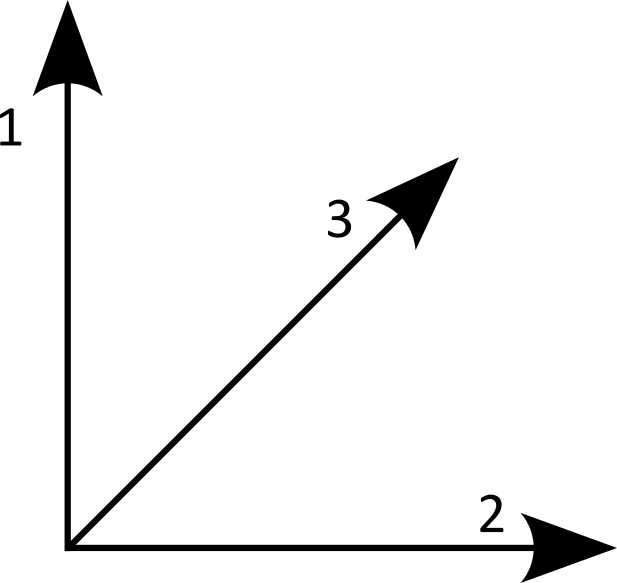
The only formalism which we know that can be taken over from mathematics (once we have rejected: set theory, taking ratios and using addition; which thereby rules out the four rules of arithmetic) is that belonging to the domain of vectors. We begin with a (3) space defined by three-unit vectors (thus of equal scalar magnitude) which are mutually orthogonal, i.e. which represent for our purposes mutual independence. In the usual nomenclature, the unit vectors are called: i, j and k. We shall, instead, use the nomenclature: 1, 2 and 3 because this was employed by Bennett in his treatment of triads (all we have to note is that these terms do not signify actual numbers). From the formalism of vector products we may then write:
| 1 x 2 = 3 | 2 x 3= 1 | 3 x 1= 2 |
| 2 x 1 = -3 | 3 x 2 = -1 | 1 x 3= -2 |
The negative vectors, entering again into products generate the same set of positive and negative vectors such that the sum total of mutual production is zero. The triad confirms itself. It might even be said, though only by analogy, that the triad makes itself. This conforms with the intuitive notion of the triad and relatedness as deriving from, or of the nature of, will.
Interpretation of the Vector-Product Model
Any model can only be suggestive not prescriptive. We shall follow through some implications of the model seeking to confirm and also clarify some of the notions we already have about how triads work. In this way, the model can serve to refine and criticize the accumulation of concepts which become associated with triads. First, we should note that:
| 1 x 2 x 3 = 0 | |
| also, | 1 x 1 = 0 |
| 2 x 2 = 0 | |
| 3 x 3 = 0 | |
| and, | 1 x-1 = 0, etc. |
We propose that the condition indicated by zero stand for the unity of the three terms (as in equation A) which is present in each of three terms (as in equations B). A suggests strongly that the triad as a whole should not be taken as yet another term. This is very important. B suggests that the terms are invariant in the relationship, i.e. they preserve their distinct characters.
We have a matrix table for all the possible products, deriving from the six possible directions of (3) space:
| 0 | 1 | 2 | 3 | -1 | -2 | -3 | |
| 0 | 0 | 0 | 0 | 0 | 0 | 0 | 0 |
| 1 | 0 | 0 | 3 | -2 | 0 | -3 | 2 |
| 2 | 0 | -3 | 0 | 1 | 3 | 0 | -1 |
| 3 | 0 | 2 | -1 | 0 | -2 | 1 | 0 |
| -1 | 0 | 0 | -3 | 2 | 0 | 3 | -2 |
| -2 | 0 | 3 | 0 | -1 | -3 | 0 | 1 |
| -3 | 0 | -2 | 1 | 0 | 2 | -1 | 0 |
We note that each row and column adds up to zero. The general idea is that in a perfect triad there is an internal dynamism which does not produce results outside of itself. This is in conformity with the doctrine of the Trinity.
As a first step, we can allow that the positive and negative versions of any term are not different. When we do follow the implication of a difference, then we can posit that the versions complement each other rather than simply confirm or neutralize each other. The most elementary notion we can apply is that of increase and decrease. Thus, in following the implication of a difference, we impinge on quantitative aspects of the triad and have left the entirely qualitative.
We will now, quite arbitrarily, introduce in our scheme the conception of essence-existence. Existence implies that there are finite relationships and thus must be distinguished from the purely qualitative relationships of the perfect triad. A way of dealing with this suggests itself, though imperfectly, from consideration of the vector products as laid out in the table. It is to ascribe terms given a negative value an ‘existential’ character or distinction. Now, this would introduce an asymmetry between the terms as inspection of the table will make evident. How can this be dealt with? We have to remember that the table derives from an orthogonality which obeys right-handedness. If we allow equally a left-handedness (the mirror image) then we would have the complement of the above table (which we need not bother to lay out).
Taking the two tables together and discounting the zero terms, we have 48 different vector products, in conformity with the notion that there should exist forty-eight ‘laws’ at some level of existential reality. Bach of the two tables then represents 24 different forms. We should also note that, if we remove the distinction between positive and negative, then the portion enclosed in the table exhibits Just six forms. The addition of the quadrant situated to the right of the former gives twelve forms.
In some such way, we have arrived, at least in part, at a formalism which generates the various levels of worlds: 1 (1 x 2 x 3 = 0), 3 (1 x 1 = 0, etc.), 6 (1 x 2 = 3, etc.), 12, 24 and 48. One way to treat of worlds 6 and 12 is as follows:
In World 6, we consider the basic products, in both right and left handedness, combined into six forms.
In World 12, the right and left handedness remain distinct Ile still suffer under an ambiguity (left and right) which makes it matter of choice whether a given product is ‘negative’ or ‘positive’ and this makes it inexact to deduce properties of a form in a way depends on the positive or negative sign. In other worse, depending on our choice of handedness, we may write:
either 1 x 2 = 3 or 1 x 2 = -3
and this may influence our interpretation of the form. However, when we have chosen which of the above two equations holds, then we have determined the rest. It is quite possible that arbitrary choices of gigs nave in the past, unconsciously, dictated a certain interpretation of a form to the neglect of a complementary one.
Reading the Forms
So far, we have found that the model derived from vector-products is illuminating and suggestive; even though it does not in its entirety agree in all respects with the schema long in existence. We can focus, at this stage, on the possible meaning of the product sign and the equality.
The product sign suggests that there is some generic operation that is mutual but ordered (i.e. a x b is different from b x a); the rule of associativity does not hold. If we wish to preserve a distinct sense of the order of terms, then we cannot use a notion such as ‘combine’ which is symmetrical. Instead we have to use some such notion as: ACTS TOWARDS, i.e. a notion which in words must include a preposition. In language, therefore, it is inevitable that we employ terms which are themselves suggestive of relatedness. We need to limit the possible interpretations if we are to formulate what the ‘product’ operations mean (we employ the word ‘operation’ in the light of the dynamical nature of relatedness).
One approach towards accomplishing this limitation is through ascribing relative values to the terms. Thus, by way of illustration, we may consider the Christian doctrine of the Father begetting the Son. It would not be true to say that the Son must therefore beget the Father. First of all – and most importantly – this would destroy any sense of difference between terms. Secondly, it implies that the Father is ‘more active’ than the Son. In the New Testament, the Father authorizes the Son as Jesus Christ, while Christ can affirm ‘I and my Father are One’. The affirmation of Jesus is that of unity with the Father. The affirmation of the Father is that of the independent divine reality of the Son.
The suggestion arises that the more active towards the less active affirms the independence of the latter, while the less active towards the more active affirms a unity with the latter. Now, how does the preceding relate to the character of the Holy Ghost? We remember that through the ascent of Christ ‘into Heaven’ to be with the Father (att. His right hand) comes the descent of the Holy Ghost (at Pentecost). The begetting of the Son, on the other hand, is Divine Love (the Holy Ghost) which love penetrates everywhere and is within everything. All the above suggests the following:
the active operating on the less active (or in or through) affirms the independent reality of the less active and releases the communion between them everywhere as an independent whole.
the less active operating within the more active unites with it and concentrates the communion between them into an independent act
We can, at this point, recall the meanings which have been ascribed to these two operations. If we take our vector notation, we can easily transform it into a form corresponding with the nomenclature used by Bennett in discussing these meanings. Thus:
1 x 2 = 3 in vector notation
becomes: 1-2-3 in Bennett notation, etc.
We then have, from our consideration of more or less activeness and the example of Christian doctrine:
1-2 constitutes 3 (expansive)
2-1 constitutes 3 (concentrating)
which agree closely with:
1-2-3 expansion
2-1-3 concentration
but, we have a way of describing in more detail the various connections than in Bennett’s scheme.
1 acting towards 2 is released as 3
2 acting within 1 is concentrated as 3
If we can determine the relative value of e.g. 2 and 3 then we can formulate equivalent definitions for the remaining four forms of operation It is implied in the New Testament that the ‘insemination’ of Mary to produce Jesus was through the holy Ghost. On these grounds, term 3 is more active than term 2 (though this very point gave rise to much controversy and the need to re-assert that the Son acts in co-operation with the holy Ghost). We must admit that, in this treatment, we are veering back closely to some notion of the third term being ‘between’ the other two; in this case, in terms of relative value. Such a notion is supported by the meaning of the two forms 1-2-3 and 2-1-3. Adopting this view, we can formulate the other four forms:
1-3-2 1 acting towards 3 is released as 2
3-1-2 3 acting within 1 is concentrated as 2
3-2-1 3 acting towards 2 is released as 1
2-3-1 2 acting within 3 is concentrated as 1
The active-passive operations imply separation while the passive-active ones imply union. We believe, however, that it is possible, from all the foregoing, to utilize words without being subservient to their accidental suggestions. The formalism enables us to be loss suggestible. it also enables us to derive alternative definitions in a way that discloses our assumptions and starting points.
Language
Our language is saturated with our understanding and experience. It should contain within itself all that we could ever understand by anything. Our understanding of relatedness is so-to-say ‘locked up’ inside our words and needs to be released or disclosed. When we look at how we describe relations, it is fairly easy to see that we do have alternative forms for the same situation, alternative which suggest different aspects, however vaguely. These constitute what we shall call the nuances.
We will take the example of ‘gift’ in its transactional sense (i.e. not as an object but as a locus of acts). Let us, naively, ascribe words to the three terms involved: donor (1), recipient (2) and gift (3). We can echo the six forms of the triad in a superficial way through the following statements:
123 donor acts towards the receiver to make the gift +
213 recipient acts within donor to make the gift –
132 donor acts towards gift to make the recipient +
312 gift acts within donor to make the recipient –
321 gift acts towards recipient to make the donor +
231 recipient acts within gift to make donor –
Remember that the signs + and – do not signify better and worse out something on the lines of expansion and concentration; or extensive and intensive. Indeed, these latter two terms can be substituted for + and – in the above.
Now, as such, these statements do not begin to approximate to plausible sentences that might be found in a discussion or description of giving. What we can do is to scan a range of vocabulary pertaining to giving – which will amount to some hundred words in Roget’s Thesaurus. The choice of vocabulary in a sentence will be deeply connected with the particular nuance of giving that is being expressed. In this respect, we can offer:
123 largesse
213 boon
132 obtaining
312 undergoing
321 giving
231 relinquishing as indicative
It should be noted that the most usual term – simply, giving -for describing the dynamism of the gift is linked with the third term – gift – and derives from it. Thus, we have the triad as a whole, the first term and the third term all closely linked in our usual descriptions. Undoubtedly, this has a bearing on the doctrine of the Trinity and may prove to be evidence of a corruption of our thinking deriving from linguistic bias; alternatively, it may be suggesting that our language carries in it information arising ab initio from true understanding. We should also note that the dynamism of giving is not possible without the act of the recipient and that it is from this act that the value of the gift largely stems.
From the above set of statements, it appears that there is no easy correlation between acceptable statements and triadic forms (as we have been notating them). The linguistic and the formal are, to some degree, orthogonal to each other and, therefore, there is an implicit suggestion that there is get a third dimension of discourse in which the linguistic and the formal are related and reconciled. In Gurdjieff’s writings there is made a distinction between ‘mentation by word’ and ‘mentation by form’ which is pertinent to our discussion. There is the suggestion that mentation by form is somewhat superior to that by word; but let us be relational about this and argue that:
WORDS CONVEY MEANING IN AN EXPANSIVE WAY
FORMS CONVEY MEANING IN A CONCENTRATIVE WAY
The former is to be limited because of tendency towards unordered proliferation of associations while the latter is too limited by its tendency towards abstraction. One possible suggestion for a reconciliation is in the IMAGE. We must qualify this by saying that we mean a KINETIC IMAGE, that is to say, of a kinetic or dramatic character. Our reference to the dramatic is supremely important since it is in this that we find the interest and significance of relatedness.
In reality, we understand ‘giving’ through participation in giving. de need to experience the role of donor as well as recipient. We understand by DOING and in this is what we mean by ‘kinetic image’. nut, we have to deal with a question here: how is it that we would not easily think of playing the role of the gift? In part, the answer is that this term is not the proper expression for the third role in the triad. To indicate what we mean, we can re-express the triad la the following three terms:
donating (1) receiving (2) sharing (3)
and we see immediately that we have an improved description since these three terms are clearly of the same ‘substance’, (Our reference to substance harks back once more to the Trinity and we should remember that the relation between Father and Son is sometimes described as that between Giver and Receiver). We now adduce the statement:
DOINGS CONVEY MEANING IN A DIRECT WAY
Words are suggestive, forms are restrictive, and doings are concretive. Doings run the risk of identification: the inability to see the whole relationship through the role one is playing. As a complement to this, understanding enables one to play a role without identification. (see below, discussion on Goethe).
Leaving, the dimension of ‘doings’ – participatory experience – to one side, we can end this section by proposing that the formalism can enable us to organize the vocabulary we might employ by providing a framework that allows us to discriminate between the different nuances. Language also enables us to seek for a more uniform set of terms by insisting on a vocabulary made up of terms of the same grammatical type. It is also interesting that, in the particular example of ‘giving’ we have been led to adopt the third term ‘sharing’: sharing and ‘share’ imply distribution and proportion which are integrally linked with the concept of relatedness.
Words and Forms
We have the bare statements:
123 1 acting towards 2 makes 3 extensive
213 2 acting within 1 makes 3 intensive
132 1 acting, towards 3 makes 2 extensive
312 3 acting within 1 makes 2 intensive
321 3 acting towards 2 makes 1 extensive
231 2 acting within 3 makes 1 intensive
We can have various words ascribed to each of these, but any terminology is limited by its suggestiveness of a particular content of the relationship. Here are some terms suggesting themselves from the example of giving but transcending, that particular as far as possible:
123 Power
213 Value
132 Change
312 Invariance
321 Release
231 Containment
These can be correlated with the ones given by Bennett:
123 Expansion – Power
213 Concentration – Value
132 Interaction – Change
312 Order – Invariance
321 Freedom – Release
231 Identity – Containment.
The correlation is fairly good, but this is not to validate either in terms of the other, since the process of our deriving a terminology has been undertaken with prior knowledge of Bennett’s terms. The important point is that such terms can be derived from our explicit formal base, whereas those of Bennett were derived in some unknown intuitive way and followed largely by custom rather than by understanding. In our scheme, the words we have presented explicitly refer to the influence upon or the mode of the last term in the formal expression (e.g. ‘power’ refers to the state of 3 issuing in the triad 123) and, then, implicitly to the role of the other two terms, primarily of course the first (e.g. to 1 in 123). To understand these explicit and implicit references, we need to entertain all six forms when we consider any one form. We want to emphasize however, that in our treatment there is no suggestion that relatedness is to be found exclusively in the mental or even spiritual domain. That is why we have eschewed such terms as ‘freedom’. By way of example, we can take the situation studied in neurophysiology which centres on ‘stimulation’ and ‘inhibition’, and incorporate a third term ‘readiness’. This is really a cybernetic situation and is, therefore, indicative of wide-ranging significance. If we ascribe the terms thus:
1 – stimulation 2 – inhibition 3 – readiness
then:
123 tension
213 relaxation
132 control of movement
312 control of stillness
321 acceleration – initiation of movement
231 deceleration – cessation of movement
(the above clearly deal with the neural control of muscle action). We find, however, that any attempt to derive six forms for a purely physical situation seems to devolve into an expression of our conceptual understanding rather than the situation per se. It is suggested at this point, without demonstration, that instead of six forms we will find only three, such that:
123 and 231 are taken together
132 and 312 are taken together
321 and 231 are taken together
this would apply when, for example, we have a mathematical relationship such as: PV = RT (R is a constant), when:
PdV + VdP = RdT
P˳ -1/T.²dT + 1/T.dP =-R.dV/V²
V. -1/T.²dT + 1/T.dV =-R.dP/P²
We must remember that, usually, in physics we are dealing with scalar products and this is bound to diverge in form from taking vector products.
When we have a situation with three degrees of freedom, such as the three modes of kinetic energy available to a molecule in a gas, then there is an equipartition of energy between them (of course, the rotational form can itself divide into three degrees). Our thinking at this point is that we cannot begin to understand relatedness in the physical world starting with our formulations which are made to conform with a treatment expressible in terms of scalar products. These formulations are an abstraction from the phenomena and must, af necessity, render something of the phenomena opaque.
Goethe’s Colour Theory
After our critique of usual physical science, it seems proper to briefly examine an example of the not usual in science and Goethe’s Theory of Colours immediately offers itself. We cannot claim la more than a barely adequate nodding acquaintance with this theory. What we will do is to assign the terms:
Light – 1
Dark – 2
Colour – 3 and develop the triads
123 light acting on darkness makes colour expand
213 dark acting within light makes colour recede
132 light acting on colour makes darkness expand
312 colour acting within light makes darkness recede
321 colour acting on darkness makes light expand
231 dark acting within colour makes light recede
As these stand, they are unintelligible; alternatively, they are in some kind of code yet to be deciphered or, are merely allegorical. None of these possibilities are to be accepted, since our whole effort has been directed towards translucence and intelligibility. Where, then, is our error?
We began by assuming, implicitly, that Goethe’s doctrine could be summarized in the notion that ‘colour arises out of light and dark’. This led us to assume the third term to be colour. And this has been shown to be inadequate or misleading.
Some reflection and experimentation with alternatives leads us to understand the theory better. Though it is true that colour is some ‘combination’ of the light and dark, colour then would hot have any independent status: it would lie in some sense ‘between’ the light and the dark; that is, in the region we describe as grey. Study of Goethe’s writings reveals the missing element in our thinking (cf. Theory of Colour, section 199 et seq.) for there he describes the arrangements and the use of prisms and lenses which are necessary to bring colour to perception. There is the setting up of a boundary between light and dark; there are the different effects of using convex and concave lenses.
We subsume all such elements under the term visual interface, with Implications of the geometry of figures and the refraction of light through optical devices. That is essential is the intentional formation of the boundary between light and dark.
We can then allow ourselves the insight that each of the forms, reflecting the experiments done by Goethe, describe a way in which ‘colour’ arises and that the whole triad concerns the dynamism that we perceive as colour. We write:
123 light acting towards dark making interface expand
213 dark acting light making interface concentrate
132 light acting towards interface making darkness expand
312 interface acting within light making darkness concentrate
321 interface acting towards dark making light expand
231 dark acting within interface making light concentrate
We are still some distance from immediate intelligibility. However, we are going to make a discontinuous to write the following:
123 light on dark appears larger (cf. section 16)
213 dark on light appears smaller
132 light in its boundary with dark (produces blue in the light)
231 dark in its boundary with light (produces yellow in the light) (sections 199-201)
312 boundary in light diminishes dark (spectrum with purple)
321 boundary in dark increases light (spectrum with green) (sections 214-216)
It must be admitted that we have largely neglected the distinction all expansion and concentration – with the important exception of 123 and 213 – or made it vague. We have also interpreted 312 and 321 for the special case of forming spectra. In this respect, we note an increase in complexity as we pass from 123 & 213 to 132 & 231 to 312 & 321, which sequence is a departure from our previous one.
All that we have done – but this is no small thing – is to begin to show the intelligibility of triadic thinking, as applied to a sensory phenomena. However, it has been claimed either that Goethe’ was working in the domain of psycho-physics or that his work belongs to a realm of intentional perception: in either case, we would not have a truly physical situation. That we must bear in mind.
We should note that the derivation of the forms 123 and 213 preceded confirmation of them in section 16 of Goethe’s writings. We should also note that what we have done is not restricted to Goethe’s work. In Land’s theory, for example, the three terms are: light of short wavelength, light of long wavelength and boundary conditions (visual interface again). The colour seen is synthetic; it is not something simply there to be registered. We suspect, therefore that Goethe exemplified a type of approach to the relation we call colour which others have also tried. The process has gone on from Goethe: for example, we now know that our perception of white is synthetic and not a true replica of ‘light’ but a colour itself. What we have come across is a relatedness which can be perceived in its various forms: the forms of relatedness of dark and light (or snort wavelength light and eh long wavelength light) which arise through their conjunction in and through the geometry of their interfaces produce the spectrum of sensations we know as colour. Do we ever perceive the whole triad? Is it not the case that we understand the whole triad?
Referring back to Goethe, we see the importance of his experiments, his doings and the reflection upon and intensification of them in his exakte sinnliche phantasie (exact sensorial imagination). It would seem that our sensory, immediate experience is of a form, our doings pertain to one term while our ‘seeing’ or understanding is of the whole.
Our doings are tripartite arrangements that coalesce into acts which are not, as might be supposed ‘our’ acts but phenomena. In this sense, experiment is ordained to disclose a relation. We should note in the case of light and colour that the scientist himself directly acts upon the third. term. This may well be a general truth.
IN DOING THE AGENT ACTS DIRECTLY THROUGH THE THIRD TERM SUCH THAT A FORM OF THE TRIAD CAN BE PERCEIVED
Reconsidering our comment on the progression of complexity observed in our treatment of the forms corresponding with Goethe’s theory, we can detect here a reflection of the varying degrees of control and intervention of the experimenter. Even in the case of neural muscle control, the neurophysiological experimental work itself is directed towards the state of readiness the neuron, by altering its chemical boundaries.
We can also note that we have approximated very closely to the archetypal definition of Gurdjieff which he gave the ‘law of three’ namely: Triamazikamno (‘three together I do’). This is ‘doing’ in the fullest sense. Ordinarily, when we ‘do’ it is to act within one form of the underlying relatedness.
Lateral Thinking
In following through and working with an attempt to understand Goethe’s Theory of Colours we came to emphasize and re-emphasize that the third term (3) must be truly orthogonal to the other two and not something posited as somewhere ‘between’ them. This is largely the crux of understanding the triad. It is reflected in general discourse on thinking in the notion of lateral thinking which rests on just this point. For example, the typical situation is one in which an impasse is reached, to resolve which one needs to move at ‘right angles’ to the given axis or plane of tension. This movement may be engineered by absurdity and humour or even by random input. However, little attention has been paid so far to the ‘understanding action’ which can check out the relational value of a sideways move. The movement is meaningful if the triads it allows and generates are meaningful: if the triad coalesces. Of course, even the vaguest or most random element can be turned into a valid term by the dynamism of understanding (or, as with Beethoven, the most banal). Our working with Goethe’s theory indicates what may be possible in this respect.
Will
In one of the formulations of the Trinity it is asserted that: the Father Wills, the Son Does and the Spirit Perfects. This is a reflection on our present work. It is also a suggestion that the triad can be understood as the key to understanding will, in that it is will. The will moves and is not itself moved: this is a near-perfect expression of will in its forms and will as the underlying relatedness.
We can state some assumed properties of will:
will is always will even when divided
what divides will can only be will
will results in will and arises from will
will is the same even when it is not
will can release itself and limit itself
will is always active
On reflection, these properties fit very well with those we have implicitly assumed for relatedness as can be found by substituting ‘relatedness’ for ‘will’ in the above statements. Let us, then, on this speculative basis, look into the question of individual and universal will.
The approach is fairly obvious. Our personal experience of will (from whence derives our sense of an individual will) is through what we do (actually, or in the kinetic image) and this attaches itself to one term (in the case of intentional experimentation, the third) of a given triad. The given triad as such is an expression of universal will. Therefore, individual will is not possible without universal ill and is exercised only in regard to given situations. (Very possibly, in most situations outside the domain of intentional experiment the third term is inaccessible). It is possible also, that the forms of a triad express the origin of the self-limitation of will which manifests as the distinct operations of the six forms. Hence the notion that the Creation is ‘conceived of in World 6.
SELF-LIMITATION OF WILL ARISES FROM THE DISTINCTION OF ITS SIX FORMS OF OPERATION
Energy
Any two terms of a triad without the third fail to relate. This means that there can be no transaction between them or, that nothing can happen. The completion of a triad means that a dynamism comes into being. As thus described, it is plausible for us to see that we have here a description of energy (‘energeia’ according to Aristotle, is the passing from ‘potentia’.’into act). Since we have supposed that a pure triad renews itself invariantly, we have in the preceding the basis for the
CONSERVATION OF ENERGY
and the possibility that this stems from the nature of will.
Systems
All that we have said concerning the triad does not offer any particular insight into the nature and forms of any other systems. However, we wish to note a correspondence and suggest that there is in effect some ‘law’ of affinity between the odd-number systems such that:
Monad
Triad
Pentad
UNITY IN DIVERSITY
SAMENESS IN DIFFERENCE
UNIQUENESS IN DIVERGENCE
relying, to some extent, on the ‘magic’ of verbal affinities. Following along this speculative magical path:
Heptad
Ennead
SINGLENESS IN DIFFERENTIATION
UNION IN DISPERSAL
WHOLENESS IN DISINTEGRATION
ONENESS IN DISSOLUTION
all of which are noted here to suggest that we should not consider the operations of systems beyond the triad to conform to the type of organization which we have identified for the three-term system. In putting forward an increasing accommodation of destructive tendencies, we are suggesting that the higher term systems reveal with ever greater intensity the dramatic experience of the Whole. Understanding should not be confined to creation and order – at least, as we habitually feel them.
From this perspective, we should consider a re-examination of the triad to uncover, if possible, those features which ordinarily we would hope not to be found. It maybe no accident, for example, that the earliest interpretation given to the form 321 was crime! Put, in another way, it should be as possible to find Satan in the triad as God.
Note on the Tetradic implication of the Table of Forms (p.4)
If we examine this table purely in terms of the headings of its rows and columns – i.e. disregard the actual content – and consider the whole to be divided into four quadrants, then we find that we have a form which corresponds with a form of tetrad. What we have to do is to regard the headings 1, 2 and 3 as the ‘uncreated’ and the headings -1, -2 and -3 as the ‘created’. Then:
| A neither created nor creating | B uncreated creating |
| C created uncreating | D created creating |
This is Eriugena’s division of the totality of being into four classes. He described them thus:
A the last goal (in God)
B the ground (in God)
C the primary causes of things
D the effects, or the things themselves
and, C and D constitute the Creation.
If we take this schema (and incorporate with it the complementary table mentioned in the text) we have the usual four-fold division within World 48 (Bennett The Dramatic Universe, Vol.2) :
| A essential triads | B essence dominated triads |
| C existence-dominated triads | D Existential triads |
The character of the form derives from the schema:
| A | B |
| ++ | +- |
| C | D |
| -+ | — |
The Triad and Its Workings
The 3-M Equation of E. Matchett
From the field of design science comes one of the most remarkable formulations of a three-term system, or triad. Matchett’s ‘equation’ states that the essence of all design – and that is design of any kind and in any sphere – can be expressed as:
MAKING MEDIA PLUS MATTER MEANINGFUL
or, MEDIA + MATTER = MEANING.
The term ‘matter’ includes all existent forms, mental as well as physical. It includes all that can be investigated by established techniques, at least in principle. It belongs to the domain of the known, or the knowable. It is open to public perception and can be pointed to, described, enumerated and controlled. In its simplest and most common sense, design is the act of making matter into something which serves a purpose, fulfils a need, or -as we shall see – creates a meaning.
The term ‘media’ serves to indicate that in which purpose and need reside; but it includes more than can be encompassed by the purposes and needs that any group of people can currently entertain. In other words, it is not something, generated out of human motivation. Instead, it is an independent realm – as independent of man as matter is taken to be – and has a kind of initiative and movement of its own. If we consider design to be a reflection of the underlying forces of evolution, including those which drive the progressive tendencies of human societies, then we must allow ‘media’ to be as much an objective reality as we take matter to be.
If we take ‘matter’ to represent the conditions or constraints relating to the creative act, then ‘media’ should be taken to represent the unconditioned and relatively free influence which makes creation possible. In this sense, ‘media’ is the harbinger of the future, while ‘matter’ is the carrier of the past.
It would be misleading to regard ‘media’ as some kind of super-force, pushing the act of creation. If anything, it is more like a pull. This corresponds with our apprehension of need as something that draws towards itself what is needed: need is attractive rather than active. For this reason, it is usually supposed that ‘media’ can only enter the equation through some openness and sensitivity, i.e., through some capacity to experience in anticipation what has yet to be formed.
The designer aspires to the creation of life, that is to the enablement of something which has a life of its own, which is then independent of the inventor. This quality of independence is the crucial test. of meaning. There are two attendant criteria: what is made must work (the ‘matter’ condition) and it must fulfil a purpose (the ‘media’ condition).
It has been implicit in what we have said that both ‘matter’ and ‘media’ though objective assume their definite roles and relationship with each other within human perception. What is it that provides the central perspective, the standard of reference by which we can be guided? It is meaning. Meaning is our underlying frame of reference. It underlies both fact and value, or ‘matter’ and ‘media’. Matchett suggests that we steer our way from point of meaning to point of meaning through the joint space of matter and media. There is an uncertainty as we leave one point of meaning before gaining another, particularly when the second point of meaning relies on us for its creation. When a new meaning is found, it is then no longer possible to decide whether we have ‘found’ it or ‘made’ it.
It is therefore possible to regard meaning, as both a result (a certain combination or matching of matter and media) and as an independent factor in its own right. It can never be regarded as a cause in the sense of doing something to something else. If we allow ‘media’ to be associated with the teleological, then ‘meaning’ is to be associated with the normative and ‘matter’ with the substantive.
The 3-M equation, then, fulfils the exacting requirements we have been setting for a true relatedness, in which three independent but mutually relevant terms are established in a dynamic whole. The three terms matter, media and meaning are distinct agents but none of them ‘does’ anything on its own. They mutually cohere and ‘call upon’ each other. All ordinary causality is within the realm of matter. It is in matter that the past determines the future; but, not in respect of media or meaning.
The much abused term ‘creativity’ has been introduced into common parlance to give a name to connectivity’s which are not to be accounted for by material causality. Unfortunately, it is a term which has become attached to a psychological view and restricted in its scope to human experience and doings. The 3-M equation gives some basis for the view that ‘creativity’ is a property of reality in general.
We will now see whether or not we can give expression to the six forms of the dynamism. We must suppose that operations involving two of the terms have a bearing on the third. The characters of the terms are ascribed thus: Media – 1; Matter — 2; Meaning – 3. The metaphor is: light (media) reflected (in matter) is seen (meaning). The relationship of matter and media is the meaning. It is important to remember that the model of perception is more apposite to understanding the triad than the model of action: the triad is more an experience than an object.
The six forms are first defined thus:
123 media acting towards matter expanding meaning
213 matter acting within media concentrating meaning
132 media acting towards meaning expanding matter
312 meaning acting within media concentrating matter
321 meaning acting towards matter expanding media
231 matter acting, within meaning concentrating media.
123 Logosphere
In this action towards matter, media is not absorbed into matter, but begins to come out of matter as meaning. The light reflected from an object appears to come from that object. Illumination converts materials into secondary sources, themselves illuminating. This is expansive because it increases the number of sources. The sphere of meaning – the logosphere – intrinsically expands. Here, meaning is ‘next to’ matter, the limited aspect; so we are dealing here with codified meaning. or meaning that consists In making connections between things.
213 Metacontrol
Matter acts within media and loses its restrictions, becoming assimilated into the nature of media. It is an action of perfecting Instead af being – as in 123 – a veiled substratum behind the deeds and sufferings of light (media) it is brought into a new state. This is not an imposition of a state but something that is of its very nature, or of its ‘promise’. Within all materials there is latent a state of being and when this is realized, there is a meaning which endures. The alignment and perfecting of matter is called meta-control.
132 Logofunction
Media acts towards meaning, which constitutes purpose. Here we have purpose coming out in matter: we have perfect function, a function that exactly corresponds to a need. Matter is being used correctly. il This is technology serving the needs of the future, bringing into operation the skills, techniques and methods which contribute to greater freedom.
312 Intelligibility
Meaning acts Within media and matter is drawn back into a certain state. This state is intelligibility. Indeed, the natural and general law of perception is that what we see is first of all meaning, which only ‘after’ is resolved into objects, actions and the like. In this action, matter attains a translucency; nothing is obscure or hidden.
321 Immanence
Meaning acts towards matter; this is the awareness within the present moment of something missing or unfulfilled or, better still, of something possible and at hand. What is possible is at L hand in media. So, we have an awakening to media which arises not as a response to some incursion ‘from beyond’ but from the contemplation of the given, what is at hand. It is in the very nature of consciousness that it gives the sense of a kind of absence: the transcendent is immanent in every act of attention.
231 Form
Matter acts within meaning; it is made meaningful. The issue is in contained media, which is form. With form, matter enters the realm of media. There is an ambiguity in the term ‘form’ which was, in classical times, used to denote the guiding principle of an entity and is now generally used to describe its appearance.
Reflection on these interpretations of the forms shows that they are superficial. The main reason for saying this is that there are no signs of a deeper insight into the three terms than we started with. There is even a sense that the interpretations are drawn from some repertoire of experiences, approximately fitted to the forms as we have expressed them. Anticipating ourselves, we can admit that the three terms have remained opaque; they are still largely ‘unknown objects’ and the relationships we have drawn out do not serve to illuminate their individual natures.
The main problem resides in the use of the verb ‘act’. We must know that e.g. media does not act in the same way as matter; yet we have use the same term, relying on some largely unformulated sense of what these terms are to guide 1.18 in making distinctions. Are we here asserting that we can understand what an ‘act’ means by inference from the two terms it connects and the manner of its orientation (i.e. ‘towards’ or ‘within’)? Clearly, there is some unfinished business.
The Isaac and O’Connor Model of Relations
In their book written together with Jacques and Gibson ‘Levels of Abstraction in Logic and Human Function’, Isaac and O’Connor lay a formal model for relations which is useful to our purpose, Their concern was with the development of the articulation of experience, or learning; and they begin their analysis by assuming that the Primal articulation is that of a relation between a subject pole and an object Pole
S—-R—- O
We may think of the relation as ‘cognition’ and understand it as Wes both ways – towards subject and object – at one and the same time. however, there is no need to identify the nature of the relation as such for the purpose of to the model. The next articulation has its origin. in establishing a new subject Pole, S’, which is constituted by the whole of the Primary relation:
S’ = (S —-R—- 0)
This second ‘subject’ is in turn necessarily involved in another relation, R’, with another object O’.
R’
S’—————-O’
So, there are now two subject poles (and two object poles). In this model, it is taken as axiomatic that the primary datum is a relation and the emergence of any one of the three aspects – subject pole, object pole, relation – announces the operation of all three. A further articulation relates the previous two. We have a third subject pole S’’ which relates the previous two subject poles and, therefore, also relates the two object poles without need of a third.
S” = (( (S—- R—– O)–R’’– (S’ —–R’—–O’) ))
The whole system may be shown in a diagram as follows:

What we hope to show is that this abstract model is an exact analogue of the Procession of the Persons as worked out in the development of the doctrine of the Trinity. To summarize:
there is an inarticulate state of experience
then; the first subject appears SS in S —-R—-O
then; the second subject appears S’ as (S–R—-O) in S’—-R’—-O’
then; the third subject appears S” as S- R”- S’ in (S—- R—– O) -R’’- (S’ —–R’—–O’)
In respect of the latter, Isaac and O’Connor state: “S’’ is identified – with (S –R–O) and (S – R’ – O’) conjointly, through R” ” (p,108: we have changed the terminology slightly and rephrased the sentence). It is blindingly obvious that these words say much the same as is asserted in Christian dogma with the words: “The Holy Ghost proceeds from the Father and the Son together” (again, this is our own phrasing) where it is understood that it from the relationship (R”) of Love that we have the Spirit or, even, that He is that relationship.
Comparison with the Trinity
Our claim to an exact analogue will, no doubt , have to be qualified; but it is staggering that the abstract model provides us with a procession of three subjects, which can properly be associated with the Persons of the Trinity. The second subject pole proceeds from the first and the third proceeds from the first and the second together.
Of great difficulty in the history of the dogma has been to account for the Son – identified with Jesus Christ – as co-eternal with the Father, that is: one with Him before the creation. The Mission of the Son has no meaning before the. creation, Yet, in order to preserve the Integrity of the formula, the Son must be taken as the equal of the Father in Goodness (we will not go into the many problems surrounding the question of what it is or in what the Three Persons are the Same). In the abstract model, we have a subject-object relation which we will, for or convenience, consider in the guise of ‘God the Creator’. Then: God the Son is the very Image of the Father, taking R as the relation of creation:
Son = (Father ——creation—-Existence)
It is striking that, according to some authorities, the Father is responsible for all existence while the Son is responsible only for rational entities or minds. This follows the abstract schema in that we now require another object pole 0′: now defined loosely as ‘individuals’. And we have:
(Son—- incarnation—-individuals)
where the relation is labelled ‘incarnation’ simply to serve all such passible meanings (including, for example, salvation and the like). So, we can easily have the Son as an image of the Father, if we regard the Father in relation to existence (the most general object pole!). The Son is fully the Father, yet proceeds from Him.
We note that the Holy Ghost — or, rather the third subject pole — requires no further object; unless we regard the aspect
O—–R’’—–O’
as some kind of further object. At times, certain authorities suggested that the mission of the Holy Ghost was restricted or concentrated in holy individuals or saints but this was not generally agreed; since the Holy Ghost is also associated with the Church in the sense of a ‘future’ perfect communion of souls. So, we can simply write, following the model:
Holy Ghost = (( (Father –creation– Existence)- communion – (Son—incarnation– Souls))
If we wish to consider the three subject poles simply as a sequence, then we have the procession of the Persons. We can note that the ‘Father’ is the simplest and the ‘Holy Ghost’ the most complex. In this sense, the ‘Son’ mediates between them. At the same time, the ‘Holy Ghost’ arises out of the mutual relation of the other two Persons. He IS their mutual love. The abstract model suggests that we cannot have the third Person without the Second.
There are many other implications which go way beyond our scope. Just to illustrate this, consider how the Son and the Holy Ghost are with respect to individuals.
The Son addresses individuals; but they are many.
The Holy Ghost addresses the Community; but it is One.
In the parlance of Trinitarian doctrine, there are distinguished the ‘Economic’ and the ‘Immanent’ Trinity. The former is concerned with the workings of the Three Persons in history: what is it that They do individually which distinguishes them and tells us of Them? The latter is concerned with the Trinity in itself, without regard to any created universe: it concerns Their Personal Relations entirely. Arguments have raged over whether or not an investigation of the possibilities of relationship between the Persons alone can serve to provide a basis for faith in the Trinity and, in general, it is thought that this is not the case. We always have some implicit reference to a creation in order to be able to distinguish the Persons. In this, we have another confirmation of the appositeness of the abstract model. The model is also invaluable in drawing our attention to the fact that we are dealing with subjects and, therefore, to revert to our traditional parlance.
THE TRIAD IS SUBJECTIVE
which implies that it cannot be a matter for observation (pure object mode) ; but, neither does it deny the triad as an element of experience. In a sense, we must go through the procession of the Persons over and over again in ourselves but not know that this is the case. Why? Because the relevant content of our experience is not objective and is, therefore, inaccessible to memory. To be dogmatic at this point:
UNDERSTANDING INCORPORATES A SUBJECTIVE ELEMENT WHICH IS INACCESSIBLE TO MEMORY
We must also note that the subjective core of all this entails the following: that we will always tend to find ourselves identifying with one of the subjects and regarding the other two through their relation wit: objects. In mystical tradition, to ‘establish the triune god in oneself’ is to be free. Freedom is essentially freedom from identification which is only possible if one has all the subjects awake in oneself.
The Sequence of Terms
The abstract model provides us with a formalism for viewing the terms — taken as the subject poles – in sequence. What is regarded in the Trinitarian doctrine as the central act of Procession, which takes only One and Unique Form, can be regarded as applicable to any sequence of three possible subjects. In a word, the. Procession has provided the model for the interpretation of what has usually been called the ‘combinations’ of the three terms (which we have called the ‘six forms”). Indeed, there is no logical reason why any one of the three relations (in the abstract model – relations are treated differently in the Trinity) should not ‘come first’ and then give rise to a different second subject pole and so on. In the traditional treatment, the ‘first’ term was regarded as the ‘initiating’ and the third as the “resulting’; while the second was the ‘mediating’. These terms are all perfectly understandable in the light of the model.
However, what we have to grapple with is this: are we faced with having to deal with six distinct elements rather than three? This question arises out of the abstract model -, as it does though in a different manner in our initial vector model – because we have three subject poles and three relations and it is necessary to use both in order to arrive at six distinct sequences. If a given relation is restricted to a given subject pole than we can have only three sequences. Otherwise, the meaning of the subject poles becomes a Variable. For example, it would dissolve the triad if:
S’ = (S—–R’’—-O)
for that would change the meaning of what S” is. Indeed, as we look at it more closely, we can see that either we allow the subject poles to range widely in meaning or we are restricted to just the one form. That is, if:
S’ = (S—-R—-O)
then S’ must follow S (proceed from S). If not, then S” could mean something depending on any combination of two subject poles, three relations and two objects!
Interestingly enough it is something of this kind that we find when attempt to interpret the six forms: that the meaning of the three terms ‘slips’ or adjusts according to their combination. Which has been illustrated above in the case of the 3-M equation, What we need to work towards is presented in the abstract model: that the subject poles, their relations and their objects are all mutually definitive.
We also have the programme of providing a rational foundation for the six forms; which requires some variation in the sequence of terms. further, we should not lose sight of the contribution made to our thinking by the vector model.
Finally, we cannot allow ourselves to retain the full range of elements in the abstract model: three subject poles, three relations and two object poles. We are concerned with the triad: with what is meant by the Three in One and the One in Three; or relatedness. Incidentally, it was St Augustine who introduced into the ‘Aristotelian’ canon relatedness as a category.
Redundancy
Even with our use of the term ‘acts’ as in “acts towards’ (which introduces yet another term albeit a preposition) we are relying on extra ingredients to make our system work. Redundancy is also evidence even in our vector model, wherein the sign “x’ is an addition; not on: that, it is something that has to be interpreted for each of the forms() How to proceed? What we shall do is to take as our primary datum the subjectivity of the terms of the procession.
We cannot know a subject pole as such, only the subject pole in relation to some object. Yet, we are in the experience of a subject p in our own being. Through this, we apprehend the reality of subjects beyond the range of our consciousness.
We do not know a subject pole as such, but we can experience it. How is this? For the first time, we approach a rapport with the terminology traditionally employed for the triad; for, in that terminology, it is asserted that the terms of the triad are to be described as impulses. An impulse is something that can be felt. It is not an object. Also, it is not a subject as such but akin to the act of a subject. For our purposes we wish to assert that:
AN IMPULSE IS A SUBJECT IN A POSSIBLE RELATION
reverting to the abstract model, we can picture an impulse thus:
S————R———(O)
that is, put into parentheses the object pole. The other subject poles in the equation must not be regarded as objects.
THERE ARE NO OBJECTS IN THE TRIAD
The reason for this corollary is easy to explain: no object can serve as a subject, especially in the sense that we feel that objects can only be acted upon and cannot themselves act.
This is why the Christian Trinity is such a remarkable achievement in spite of its tortuous history and sense of irrational mystery. The Trinity is a matter oil Persons and not of objects. It was made central to the doctrine of the Church. And it is the key to the making of the Communion of Saints, that is: to the realization of God on Earth. The Triad is nothing but relationship. In the Trinity, each of the terms has full initiative. That seemingly impossible condition has been held to against all odds. Looking at the matter in history, it seems impossible that such a weird doctrine could have prevailed. That it did, is one of the great testimonies to the truth of the Revelation. (It is the Great Source from which the genesis of the modern era sprang as in e.g. Kierkegaard’s “Truth is Subjectivity”). What we have to do is to eliminate the separate requirements for poles and relationships and deal in something far more primitive. Just as we have in electricity and magnetism the duality of positive and negative or north and south, so we have in the domain of the triad a triunity of three poles which are no longer static conditions or states but active, intentional initiatives.
Whenever we name the terms of a triad in semblance of a combination of things or types, we rely on a deeper understanding to grasp their movement or enterprise and, in our depths perhaps, feel the joyous and anguished drama of their uncertain meeting.
We take our way from the saying attributed to J.G. Bennett: ‘Maybe, there are not beings who do things but doings that be things.” This is the best, most primitive, assertion of the reality of the triad. For, nothing can be done unless the impulses or the three are one.
The Natures of the Impulses
We might consider the following argument: if there is to be created a relatedness out of three impulses, then these three are mutually defined.; therefore, given any one of them, the other two can be inferred, This is a stronger argument than our previous one, the one in which we argued that given two of the terms the third was inevitable, both of these arguments rest on some underlying assumption of a primal relatedness, or upon a persistent image which suggests that relatedness is itself the constitution of three terms. If we allowed such arguments full sway, then we would lose any contact with empirical reality or with the stuff of our diverse experience. All that would be left would be the abstract formalism of our intuition of relatedness. And yet: not just any ‘three things’ can constitute a relatedness! And also: why should it have to be three and only three and not some other number?
Let us remember that a relationship is not anything. It is not an entity. Being or substance is hidden ‘behind’ it (cf. the arguments of the theologians). When we defined relatedness as ‘sameness in difference this was not to assert that different things were made the same; it was, instead, to indicate that there could be a sameness in a ‘lateral dimension’ or degree of freedom. In this sense, there was an appeal to vision, to a creativity of perception, to the power of seeing. The triad is not made, it is seen.
The possibilities of deducing terms from other terms is so much mixed in with the properties of our language that they are difficult to understand as such. Relatedness is, first of all, something that arises in language and begins to articulate our feelings of love and separation in love. But, in mentioning love we are anticipating ourselves. Many things in here in our notion of relatedness and the practical truth is that all of them can be subsumed under the ordination of triplicity. Why? Because, thereby, we can have both apposition and non—opposition at the same time; we can deny something and affirm it, at the same time: which is just what we want to do in our lives and in ourselves; we want to have our cake and eat it!
If any of the terms can be overcome by another, or if any two of the terms can combine together in mutual annihilation, then we have only something temporary and ‘unreal’. Most importantly, we cannot have any real evolution: evolution requires that there be terms in apposition, retaining their opposition in spite of their ‘underlying’ mutual support. Thus, life appears to act anti—entropically, towards greater order, while non—live does the opposite; nevertheless, life arises ma out an entropic milieu and life and non—life are in relationship: we want to ask ‘how is this possible?’ or ‘what is the secret?’. Perhaps the triad is always a mystery and every triad is as unfathomable as the Holy Trinity.
But, we have introduced language once more. This must be explained. Let us consider the following (which might serve as an indication of the work needed which is ‘beyond Roget’):
(at random) take the word ‘go’
think of its opposite: ‘stay’
ask: is there a term ‘in common’ between the two?
try: ‘turn’
check:
(i) turn’ can fit ‘stay’
(ii) ‘turn’ does not fit ‘go’ very well
change one of the terms
try: change ‘go’ to ‘move’
the three terms: , ‘stay’ and ‘turn’ do relate
check the relatedness by combination:
(i) are ‘move’ and ‘stay’ = ‘turn’ ?
(ii) are ‘stay’ and ‘turn’ = ‘move’ ?
(iii) are ‘move’ and ‘turn’ = ‘stay’ ?
the last of the above is too strange to accept
can we reinterpret the situation?
only by introducing a special interpretation:
‘move’ and ‘turn’ are to be just of the kind
that produce a rotation around the ‘stay-point’
thereby, ‘move’ and ‘turn’ are a kind of staying
we note that: there are only two solutions
(i) rotation on the spot
(ii) orbit around the spot
we also note that: there is a suggestion that here we have discovered a kind of O and O’ i.e. the ‘object poles’ of the relation.
What we see demonstrated here is a method of progressive refinement working towards a true relation from initial approximate terms. To make the relation intelligible we cannot accept the blanket terms with which we began. What we arrive at is a very special case amidst all the possible ones: relation is a stringent condition with its own logic. Indeed, we have uncovered something which hints at the possibility of a triadic logic.
Our reference to Roget needs to be explained. In Roget’s famous Thesaurus we have lists or synonyms and antonyms – terms which are similar and terms which are opposite in meaning. What we are suggesting is that there can be a third category, namely of logonyms: terms explicate the meaning of the synonyms and antonyms in terms of relation. The root ‘logo’ is used to give implications of logic, ratio and meaning.
We note that it is impossible to relate terms which are strictly apposite; at least, this cannot be done without reinterpreting these terms in very special ways, ways which remove the sense of opposition. Hence, what we have done is to find a way in which an opposition proves, in special cases, to be only an apparent one; and the two initial ‘opposing’ terms to be simply partial descriptions of the same thing. This is very close to the Trinitarian situation of positing a common ‘substance’ for the three Persons; the three being distinguished by and in their relationship. Scholars have argued that the distinction of Persons is a mental one rather than a physical or substantial one; from the premise that relatedness itself is mental and not ‘real’. As we said before, it was St Augustine who simply began to assert to the contrary that relatedness was a substance itself.
Our example, worked out above, which was chosen for its simplicity and obviousness, shows us something more the terms are not objects; there is no explicit reference to any entity; the existence of objects and even of spatial coordinates is held implicit as a background. Why is this? Obviously, because the terms are relational.
Can we ever have terms which both, relate and are substantial? Let us take the example of the active and the passive, to begin with. We must note: traditionally the term ‘passive’ was associated with passion (as in the ‘Passion of Christ’) and meant the undergoing of some action, reaction to action; as well as the emotional undertones of the word. The passive is not the lifeless, inert state; which is properly given the name. ‘apathy’, i.e. without passion. Thus, in its own way, the passive is active.; a phrase we have to use in the context of modern usage to correct our thinking.
Let us take the concrete case of normal but effective sexual union. In this we have the male as active., the female as passionate and the third term as the orgasm: lets us write this as – ‘action’, ‘passion’ and ‘orgasm’ – this time dealing in nouns. Clearly, any two of these implies and even necessitates the third. Each of the three terms can be regarded as in some sense ‘active’. In none of them is there sense of apathy or inertness. We note, however, that experience teaches that the ‘sequence’ beginning with the action and ending with the orgasm leads to cessation of the action; while the ‘sequence’ beginning with the passion and leading to the orgasm tends to reinforce the passion. Sa, in the one case we have a negative feedback and in the other a positive feedback. This has echoes of the way in which we tentatively suggested a difference such as ‘expanding’ or ‘concentrating’; but there is no exact analogue, What are dealing with here is some requirement to make a distinction of such a sort. We must also note in passing that the nature of the terms, even though they are nouns, is not that of objects (pace Meinong) but more that of forces. It may ‘take two to tango’ but two people do not dance unless they are acting together like a man and a woman respectively and are activated to dance together. The combination of man and woman constitutes a ‘potential’ which has to be realized in a mutual act if there is to be a relationship. Most philosophical discourse on relations is restricted to judgments, which concern potentials rather than a real interchange or transaction. In this, the ‘third term’ is being provided in the judgment and we have a cognition rather than an experience. In the world. of objects, cognitions, and judgments nothing is actually coming about: it is a dead world.
Hence the triad has to be approached through a language which is more akin to the Hopi model beloved of Benjamin Lee Whorf than of our usual Indo-European one; e.g. the ‘grass is green’ should be thought of more along the lines ‘the grass is greening’.
Our original model of vectors itself suggests we should deal in forces rather than in things, in tendencies rather than in states, in impulses rather than in properties. Which further suggests that we are in the domain of affect; and this may be well characterized as ‘disturbance’ with the proviso that we have ‘disturbance in equilibrium’, reminding us of Wordsworth’s ’emotion recollected in tranquillity’, every impulse is a disturbance. Yet, we want to assert that a true relatedness of impulses constitutes an equilibrium and that relation and equilibrium amount to the same thing. The impulses are brought to rest through their mutual relation; as T.S. Eliot says, “The detail of the pattern is movement” (this is in the ‘Four Quartets’ which is thoroughly triadic in spite of its title!).
We should also note that this view gives the triad an emergent quality not present in its component terms and also that there is a relation of part to whole which itself conforms to the nature of relation in our demanding taxa= requirements. If the terms are affective and the triad as a whole tranquil then the third is in the combinations, the endless weaving of each of the terms from the other two. For, each term is, apparently, ‘shaped’ by the other two as equilibrium is approached. This way of talking implies, of course, the assertion of some quasi-physical ‘law.’ which is to assert something fax beyond the existence of & judgmental process underpinning our cognitions.
Independence of the Terms
There are many implications at which underly the assertion that, in some way, the terms ‘shape each other’. First of all, to enlarge on our conception of ‘impulses’ and that we cannot deal in things if we are to see a triad in operation: our view is evidently vitalist, at the very least. We have asserted that that none of the terms can be regarded as ‘apathetic’ or inert, i.e. ‘thing-like’„ So, there cannot be any triad that includes a term such as ‘matter’ where we are regarding ‘matter’ a: priori as something such as wax on which shapes can be imprinted. Every term must be capable of an original response to the others or, at least, capable of showing some new aspect of the others. As we ascend the scale of being, we expect to find mmxx increasingly active entities and greater originality. We do not have to find an increasing isolation and fixity.
In a word, the triad is alive!
Philosophy has failed dismally in providing ways of understanding life. We must know from our own experience that we only begin to grasp what life is in the domain of affect, And the most, powerful model we have in ourselves is that of our passions moving, within an unmoving love.
Which prefigures how all our ‘doings’ are within the will. We might as well say that if a triad is not interesting it is no triad, or we are not seeing. it right.
Interest suggests the unexpected and that we must have if we are right in linking the third term with lateral thinking. But, we can say more about this feature: let us regard the arising of the second term with respect to the first as a deviation; then, we can regard the arising of the third term with respect to the other two as a correction. Such a view conforms to our model of the triad as an equilibration; as a movement coming to rest in itself. It also reminds us of the theory of Gurdjieff concerning the necessary conditions for the transformation of a state of affairs. In this perspective (and allowing for a real interpretation of every one of the six combinations) the first term arises as a promise or aim, is deviated by the second but in such a way that it can be enriched, which enrichment is realized by the third term which restores the initial promise.
In this sense and this sense only are the three terms independent. As we have said before, given two of the terms and the triadic law the third term is inevitable. But, though inevitable, we may not know it or find it. The important thing is that it is inevitable and understanding the triad may help us see it for what it is. Thus, in the simple illustration we gave of movement, it is clear that the arising of the impulse ‘stay’ acts as a shock to the impulse ‘move’, which state of disturbance can only be resolved by some further category of movement – which we identified as. ‘turn’. Incidentally, we can see in this example haw our understanding of ‘active’ has to be stretched: we may regard ‘stay’ as passive, but it is really negatively active with respect to ‘move’. We have introduced the notion of ‘deviation’ to suggest that the coming together of two of the terms is an ‘organized disruption’: they create the need_ for the third term. In this sense, it is both created and sought for (i.e. it is both causal and teleological); it is both a resultant and a saviour.
In Sartre’s ‘Being and Nothingness’ he writes: “The Other first arises in our world as a Not”. This is a raw statement of deviation or disruption and he does not go on to give much hope of a further correction, something he looked for in vain in Marxism and the like. The Not is the condition of betrayal and tragedy and, we might add, it is the Nought which has to turn this into comedy – the fool or trickster as an outward role and the void internally. As Nietzsche said: “Oh my enemy, I love you.”; or, Gurdjieff’s “No strong affirmation without strong denial.”
The second term is not to be understood as a lack of what the first term Jazz. Hence, in Goethe’s Colour Theory, the dark is more than absence of light. Similarly, it is often said that: “the higher contains all that the lower has”. In which case, why is there the lower at all? Which, in our Christian tradition is given explicit acknowledgment by the Incarnation. The notion that all activeness can be contained in one term is the destruction of the triad: in the triad every term must be active, though in its own way. Hence, any exemplification of a triad in terms of different levels requires us to understand these levels not only as a hierarchy but in other ways, including that of an heterarchy (in which, e.g. in some aspect we can have A more than B and B more than G but C is also more than A).
What is going on at the level of the separate terms is deceptive in that it is partial and distorted. We can indicate this through the insight. of Meister Eckhart (his writings are a continual illustration but we take one example which we have encountered before) who said: “… the giver, offering the money with one hand, takes in more and better than he gave with the other…”. And he also said of this:” I much prefer a person who can love God enough to take a handout of bread, to a person who can give a hundred dollars….”. This is a true illustration of the triad and it gives a further insight. which has only been hinted at so far: in the working of the triad the relative values of the terms can be inverted, so that the higher then appears lower and the lower higher, the more active appears the loss active and vice versa and so on. So, we have the mystery, for example, of the “suffering god” as higher than the “almighty god”.
THE ESSENCE OF THE TRIAD IS LOVE.
LOVE IS THE ONLY MIRACLE
LOVE DOES NOTHING BUT CHANGES EVERYTHING
Do the Terms of the Triad Change Through its Workings?
Yes and no.
In a strict sense: NO. The terms of the triad, taken as impulses, retain their independent though related identities. Otherwise, if any one of the terms changed it would require changes in the other two terms for the maintenance of the relation; and, these changes must be such as to restore three similar terms to the original ones. Hence, any change in one of the terms would require other changes resulting, in effect, in no change.
We are regarding the self-regulation of the triad as axiomatic. We are appealing to some intuition of the organic nature of relations in a naively biological sense.
But, there is a sense in which we might answer: YES.
Thus: the procession of the terms is something like the addition of further dimensions or degrees of freedom. In was in that sense that we spoke of the second term as constituting a ‘deviation’, implying an opening up from a one-dimensional linear world to a two-dimensional one. With regard to the third term, which we described as ‘corrective’, here we were appealing to the vector model; the pertinent point here being the further enlargement of the ‘world’ to three dimensions with its possibilities of a rotation back to the direction of the first term.
Let us adopt this image of the procession – and hence, by implication, of any sequence – as introducing, additional dimensions. We want to argue that the meaning of an impulse change as it goes from a one dimensional to a two and then three-dimensional world. As a first approximation, we can make the following picture:
term 1 ——————————————————–
term 2 ———————————————-
term 3 ————————————
We can describe it thus: term 1 lives in its own perception, then enters the perception of term 2 and then enters with this perception into the perception of term 3. Why do we speak of ‘perception’? because we are returning to one of our strong motifs, namely that we are dealing in subject poles, or persons, and not in objects or things.
At this point, we must put paid once and for all to the silent but dominating presence of the unknown observer of the triad, the god-like consciousness which is capable of seeing the triad aura a whole and also all its workings. Initially, we are offering the alternative view of the triad being itself in a state of self-perception in which an observer may participate (as we have been suggesting in our earlier remarks about ‘identification’ and ‘doing’). In other words, consciousness of the triad is relative and not absolute and is a property of the triad itself!
Hence, we are able to speak of perceptions viz, a viz the terms of the triad amongst themselves. We could, with equal roughness, speak also of feelings or affect. All such ‘subjective’ descriptions match our intuition of the terms of the triad and their mode of mutuality. We are arguing that what was called ‘mutual relevance’ is more than a logical property; it is also ontological (which contradicts most thinking about relations, with the possible important exception of Pierce).
If we are familiar with the metaphysics of J.G. Bennett, then we might suspect that the term ‘ontological’ should be replaced with something that refers to will and not to being. And, in this, we would have come full circle.
It is unfortunate that philosophy has failed to match the conceptual progress in science and still tends to deal in an atomic, rigid world of exclusive categories (which is one reason why quantum theory has failed to be understood).
We have to face it that there is no way in which we can decide whether or not a certain form of the triad arises through the mode of perception of the ‘observer’ or from the self-related activity of the triad itself. The ‘observer’, we note, cannot be outside of the triad: his mode of perception belongs as much to the triad as it does to ‘himself’. What we assert here is, of course, very similar to the view of Goethe and arc denies that we/only playing with ‘ideas’ and discovering structures of our creation. The intellect can give us only the forms of the triad; we also need to feel the terms in order to understand. When it comes to the essence of understanding – what it is we can do – we can begin to realize the wide-reaching, implications of the theory we have been exploring: any attempt ‘to do’ involves us within the triad with the tendency for us to identify with a given subject pole and its one-sided perception of one other term; we will try to make a certain form work and suffer the results of the other forms which work beyond the scope of our perception, in the ‘unconscious’ so to speak. In is in such a manner that we expect to find a rationale for why it is that a drive towards a certain working results, unknown to us, in our translation into the opposite pole. Thus: the master ‘becomes’ the slave and the ‘active’ becomes the passive’s the ‘giver’ becomes the ‘taker’ and even the ‘light’ becomes the ‘dark’.
The preceding comments bring out a way of speaking of how we can answer ‘yes’ to the question of whether or not the terms of a triad can change. The terms ‘themselves’ do not change but our identification with them can.
Attempts to understand the triad are being constantly thwarted by a tendency to identify with what is perceived as the ‘superior’ term to the neglect of what is perceived as the ‘inferior’. Crudely, the basic attitude is that the ‘superior’ is thwarted or limited in its ‘goodness° by the ‘inferior’ which has to be neutralized in its deficiencies by the ‘helpful’ or ‘smart’ term This attitude is the patriarchal, masculine and power-seeking one that prevails in our technological society. Hence, e.g. ‘nature’ is passage or recalcitrant and has to be tricked into submission by skill. And, in the extreme, ‘matter’ is ‘evil’ and must be parted from.
Hence, there is in the triad a normative aspect, or an active power for understanding, seeking to take us from partiality and distortion to the whole vision or complete will.
Clearly, the drift of our investigation has taken us far from the logical sphere. Logically, there can be no change in the terms of the triad. however, in some important sense, the triad is all about change. We get a sense of this when we consider our experiential participation in the workings of a triad. However, even in that sphere, we realize that we are subject to identification.
What enables us to surpass identification is transcendence? In a very special sense, our experience of triads is social, it is based on and in being in community (and this, after all, is the import of the Trinity). Even though our discussion of triadic experience has tended to be psychological – and in the sense of abstract ‘individual’ psychology – the truth of it is only in the ways in which the communal experience enfolded within our personal sphere of experience can be unfolded (to use the terminology of Bohm) so that we transcend our viewpoint. We are claiming that it is in this way that we can say ‘yes’: there are changes in the terms; and that this is the condition of our understanding; by this we transcend our self-imposed limitations, which are the limitations of being a person or a ‘subject pole’.
Being in community is the very condition through which we can be persons. The primal structure of this being is the triad. In the triad we can realize that the persons are equal while being distinct; and we can realize this by entering a realm of experience in which ‘we’ are able to ‘pass’ from one term to another. This ‘passage’ is not a movement (as it was insisted by the theologians of the Trinity) nor is it a conceptual linkage. It is a movement without movement, which notion restores us, once more, to the contemplation of will. Finally, it is very significant that, in the ancient treatment of the Trinity it was taken as axiomatic that the Love which is the substance of the Holy Ghost is taken as an aspect of Will, while the Son begotten of the Father was taken as an aspect of the Understanding (or Intellect Existence, understanding and love are the motives of the triad and unite in will.
Hegel
Of course, it is true that the triad can be taken to underly the very working of our thought. Every thought that we have is an expression of a perception, with its own viewpoint and feeling, its own tendencies and implications; indeed, we might say that every thought carries a belief, became thought is intentional: a thought says ‘this is the case’ or ‘it is like this’, where the this is the formation of some object pole. Thinking is a matter of bringing thoughts into relation. Otherwise, it is fragmentary (or, even, we might say, monadic and dyadic only). Coming to a conclusion, articulating an insight, finding a solution are all occasions of relatedness. The essential argument is triadic. One arrives at a deeper view through discussion with oneself. Disparate thoughts are united. And so on. We hake hanging over us the spectre of Hegel! Although he is largely spurned except in the guise of Marxism today, our view is that his insight into the Spirit as Reason remains valid. All we have to do is explain how his classic formula – thesis, antithesis and synthesis – can take various forms.
Let us review some of the things we have asserted. After the first term, we said that the second comes as a ‘deviation’ and then the third as a ‘correction’. The action of the whole is unitive and restorative: the initial term emerges in a more perfected form. Now, the is ‘deviation’ we spoke of can easily be taken as an act of criticism, or denial; and the ‘correction’ as amounting to an act of synthesis. Where we diverge from Hegel is in assorting that this sequence of the relation (akin to the procession of the persons) is independent of the nature of the terms involved. That is to say: the sequence of direction (first term), deviation (second term) and correction (third term) applies in whatever order the primary terms are taken. These primary terms may indeed be taken in the spirit of: assertion, denial and spirit (the latter term chosen provisionally). But, we argue that in the true work of understanding, all the six forms of sequence are required. Thus, the ‘spirit’ or third term, however derived or spontaneously created, must itself be tested against the other two; and it will load to a different understanding of these other two. As soon as the third term ‘has arisen’, the meaning of the other two terms must shift; otherwise, it is not an integral part of the relation. As we increasingly look at this, it becomes the more obvious. The generation of Hegel’s synthesis can only be provisional. In terms of scientific activity, we can picture this third term as some hypothesis which promises to resolve some tension between current theory and recent experiment, Even so, the hypothesis has to be brought into conjunction with both theory and experiment to bring out its implications for the re-interpretation of theory and the illumination of experiment. This is only common sense. Thus, for example, the hypothesis itself would have to generate grounds for new experiments. It would also have to show new aspects of theory, or novel ways of applying the theory. In this way, both the theoretical and the experimental ‘poles’ are subject to revision. The powerful new hypothesis changes the very way we understand theory and experiment and generates new activity in their domains.
The simplistic Hegelian formula seems to take no account of kill’ this obvious process of checking out an insight! Once we accept this practical necessity then the six sequences, we have made mention of become entirely intelligible. Their primary function is to ascertain whether or not the third term can really do the job!
Let us consider the forms 123 and 213. We remember that in this. situation we are considering, the theory acts as the assertive and the experiment as the counter-assertive or critical. Then:
213 hypothesis = isolation of now element
213 hypothesis = isolation of now element
examples:
123 – epicycles in Ptolemaic astronomy
213 – quanta is discovered by Planck
the two are unmistakably different.
We must note, however, that the hypothesis must have something of both theory and experiment about it. Thus, it is able to translate theory into experiment and experiment into theory:
132 the hypothesis enables the experiment to be understood
231 the hypothesis enables the theory to work
A question should arise here: how can the theory be made to work since it is being shown to be inadequate, or the experiment to be understood since it has appeared just as something which cannot be understood? The answer to this dual question is in the other two sequences:
321 the hypothesis gives a new direction to theory
312 the hypothesis gives a new interpretation to experiment
In other words, what the theory and the experiment ‘are’ is changed by the theory: they are understood in a different way. Then, the forms 132 and 231 can be shown to work. These last two forms are just those of checking whether the relation is working! From the above, we can easily appreciate that there will be a period of great fluidity and uncertainty. One enters into shifting ground. It is just in such conditions that we consciously or unconsciously call upon the law of the triad. It is the only way to keep track of the shifts taking place in the meaning of, or our perception of, the terms being related. Thus: Hegel’s triad is simply a statement of the initial and approximate act of thought and neglects the workings which go into making the relation valid.
THE DIALECTIC REPRESENTS A FIRST APPROXIMATION TO THE TRIAD
THE VALIDITY OF THE TRIAD HAS TO BE WORKED OUT THROUGH THE FORMS.
For the very first time, we have a rationale for the six forms.
We must note very carefully that our exemplifications of this working in the above are only faint indications of the truth. It is very easy to neglect areas of the working and concern oneself with only a partial view. For example, the forms 321 and 312 suggest the arising of new theory and new experiment. The latter was neglected; yet it is of the foremost importance that the hypothesis generate exacting new designs for experiment; and sometimes this is possible without change of current theory, even though the results may further serve to show up its limitations.
The Bennett Terminology
It is time to take at least a provisional look at now our thinking compares with that of Bennett as expressed in his various writings about the six forms, We will do this by making a comparison between the ideas in the previous section and the words used by Bennett. In doing this, we will give approximate phrases which reflect the particular example chosen.
|
123 |
Expansion |
theory is extended or added to |
|
213 |
Concentration |
experiment reveals a new phenomena |
|
132 |
Interaction |
theory is made to explain experiment |
|
231 |
Identity |
experiment is made to support theory |
|
321 |
Freedom |
hypothesis gives rise to new theory |
|
312 |
Order |
hypothesis gives rise to new experiment |
The comparison is open to a range of evaluations. However, it is striking that the two versions are mutually intelligible with the exception of 312, where we have expressed a sense of originality. If we. hold to the view that Bennett’s intuitions should remain valid, then we can follow our own theory and generate a requisite hypothesis for this which will resolve the contradiction of the evidence. Thus, in the triads 321. and 312 the middle term is conserved. That is why 321 can give rise to a new theoretical direction (incidentally, we can see that this might be termed ‘heresy’ and hence accord with our much earlier remarks concerning the original name given to this form – crime!). In 312, theory is conserved — and the ‘new experiment’ can be thought of as having at its aim the resolution of the dilemma through additional anticipated evidence. In this sense, there is the meaning of using theory in a different way, for example by redefining its domain of Applicability as was done with Newtonian mechanics in the light of relativistic data, so that the original structure, under this newly designed restraint, can be preserved. Then, there is some approximation to ‘order’. However, we have opened up further questions stemming from the fact that we have begun to ascribe to the last term in the forms some kind of change. In this respect, we must suppose that the forms 132 and 231 result in changes in 2 and 1, respectively° The changes a such, according to our view, that it is ‘as if’ something of 1 goes into 2 and something of 2 goes into 1, respectively. This needs explanation.
There is no such thing as pure theory or pure experiment: certainly, experimental results are always seen through a theory and we would also assert that theory is always being seen through experiment. This ‘being seen’ is expressed in the two forms 132 and 231. Thus, these forms do not imply the ‘new’ as a new content of 1 or 2, but a ‘new’ in the manner in which they are seen and, therefore, used. We can on to represent to ourselves a further stage, one in which the workings of the triad have been perfected to the point at which the state of the Trinity has been achieved! In this state, the hypotheses has become one with the theory and experiment has been assimilated also. There is a seamless whole: a new state of science.
The Significance of the Starting Point
The Hegelian approach starts from the ‘rational’ procession of the Persons. It begins with an explicit assertion which is then subject to criticism and a consequent revision. As such, it can be shown to necessitate the kind of working out that we have outlined above. however, it is not the only starting point and, as we have hinted at before, we feel that this starting point derives from a patriarchal, masculine approach which is only one of a range of possibilities. What are these other possibilities? They are given by the other forms of the triad. Any one of them may be taken as the starting point and it is really this that e.g. Feyerabend in his ‘Against Method’ is arguing about: “… the actual development of ideas … often does not start from a problem but rather from some irrelevant activity such as playing …” (p.176, on which page is also exemplified the transforming process which comes with the new hypothesis as we have formally outlined). Play may be like 321 where we are saying: “If we look at these facts in this way it means…” and we have a new theoretical direction that may then put to the test in 213: “Given these facts in the light of our new theory, the implications are they can be explained in this way”. So, for example, Kepler submits his Tycho Brahe data to the elliptical theory and derives his planetary laws, ripe for deeper ‘explanation’ by Newton. Playing about in Feyerabend’s terms means spontaneously evolving new points of view. These change the very epistemology of the science and theory has a new value and experiment a new interpretation as a consequence. Feyerabend writes (p.179):
…what appears as ‘sloppiness’, ‘chaos’ or ‘opportunism’ when compared with (the laws of reason) has a most important function. These ‘deviations’, these ‘errors’ are preconditional of progress. They permit knowledge to survive in the complex and difficult world which we inhabit…
Feyerabend tends to concentrate rather exclusively on the freedom of playing with term 3, the hypothesis, starting from which, through the forms 321 and 312 we can change the value and import of both fact and theory. What is emerging now is that this third term is the key to changing the epistemology and hence the ontology of science. As he points out, what we witness in the progress of science is the death of such entities as the four elements, phlogiston and the like and the birth of new entities such as forces and particles: the very ‘facts’ of the world change. Truly, there is a transformation And, in this transformation, speaking from a broader basis than Feyerabend, there are sorts of policies such as: ‘Let the facts speak for themselves’; ‘The theory must be right’; ‘What matters is to be able to calculate the results of experiment from theory’ and so on. what all such policies do — or attitudes of mind – is to determine a starting point for the procession of the terms. Contra Feyerabend, what happens in the transcendence within the complete scientific community to any starting point is its working through in the forms; and that is why science is inexplicable without reference to the community. There is no science for an individual. The individual is too liable to identify.
It remains to explicate a procession of the ‘persons’ for each of the six forms.
Meanwhile, we note that the three terms we have dealing with, starting with Hegel and going on with Feyerabend, correspond to the subject pole, object pole and relation of the Isaac -O’Connor model. In that model, as we mentioned in passing, the definition or bringing into focus of any of the three terms leads to a great resolution of the other two. This is just the abstract form of the procession of the persons. It does not matter which of the terms is clarified ‘first’ as long as the distinctive character of the term is recognized. Let us consider something on the lines of the science-based example we have been using: in this case, we will take the 1 to be the term of authority, assertion and even dogma; the 2 to be the term of contrasting data or experience and the 3 to be the term of ‘active shift in the relation of dogma to experience’ or the new hypothesis, or the new method. It is fairly easy to see that dogma or theory will extend itself automatically to the point at which it encounters or even stimulates ‘contrary experience. This constitutes a crisis or a challenge, the ‘energy. of which empowers the creation of a shift in the relation of doctrine to experience in which, predominantly, theory is extended (even by ad hoc additions) to cover the new data. What we have described is the usual 123. Now, let us look at much the same situation but starting from the viewpoint of the new experience. Remember that the new experience as such is not yet ‘codified’ into the culture. It may belong to a special or even private perception (e.g. as with the mystics arising within the provenance of the church) which is itself inaccessible to the majority (here we deliberately and inevitably introduce communal concerns). The only way in which this special experience (of the few) can enter the community is by submission to the demands of theory. Here, we discover that theory or dogma is not in fact monolithic: it is a structure of different parts and many levels, with gaps and contradictions. The new experience can find its way within dogma; though not entirely. What arises out of the experience is something that cannot be denied because it has been tested against all that dogma can require of it. We have, for example, something like the Defence of Eckhart. The Defence makes a contribution to the community of believers. The contribution it makes is from experience rather than from dogma. We have the form 213.
Now, we must note that this latter form arises out of an over-all need which is that of communication in community. The private or special experience would not come into contact with dogma unless there were an encompassing impulsion to communicate, or share thought and experience, These two – thought and experience – are adjusted in their relation together through communication. Thus, if the experience ‘wants’ to communicate itself it must suffer the strictures of the authorities. In doing so, it loses much of its essence; but this need not always be true.
Dogma and experience need each other. Dogma, in its self-intent of claiming authority over all experience must in time stimulate the emergence of contrary experience and enter a crisis. from this crisis, it has to be saved. Here, we might note a contrariness of terminology in the phrase used in Greek science of ‘saving the phenomena’: in fact, it was not the phenomena that was saved but the theoretical dogma. In a similar though distinct fashion, experience arising mat independently of dogma needs to find a place for itself in the community and, in order to do so, has to submit to the strictures of dogma, the requirements of authority. This submission amounts to a kind of death from which it requires a resurrection. We have used such words as ‘crisis’, ‘salvation’, ‘death’ and resurrection’ to be explicit about the dramatic content of the triad and also to renew our connection with theological and historical thinking.
In this example, where we have looked at the forms 123 and 213, we can see the terms 1 and 2 as spontaneously engendering each other given a certain context of community and communication. This context is nothing other than the triad in itself, the pure relation, as the unitary principle of the diversity of content. Both 1 and a, in their own ways, seek to extend themselves – and then come up against each other as a ‘limit’ (which has a different meaning in either case); this confrontation, in its turn, creates a need and a new ingredient is created. The import of all this is that the processions 123 and 213 arise from an imbalance: in some sense, one of the terms becomes stronger than the existing relation can contain and this requires of the other terms a response or dialogue. An argument ensues! The argument may, in fact, be serenely formal or passionate and bitter; it retains the same structure. Reverting to Sartre’s pessimistic view of human community (the Other first arises as a not) we see that it has two faces: the Other is the other to the given and there are least two possible types of given. Starting from either 1 or 2, the 2 or 1 respectively answers ‘no’. And it is an answer to an assertion, a reply to something said, not a logical denial; because it is the beginning of a new dialogue, the language for which is evolving.
What of initiatives and answers from the third term?
To deal with these we need to take account of the role-character of 1 and 2 as they appear in 123 and 213. In the initial positions, they both have an expansive quality or a dominating tendency; and, in the secondary position, a self-preservative or defensive quality. This is to follow the Hegelian thesis-antithesis-synthesis concept. In the forms 312 and 321, the middle terms 1 and 2 respectively, are the conservative forces. The third term at the beginning is the integrated result of the shift in meaning (meaning creates meaning) and threatens the balance between dogma and experience. The result is a shift in the possibilities for these. In 312, there is the determination of ‘allowable’ experience and in 321 there is the determination of ‘substantiated’ theory. Insofar as 3 is ‘new’ so are the modifications in 2 and 1. These modifications are seen, naturally, through the conservative form of their antitheses. What we have is the equivalent of the differential form:
d(XY) = XdY + YdX.
3(1,2)’= 312′ + 321′ where ‘ marks modification
applying in nova conditions and super-nova, when nuclei heavier than iron are produced. The term 2, representing the ‘fuel’ or potential energy is ‘used up’ in 123 and synthesized in 213. The term 3 represents the shifting balance between gravitational, thermal and binding energies; and, of these, the gravitational is the most significant as the ‘independent’ ingredient. The state of balance of the various energies determines the concentration of matter, which is crucial.
The analogue from stellar evolution is useful because it represents an actual conversion of substances: matter is turned into energy and energy into matter.
It becomes then a permissible speculation to suggest that the form 213 extends beyond itself on a higher level and represents the conversion of matter into information. In an artificially formal sense, we can say that 1 becomes 2 and 2 becomes 1: in 123, 1 as (energy)1 becomes (matter)+(energy)2; while, in 213, 2 as (matter)2 + (energy)2 becomes (matter)1 which also indicates the shift in extension and intension. fire see that there is no difficulty in fact in understanding now, in the form 213, we have the seeming paradox of the ‘more passive’ term 2 acting in the ‘assertive’ role. It is a matter of concentration. 2, when ‘concentrated’ can act like 1, Similarly, 1 when ‘expanded’ can act like 2.
THE STATE OF THE TWO TERMS 1 AND 2 DECIDES WHICH OF THE TWO FORMS 123 AND 213 WILL PREDOMINATE
THE CHARACTER OF THE STATE IS ISOMORPHIC WITH THE CHARACTER OF THE RELEVANT FORM
Needless to say, the other forms – or, at least some of them – tend to drive the terms into active states. We would suspect that the forms 321 and 312 are the important ones; while the forms 132 and 231 tend to conserve the self-nature of the terms (hence, 1 will remain concentrated and 2 expanded).
THE CHARACTER OF THE FORMS 231 AND 132 IS CONSERVATIVE
THE CHARACTER OF THE FORMS 321 and 312 IS TRANSITIVE
THE CHARACTER OF THE FORMS 123 and 213 IS CREATIVE
By ‘transitive’ we mean that something of the character of 1 is being passed on to 2, or vice versa. We can have some intuition of this if we remember term 3 as what we once culled the ‘active interface’ between 1 and 2 (which reminds us, in physics of the importance of surfaces).
Interim Summary
Our exploration has generated a number of important guiding notions which we need to summarize before going further.
- The general pattern of a sequence is: DlRECTION – DEVIATION – CORRECTION
- The role character of the first place is DOMINATION The role character of the second place is CONSERVATION. The role character of the third place is RESPONSE
- A sequence can be thought of as an ARGUMENT in which the first two characters co—establish the NEED for the third
- Where 1 and 2 meet each other directly there is a ‘crisis’ or energy which enables a ‘creative response’.
- Where 1 and 2 meet each other directly there is an actual CHANGE OF SUBSTANCE; or CREATION.
- Each of the terms has something of the others reflected within it. This is because any of the terms can ‘generate’ the others and, hence, the others are its IMAGE. In this way, any one of the terms can develop its secondary characteristics and assume, for example, the directional role.
- However, the individual character of each of the terms is conserved. This is the function of the forms 231 and 132.
- However, each of the terms can shift towards the nature of the others. This is the function of the forms 321 and 312
- While the terms 1 and 2 tend to ‘mirror’ each other (i.e. reflect the ‘same’ in a ‘different’ way), term 3 tends to reflect both the others. Hence, any shift in 1 and 2 automatically means a shift in 3.
- A sequence arises whenever any one of the terms becomes out of balance with the other two. This is to say that the essential nature of the triad is UNMOVING; while the workings of the triad constitute a DYNAMISM moving towards equilibrium.
- The essential triad first reduces the workings to the two forms 231 and 132 and then these two coalesce into one. (The Trinity).
- The three terms both remain the same and also change.
- There is an overall ‘triadic law’ which may be construed as a binding force motivating the three terms to relate. This overall factor is the primal substance of the triad, such as ‘God. in the Trinity, ‘Communication’ in A the realm of belief and so on. Our intuition of this primal character determines our understanding of what the three terms are. It is both intrinsic —in the nature of the terms themselves — and extrinsic in the guise of context.
- It is next to impossible to state anything about the triad and its workings without asserting something about the nature of reality.
- Our representation of any triad and its workings must, inevitably reflect our beliefs concerning existence, perception and understanding.
- Our representation of any triad must always be ’embedded’ within other triads, of different scope and order.
- Our attempt to deal with one triad requires a decision as to the primal triadic ‘substance’ and the primal triadic ‘law’. It depends on the monad.
- The terms in which we conduct any discussion of a triad remain only relatively the same.
- Understanding a situation does not only mean grasping the triad at work in it but also the way in which we are participating in it.
- With the progression – belonging (monad), excluding (dyad) and relating (triad) – we come to a stop or hiatus in our understanding. There does not seem to exist in our language any word which denotes a structure beyond that of three terms. If we try to investigate further, then we have to ‘add’ to the intrinsic and evident implications of the designating term. In some such way, we also find that three dimensions constitute the limit of our perceptual space. Analogously, we may suspect that time indicates a way forward. The workings of the triad, in a sense, generate time. We might then suppose: (a) that there are three kinds of time, and (b) we need a different order of structure to encompass the varying states of the three terms than that of the triad itself.