
A NOTEBOOK ON THINKING IN THE SIX TRIADIC FORMS
Anthony Blake
Part 2
Quick Links
Thinking in Triads
THE THIRD TERM
Further Rationale for the Sequencing of Terms
We have still to answer the question: Why is it that, given the initiative of any one term, it does not simultaneously engage with the other two? The reason for this is partly explained in the terminology we have adopted; in which the second role has a self-preservative character. The self-preservative tendency is one of separateness and isolation. Without it, the whole relation falls into chaos. Because of it, a situation is created requiring a response – from the remaining degree of freedom. This does suggest, however, that there may be more than the six ways outlined for the terms to mutually self-engage. There is certainly, for example, the fact of self-engagement. How is a ‘response’ possible? This derives, we believe, from the following: there must be an appropriate response for the relation to hold. The response has the character of a change and no-change. If a sequence is said to be real, then it must ‘express’ something. But, what is expressed is and is not the same as the previously expressed. The expression contains its own rationale, creating in itself its own need and filling that need. All sequences are ‘free’ and ‘inner directed’ even though they come under the ‘necessity’ of the triad from which they derive. Tue different sequences serve to generate an unending stream of expressions. It is intelligible dialogue, a dialogue in and with itself.
Bodies, Space and Time
In ‘Trinomial’ Pledge suggests that the following exemplifies the derivation of six forms of combination:
taking the form of sequence to be bodies – space – time and permitting each of these to be either same or different we find 8 combinations, of which 2 are ‘impossible’, leaving 6 possible ones
putting: B for ‘same body’ and B’ for ‘different bodies’, etc. we can write the possible combinations as:
| B P’ T’ | B P T | B’ P’ T’ |
| B’ P T | B’ P’ T | B P T’ |
(the impossible combinations are B P’ T and B’P T)
Now, let us ‘distort’ the rigorous thinking behind this model and allow there to be three different states: Same, Different and Connected. We will write B˚ for ‘connected bodies, etc. The terms Body, Place and Time then designate the positional character of the terms Same white Same, lathe Different and Connected designate their nature. Using the six forms, we have:
| 123 | B P’ T0 | 132 | B P0 T’ | 321 | B0 P’ T |
| 213 | B’ P T0 | 231 | B’ P0 T | 312 | B0 P T’ |
where the translation of the terms 1,2 and 3 is obvious. A reduction of these – made by substituting Same or Different for Connected and eliminating the impossible combinations – produces only four combinations: the combinations B P T and B’P’T’. are, obviously, not found. Having a third term changes the picture entirely. But, we have ascribed the terms in a contrary way to our usual thinking, making them entirely relational, while reserving the more ‘objective’ characters to designate places in the sequence.
We believe that the terms Same, Different and Connected are about as near as we can get to purely abstract connotations. The semantic implication of the usual affirmation is singleness, while that of reception or denial is multiplicity which begins with duality. Thus, the affirmative impulse is rightly designated 1 and the receptive impulse se is rightly designated 2. This leaves us with the reconciling Impulse wherein we face the same crisis as the Pythagoreans, when we write:
1 x 2 = @ x @
Thus: @ = (2) ½
(where 0 designates the third term portraying @ as the geometric mean)
If the affirmative impulse is 1 and the receptive 2, then the reconciling impulse has no number; or it is the first irrational. It cannot be given the number 3, because 3 is only a further extension of 2. It cannot be given the number 0 because then it would not make any difference.
In like vein, we can turn to the basic operations in arithmetic. Let the affirmative be addition, the receptive multiplication (which derives from addition) and the reconciling is then not some further unknown operation but the law of distribution, which tells us how to combine operations of addition and multiplication.
As we have said, there is no need for a number 3. We have the natural ‘procession’ of 1, 1 + 1 (=2), 1 + 1 + 1 (= 2 + 1). The number 3 does not connect 1 and 2, but results from them. Number 3 is the first of the many; in no way does it ‘restore unity’. If we return to the basic concepts of sameness and difference and restrict ourselves to just these terms, then we can represent the import of the forms 123 and 213, together as:
- (sameness, difference): sameness
- (sameness, difference): difference
together where (i), in which the result is towards sameness is probably 213 and (ii), in which the result is towards difference, is probably 123. The resulting sameness of (i) is a peculiar ‘sameness’ of sameness and difference. The resulting difference of (ii) is a peculiar ‘difference’ of sameness and difference. The latter is strange, because the ‘difference’ in question is not identical with the difference of the term difference. These peculiarities do serve, however, to describe (a) the movement from the one to the many, and (b) the movement from the many to the one. But, is there any physical or existential situation in which such operations have a meaning?
Well, let us lay out the eight forms of the model for Bodies, Places and Times.
| B P T | B P T’ | ||
| A | B P’ T | B P’ T’ | B |
| B’ P T | B’ P T’ | ||
| B’ P’ T | B’ P’ T’ |
If B stands for ‘material body’, then the two forms marked A are impossible. But, what if we consider 3 as ‘wave function’? We find that the forms marked as = are possible. They are, in fact, the conditions for the two-slit experiment. We also find that the forms marked a do not apply to interference phenomena, though they are not impossible. What is pointed to is an interpretation of B that is linked wits. 1 ; in contrast with that of material bodies where B is linked with P: according to the rule of the mutual exclusion of two bodies by place. Material bodies are place-entities; and, there may well be ‘time-entities’ such as is indicated by the phase of a wave-form. Instead of the exclusion of two forms by difference, we can look for the exclusion of two forms by sameness. Thus, in order to get interference phenomena, a difference in B or T (tor) must be at the same time T.
Thus, differences between B and P (xor) have to be ‘different’ in T In the case of material bodies; whereas, differences in B and P have to be ‘same’ in 1 In the case of interference. We can Interpret the eight forms of the model, laid out above, as:
| 231 | 123 | ||
| A | 321 | 312 | B |
| 213 | 132 |
Which relies on:
- the pure sameness, BPT, is correlated with identity 231
- by contrast, the pure difference, B’P’’T’, is correlated with 132
- BPT’ is correlated with 123 because there is movement towards difference
- B’P’T’, as the opposite of the above, is taken as 213 and also it represents a movement towards sameness
- 321 is ascribed to forms 4, because they end in sameness
- 312 is ascribed to forms B because they end in difference.
- the above two forms which have 3 at their beginnings exhibit 3 as both same and different
All of these interpretations can be severely criticized. It is fairly obvious that much rests on the semantic identification of BPT with ‘identity’ 231. however, it would be equally valid to take BPT to correlate with 132 and B’P’T’ to correlate with 231. Then, ‘identity’ would rest entirely on difference, which is certainly the case with material objects.
The B P T model is extremely valuable in highlighting through contrast the added richness of relatedness over the domain of difference. In the case of material bodies, the rules all derive from mutual exclusion, or difference. Numerically, we can write the table of forms in binary:
| 000 | 001 |
| 010 | 011 |
| 100 | 101 |
| 110 | 111 |
| 0 | 1 |
| 2 | 3 |
| 4 | 5 |
| 6 | 7 |
where ‘same’ is taken as ‘no difference’ or 0. The model has wide application. For example, if we take:
A – point B – line C – plane
| A B C | A B C’ | ||
| @ | A B’ C | A B’ C’ | |
| A’ B C | A’ B C’ | @ | |
| A’ B’ C | A’ B’ C’ |
we find that the forms marked @ are impossible, leaving six once more.
Analysis of the Terms of the 3-M Equation of Edward Matchett
The act described – and prescribed – by the equation is:
MAKING MEDIA + MATTER MEANINGFUL.
We have assumed that the three terms are: Media, Matter and Meaning. We have also assumed that the ‘most active’ term is designated Media and the ‘least active’ is designated as Matter.
What we have now to be concerned with is the character of the active Ingredients, or the way in which the terms are active; enabling us to see how. they can conjure. up and enter into a dynamic relation. The terms as they stand suggest different ‘substances’ or classes of experience and the equation as it is usually expressed puts the most active word outside of the three terms altogether: thus we have the ‘making, of media and matter into meaning rather as if this were something these terms would fail to do by themselves. There is something to be uncovered here. We begin with the bare bones of the sequence of words and see what can be made of them. There are at least two forms which suggest themselves:
- MAKING (MEDIA + MATTER) MEANINGFUL
- MAKING (MEDIA) + MAKING (MATTER) = MAKING (MEANING)
The first of these implies that there is an operation between Media and Matter which is ‘making meaning’. This would be similar to the sense in which it is said that the Holy Ghost is the communion of the Father and Son; but dissimilar in that we would tend to distinguish ‘making’ from ‘love’; the synthesis offering itself, of course, that the making of meaning is the central act of love. There is no doubt that this form of interpretation is important: the equation does focus on the making, of meaning and not on the making of things per se, or the execution of purposes per se. It is saying that the central and most important WORK is the making of meaning and that this is realized by combining, Media and Matter together in some way. The making of meaning, is then an end and the combining of matter and media the means (and there must be a harmony of end and means). We have no means of making significant use of the different implications of ‘meaningful’ and ‘meaning’; except that the first suggests meaning as a. joint property of matter and media, while the second suggests meaning is a substance in its own right.
Before going, on to the second possible form of interpretation, we need to note that the first form does draw attention to some possible ‘resistance’ or difficulty between Media and Matter that has to be overcome. Media and Matter do not ‘of themselves’ combine into meaning. This can be treated in a number of ways. In one of these, we can revert to an earlier treatment of ours and say that the meeting of conjunction of Media with Matter creates a ‘need’ or a ‘problem’ that can only be answered out of Meaning. Here, Meaning is the resolution of the crisis, without which Media and Matter fail to combine. In another way, it is being suggested that yes, there is a way or ways in which Media and Matter can be combined and these, or some of them, do result in the accumulation of meaning. In this approach, the combining of Media and Matter becomes a secretive affair, one in which method is invisible or subsumed under ‘making’: in which case, we have four terms and not three!
The last point needs some further emphasis and amounts to this: unless the ‘making’ is inherently part of one of all of the terms, it must be accounted for as a term in its own right, which would take us out of the domain of the triad. Although we have not raised this point until now, it is generally important: in the tradition of the triad, it is sometimes asserted that the ‘harmony’ of a given system of terms can only be established by a system of a higher number of terms, thus, the harmony of the triad depends on the action of the tetrad and so on. We have to bear this in mind. The very form of the 3M equation lends itself to such an interpretation. It suggests the necessity of intervention – perhaps into Nature or into a given state of technology from a more complex perspective. But, let us move on to the second form of interpretation.
In this second form, ‘making’ is seen as taking on a three-fold set of possibilities: there is making of a ‘media’ kind, malting of a ‘matter’ kind and making of ‘meaning’ kind. The 3-M triad is then entirely about MAKING. This is very suggestive, especially since we know that the equation arose out of deep experience of and insight into the design process. Let us think, first of all, about the possible contrasts between ‘media-type’ making and ‘matter-type’ making.
We know that nearly all design (restricting ourselves, for the moment, to engineering) is a matter of altering the parameters of existing machines to do something slightly different. This is ‘matter-type’ making: modify existing machines to match a tangible gain. However, it is done – by actual tinkering, by computer simulation, by ‘Darwinian’ methods, or whatever – it rests do the existing state of affairs, the actual machines, materials and know-how currently available. Nearly all of technology is concerned with this. It requires very little science. Now, when we turn to ‘media-type’ making we must have in mind not only a simple contrast with the matter-type but also some sense in which it can be said to ‘Father’ the matter-type. The reason for this is that we should not, according to our principles, seek out the interpretation of the ‘most active’ term by means of regarding it as the opposite of the ‘least active’: the boot should always be on the other foot. This presents us with an unusual situation in the given case, since ‘matter-type’ making is currently regarded as a ‘most active type of action. What we are doing is distinguishing within something we might characterize as design-technology two poles which, in their mutual contrast and unity provide an insight into the dynamic life of this design technology. The more visible pole, we would claim a priori cannot be properly understood without the less visible pole.
We could, rightly, be accused at this point of advocating a peculiar kind of induction: a reflection on a given type of action which leads to recognition of its higher type; in other words, the PLATONIC DOGMA. The only defence it is possible to offer for such an act of induction is evidence of this higher type in experience. That we shall begin with is dreaming or fantasy. An exemplification is in Roger Bacon ‘visions of the future’; another is in the machines for flight of Leonardo. What is central and significant is the vivid conception of a possibility without regard to its practical realization in terms of existing machinery. An extreme case afforded by way of fiction and m film is that of Arthur C. Clarke’s ‘monolith’ that instils images of a better life in a group of australopithecines. Media-type making is entirely a matter of conception or of goal-creation, and this is truly the ‘Father’ of tangible design.
We take note, however, that all the dreaming and fantasy that we know in our experience is derived from the material of our existing world. Thus, for example, we know that deliberate attempts to fantasize about the future produce ridiculous results, mere childish projections of contemporary appearances. In ordinary life, reality is far richer than the banality of daydreams. But, is this all?
No, we have a contradiction. We have said that dreaming is derived from the ‘matter’ of our experience, yet earlier we said that ‘conception’ is the ‘Father’ of our matter experience. The contradiction begins to dissolve once we recognize that our ordinary dreaming, a kind of wish-fulfilment, works in the ‘matter-type’ way by assembling and modifying from existing experiences. If, then, there is something genuinely Father to our ordinary making, it must draw on another order of experience and works in another way. We have arrived at creativity. Then, ‘matter-type’ design is to be taken as the ‘shadow’ of creativity. Or, the Image of Creativity. Or, as ‘proceeding’ from Creativity.
‘Creativity’ is a word we are using to designate ‘media-type’ making. What matters at this point is to emphasize that the organization and controls which are appropriate and helpful in ‘matter-type’ making are not so in ‘media-type’ making. Herein lies a useful, though provisional, guideline to the aspect of opposition between media and matter. Further, if ‘matter-type’ making is regarded as doing, then ‘media-types’ making is to be regarded as seeing. Up tp a point, it is useful to regard the matter type as the ‘hands’ and the media-type as the ‘eyes’; the point in question is set by the requirement that we do not let ourselves imagine that the ‘eyes’ give a frontal exposure of reality but remember them more as at ‘the back of the head’.
What we have to avoid is imparting to ‘media-type’ making merely a sense of superior making, as if ‘media-type’ making were the ‘real thing’ and ‘matter-type’ making a poor and inferior substitute. The Media term is superior to the Matter term but only in one of the three dimensions of the triad.
We also have to avoid – and the path we have followed so far has by design done so – considering the Media term as the active agent acting upon the passive agent of the latter term. In Greek and Scholastic thought, the concept of Form and latter centred on just this point that we want to avoid. Why do we wish to avoid it? Because it leads inevitably to a negatively passive view of matter in which it is next to impossible to regard matter as having any ‘will’ of its own. We are left, at the end, with an image of matter as a ‘wax’ receiving the imprint of Form. Only a few of the scholastic masters made a radical attack on this problem, amongst whom we should mention Duns Scotus and Avecibron, both of whom were centred in the concept of will. Here is not the place to go into this philosophical problem (it will be examined later). What we draw attention to is that our Matter term is matter being worked with: it is as much to do with brains as it is to do with physical artefacts and materials. It contains the dichotomy of ‘self’ and ‘object’ in the context of manipulation. It is technological reality.
Evidently, there are innumerable considerations we have to bring into play in order to progress to a proper understanding of the Media term and its relation to the latter term. Out of our discussion so far, we will focus on one consideration above all the others: that the Media terra must be, in some sense, ‘logically prior’ to the Matter term. Hence, where there is division or dichotomy in the latter term, there will be unity or sameness in the Media term. All this amounts to a restatement of the Platonic Dogma.
We cannot proceed without a hypothesis. What we put forward here is that the Media term is ART in relation to the Matter term of TECHNOLOGY. This is meant as no slur on technology. It is simply that the work of art is by its very nature and creation sufficient to itself. The work of technology, equally by its very nature, is conducted in the context of service towards something other. The work of art affirms its own reality whereas the work of technology has to find a use.
To repeat: in no way are we suggesting that artists are creative in contrast to technologists who can only manipulate things; artists need to be technologists and technologists, artists, to fulfil their work. However, the meaning of these two terms, Art and Technology, point out very clearly the contrast we wish to make between the Media and the Matter term. We should know that making art have a use is to destroy its spirit, just as making technologies things in themselves is to produce perversions of life. Now, what we are about is something more than producing a naive two-fold division of types of making. A work of art is as tangible as a work of technology; but we note the striking and curious fact that works of art take their value from their uniqueness and irreproducibility while, for technological products, the reverse is the case. We want to work towards the extreme limits and consider the work of art before its existence as something unknown and unforeseeable; while we consider the work of technology after its formation as something completely knowable and accountable. These extreme perspectives are Important for highlighting what is involved in the first significant meeting of the two terms when, according to our theory, they call forth a response in the dimension of meaning (which we have yet to consider).
Considerations from Nature
Before we attempt to investigate the character of the third term of the equation, it may be profitable to take a look at the natural order (something that good technologists and engineers do quite often). that is immediately striking is the parallel we can draw between evolution and ‘making’. Evolutionary theory is still grappling with the two-fold requirement of (i) piecemeal, bit-by-bit, Darwinian change and (ii) total, radical and holistic change. In other words, though we accept that everything that lives on the Earth came out of things that lived at earlier ages book to some quasi-organic original complex, we still have to account for the discontinuous and highly distinct major steps in evolution. Evolution is both Art and Technology, to use our current terminology. We have to say this in spite of the offense it might cause those who regard everything as a priori technological. We can allow that technology can be conducted mechanically, or without a context of conscious purpose or subjective awareness, but not that art can be. Of course, Goethe was on the side of the artists in Nature and upset the technologists by daring to claim that he could actually see the primal works of art in nature -such as the Ur-planze.
We might suppose that work on artificial intelligence tends to strangle itself at birth, so-to-say, because it is entirely based on the technological and avoids the artistic. Could there ever be intelligence without beauty, humour and drama?
The Nature of the Confrontation between the Media and the Matter Terms
In a way, the issue of this confrontation is already clear. The Media term carries with it all the implications of subjectivity, of irreproducibility, of self-sufficiency, of eternity which threaten to founder on the shores of the Matter term with its objectivity, reproduction, interdependency and temporality. This is, often enough, cause for renunciation of Media altogether resulting in a design science which is entirely experiment and computation. To put it crudely, this is design without vision, a calculus of the possible within the domain of the known.
As far as the initial confrontation goes, we have, in effect, an exemplification of the Sartrian Other – who first appears as a Not. The Matter term arises to insist that what is conceived of is not possible.
Indeed, we may well take it that the whole tenor of this confrontation has to do with the possible and the impossible. What is possible ‘in Media’ is impossible ‘in Matter’. Now, if this were not the case, then there would be no point in having these two terms! When the Media term encounters the Matter term, there is a crisis of reality: the conception is made to appear as unreal. When the Matter term encounters the Media term there is a crisis of value: the technology is made to appear as without substantial purpose. These two encounters may well echo the two states of lack of confidence and uncertainty which are crucial in the transformation towards the complete functioning of the 3-M equation. They are the states without meaning. They indicate what it is that is required of the third term, the Meaning term. We have:
Media —- Matter: calls for the conversion of the impossible into the possible
Matter —- Media: calls for the conversion of the possible into the impossible
This can also be regarded as a conversion between Media and Matter; in the first case, a conversion from Media into Matter and, in the second case, a conversion from Matter into Media. Thus, in the first case, Matter ‘expands’ and, in the second, Matter ‘concentrates’. To illustrate the second case, consider the very practical and significant problem of pollution associated with technology; where there has to be a law inhibiting e.g. waste in function (waste materials, waste heat, etc.) with respect to an ecological vision. This second case is then one which we could well associate with sacrifice and may parallel what has happened in nature in periods of mass-extinction of species. To illustrate the first case, consider the work currently being done on converting angular momentum into reactionless thrust: this is almost an act of faith.
Neither ‘sacrifice’ nor ‘faith’ are easily recognizable as any kind of making, yet it is this recognition that is required to be able to come to the third term: ‘meaning-type’ making. The very difficulty of relating ‘making’ with such acts as sacrifice and faith is, in fact, how we are able to understand this third term. ‘Meaning-type’ making must be distinct from both ‘media-type’ and ‘matter-type’, i.e. distinct from creating and making, or art and technology. It should not surprise 112 (in the midst of our surprise!) that the third term has an ethical slant. After all, it is the further degree of freedom; it is the positive acceptance of what first appears as a negative, unity in place of dichotomy.
It is the central discipline of the 3-M equation; here we revert to the first form of interpretation: Making (Media + Matter) Meaningful. Meaning also signifies the union between inner and outer space. Thus, we have distinguished Media from Matter in terms of the ‘impossible’ and the ‘possible’ respectively, which belong to the perspective of Matter. There are, however, possibilities of ‘inner space’ which are ‘impossible’ in physical space – such as having two different bodies occupying the same space at the same time. Meaning has no content of its own, unless we allow ‘relating’ to be a kind of content. The meaning term provides the sameness in difference for the other terms which we have expressed as conversion between possible and impossible.
Some Interpretations of the Third Term
It should be clear that the Matter term contains everything that has to do with ‘hard data’, explicit technique and tangible operations. In this respect, the Media term must appear as ‘insubstantial’ or, even irrational. As we have said, the Media term carries with it a value-in-itself, while the Matter term has its value-for-other; which is a kind of inversion of the contrast between the for-itself of the subjective and the in-itself of the objective. (Such play of inversions are characteristic of the triad and are extensively detailed in Hegel’s ‘Science of Logic’). If we continue to associate Matter with technology and Media with art, then we are tempted to associate Meaning with religion! But, here we are perceiving, ‘religion’ as centred in the commerce between value and fact, that is in the interconversion between the impossible and the possible. Our religion does not have to be theistic at all; indeed, in this context, we are concerned with it as a kind of making.
As we have expressed it, our ‘religious’ term is rather close to magic. We have chosen the word religion to keep a connection with the ethical and to suggest that it is this ethical dimension of freedom that constitutes the enabling force in the marriage of Media and Matter, In a sense, science belongs to religion and does require sacrifice and faith in a very practical way. For example, the existence of the monopole is still in the domain of ‘art’, albeit the art of mathematical physics as practised by Dirac many years ago and has yet to be converted into the domain of technology. The search for the monopole which continues today is an expression of meaning: it is the search which makes the meaning. This example draws our attention to something which was mentioned before: the meaning term first appears as an ‘absence’, or as something looked for which is not yet; it is an active connection with the future which it is itself making. It is an integral part of meaning that any work to uncover or arrive at the meaning of something marks a shift in that meaning: meaning is powerfully self-related. Also, if I ask: ‘What is the meaning of my life?’. Though I look towards the past I am being impelled towards the future.
‘Meaning-making’ is not the same as ‘meaning’ per se! It is not a given; it is an act. It involves the subject. It is taking technology into life as a whole. It is an art-in-the-making. Its only possible foundation is the ethical, that is: it must be constituted out of decision, choice and commitment and it must transcend the objective world. It is not a matter of magic in the crude sense – getting something for nothing! – it is magic in the only practical sense of faith and sacrifice. It is the core of genius.
To see this, we need to look at the two forms in which meaning-type making has first appeared for us and find their common nature. In the mode of sacrifice we have the man who can allow everything to be taken away, even all his powers, because he understands that reality is not a matter of his fabrication and also that his, powers obscure the deeper facets of reality. Ordinary men become entrapped in their own powers, or knowledge, or technique and incapable of generating new ones. New powers come from the suspension of old ones! But, there is no ‘method’ for this. The transformation is made by commitment to its being made. In the mode of faith we have the man who sets himself to do something that he does not know how to do. The genius is not content to do what he can do. Genius is a matter of transforming CAN. By entering into faith and sacrifice, the genius participates in an unknown process (one cannot use faith and sacrifice as a technique!). That is why the true guide here is of an ethical character; because the process cannot rely on any calculation of probable results. The action takes place for its own sake.
Since we tend to see actions from the perspective of Matter, the way of faith appears as an expansion in meaning and the way of sacrifice appears as a concentration in meaning.
THE THIRD TERM IS THE ‘MAGIC’ OF DOING
One of the most important lessons implicit in the triad is that ‘doing’ – that is, the attainment of meaningful results – does not proceed by effort along known lines. It is this which makes a divide between those of genius and those who merely ‘try’. The genius understands that real results ‘come of themselves’ if he is able to bear it.
Confrontation between the Third Term and the other Terms
It is an essential part of our whole argument that we shall find a deeper understanding of the three terms of a triad by following through the six forms in which they can combine; that this is, indeed, just what happens in reality within the field of the primal relatedness. Hence, we will now examine the possible interpretations of the confrontation between the Meaning term and the Media and the Matter terms. We have arrived at some understanding of the third term from an investigation of the confrontation between Media and Matter and this understanding will act as our departure point. What is it when Meaning is confronted by Media, or ‘magic’ by ‘art’? Why should this call forth a response in the domain of Matter or ‘technology’?
The most obvious notion we can have is simply that of ‘incompleteness’ the Meaning term contains is itself a ‘union’ of Media and Matter and, when confronted with Media alone, calls forth Matter. How can this work? Which is really to ask: ‘What is the motive?’ (the first form of expression being causal while the second is teleological). What we need to grasp is that the unitive character of the Media term is a privation. What it lacks is actuality and the functional interaction within a world of diverse objects. It is the temptation of the theoretical which can be more practically and cogently expressed as absenting from risk. If no concrete action is taken then there is no risk. What we need to understand is that risk is essential. The ‘perfection’ conceived of in the meeting between Meaning and Media is an unreal one; it needs to be put to the test. Without this, there is only an abstract promise.
Contained here is the understanding of hazard as the way in which values are made real. Hazard entails risk. By its very nature it must venture beyond what can be calculated; and it must engage in a concrete situation riddled with imperfection. Thus, in a strange way, the perfection created between Meaning and Media calls forth imperfection; and this is the way of perfecting.
Does something different show itself when we have Meaning in confrontation with Matter? Or, ‘magic’ confronting, ‘technology’? We can regard this as Meaning creating Media out of Matter! It is in the nature of experience that consciousness when confronted with the objective world creates a subject for-itself that is conscious of the world. This is an important insight into Media. Media is more the subject-pole than another kind of ‘object’ to Matter; it is from where Matter is being seen. That is why we first suggested that Media is to be associated with seeing while Matter was to be associated with doing. Now, the act of seeing is not the same as what is being seen!
Thus, when Meaning comes into confrontation with Matter, it calls forte a seeing. We can, if we like, picture this as if Media were latent within Meaning, rather as in a holographic image which will give up its original ‘image’ if the correct reference beam is las shone on it. In saying this, we are expanding our understanding, of the Meaning term; even if only by use of the now quite fashionable holography analogue. We are saying that the ‘magic’ of doing is capable of generating Media out of Matter, art out of technology, seeing out of doing. This does not mean that it is taking a ‘substance’ Matter and turning it into another ‘substance’ Media; it is more akin to the ‘begetting’ of the Trinity (‘begotten, not made’). It is extraordinary. It is ‘waking up’ to the seer within the whole process of making.
To summarize, in the confrontations between leaning and Media and Matter we have indications of two remarkable actions:
- Hazard
- Awakening.
These come out of the Meaning term and lead to (or call forth)
- Commitment (risk-taking)
- Seeing (realization)
In the first, we have the will in action; in the second, we have the will in seeing. The forms of combination which are initiated by the third term stimulate the will. In the first form, the will enters the dyadic realm while, in the second, it enters the monadic realm. Without this stimulation, the Media and the Matter terms would be unable to initiate the forms which we discussed before and Meaning would be generated. Here, we see at work the extraordinary reciprocity of the forms in which it is not possible to discern any one form having precedence over the others. We would strongly argue that the triad cannot show any lesser degree of reciprocity with itself than the world of organic life, for which it is the ‘model’. The triad is alive and more than alive.
THE SIX FORMS
Interpretations of the other two Forms of the Triad
We now need to look at the forms in which the third term of Meaning confronts the other two. Just as in the previous cases, we will have the reciprocal responses; and we have to determine in what ways these responses differ. In other words, is the Matter response the same when Meaning is in the middle place as it is when Meaning is in the initial place?
We begin with the form in which Media is brought into confrontation with Meaning. Or art with magic. The creative seeing of Media is being interrogated: what does it mean? Which translates into: what can I do about it now? In other words, what takes place here is a bringing of Media into contact with the present moment as an actual state of affairs. It is a translation of eternity into time. It is the way of enabling Media to set a direction for matter-type making. It creates and answers the question: what do I do now?
In a strong sense, there must be a flow from the unknown to the known. This is the form of the efficacious. It suggests that the Meaning term has the power to extract from Media signals or indications which can have immediate effect. Without the Meaning term, the creativity of Media is ineffective. If we assert that everyone is subject to Media input, then the critical thing is their recognition in a form which can be acted upon. This is the ‘eye’ of meaning; though it would be better to call this the ‘heart’ of meaning, to include the role of conscience as an organ of perception not guilt! Media by itself reverts into dream and unreality. We have encountered the need for risk and hazard. Now, we come across the need for ‘attainment’; which is bringing the insight of Media into effect in the realm of Matter.
When Matter is brought into confrontation with Meaning, the question being asked is: what does this mean? Which translates into: what is it leading to? In other words, in this form, Meaning takes the issue out of the present moment into the future. In raising the question, Meaning is not distorting any-thing in the nature of the Matter term: it is, as we said right, at the beginning, an integral part of matter-type making to be a work that is for something else; und Meaning, does nothing but raise this incipient character of use to the level of service. What does it serve? In the highest sense, it must serve the future.
Without the crisis caused by the interrogation from Meaning, Matter degenerates into the ‘mega-machine’, the blind technology criticized by Lewis Munford and many others. In making the interrogation, meaning both projects forward from Matter (where are things tending to?) and also projects backwards from Media (what is it for?).
Mankind itself can be regarded as a ‘technology’, a ‘matter-type’ making. Let us note that it has responded to meaning interrogation by both extrapolation and belief (as in religion). It is the realm of eschatology (‘last things’) which has been treated in either a banal or a superstitions way (or both). It has never been faced. We introduce this theme at this point because we want to emphasize that the triad we are considering is not some theory of design engineering per se, but a fundamental understanding of MAKING. In this respect, the whole of mankind is equivalent to any other realm of purposeful activity. Very probably, as he understands his technology so, to the same extent and no more, he understands his own situation. One of the most powerful questions that can be asked is: What is the purpose of human life on Earth?
Leaving that on one side for the moment and reverting to the form under discussion, we need to say that it is not a matter of generating a Media content, as was the case with ‘awakening’; it is more a matter of passing from the unconscious to the conscious, from the obscure to the clear, from the fragmented to the unified. Since in reality matter-type making can never be entirely divorced from media-type making, there is an implicit media content in every work situation. Experiencing this explicitly in what the form is about.
It may well be that we will have to consider something akin to negative media, in that we have to allow for the existence of working situations which are evil and destructive. In this sense, romantics, for example, have often said that modern technology is satanic. Certainly, the usual view that technology is ‘value-free’ is quite false. Technology always serves something; if this is not art then it is likely to be the devil – or something like pornography. As philosophers such as Heidegger have pointed out, technology reflects a view of the world and even the condition of being. Saying that it is merely a tool is to take on the forms of thought which belong to this technology itself and begs the question.
In this sense, the form of the triad in which matter is brought into confrontation with Meaning is also an accession of conscience. However, in this second case, conscience acts inwardly, in seeing, rather than outwardly, in doing.
The Six Forms
We will protect the six forms briefly, giving their abstract nomenclature as well as indications of their interpretation.
| GENIUS | 123 | ‘faith’ |
| 213 | ‘sacrifice’ | |
| WILL | 312 | ‘hazard’ |
| 321 | ‘awakening’ | |
| CONSCIENCE | 132 | ‘attunement’ |
| 231 | ‘service’ |
The working of all these together at once is called META-CONTROL. We must remember that each of thorn contains two phases – as e.g. ‘question and response’, ‘crisis and resolution’, etc. – and, as we shall see, this has a significant bearing on the actual form of the control function.
Intervention and Control
We have allowed ourselves the belief that any of the terms can come of itself into confrontation with any of the other two. This ‘of itself’ is questionable. It is also questionable in terms of an individual psychology. Is it common for the average man to bring himself into a state of inward self-confrontation? No. If any one of these terms becomes strong in a man then the others toad towards the unconscious. Sooner or later there must be a crisis but it will come) about in a contingent manner and the individual will rarely be able to contain it in himself (so it will be experienced as conflict with someone else or as ‘things going wrong’ etc.).
It is because of this that the 3-M equation has to be ‘taught’ through intervention. That is to say, the creative confrontation has to be engineered in people. We might well recall at this point our remarks concerning experimental intervention while discussing Goethe’s Theory of Colours: there we suggested that intervention would most likely operate through the third term.
This would make intervention to be along the dimension of meaning. It would also indicate that intervention has the primal character of ‘genius’ and operates through faith and sacrifice. Interestingly enough, we would suspect that the matter-type making would have to be intensified side by side with the intensification of media-type making. The participants must be led to work extremely hard and in unusual ways, bringing them to the point of Media-Matter confrontation. That can then manifest is the creation of meaning, which can ‘take hold’. But, this creation is in the genius of the guide or the one who intervenes. The meaning that is created can only be shared through a kind of contagion.
Contagion of this kind is only possible because of the character of the triad which energizes community in communion: we must allow for an action that transcends individual psychology.
Nevertheless, this is in itself insufficient. The critical test is in the activation of conscience. Here, the guide and the participants need to act side by side, in communication and mutual support. It is a condition of dialogue with an ethical centre. A sharing in the work of conscience sets the participants free in their own work. This means that they take hold of their own meaning-type making. Their own will can be made conscious in hazard and awakening.
This brings them to the threshold of the forms of genius. The progression of contagion, community and consciousness is very Important. Contagion operates mainly through the environment. This environment needs to be artificially prepared to induce sufficient intensity of Matter and Media to make Meaning possible. It cannot be ‘taught’ per se. Community is a matter of dialogue and is accomplished through tutoring. The essence of the tutoring is the transmission of meaning-consciousness which activates conscience. Consciousness, or the bringing of the will into consciousness, is entirely a matter of concrete acts. It will operate through what will appear to an ‘outsider’ as random impacts. Sometimes the activities of the guide in this sphere will appear absurd or bizarre. It is a matter of will.
There is a parallel progression in the ‘art’ of the triad, on the following lines.
First of all, there is work with the individual terms of the triad. Second, there is work with the mutual impact of two terms of the triad Third, there is work with all three terms.
The ultimate state is one in which all three terms of the triad are coalescent, a unity not requiring a work of correction. Then, there is only making or creative action, in every moment. Just as the Trinity said to operate in every godly occasion and each of the Persons, equally.
It is in this sense that man, though an ‘artificial’ and ‘unnatural’ being in comparison with nature, nevertheless, is in nature entirely natural. We tend to give too much weight to our feelings of the separateness of man’s practical intellect from the ‘wholeness’ of the Biosphere; that we are the ‘enemy’ of nature. That this separation is possible and, in some sense, real is an important part of the natural whole. The triad will enable us to understand this.
The Significance of the Present Moment
The sense of meaning is such that we experience the unity of our limited, selves and powers with the unlimited intelligence or reality in which our limited existence is ‘contained’. A sense of expanded worth of the limited self is delusionary aggrandisement. A sense of dissolution in a ‘cosmic light.’ is the abandonment of humanity, a fundamental loss of being. The limited self can never be expanded sufficiently to match the totality. Therefore, it is always in its foundation ignorance. When this ignorance is seen, concretely and in specific detail as well as in a total sense, then it can turn into an access to the unknown.
These clumsy expressions are attempts to point out something that is inherent in the triad and the foundation of relatedness in any form. The lack or privation which we can most easily associate with the second term is the way of access to the positive content of the first term. We should never consider ourselves as standing outside the triad, looking on. If we try to do that then the triad withdraws, and we are dealing with a fabrication. Traditional thought – such as that of the desert ascetics – has given us various terms such as humility to describe this miraculous property but they are taken wrongly. Humility is taken to mean an amplification of inadequacy, not a seeing through it One can even say; seeing by means of it. A Hasidic saying has it: ‘To think that one small hand can cover all the moving lights and mysteries of the universe’. This means that our concern with the proximate, with ‘ourselves’, is the barrier to seeing is not a matter of acquiring some super-power! The seeing is already there; all we have to do is to see that we do not see.
Thus, what first appears as an ethical or moral stricture is, in fact, something very exact about seeing.
The 3-M equation is firmly based on the realisation that all our actions and knowledge are within being. However, ‘alienated’ we try to be, we cannot escape being. We might think of it as a field within which we move and exist, according to the properties of the field. We do not generate our own being. Our immaturity as beings takes the form of denying being through our existence. This is the fall. Perhaps it is inevitable; perhaps it is an integral part (if we can speak at all of parts) of Being that man must deny.
There is an ancient tradition that teaches that the only thing that man in himself is capable of is denial! He denies the ground of his own being as a wayward adolescent denies his own father.
What has this got to do with the present moment?
We do not make our own time. We find ourselves in time. Time is Media. Without Media, we could not exist; that is ‘stand out’ from the whole. Ordinarily, our sense of time is weak. When we begin to register time, it often comes o us as anguish and even panic: ‘time is passing’. This is the sense of utter dependency on time: time is making us, rather than we are making time.
We have come to the deep connection between making and time. Our only point of access to time is the present. Making the present count is meaning.
Different points of time can be linked together in imagination to produce the illusion of an extended self and hence as an extended sense of control, but it is an illusion, an imaginary thing. Real effective control is always instantaneous. That is why the description given of 3-M equation frequently emphasise achievement in zero time. Anything else cannot have the triad at work. Thus, what appears at first as some kind of exaggerated and bizarre claim is, in fact, a cool statement of the reality.
AN ACT OF CONTROL DOES NOT TAKE TIME – IT MAKES TIME
Thus, meaning always expands the Present Moment.
The triad creates the Present Moment. This means that when it is not in the operation for a subject, that person has no real time (he is lost in activity o dream). Whenever there is a Present Moment there is making meaning. In the Present Moment, nothing is neutral. Something akin to ‘choice’ challenges every gesture, every single thought. Described in this way, it appears impossible. In fact, it is easily accessible. At first glance, this may seem as yet another extravagant and irritating assertion; yet it is the only proper way to express what has to be said. All that is needed is to see reality for what it is. This seeing has the three components: (i) all that we can know and do is very confined and contingent (ii) we cannot be separated from the totality which is non localized but reaches us from everywhere (iii) now is the time.
It is very important to recognize_ that we need to eschew all beliefs and systems to grasp the point, to realize that we need to abandon — when it comes to the significance of our own lives — concern with making, statements about reality to convince others or ourselves, to realize that everyone in every circumstance has his or her own unique access to meaning. The setting up of systems is to render them superfluous.
Then it may well be asked, what is all this about an equation and three terms? It is what is known as a ‘pointing finger’. Its only value is in what is created for those who work at the point of its shadow’ in themselves. This work is what it is all about. This work is the seeing. There is nothing to learn but much to unlearn — in becoming a meaningful being.
It is to enter fully into time.; to die before we die, since the main delusion is in the failure to realize that we are being killed by time in every moment.
Man
Man is a crisis.
He is a delusional creature, a nightmare. The visible man that we see around us and inside us is the shadow of another man. This man is created in the death of his delusions. That is his meaning.
He is born in ignorance and learns through terror.
By his death, God is known.
Sameness, Difference and the Arising of Meaning
It would be good if we could arrange a series of experiments in which the triad is ‘made’ and not rely on the ‘interpretation’ of situations. In that way we could convey a tangible understanding, an understanding that could be generated by anyone willing and able to perform the experiments. We could convey what has to be done, rather than what has to be thought. We could show how, given an initial thought, an action (or a complex of actions) enacts all that we require of the triad.
At the moment, however, we have no such series of experiments nor even a theory of such experiments. But, the prospect needs to be borne in mind. It will inform us of the ends to which our work is directed. In all our exploration of the triad we have all the time been up against a very difficult question: What is it that is required of us in doing this? What is it that will constitute an explanation or a model of the triad? Is there any way in which it will be possible to know that we have arrived at the triad?
The suggestion of experiment is to remind us that our work needs to be more than interpretative. It is to suggest that we do not simply find or not find triads in this situation or in that: that there may be something we have to do in order, at least, to have the experience (or phenomena) of the triad come to us.
It is in this spirit that we suggest an examination of certain specific situations in which our active involvement is necessary. These also exhibit in striking ways concrete forms of sameness and difference; and also an independent factor to both of these which may prove invaluable in taking our understanding of the requirement for three terms further.
EXAMPLE ONE. The stereoscopic effect.
We have before us two photographs, both of which show the same scene. We have a device such that we look at one of these photographs with the left eye and the other with the right eye. Looking at these photographs through the device we come to see the photographed scene in depth.
There is sameness in that (a) the photographs are of the same scene (b) they are ‘brought’ to the same area of the brain.
There is difference in that (a) the photographs are different views of the scene (b) they are presented to different eyes.
Clearly, this combination of sameness and difference produces a ‘new’ effect. This effect i- the meaning of the separate photographs seen as one. This meaning is the scene seen in depth, in three dimensions.
When we look at the two separate photographs, we understand them to portray a scene that really is in three dimensions; but that is not a matter of immediate experience. We are disposed to seeing the scene three-dimensionally – if we consider the scene to be actually there before us. If we have only the photograph, then we are disposed to seeing the scene two-dimensionally. Thus, a real change is brought about through the device. It is a surprise – that is, counter to our disposition – to see the three-dimensional image.
The device achieves the end of combining, sameness with difference. The combination of sameness and difference gives rise to meaning. We have here an interesting parallel with the 3-M equation, for we can write, concerning, the stereoscopic effect:
MAKING SAMENESS PLUS DIFFERENCE MEANINGFUL.
It now behoves us to explore whether or not we can find other forms of this ‘equation’ which correspond to actual situations of like character. Are there other examples of visual perception, involving the meaning transition between two and three dimensions, but of different form?
EXAMPLE TWO. The appearance of the cube. We have before us the set of lines as shown. We recognize these as portraying a cube. We find that it ‘becomes’ a cube; but we also find that it can do this in two distinct ways, which cannot ‘exist’ at the same time. In this instance, we have a difference appearing only in the outcome. The lines remain the same. What is operating to produce two different results? We suggest that this is the same ‘meaning’ as in Example. One, We can then write this example as:

MAKING SAMENESS PLUS MEANING DIFFERENCE
We believe that we are justified in treating the meaning in this case as the ‘same” as in the previous case: in both, there is a passing from two to three dimensions’. The character of the difference is very marked. It is possible to ‘feel’ the conflicting ‘pulls’ from each image of the cube.
We might now suppose that there exists some situation in which it would be possible to write:
MAKING DIFFERENCE PLUS MEANING SAMENESS
We note that: the unification of sameness and difference produces a potency, a power to enhance; this power applied to either sameness or difference alone can yield only the other; so, sameness turns to difference or, difference turns to sameness.
EXAMPLE THREE. Recognizing two views as of the same object. The situation is common enough to be obvious (it is used in teaching mathematics and practised in art). Matching pairs of drawings according to this sameness is a common puzzle or intelligence test. We have perfect accord with the formula. The meaning, term is the act of passing from two to three dimensions. The sameness is that of the three-dimensional object (in this case).
This example brings out very strongly that the ‘making’ we have introduced into our three formulae is very akin to intentionality: both in the sense of the general intentionality of consciousness and also in the specific sense of maximizing, the information in the situation. In each of the three cases, this specific sense, this maximizing of information, is most closely associated with the passing from two dimensions into three, that is with the meaning term. It is also the case that this is felt; we are not talking about information in a cold-blooded way.
It is very striking how different the ‘results’ are in each of the three examples we have looked at. In the first we have the vividness and surprise of the three-dimensional scene appearing before us. In the second we have the bizarre feel of the conflicting pulls of the two ‘solutions’ for the three-dimensional image of the two-dimensional lines and also that this works whether we use one eye or two In the third we have only a mental recognition, a mental three-dimensional reality to unify the two two-dimensional images. Nevertheless, all three cases are properly described by the formulae we have presented. It might appear, then, that we have a fundamental triad, the terms of which are:
SAMENESS DIFFERENCE MEANING
We can find situations in which the ‘product’ (or ‘sum’, whatever) of two of these„ constitutes the third. In no way, however, can we distinguish any order in these ‘products’. We are restricted to just three forms.
Sameness, Difference and the Geometry of Subjective Relation
If we are to make ourselves represent as clearly as possible what it is, we are meaning in our discourse on triads, we should begin with the basics of sameness and difference. Our only possible representation on paper is by way of some mark or set of marks. Now, if we gave sameness a symbol, or some kind of graphically elaborate mark, we would have to explain what we meant by the mark or symbol. Yet, any mark whatsoever is like a symbol if we are to imply that it is really ‘showing’ something about the subject and not just standing there as an arbitrary sign.
Bearing this in mind (and, of course, remembering the course of our investigations during which certain favourite models have turned up) we set ourselves to represent sameness and difference. One thing we feel we want is: that sameness and difference ‘look’ different from each other. Another thing that we want is to make our representation as simple as possible, so that we can see what it is we are making out of our representation.
If we are making all this up, then we want to catch ourselves in the act and see how it is we do it!
REPRESENTATION ONE
Let sameness be indicated by a point •
Then difference can be represented by any other mark. To take the simplest case; another point. Thus, sameness and difference are both in:
- •
Although we have sameness and difference together the above representation, they are not unified. Note that the representation • • though it is directly of different contains also the representation for sameness •
What we now require is a representation of the way we ‘look at’ • • and ‘see’ it as
both: • • and •
Normally, this is a matter of scale, e.g. if two pinpricks made on the arm are ‘close’ enough together than they are felt as one. But, we cannot represent that. What we have to do is to make the representation fit the requirements; that is, modify the given representation.
If • • has also to be seen as • we have a situation similar to our example of stereoscopic vision: we can imagine the introduction of a device rendering the two points as one and resulting, in a point ‘floating in space’. So, we append to the picture of two points the instruction to ‘stare at them until they merge into one’ which is quite tricky to do, but can be learnt.
Our representation, then, requires a cross-eyed observer! Another form is possible. In this, we realize that it is not necessary to show difference by means of two points, if we take ourselves to be one of the points. The single point is then the other point: it is the representation of difference. Where is the representation of sameness? Well, it is in the single point also when I forget myself; or it is in myself when I close my eyes!
This makes the representation of the unification of sameness and difference very difficult; is it possible at all? We believe that it is and that is given by the single point as well. What is involved is that I see this point as myself!
Therefore, we find that • can represent sameness, difference and their union, if we allow ourselves a particular structure of intention in our looking. However, we found above that we can use • • to represent the same things. Yet, in our initial steps, we represented sameness by • and difference by • •
.
Which implies that the triad as sameness, difference and their union) can be represented by either sameness or difference; an important confirmation of our approach in which sameness, difference and their union are equi-valued.
REPRESENTATION TWO.
Instead of using points, we will use lines. We let sameness be represented by

then difference is represented by line in the direction: ____________________
Sameness and difference together may then be represented by the figure:

Interestingly enough, the figure reminds us of Euclid’s fifth postulate, the one concerning parallel lines. We can see how it is possible to question the assumption that there is only ‘one’ sameness, both in the sense that there might be more and in the sense that there might be none. These geometrical issues aside, how are we going to represent the union of sameness and difference?

The representation we require is that of a square area which gives the combination of the two lines. The ‘linearity’ of this area is out of the plane of the paper.
In the forms 132 and 231 we have the mode of confirmation: in these, dogma and experience confirm each other, which is enabled or regulated by the third term in conservative mode. Put in another way, 1 and 2_ are made to answer to each other.
The originative character of 123 and 213 comes out of the nature of 3, 0 which the correction is manifest: because this implies that both 1 and 2, simultaneously and in their point of fusion, are altered. If we remember our exploration of Goethe’s theory, these two forms produce results in the boundary or interface between the light and the dark, results generated by the direct contact of 1 and 2, light and dark. This is very important. It means that there is an ontological shift.
Creation
Creation
In the realm of physical bodies, it is taken as axiomatic that ‘two bodies cannot occupy the same space at the same time’. In the logic of the relation, it is taken as a rule that 1 cannot occupy the same state as 2; but this is a qualified impossibility. It is in the forms 123 and 213 that the rule is suspended because in these we have a fusion of natures. It was with this that the early theologians grappled in seeking to assert. that Jesus was both God and man. The forms 123 and 2.13 may be called chemical, because they involve the transformation of substance: ‘two into one’ will go. The fate of the 1 in the transitive form 123 differs from that of the 2 in the form 213. Using the logical categories of extension and intension, we can state: in 123, the 1. increases in extension but decreases in intension; while, in 213, the 2 decreases in extension but increases in intension. Using this framework of description, it is now intelligible that the form 123 was called ‘expansion’ while the form 213 was called ‘concentration’; especially now that we can see, behind these aspects, the complementary ones in which the labels of expansion and concentration may apply in a contrary sense.
The chemical description, or analogue, rests on the following two points: (i) in chemical combination of two substances a third (or other) substance or substances is produced, (ii) a chemical reaction has direction and is ‘driven’ according to the relative concentrations of the two sides of the ‘equation’.
We may also think analogically of the relation between matter and energy. Thus, in a star, we may consider 1 to indicate the energy component and 2 the matter component. Then 123 represents the exothermic and 213 the endothermic nuclear reactions, the latter.
Now, the line of sameness we can take to define a subject (self). Then, the line of difference acts to define another subject. We have ‘I’ and ‘You’. Using the postulate of the parallel, we speak of you as a subject in the same sameness. as I myself as a subject. That which makes me a subject, an ‘I’, is the same as that which you have (differently from me) to make you a subject, an III. This subtle and shifting ground is ‘contained’ within the square area, the representation of the union of the sameness and difference.
It might be called: The Ground of our Subjectivity.
If we. assign ‘I’ to. sameness, ‘You’ to difference; we would like to assign ‘He’ to the union. (‘We’ is a compromise between ‘I’ and ‘You’ and not the true union it appears; this is important). At this stage, we can only suggest that ‘He’ can act rather as an independent witness. It is another matter to fully explicate how ‘he’ and ‘he’ only can act as union of ‘I’ and ‘you’!
What is hard to bring into focus and constate is that ‘you’ are not ‘like’ ‘I’: you arise as the stranger, whether beloved or alien. But, once this is done, the following formulae become intelligible at once:
- MAKING I PLUS YOU INTO HE
- MAKING I PLUS HE INTO YOU
- MAKING YOU PLUS HE INTO I
(in these formulations, the word ‘plus’ does not imply addition; rather, combination.)
These constitute the forms of subjective relation. We have claimed that these forms are intelligible but not that they can easily be understood There needs to be a constant self-confrontation with the meaning, of ‘he’, that must derive from confronting the meaning of ‘you’; which rests, in its turn, on how ‘you’ arise with respect to ‘I’. Obviously, ‘he’ is not simply the observed subject or the inferred subject. We should remember the kind of transition that takes place in the union of sameness and difference, as in the cases of visual perception we discussed before. ‘I’ and ‘you’ are rather flat in comparison with ‘he’, which is contrary to normal usage and therefore something of a disadvantage.
We must always begin with form I. What is the device which can help us? It is the ethical: that is, it is conscience. It is not a matter of ‘knowing together’ but of being felt, all at once.
The Form of Subjective Relation
It would be true to argue that ‘He’ is not a simple given; some would even say that is a mystical postulate. What we have to do is to reflect on what the form tells us and allow a proper understanding of the term ‘He’ to emerge of itself. What we must not do is to assume that we have at hand a proper image of ‘He’.
In a sense, there is no possible image of ‘He’. He is not ‘another other’; You are the only other. He is not the ‘same I’ as I; only I am the same as I. Or, we can say: He is I only if He is also other to I, or You.
He is not the traditional ‘transcendental ego’. He is encountered only in subjective relation. He may be considered to be the truth of the relation, the meaning which is not the property of I or You. Remember that we are not introducing another subject ‘alongside’ I and You, some third person we can refer to or appeal to in the case of differences between I and You. He arises in a way similar to the three-dimensional image. What is entailed? It is an intention or will-to-meaning which is seeking a unity. This intention is not permitted to collapse into mere sameness: there is difference and difference must be preserved.
He is not my ‘true self’: in the triad, there is no true self, only phenomenal subjects in relation. Nor is He the ‘same self’ in You and I.
He has the form of the union of I and You; which is a crude expression for the meaning that is in the unity of the sameness and difference exhibited in the singleness and duality of subjects. Now we return to some of our earlier discussion of the forms and consider what takes place when we have from the principle that any one of the terms can evoke all of the terms. Thus, for example, I cannot stand alone; I. entails you and I and You entail He.
Thus, we have the first moment: I (AM)
That ‘tentative unity’ is disrupted by the second moment: YOU (ARE)
The third moment begins to arise as: I (AM(YOU ARE)) which we can simply explain as ‘I must contain you’.
Now, if the first moment, instead, is: YOU (ARE)
we can arrive at the third moment as: ‘You must contain me’.
The first of these two cases corresponds to what we have previously written as 123, while the second corresponds to 213.
1 – I
2 – YOU
3 – HE
In the form 123, the tendency of I is towards increase.
In the form 213, the tendency of I is towards decrease.
Psychologically, 123 corresponds to the quality of power; while 213 corresponds to love. Where I begin with I, my tendency is to enlarge myself to encompass the other. Where I begin with You, my tendency is to be absorbed into the other (the beloved).
In the above brief analysis, there was no mention of He. Instead, we spoke of the form of the arising of the third moment and not of the completion of that moment. It is the completion that is He. He may be regarded as the reconciliation of the two aspects:
| ‘I must contain you’ | ‘You must contain me’ |
Each on its own is not real. They are impossible conditions. The real conditions are:
| ‘You are contained in me as You’ | ‘I am contained in You as I’ |
THE SYMMETRIC FORM OF THE TRIAD.
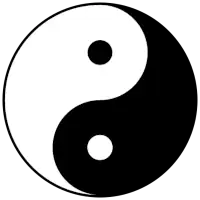
According to the Chinese system, the third term will be the TAO. The Tao is the union of duality with oneness; it is reality in depth! We note once more that union is not the ‘same’ as sameness. We need to change our formulation of relatedness from ‘Sameness in Difference’ to:
THE UNION OF SAMENESS WITH DIFFERENCE
This is, of course, also a formulation for the third term. The triad as a whole has to enter into itself; it ‘informs’ itself.
We should remind ourselves that the given reality of subjective relation is not the isolated subject (such as the cogito). The isolated subject only becomes possible as a thought through the triad. It is the triad which is the given. Just as there is the notion that the ‘primal substance’ of the world is neither subject nor object, so we can put forward the notion that the primal given is not ‘I’ but the subjective relation.
‘He’ and the Gaze
He is the ‘possible subject’, in the sense that the’ makes the two subjects ‘I’ and ‘You’ possible. At first glance, this is difficult to comprehend: what is this mysterious ‘pre-subject’? does it ‘exist’ in some other dimension waiting for the tension of I and You to manifest? All such ways of talking are metaphors, or strained approximations. We need something more concrete.
Let us think of the gaze: in the gaze there is I and You. We are not just looking at each other, we are also revealing ourselves to each other; we are giving a ‘place’ to each other. Once we grasp the particular existential intent of the gaze and understand it as more than mere looking, we can realize that here is the He! Up until now, we have had no concrete occasion for the triad, no way therefore in which we could give substance to the making of the triad. When we contemplate the situation of the gaze, we realize that it is the gaze which makes the triad: it is the substance or energy of the triad. Now, whose gaze is it? It is the gaze of ‘I’ and it is the gaze of ‘You’; and it is the gaze of I and You. It is his gaze, that is: the gaze itself.
The statements on the previous page concerning ‘containment’ are intelligible in terms of the gaze: the gaze contains, without the restriction of a boundary.
It is necessary to have attained the experience of the gaze and known the feeling of positive release that comes with it, the release from ‘looking’ which is also ‘hiding’; the attainment of a third-dimension. The attainment is not automatic; that is why it is meaningful. The form 123 suggests that: ‘I look at you and find the gaze’. Otherwise, we have merely the form 12: ‘I look at you’. I can also and equally well say: ‘You look at me and find the gaze’. This, too, is given in the gaze.
It is important to register that the above-mentioned ‘equally well’ is a feature of the attainment of meaning; that is to say, of the making of the relation. It constitutes a kind of test for the validity of the third term and its operation.
The difference between the two forma – 123 and 213 – is the difference they have for the term 1 – ‘I’. There is no difference in the outcome. Therefore, we can assert that the difference between the two forms is subjective. Both rely on co-operation between I and You. But the form 123 is ‘I-affirmative’ while the form 213 is ‘I-receptive’.
We note again and wish to emphasise that the triad cannot be properly understood ‘from outside’; it cannot be ‘observed’ but requires active participation. There is no difference between the forms 123 and 213 unless I ‘really am’ not You.
The Other Two Types of Combination
At this stage, from our work with the forms, we can assert that there should be two other forms of combination of the ‘subjects’ besides that we have discussed through the example of the gaze.
In the first of these, we must have:
The single subject (I) combines with the unitive subject (He) to give two different subjects (I or You).
In the second of these, we must have:
Two different subjects (I and You) combine with the unitive subject (He) to give the single subject (I)
We have spelt out these forms to enlarge on the brief formulations we previously gave: II Making I plus He into You; III Making You plus He into I.
We will begin with the first of these. It is the condition of realized self-consciousness. We have to say ‘realized’ because it is ordinarily assumed that consciousness always entails self-consciousness This is rather like assuming that every look is a gaze. There is an important difference which must be recognized deeply and surely in experience in order to understand what all this means. In realized self-consciousness, we have the single subject ‘I’ combining with the unitive subject. This produces a peculiar and intense state of: being strongly ‘I’ and also being strongly ‘not-I’ (which we can equate with ‘You’). Amongst many attempts to render this state into words, one stands out. In this, the expression used is that of ‘being observed’. This highlights the difference between this state and the usual one. In the ordinary state, one is identified with being the observer and, therefore, one’s world tends to be one-dimensional or, at least, ‘flat’. The state of ‘being-observed’ has also been rendered more metaphysically as: being-consciousened. Hence, one is both observer and observed; but with no infinite regress because the two subjects are contained in the unitive subject ‘He’. I am observed as if by another. The descriptions evoke very well the role of the term He which is to make happen the transition from two to three-dimensional experience. The seeming paradox of the state serves to explain how problematic it is to sustain or make the state. Our suggestion for the second form is rather more tentative. Lat us imagine a conversation in depth. I am taking part in this conversation. Now, where there is in action the third term, this is rendering the conversation more than an exchange between two subjects. How? By listening. There is this peculiar property whereby if I listen to the meaning of the conversation I am not, essentially, ‘listening-to’ You but listening to myself. The meaningful conversation discloses ‘I’. The ordinary conversation preserves the two different subjects. It is, in fact, only by entering into meaningful conversation that I can find my own voice. I do not have it in my possession; it is not a ‘part’ of me. I can find my voice only through the subjective relation. At this point, let us note the parallels between the features of the subjective relation and what we explored through the case of visual perception:
| Subjective Relation | Visual Perception |
| The Gaze | Stereoscopic vision |
| Self-consciousness | Appearance of the cube |
| Listening in meaningful conversation | Recognising two views as of the same object |
Of course, we have to bring to mind all that we said about these examples to benefit from their conjunction. Suffice it to say that the comparison gives substance to the notion that:
THE TRIAD IS AN INTEGRATIVE POWER WORKING THROUGH THE THIRD TERM
Theologically, we may well take the Holy Ghost to be our symbol. The Holy Ghost means the creation of information! Very probably, the triad will be found to be the basis of learning and evolution. It can never be reduced to any composition of parts. In its very nature, it is akin to perception and consciousness. It ‘tends towards’ the pure subject. It does not require any mechanism for its operation: it is prior to ‘means’ of any kind. Such ‘feeling-thoughts’ are easily stimulated by the contemplation of the triad in meaningful examples, where something important is at stake. However, we need to restrain ourselves and follow through the ‘subjective alternatives’ of the last two main forms we have discussed.
In the situation of self-consciousness, it is fairly easy to see that this can take two forms: in the one, the emphasis is on ‘I am’, the shock of ‘naked existence’; in the other, it is on ‘being seen’, the shock of discovering oneself ‘contained within’ consciousness (i.e. direct contact with the universality of consciousness).
In the conversation we have; you say what I mean’ or you mean what I say’. The second of these, which sounds rather strange at first, is the reality of the address, that I am addressing you, my speech is for you. With these distinctions, we have accounted for all six forms of the triad, the fine structure of the subjective relation I, You and He.
The Question of Will as a Cause
Discussions of the category of will with respect to causation have assumed that the only important to be asked is whether will can be considered as a primary cause; that is, as something more than a psychic phenomena embedded within a series of events. This view of will as ‘cause +’ is naive in the extreme. It is very easy to show that our will cannot really initiate and bring to pass anything at all that is not already in some sense ‘on its way’. This has led many to suppose that the will is a question of subjective feeling, something that accompanies the flow of events through us but is equally part of them. Do we have to abandon the special regard with which we conceive of our will – or of will in general? We do not think so. What is needed is to find the correct category under which will should be understood. We begin with the basics of our experience. If I want to do something or, even fleetingly in the moment, have a movement in my mind directed towards some goal, then I can say that there is some thought, some directed thought, a mental vector. For the purposes of our discussion, we will call this a ‘directed thought’ to distinguish it from thoughts which may have no end in view, idle speculations or pure conceptions, memories and the like. At the very same time, or almost, there are the movements of my body. I say that ‘I lift my arm’. Everyone knows this. (who has arms) but we struggle to see how this can come about. Let us call the physical movement (which is to include a cessation of movement) a ‘physical kinesis’.
Right here and now we have to face the following issue: we have no idea whatsoever of how this thought can result in that movement. Initially we are tempted to think of. a ‘causation +1 and identify the directed thought with will. However, a little analysis shows that the thought has as little to do with causation as the movement has. And yet! The thought seems to us to imply a will – otherwise, we would not think as we do. It is a real issue here of whether we live in fundamental deceit.
We want to say that our directed thought does imply a will – but, it is not itself a will. The thought and the movement are two aspects of one whole. But, what is it that makes them whole? It is that which is the will!
Let us look again at thought: what is its character? Surely, it is always of ends, that is of final causes. And, yet we think of our movements in terms of prior causes˳ (or, efficient causes) ˳ The two forms of causation – teleological and efficient – need to be reconciled and it is in this reconciliation that will has a meaning.
It is a common experience to conjure up an end or goal – such as something we might regard as a decision – and see it fail to come to pass. At other times – or in simpler things – the thought appears as father to the deed, effortlessly. What we take to be a failure of will in ourselves – not carrying out our resolves – is, in fact, the major source of support for the reality of will.
Let us consider the character of the third term:
THE THIRD TERM IS THE UNION OF FINAL AND EFFICIENT CAUSE
(Clearly, we have used terms belonging to our present concern). Notice that we might well have used more homely language as follows:
THE THIRD TERM IS THE UNION OF ENDS AND MEANS
In our present context, this means that will is a reality only when the above union is fulfilled. The dichotomy between ends and means – or between final and efficient cause, or between directed thought and physical kinesis -.is the very ground in which will is uncertain and therefore significant.
Will is not a cause ‘contained’ in thought; nor is it the efficacious mechanism by which things are moved. It is the interface or ‘kinetic boundary of the kinetic’; that is, the medium in which thought and action are unified.
We can well imagine that, out of some innocent state of early childhood there arises the disjunction between thought and action, as soon as thought could find its own expression in words and images. This disjunction liberates thought and makes it an agent of the possible; produces a distance between the two that renders every act uncertain. The baby, the child, have will – as every parent easily knows – and this will we may imagine remains much the same throughout life. However, will is not there to enable us to do what we want whenever we want; or to give substance to our intellectual choices; or to affect our desires in the world around us; etc. Will is embedded in the very act of living itself and not apart, not a faculty.
We have in our concepts the common notion of the dichotomy between thought and actuality, an uneasy dualism haunted by the recurrent themes of mechanism, vitalism, spiritualism and the like. We would like to argue that yes, thought is an actuality; but, no, it is not an actuality of the same kind with physical movement; and yet, thought can become motion and motion can become thought. Such a transformation must be possible as a property of will. And, how is it possible? Ad always with the third term: it shifts the boundary between the two; it redefines the distinction; which it can do only through the integrative union.
The actuality of thought is not the same as the actuality of physical kinesis. Whether we argue this in terms of language, the peculiar intimacy of thoughts to our ‘self-consciousness’ or in any other terms; whether regard thought as a mere ‘model’ of physical kinesis, or as some ‘condensation of the spiritual’ matters very little. What does matter is to register thought as thought, thought as we experience it, side by side with our experience of physical kinesis. That is to say: directed thought is different from physical kinesis in the very experience that gives us either of these. They are given as different. Now, of course, when we have two different things so-to-say ‘competing for priority’ the tendency is to make the one subservient to the other, which is to become a materialist or an idealist. But all assertions of the kind: ‘there is only —–‘, are a failure, a retreat from difference into a monistic sameness.
We wish to preserve fully the difference between thought and motion and seek out their union without allowing ourselves the collapse of the one into the other.
As we have been implying, difference is itself only possible by means of the triad. The very same action that unites the different fully preserves and sharpens their difference. A marriage should not make a man less of a man or a woman less of a woman! The two are united in their difference.
Our way of talking may appear to delight in the paradoxical and do little to illuminate the situation we seek to understand. What we claim is that the words serve to indicate what we already experience but in a heightened way. By a construction being made out of our experience and a following through of that construction, we hope to arrive at an element of experience which is not known to us as either thought or motion but, without which, neither thought nor motion could be what they are.
In our usual experience – in which we all too often fail ourselves in not acting as we believe we have decided – we are much occupied with making further thoughts to ‘explain’ the hiatus: we say to ourselves that we have ‘changed our minds’ or that ‘circumstances were against us! That is, we turn to one or the other of the two different terms to explain away the actual difference that they exert in practice. What we are groping after is something like an element of power or ableness. We know already in advance that there are things (motions) we cannot ‘make’ – for example, ‘Can you, by taking thought, add a cubit to your stature?’ We know that if we resolve something ‘in our minds’ concerning another person (another subject) then, all too often, what that person does (or says) may completely vitiate what we have set ourselves towards.
If we were an athlete, we would know something of our limits; but we would be determined to extend them; to find what in these limits is due to a physical restraint, or what due to a habit of mind. The athlete knows very well about ableness in the sense of the power to do. There are myriads of examples we could take: we know for example, how next to impossible it is to set ourselves to have a creative thought.
Between the idea
And the reality
Between the motion
And the act
Falls the ShadowBetween the conception
And the creation
Between the emotion and the response
Falls the ShadowBetween the desire
And the spasm
Between the potency
And the existence
between the essence
And the descent
Falls the Shadow
(T.S.Eliot ‘The Hollow Men’)
It is the Shadow that constitutes the will. To say this is unusual, since we regard the will as something positive and, even, something all the time at hand: in a word, however, we tend to regard the will as a faculty, which means that it is something we can use. But, how is it possible to ‘use’ will? Who or what is there to have it in its employ? If the will is to be used, then it is to be directed, controlled and thus, in some sense or other, ’caused’ by something else. But, we regard will as the originator par excellence. It is not possible to go further back into ourselves to find out how we do things or effect change.
WILL IS THE MAKING EQUIVALENT OF THE DECISION AND THE FULFILLING THE DECISION
What we call the ‘decision’ here is the sameness; while the action taken is the difference. It is in the very nature of will, that the act is all-at-once and completely whole; while it is in the very nature of the action taken that it is in different parts at different times. While the decision – as directed thought – fails to be united with its ‘consequent’ action, it is only dream, or a thought of a possibility. At the same time, vice versa, while action remains without a union with a directed thought, it is simply a play of mechanism.
We may feel that ultimately the act of will we have been describing comes out of the nexus of the world-process and we may be pleased to call that mechanical. But, such is only supposition. The effective directed thought comes to us as evidence of our own will. This is true even when we do not see and have no means of knowing how it is made effective. We might even regard that we are calling the act of will as sheer coincidence, or a synchronization of mental and physical events; but these terms ‘coincidence’ and ‘synchronization’ attest the significance of the third term of the relation.
The Creation of Will
Following the argument we have been conducting so far, we can lay out the forms under which we speak of the creation of will, by paying attention to the two ways in which thought and movement seek to combine in time. Our argument is going to rest on the following supposition: will is created by awareness of absence of will. Yes, we do have to introduce another term or idea in awareness. We can no longer use such an embracing concept as ‘making’ since in will we are going for the very source of making. Awareness is introduced as the general condition of our having experience at all – which is to have different elements of experience at one and the same time without loss of unity. Indeed, awareness we say is heightened when we have simultaneous contrasting experiences.
We should not expect will to be ‘made’ by ‘doing’ anything: here we have an example of creative non-doing.
It is only by suffering and delighting in the ambivalent contact of directed thought with kinetic actuality that will can arise. These are the ‘calling’ which can call forth the response of will: not to execute our immediate desire, but to change our relation with ourselves.
When directed thought (or desire assuming definite form) impinges on the field of actual motion – when we, to put it crudely, set ourselves to do something that we cannot do – then we can put ourselves into a definite mode of suffering, a pain that is even a pain in our thought. In part, this changes our decision to do into a decision to see: that is, the basis of our act of willing is altered to become as we might say, more realistic.
Then will arises as a seeing beyond thought. We have been brought more near to what is real (not to what is more actual). Thereafter, our decisions have a ‘tone’ which they lacked before.
When our actions are made to impinge upon our directed thought we have, for example, the will-to-cease, the power of cessation. Stopping what it is that we are doing is as important an aspect of will as initiating a new course of action. Here, will arises as the power of the Shadow; which is to say, an hiatus is capable of entering into our actions that can bring about a stop. It can arise in our experience in the form of the realization that nobody is doing these actions – they are simply taking place.
Thus, in these two forms, the will arises (a) in a new way to liberate new kinds of ‘action’ and (b) in a way that is tantamount to a withdrawal from action, an inhibition not through effort but through a realization.
123 Will is liberated into new pathways (as ‘seeing’)
213 Will is withdrawn from old pathways (as ‘not-doing’)
We have touched here upon two important aspects: firstly, that will is as much involved in seeing as it is in doing; secondly, that will is very much connected with how we identify ourselves with the field of action.
In 123 we liberate the ‘thought behind the thought’
In 213 we withdraw from the action that is no longer our action
Will as the Connection of Connections
Where will itself is encountered – if we may use such a phrase -by either action or thought, each oil these, in their own way, serve as a limitation or reveal their incompleteness.
Nobody knows how they do anything. But, we know that there are things which we can do. We have a directed thought and then – it is absorbed somewhere – or even felt to be taken away. We know that it is not the thought which ‘does’ the action of itself. It is up to the will to summon forth the means of execution.
Equally, when we find ourselves ‘doing something’ then this awareness summons up the unknown thought which lies behind what we are doing. Action impinges upon will to produce a kind of seeing. This is q seeing of ourselves: it is catching ourselves in the act. Our motive or directed thought appears; for there is nothing to say concerning will that it is an execution of a thought at all times. No, will is the union of directed thought with kinetic actuality and in both ‘directions’. We must rid ourselves of the crude model in which we imagine ourselves as a mind-region within which things are ‘cooked up’ to inflict on an external world. All the time, will is creating anew the meaning of thought and the meaning of action and the meaning of their relation with each other. It is in this that will resides.
Will is Articulate
The forms which originate with will itself find expression in thought and action. Will creates thought and will creates action, equally. But these are not created directly by fiat. They are created through the limitations of each other. The will is completely spontaneous but it acts in relation. It is in these forms that will ‘turns’ thought into action and vice versa.
In 312 we have what was once called ‘the materialization of thought’
In 321 we have something equivalent, which we might call ‘the creation of thought out of the body’
When we become fixated on will simply as a connectivity, we can lose sight of the other possibilities. These other forms are making real changes in the relation between thought and action, changes which amount to creatively redefining what it is to be in a body and what it is to think.
It is quite inadequate to regard thinking and action as ‘powers’ or t ‘properties’ of human beings as if they could be considered as either separable or unchanging. What we ordinarily call thought is associated with words and images, reflective of actions; what we call action is associated with habitual capacities: these are the residues of the relation. When there is a ‘task’ or a ‘work’ then these signs of ‘unreality’ and ‘familiarity’ are an indication of failure. This is so even when the task is ‘mental’ – say, we struggle with a problem in mathematics – for there is still something to master in the world of the actual, where there are constraints and laws which bind us. In the heat of the struggle, what it is to think and what it is to do fall into question; and, what it is we have to make happen and what it is we have to let happen change.
Will is articulate in terms of the combination of thought and action. We find ourselves unable to account for what is happening; as if there were an absence in our awareness of an almost tangible kind. This absent is tantamount to a ‘missing person’. And:
THE ‘MISSING PERSON’ IS ‘HE’.
The Forms of Willing and Feeling
Our model of the triad of willing rests on very simple ingredients of experience, in spite of the inferences and possibilities we have been moved to make from it. The main points are these:
- Whatever we might conceive of doing, it is quite another thing to realize our conceptions: a thought or a mental choice is not an act of will.
- Whatever we might actually be doing, we do not normally regard it as the outcome of an act of will unless we see it in that way: otherwise, will is indistinguishable from behaviour.
- There is nothing intrinsic to either conception or action that can overcome their difference from each other: this reaches an extreme in ‘dreaming’ and ‘mechanicalness’ respectively.
- In a complete act of will, the conception of an action is the ‘same’ as performing that action
It is also important to remind ourselves that we have taken the experiential evidence of ‘failure of will’ as demonstrating the positive significance of will: that is to say, will can be judged to be an independent term because we can have the other two terms without it, when willing is not fulfilled. However, the sense or consciousness of a ‘failure of will’ has a significance for will: we have even suggested that an acute awareness of such failure is the very condition for the ‘creation of will’ – which is not the making of something but the emergence of a new way to act.
Now, we have to consider what it is that is present in the various forms of the triad, or: how do these forms enter our experience? If we regard the overall medium for the triad as awareness, what is the quality of experience that arises with the various forms?
Our answer is that this is feeling. Indeed, we have already anticipate( ourselves in the foregoing sections in describing some of the forms. For example, we have in regard of the form 123 spoken of suffering. Let us review the six forms in this light.
123 Suffering. This is the feeling generated by the realization in any incident or class of incidents, that we cannot do. It is the sense of an intrinsic failure or lack; which also means that it is an energization of the ‘void’, the will-region ‘between’ the conception and the act; or, the Shadow.
213 Remorse. This is the feeling generated by the realization in any incident or class of incidents, that we have not chosen to do what we are doing. It takes enormous energy to stop what we are doing. The term ‘remorse’ is used because this feeling arises out of conscience, where all three terms are felt at once but without relation. It is this feeling that makes us ‘turn’ instantly towards ‘help.’: it is a connection with a higher power.
132 Delight. This is the feeling inherent in willing itself. The will is its own delight, its own source of satisfaction. It gives the sense of freedom and autonomy which we greatly value.
231 Wholeness. This is the feeling that comes acting as an integral being; the feeling that our actions always mean the same thing. It is serenity in life, the feeling that nothing can interfere with us.
312 Detachment. This is the feeling of will in an impersonal sense. Thought is no longer felt as the originator but as the vehicle of the act of will.
321 Ecstasy. This is the feeling of spontaneity, of not knowing what we will do next. Thought ‘follows’ action.
We remark here that, very probably, the forms of any triad which can enter our experience are ‘perceived’ by feeling, or as a feeling. Clearly, there are feelings in the forms of the subject, relation. The forms we discussed for the t case of three-dimensional perception make no sense without the right feeling tone. In a peculiar way, then, we are saying that feeling is an essential requirement for the correct cognition of the forms of the triad. We also remark that our treatment of the will and feeling goes some way towards resolving the differences between two ways of describing the main triadic structure of a human being. One description speaks of thinking, feeling and willing; while another speaks of thinking, feeling and moving. The second is intrinsically far more self-consistent in that all three are recognizable functions; but, we easily understand the term ‘willing’ in the first description to correspond in some degree with ‘moving’ in the second. Our description has it, in simple terms, as thinking, willing and moving and ascribes feeling to the forms of this triad. prom our considerations of will as the third term we can make the step to seeing that willing is ‘in’ and ‘in action’ -when there is a relation – but not otherwise. There is no willing in isolation.
However, the true resolution of the differences lies not in any re-arrangement of translation of terms but in realizing the inherent character of the triads taken as a whole. Thus, the triad thinking, feeling and willing concerns living; the triad thinking, feeling, and moving concerns being; while our triad of thinking, moving and willing concerns doing. This raises many questions!
The Relation between the Terms and the Character of the Whole Triad
We can distinguish between the three triads spoken of above by means of the characters at of their third terms. Thus, in the triad thinking, feeling and moving it is feeling that best exhibits the third role. In the triad thinking feeling and moving the third role is exhibited by thinking. In our own triad of thinking, willing and moving the role is taken by will, or willing. Then, we can associate living with feeling, being with thinking and doing with willing and it is fairly clear what it is we are doing by making these associations. However, we have to take into account some more aspects. For every one of the three triads, some kind of awareness is taken for granted. 4hat this in fact means is that we are instinctively regarding every one of the terms as concerning a subject: as we said very near the beginning of this paper, the terms of a triad are more subjective than objective and it is this that makes them of the ‘same substance’ (homoousia). So, we can form classes of triads according to the underlying substance of their terms. However, we have also to acknowledge the differentiations which arise through the forms. In the case of our own triad of thinking, willing and moving this was through feeling. We suspect that in the case of the triad thinking, feeling and moving we would differentiate the forms as through willing! And, in the case of the triad thinking, feeling and willing we would distinguish the forms through moving!
These modes of distinction are not very convincing. Now, this should suggest such possibilities as: the three triads are not, after all, of the same substance; one or more of the triads is not a genuine triad but a collation of terms only; we have an incomplete array of possible terms. What is important at this stage is to entertain the possibility of an ensemble of triads which are interconvertible in the way we have been indicating. It should not surprise us that this can lead us to conceive of terms of some triads being forms of others; which amounts to asserting that the perception of a triad is itself an element of a triad. A triad cannot be observed only experienced and this experience is active.
Third Force
Characteristics of the Third term of the Triad
In exploring this theme, we wish to take as our starting point a particular instance which will serve us as a model. We will then consider other cases and see whether what we have learnt from our model has a general applicability.
The particular instance we wish to start from is this imagine that we have two well-defined points and of light and (gifted with excellent eyesight) we look at these paints. Within a certain range, we will indeed see two points. Moving outside this range – further away – we are able to see only one point (i.e. we are not able to resolve the points). Thus, within a certain range, we can see two different points but, outside that range, what we see are the two as the same point. Clearly, there is a ‘region of transition’ within which it is possible to see either one or two points. We can, realistically, say that within this region we can see both sameness and difference -(although maybe not at the same time). This region of transition, considered itself as a point, is the third term.
We note the following features:
- the third term is a place of transition
- it has itself no clear-cut boundaries
- it is outside the linear dimension of the other two terms
- it is a region of perception which has two possible states in time (according to a judgment).
- there is a kind of nesting of characteristics, thus: it is a spatial region, within which there arises a perception, within which arises a judgment, within which arises an intention …. the open form given by the dots … signifies that we have no way of deciding if this nesting comes to an end the reference to intention is to remind us that we can ‘make an extra effort’ to resolve the points which will have an effect
- it exhibits a dichotomy between space and time (hence, we can speak of a ‘transition’)
- in this dichotomy, time carries the character of difference while space carries the character of sameness
- this, in its turn, raises the question of whether or not there is a further type of third force in which the sameness of space and the difference of time are unified
- this, then, leads us to the question of the present moment
Before we go on to investigate the space-time dichotomy, we want to advocate that we regard the ‘region of the third term’ as sensitive. This means that minute changes of some kind can alter the totality: the transition between sameness and difference is made by an infinitesimal.
The Present Moment
It is usually accepted that our experience of the present contains both a sense of succession and of simultaneity. Pure succession would amount to senseless fragmentation. On the other hand, by simultaneity we do not mean something impossible – that different moments are experienced tat the same time’ – but only that they can be and are experienced together. This is fairly clear in music, where we hear both distinct notes, one following the other; and also, the sound of these notes ‘together’ (for example, as if they were forming a chord). Hearing these both as a unity is what gives the sense of melody, or of a musical phrase. There is no hearing of music without this unity. It is, of course, quite another thing to generalize this supposition to the present moment in general. We should notice, however, that just as it is next to impossible to register one single sound out of a piece of music- .i.e. without in some sense also hearing other sounds with it -so it is next to impossible to experience simply an instant. It is a false atomism. The unit of experience requires there to be some interval which means that there must be at least two different moments. We suggest the following model: we have two different moments (marked in some way like two sounds one after the other); these collapse into each other as one moment which is then contrasted with a further moment. There is a transitional structure of two passing into one passing into two and so on. The question is whether this transition requires a specific act to make it so?
We cannot answer this question. What we observe is that our description – which has implicitly contained in it the characteristics of the third force – turns out to be a description of what we feel as ‘time passing’. Time is, of course, transition!
There appears to be nothing we can do about it.
We have what appears to be FUTILE WILL. Just as sameness and difference are unified, they are dis-unified. We might suppose that our own will proves unequal to the task of stopping time!
Such statements can only be metaphors. Let us attend more closely to the bare phenomena. We found, in the previous example, that the third term could be associated with a sensitive region in which sameness and difference transposed one into the other. Now we discover that our present moment has this characteristic built into it.
But, we need to think some more about our experience. If we get hold of the idea of sameness and difference and intentionally attend e.g. to music in the light of this idea, then we tend to discover that our hearing has become more sensitive. Sometimes, this can amount to having ‘another dimension’ of hearing, so marked is the difference. In this, we enact our experience of the transition from two to three-dimensional visual perception. Thus, there are hints that an intentional act is possible; and, therefore, the third term has real meaning. We should state that the third force only has meaning if we can act ‘in it’.
Similarly, we suggest that the present moment has greater intensity when we decide to attend simultaneously to what we appear to control and what we do not appear to control. This can drive a man mad! The possibilities for our intention within the present moment exhibit one common characteristic which is of great interest: we exercise this intention by willing the transition from sameness to difference and from difference to sameness. In other words, the third force can be learned. This is extremely important for it means that the third force is not a matter of some unknown caprice but an accessible act. However, if we accept for a moment our extreme example of control and non-control, then we should realize that our third force act can be neither a matter of our control or of our non-control! The third force is changing the boundary between what we let happen and what we make happen. But, we find that this is possible! It seems, then, if we go along with these suggestions and arguments, that the third force has the following characteristic above all others:
THE THIRD FORCE CONTAINS WITHIN ITSELF THE THIRD FORCE AND SO ON
Representation of the Act of the Third Force
The primal representation is given by:

This is echoed in the account of will as:

And in the present moment as:

The symbolic way of representation reflects the above as:

‘One movement links thoughts with one another in a series, the other keeps aiming at the same spot.’ (Wittgenstein ‘Culture and Value’)
‘Horizontal’ and ‘Vertical’ Transitions and the Third Force
To extend our repertoire of representations of the third force, we want to look at ‘horizontal’ and ‘vertical’ transitions. The first of these can be pictured as an adjustment along a line. The adjustment is understood to be in which unbalanced tendencies, represented by extension in opposite directions along the line, are brought into balance: in other words, equilibration. The logic of this situation has been extensively investigated by Pledge particularly in terms of the equation:
a + c = b when a/ b and c = b – a
‘c’ is the adjustment which carries the third force. We wish to make the following model of the situation:
imagine a as

and b as

then the state of equilibrium is such that a part of a or b – depending on whether a is greater than b or vice versa – is converted into its opposite (i.e. changes sign) the amount to be converted is
(b – a)/2
we imagine that this conversion is by way of a rotation of that ‘length’ into its opposite sign:

What we wish to draw attention to is that this rotation passes through imaginary quantities, as shown in the following framework for representing the plane of complex numbers:

What we have done is to ask ourselves how the adjustment is made; and we have introduced the idea of a rotation which, in its turn, requires us to introduce complex numbers, i.e. numbers outside of the dimension of the given line of numbers. On the face of it, this model of ours is needlessly complex. It is simpler to picture ‘c’ as a linear adjustment which e.g. turns a into a’ such that a’=b; i.e. that c is ‘added to’ a. It is this which leads Pledge to state that c is either of the same sign as a or b. In our model, c represents an operation involving complex numbers, incorporating the rule: i x i = -1 to allow us to think of a conversion from one sign into the other.
There is, in physics, some support for the notion that physical explanation involves imaginary postulates. For example, c.f. the use of ‘imaginary time’ in the work of Hawkins. The suggestion we want to make is that the representation involving imaginary dimensions is a representation of the movement in ‘mental space’ which supports an intervention. For example, in the case of the chemical balance, what we can think of doing is moving some of the material from one side of the balance to the other: this is tantamount to making a rotation about the fulcrum. This is a distinct approach from the one in which we bring in to the situation additional material to make a balance.
Our model, then, is describing an adjustment of the situation without the introduction of any new material. It is what tends to happen naturally in e.g. a chemical reaction bringing itself to equilibrium. The importance of this representation for us is that it accords with our characterization of the third force as an intervention ‘at right angles’ to the ‘line’ between the other two forces, i.e. as truly independent in kind.
The ‘vertical’ transition is of quite a different kind. What we have in mind is such as the following: within a given scale, we ‘perceive’ the situation discretely, e.g. as a collection of atomic entities in interaction; beyond this scale, we perceive the situation as a continuum. There is, thus, as with the perception of two points of light, a region of transition which is closely linked with the nature of the perception involved. In certain circumstances, we can observe things which can only be explained in discrete terms, such as Brownian motion; but, for that, we have to be able to see the motions of the pollen grains, for example.
Another example concerns dimensionality. From a certain distance, a hair is seen as a line. Within another range, it appears as a tube, a three-dimensional object. Coming closer, we are dealing with a surface or two dimensions. Closer still, and we re-enter the three–dimensional world (or, perhaps, a dimensionality of e.g. 2.7) and so on. These transitions are real.
What is the nature of the third force in such ‘vertical’ (i.e. scale-related) transitions? A movement which changes from discrete to continuous, or from one to three dimensions is extremely powerful. It actually changes the phenomena without physical intervention. It has a transcendent character. It is very important to note that it makes a change in our perceptions, and: perception is the third force for judgment and phenomena. It is neither a priori nor posteriori. It has a physical character in that our senses are physically engaged with the phenomena (are we using microscopes?). Our perceptions echo the role of apparatus and apparatus in its turn echoes the significance of arrangement, the core of experiment (and technology). Strangely enough, then, we begin to suspect that the third force in science is due to technology (instrumentation and design). What our instruments and design do is to alter the boundaries. For example, in the case of the discrete-continuous transition, what we alter is in the nature of the enclosure of e.g. the gas (what is the ‘skin’ around it?).
But, in a more general and abstract way, we can represent what we mean by the following:
boundary state one: a / b
boundary state two: a b
In state one, the boundary divides the elements a and b. In state two, the boundary encompasses (as ‘one’) the two elements a and b. In. the transition region, we pass from one to two and vice versa. We may think here of the example of listening to a siren at increasingly low pitch, when we pass from hearing a note to hearing a sequence of beats. This is a transition from state two to state one.
It is clear that the representation above fulfils our favourite definition of the third force as: the unity of sameness and difference. if we regard state one and state two as being ‘one’!

and in the other solution, a = and b = , i.e. they are the same. Clearly, the second solution represents the continuum.
Tentative Suggestions concerning the Physical Nature of the Third Force
We would suspect, already in advance, that any attempt to describe the third force ‘objectively’ would be doomed to failure. In the cases we have just been trying to represent to ourselves, the phenomena are being changed by the third force; but this does not make the third force itself into a phenomena. In a very important sense, we can only describe what we can change – i.e. that for which we have an appropriate technology. If we can describe a third force then we can change it and this means that we are introducing yet another (deeper) third force.
What we can do is to indicate situations in which we suspect a third force and gain some ‘impression’ of it, just as we can for our own perception (even though we cannot perceive our perception). What we do is to replace perception with imagination and here it is appropriate to do so.
However, we wish to begin our brief exploration with a purely physical situation, to see whether (a) we can identify a purely physical third force and (b) if so, we do find a ‘third force within the third force’. The situation we are going to take is that involving catalysis. A catalyst enters into a chemical process without itself being, in the end, changed. In the case of homogenous catalysis, the catalyst enables the formation of an ‘intermediate compound’ which then breaks down to give the new chemicals according to some formula: A+B – C+ B. In this process, the catalyst accelerates a specific reaction (and may be used thereby to select between two or more possible reactions). A simple example is the catalysis of the breakdown of ozone into oxygen through chlorine oxide. It is not always true that the catalyst is perfectly regenerated. We consider the ideal case of perfect regeneration. Then, we have a substance entering into the reaction without itself being changed; producing the reaction through a ‘critical complex’ which takes the combination to the ‘energy threshold’ for the reaction. This ‘critical complex’ we wish to correlate with our notion of a rotation into imaginary space: it is a ‘movement’ of the reaction in an independent direction from the movement of the reaction represented in the formula A+B – C+ D.
In heterogeneous catalysis, the most important cases involve an ‘active surface’, though it is not yet clear whether or not the activation takes place only on special sites (such as an edge of the crystal). The reactants are absorbed on the surface in such a way that the valence bonds are changed. The catalysts are highly porous with large surface areas per unit mass. The technology employed often uses a deposit of the active catalyst on a carrier substance. All known catalysts deteriorate with use as they become ‘poisoned’ and have to be regenerated, e.g. by burning under special conditions.
Of some interest to us is the fact that catalysis is still imperfectly understood. Also, it is most significant that the action of a catalyst can be amplified by the use of a ‘promoter’. Further, sometime two catalysts are used in conjunction when they exhibit a ‘synergism’. The case of heterogeneous catalysis strongly suggests a ‘nesting’ of the action: synergism, promotion, regeneration pointing to layers of the action. It also clearly involves the transition region between the microscopic and the macroscopic domains: the fine structure of the surface involved being crucial.
Now, the general abstract character of the catalytic action is that of a transition from state a to state b by means of something that does not (in a detailed sense) itself change, c. The point of equilibrium is shifted; one state of balance is transposed into another. In this sense, the catalyst does not ‘do’ anything: it does not add or take away anything, even energy.
Now, we want to make a leap into the sphere of perception. Let us return to our example of three-dimensional perception and the case of coalescing two distinct views into one three-dimensional one. Here is where we begin to imagine. We imagine that there has to be an ‘internal surface’ within the space of visual perception in which the two inputs can be altered and, thereby, combined. We imagine that this is something to do with the surface of neurons; and we bring to mind the obvious significance of the structure of the brain which exhibits on various scales an abundance of surface area. To speak here of a ‘rotation’ can, of course, be no more than a metaphor; but we can imagine that the two source pictures have to be brought into another kind of space in order to meld together. This space would be an ‘imaginary’ space, thought of in this way to distinguish it from physical space. Hence, we are also imagining a transition from physical to mental space which would proceed in both directions, since: the two pictures (physical space) are integrated on the internal surface (mental space) and then experienced as the one three-dimensional image (projected back into physical space). We can see here an analogy with the ‘critical complex’ of homogeneous catalysis.
The question of the regeneration of the catalyst can also be found a meaning in our case of stereoscopic vision, where, as with all vision, we are equipped to deal with ‘fatigue’ both in the retina and in the brain.
What we are arriving at is that the physical third force, acting in a ‘horizontal transition’ necessarily involves a ‘vertical’ one. Which, in its turn, suggests (if we have the imagination!) that the third force itself is more like a tetrad!. It is this – or something like it – which enables to say: ‘The third force contains the third force within it and so on.’ In the triad itself, the third force is reduced to a single character, a character which exhibits the paradox of ‘making a change without doing anything’ – which is, as we may see, an important clue to the nature of the tetrad.
We have, so far, made a tenuous connection between various of our examples, seeking to unify in one conception all that we can glean from (a) insisting on the possible physical character of the third force (b) relating this physical character with its character in perception (c) bearing in mind the most abstract representation we can make that allows for a true independence of the intervention we associate with the third force.
We will extend our survey to include a brief discussion of the 3-M equation. Note, first of all, that we characterized this triad overall in terms of making. We regarded matter as containing all that we can do in the obvious sense. Then, we regarded media as all that we cannot do in terms of existing mechanisms but yet ‘does’: that is, we looked to media for creativity in an objective sense, correlating this with our situation as ‘something’ within the creative field of the Whole. Thus, matter and media represent two forms of doing which contrast with each other such that, from our point of view, matter contains what we do while media contains our ‘non-doing’. Now, what of meaning? All that meaning does is to mean! The unification of media and matter in meaning is further removed from making than Jam media itself. What we have to do is to realize meaning. Meaning is the catalyst.
However, we want to allow ourselves the possibility that this catalyst can be made. Surely, we can see vivid analogies with the technology of catalysis? Such components as promoters, synergy and burning have obvious analogues with the methods of logosynthesis (the creation of meaning). We can have a ‘technology of meaning’ of a sort and such a technology is necessary if we are to have the 3-M equation, for we have to be able to exercise the third force represented in it. It does not matter for the argument that this ‘technology’ is imaginative in the extreme: we are coming to imagination as par excellence the faculty of the third force, the faculty that enables us to unify the unknowns of objective creativity with the knowns of tangible construction. However, following our rule – The third force contains the third force and so on – we must realize that we do not speak of unbridled imagination but of an intelligent one.
We can now make a pretty ‘unbridled’ assertion:
THE THIRD FORCE IS THE INTELLIGENCE IN THE SITUATION
Hence, our model for the third force is our model for intelligence. Intelligence is the thread that links together: intervention, perception and meaning. In this respect, speaking rather hastily and with some excitement, we should note the importance of catalysis in the emergence and evolution and working of life. It is in this that the whole issue of the ‘intelligent guidance of evolution’ is concentrated. Our account is, of course, heavily biased; as is obvious if we link the definition given above with our previous formulation
THE THIRD FORCE CONTAINS THE THIRD FORCE AND SO ON
since the two together imply that the working of the third force of any kind in any situation is, ultimately, intelligent. We may extend this imaginative use of analogy further and remember our discussion of will. In that discussion, we stated:
WILL (AS THIRD FORCE) IS THE UNION OF ENDS AND MEANS
Or, OF FINAL AND EFFICIENT CAUSE
Just as with catalysis, will introduces a direction into the sphere of activity that would not of itself show itself (since it is a matter of jumping from one possible equilibrium to another equally possible). Will, like catalysis and intelligence, does not bend the rules, only employs them.
Finally, we present a ‘nesting’
Will – Intelligence – Imagination – Perception – Catalysis
and we repeat our overall assertion that the third force must include a physical aspect. The major paradigm we have is technology, taken to include experiment and design equally; which has its ultimate expression in the 3-M equation.