
A NOTEBOOK ON THINKING IN THE SIX TRIADIC FORMS
Anthony Blake
Part 5
Quick Links
MODELS OF THE SIX FORMS
An Elementary Model of the Six Forms from Geometry
After a period of dealing with complex situations, it is beneficial to return to the most simple that we can find consistent with what we suppose of the triad; otherwise we can no longer be sure that we have been dealing with the most elementary structures and not indulging in accidental images and possibilities. Our model is given below:

There are two circles side-by—side. They are of different sizes; the circle A represents what we have been calling the ’active’ term and circle B the ’passive’ term. Since they are both circles, they have in common a geometrical form; but they are distinguished by two things (i) the positions of their centres, (ii) the size of their radii or circumferences.
In placing them as we have done, we have implied a relation between them. This relation depends on (i) the distance between their centres and (ii) the ratio of their radii. The first parameter comes from their actuality: they have to be ’pinned down’ to definite places on the page. The second Domes from their intrinsic properties, which we refer to as potential: it does not require them to be drawn or fixed anywhere.
What they have in common – being circles – we refer to possibility. There are, for example, certain possibilities to do with having a centre, a radius and the ratio involving pi.
The distance between their centres can be overcome by a translation:
1-3-2 centre of A moves to place of centre of B
2-3-1 centre of B moves to place of centre of A
The difference in their sizes can be overcome by a change of scale:
2-1-3 circle B determines the size of circle A, which contracts
1-2-3 circle A determines the size of circle B, which expands
These two types of change can be effected together so that the two circles coincide:
3-2-1 centre of B moves to centre of A and circle B expands to coincide with A
3-1-2 centre of A moves to centre of B and circle A contracts to coincide with B
Commentary on the Elementary Model
There appears to be no entity similar to the two circles which enters into the relation between them. However, consider the construction:
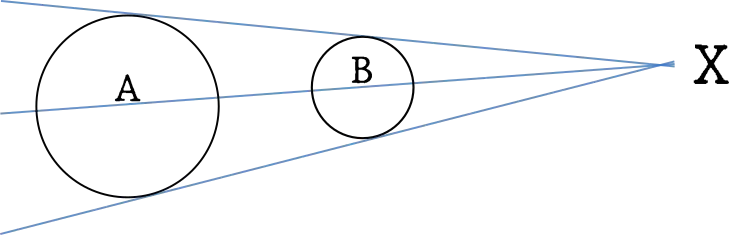
The construction lines show the third geometrical entity. This entity shows displacement and ratio for the circles. Distance from X gives the displacement of the first two forms. It also gives the ratio involved in the next two forms.
The construction also portrays, interestingly enough, the two circles A and B as cross-sections of a, cone. A cone is a three dimensional figure. Previously, we came across the third term as three-dimensional in comparison with the two-dimensional character of the other two terms The displacement parameter is given by the difference between AX and BX. However, the scale factor is given by their ratio.
In the last two forms, wherein the two circles coincide, what we have is ‘the identity of A and B as seen from X (such as in a solar eclipse) and ‘from infinity’ towards X. We can imagine the lines as rays of light and then (i) a parallel beam producing a divergent set of rays (as shown) from X through: a concave lens, (ii) a parallel beam producing a convergent set of rays through a convex lens to the left of A.
Why Three?
Is it entirely a matter of conventional definition that relatedness is constituted by three elements? We have two problems: firstly, can relatedness be less than three, i.e. two; secondly, can relatedness be more than three? The first we have gone a long way to answer, the main thrust being that in order for two things to ’matter’ to each other, there must be some kind of exchange between them, constituted of necessity from the nature of the two things. Here, we adhere to the principle of localization, meaning that we do not allow two things to be connected without an intervening signal or transfer (in this sense, two synchronized electrons are not independent things). The exchange can be of information, energy or matter. This list is not restrictive and can be extended along any lines that correspond with a ’transmission’, or as we expressed it: ’from … to’.
The second problem is of a different kind. Let us begin from an example: members of a family are said to be related and this relatedness can extend in time. Clearly, there are more than three members of such a group. How, then, can we say that only three elements are involved?
The answer is that familial relatedness stems from sexual reproduction and has the irreducible form: Father-Mother-Child. Thus, it is not that there more terms than three but that everyone in the relationship is a father, mother or child. There are restrictions such as: no member can be both father and mother. And there are extensions such as: a man can be married into the family and have no children, i.e. not be a father or child in that family. Further, a child may issue from a man and woman ’outside the family’, i.e. be illegitimate. The rules of marriage are mixed up with the facts of biology. There are further complications with adoption (let alone surrogate motherhood!).
Notice that the factual base of the whole edifice of relations is the transmission from the Father to the Mother of the seed. With flexible social rules and modern medicine this fact can produce very complex situations.
What we have in practice is a mixed situation of fact and intention. It is stakes assumed, for example, that a marriage intends children; so that the man. and woman are potential parents at least. When a child is adopted, there is the intent that he should be treated as the progeny of the foster-parents. Rejection of an illegitimate child can be considered as a counter-intention.
Thus, intention over-rides the facts, yet adheres to the triadic pattern: Father-Mother-Child.
The two terms, Father and Mother, are the same in both being parents of the child and different in sexuality. In the child (literally, in his genetic code) the two are unified.
1-3-2 is fertilisation. 2-3-1 is giving birth (she bore his child’). 1-2-3 is the making of a male child and 2-1-3 the making of a female child. 3-1-2 and 3-2-1 refer to whether the child is more like the father or the mother. These are the forms based on genetics.
The relations in a family such as between siblings we have touched on before. In respect of the primary pattern (Father-Mother-Child) they may be called sub-relations in that nothing passes between the members directly. This applies in the case of giving, where someone gives to many people: these various persons are only sub-related.
The primary pattern of Donor-Recipient-Gift remains clear. But, do we have the second term as the several people or just each one, separately? The answer is that the relation is constituted by the third term: one gift, one relation. Otherwise, there is no strong sense of unity in the third term.
Similarly with any physical situation. Each triad stems from a single physical interaction: a collision, a beam of light, a flow of heat. The entities involved are involved in a way that depends on the nature of the third term, i.e. on the transmission or interaction. Thus, the gas that gives up heat to some other body is not just a source of heat; a man who gives something to some-one is not just a donor. It is another question whether or not an entity can be regarded as the sum total of its appearances in relations; but, there is no other way that anything can appear except through a relation (including ’observation’ or even ’introspection’).
We now have to address the question of quantity.
In the triad, we do not have three things. The terms are not countable, Otherwise, why should we not count more? The argument we are following rests on this: that the three terms are a necessary consequence of the nature of the first term. The argument is somewhat tautological. That is to say, it depends on a criterion for the first term which , in fact, requires there to be three terms.
The argument is simple:
- there is an action which produces a reaction
- the combination of action and reaction is not null
- this combination comes to mediate between action and reaction
The arising of the third term is indicated in the forms:
1-2-3
2-1-3
The mediational role of the third term is indicated in the forms:
1-3-2 proximate mediation
2-3-1
and:
3-1-2 global mediation
3-2-1
When the third term fulfils all the conditions specified in the six forms then the whole triad is self-sustaining. This distinguishes a true relation from a transitory interaction. In the latter, the combination of action and reaction produces a dampening of the perturbation. Thus, e.g. an oscillating spring comes to a standstill. In transitory interactions, the 1 third term’ is akin to friction. In true relations, where we allow an organic totality open to a wider environment, the third term is akin to food (as we shall discuss elsewhere). Thus, the triad has the form of ‘perpetual motion but, in reality, it acquires its energy from elsewhere.
We can now return to our statement that it is from the nature of the first term that the three-foldness of the relation derives. The first term must be such as to evoke a reaction with which it can make a third that fulfils the six-fold conditions (of the forms). This is what is meant by calling such a first term affirmative and so on.
Such words already anticipate an ’appropriate response’ as the second term and an ’effective mediation’ as the third term. In this sense, the meaning of any of the terms requires the others and ‘contains’ the others.
The ‘Cybernetic’ Model of the Six Forms
Wholeness is not quiescent. A living whole is not a monolithic entity. It is, as a monad, diverse and changing. As a true monad, none of the changes are literally from outside but part of its nature. The triad arises whenever there is a marked shift in one recognizable ’part’ or ’aspect of the whole’ Any such change or shift must be balanced by a corresponding shift in another part of aspect. The whole preserves itself, even in flux® We have no way of knowing how this is done, only that it is done for there to be a whole that is alive.
Thus, the arising of a shift elicits a response. This response serves to define another part or aspect of the whole, as a light produces a shadow. The initial shift we call the active force and the response to it the passive force. Thus, in a society, 8, force to change energizes its own resistance. In the model, we do not distinguish between outright resistance and denial on the one hand and receptivity and support on the other.
The divide between the active and the passive is not discontinuous. Given the nature of the whole, there can be no division of the whole into distinct parts. Therefore, there must be a third aspect of the whole which is relevant, present, yet neither of the active or the passive. It is through this third part or aspect that the interplay of the active and passive are regulated. Thus, in a society wherein one part becomes active and another passive, or better expressed responsive, there will be a third part which is independent and through which the other two parts work out their relation.: this has been referred to as the ’silent majority’ in American politics.
There is no quantitative measure that is appropriate to this interplay We may, perhaps, assume that them the general property of the third part is to dampen down the contrast between the first two forces. In this, the third part is ’representative of the whole’ in the sense of the old whole, or the status quo. This is very important, since we regard the third force as that which regulates the transition from old to new.
For the active ’term’ to affect the passive ’term’ or vice versa, they needs must act through the third ’term’. The initial response or energisation of the second term is chaotic. It is only when the active passive terms are stabilized that the intermediary role of the third term is also established. This means that the third term is already bringing the first two into a balance’ However, we can easily realize that this balance is not the restoration of the status quo because of the fact that the active term has acted or done something, changed something. We may think abstractly of the transition as being composed, of an addition to the active force (that is why we call it active) and a subtraction from the passive force (that is why we call it passive). Then, abstractly, we imagine that the active force transmits what has been added (or taken by it to itself) to the passive force, restoring the original balance. This abstract view is insufficient, since there has been a change such that the original state of affairs cannot be entirely restored.
This is the nature of a living whole.
We can imagine that the active term is that in which ‘consciousness’ is gathered from its dispersion amongst all the elements; which Isai leaves the larger part bereft of consciousness. Thus, the presence of a ’teacher’ as one who knows creates those who do not know.
The implicit assertion of the active force must mean a corresponding imposition of privation on the part of the passive force. This, in its turn, produces an ’unknown’ component from the passive force, a self-assertion that is denied what the active force has claimed. This ’unknown’ component is what is independent of the first term. In many of our examples, we expressed this as the response of nature to the imposition of an artifice.
The working of the whole, its actual complexity of interconnection and adjustment, with its qualitative depths, means that the restoration of the whole must ’win out’ even though it does not mean that the same whole will result. The whole will not preserve itself as it was: it will evolve.
The interplay of the active and passive terms, therefore, particularly in respect of the role of the third term, is crucial for the evolution of the whole.
The central idea of balance cannot be expressed in precise terms since what comes out may not be predictable.
A crucial factor in evolution is that the whole maintains itself even while undergoing radical change. Thus, on Earth, there has always been the one ’same’ Biosphere.
The supposition with the triad is that the transition equilibrium can be characterized by three terms. In other words, the perturbation brought about by the active term, that produces a restoring force and, from the two together, a dampening force does not devolve into a series of perturbations, echoes within echoes. The equilibrium of transition entails that the given forces themselves stabilize. They are the stabilities of the transition, hot eternal, not an everlasting feature of the whole; but stable enough to effect a change in the whole.
This is the whole mystery of evolution: how a disturbance in a part of the whole can transform the whole. We might well feel that the whole was ’ripe’ for change. What this means in our language is that the third force prepared the way and was already implicit in the nature of the whole.
The progression of the evolving equilibrium requires each of the three terms to play its part. There is no way in which we can ascertain whether or not the key moves were made out of causal accident or by intention. There is, in the triad, a fusion of the meaning of accident and intention.
THE FORMS: In the transition equilibrium, term 1 exercises control over term 2, and this is expressed as: 1-3-2. Reciprocally, term 2 exercises control over term 1 and this is expressed as: 2-3-1. Both 1 and 2 operate through the ’neutral object’ term 3- In the case of ’gifting’, the donor seeks to control the recipient by the gift and the recipient also seeks to control the donor by the same thing. The mode of their controls is not the same. We are not talking about a man giving diamonds to a woman while the woman gives her body to the man.
It is in the nature of living wholeness that 1-3-2 and 2-3-1 are balanced, or reciprocal. Take the case of an ecosystem in which there are predator and prey. The predator keeps down the population of the prey but does not decimate it to extinction. Thus: 1-3-2 the predator culls the prey; 2-3-1 the prey sustains the predator. The prey population actually determines the size of the predator population. If the relation gets out of balance, there could be a mutual extinction. Such a possibility is taken care of according to the forms.
1-2-3 and 2-1-3- la these forms, we have the dominance of one term over the other. This results in a compensation that is an adjustment in the third term; which term regulates how 1 and 2 influence each other« Thus, a dominance of 1 over 2 results in a compensation in 3 which weakens the influence of 1 on 2. Such ’moves’ are learning or innovation. Take the role of ’The People’s Liberation Army’ in China: when the students and people began to dominate, a shift occurred in the Army enabling the leaders to restore their influence. This reversed the previous trend. We note how the leaders attempt to ’fabricate’ the form 2-3-19 support by the people, through propaganda and manipulation of the media.
The forms 3-1-2 and. 3-2-1 express how the third term can achieve such an independence that it becomes crucial for determining the range and scope of dominance of 1 over 2 and 2 over 1O In the case of predation, this may reside in food-supplies for the prey, water and disease. In the case of China, this may reside in economic factors. This means that, whatever the urge or intent of either 1 or 2, there is something which is over-riding the interplay between them; and this something is coming from another direction altogether.
We might ask whether or it is possible for the third term to be the same in all its functions in the various forms. Consider predation: we can easily take ’food’ to characterize the third term consistently. A similar consideration applies in the political example, except that we have introduced into our discussion of the case, the military. Perhaps, we have to take the military and the economic together; but the deeper factor is ’food’.
A crucial feature of the third term is that it is connected with the limitation of resources: this is deeply embedded in the efficiency of the whole system embracing 1 and 2. In 1-3-2 and 2-3-1 we are faced with 3 as representing the aspect of limitation. In 1-2-3 and 2-1-3 we are given die possibility of a change in efficiency. In 3-1-2 and 3-2-1 we have the effects of long-term changes in the third term; they represent the possibilities, given both limitation and changes in efficiency; for there are limits to possible efficiency.
Our reference to ’food’ in the examples is only an indication of what could be meant by the third term; but what we have said about limitation, efficiency and possibility is very near the mark. These characteristics are fitting for a term which has the following properties:
- •it distinguishes 1 and 2
- . it connects 1 and 2
- . it manifests the combined effect of 1 and 2
- • it governs the combined effect of 1 and 2
- . it maintains the balance between 1 and 2
- • it shifts the balance between 1 and 2
In the ordinary run of affairs, when things are more or less in status quo, the significance of the third term fades into the background. It becomes noticeable when there is a transformation, or when it begins to act ’in its own right’, independently. We might express this another way: the third term becomes significant in metastable conditions. In such conditions, there is what we have called a ’locus of sensitivity’ such that relatively small changes can produce far-reaching effects.
We cannot claim that the third term is a single simple object. In a political regime, the economy can rest on food-production while this, in its turn, rests orfe, combination of climate and management. However, to be effective, all these complex factors must be focussed into one region and not dispersed. Hence, the remarks often made on the significance of the presence or absence of goods in the shops in Moscow for the fate of social reform.
The first term we can regard as ‘egocentric’. It is something like a possessive or assertive demand. It concentrates resources into and for itself. It might well be equated with the ‘for-itself’. In contrast, the second term assumes the role of the ’in-itself’. We would like to say that the true consciousness in the situation is in the third term, in that in which the first two are unified. The ‘for-itself’ creates the role of the ‘in-itself’ and, from the ‘in-itself’ the ‘for-itself’ is confirmed. We would have to invent another word for the third term, such as: the ’is-itself’. Such a character and role was ascribed by Husserl to phenomena. This description repeats our earlier discussion in which we proposed that the given whole was disturbed by what becomes the active force. This is centric. Through assertion, it departs from itself (as an ’object’) but requires what it thereby does not have to give it substance and permanence. Thus, in the same act, the active force requires an object for its assertion as it ’breaks free’ from its environment. Prom the viewpoint of the active force, the second term is passive or non-assertive. However, this is a deception, or mere appearance.
The second term has an archetypal form in the image (where the third term becomes the mirror). However, this makes it difficult to understand what is most important for us: how the second term can gather or manifest an energy of its own. We can imagine the witch in Snow White becoming the slave of her own image (and note the intriguing role of the mirror!). There is no doubt that the image ’produced’ by a person, in whatever sense, begins to exert an influence upon the person. Hence, the prevalence of systems of ’positive thinking’, based on the same observation. The characters produced by an author are said to ’take things into their own hands’. This is more than metaphor.
It is more than metaphor by being cybernetic. The assertion of the active term requires feedback: it cannot be exercised in a vacuum. The active term seeks confirmation or positive feedback, but for this to be genuine, it opens the way for a negative feedback. Such has happened in Poland, where the population voted against the government. This example is important in that it clearly contains an independent third force in Solidarity. Of course, once part of government, it will lose its independent character!
In the feedback process, it is the third term that acts as a channel of communication. To stretch a point, we can say that it is to be characterized by the flow, organization and influence of objective information. 1 and 2 always distort information; one, one way and the other the other way. Neither 1 nor 2 in e.g. a political regime knows what is really going on
Media in the 3-M Equation
Media is the force relevant to making meaning and has particular application to the world of man. let it can be regarded as an incursion of a wider reality than that within the scope of human powers. With respect to Media, what man can ‘do’ is passive. Thus, what man can do is to be identified with what is called Matter in the 3-M equation.
We can no longer confine ourselves to the view of the active force as ego-centric. In this context, it is a disturbance but not from an egoic source. We called it an ’incursion from a wider reality’ and have to indicate what this ’wider reality’ might be and how it becomes relevant in human affairs. To do this, we return to one of our earlier notions: that on Earth, man acts as the active force and ’nature’ as the passive; and, from their combination, there arises a third force which we have called ’higher intelligence’. In this ’higher intelligence’ for example there is to be included ’genetic memory’, i.e. information on how life did evolve and various complex problems were overcome. There is also included the mental power which ax is capable of seeing alternative routes. To take an analogy: someone who solves a mathematical problem may pursue a route which, once he has arrived at the solution, can be seen to be inefficient and a better one constructed. The combination of nature with knowledge of nature is very powerful; but we must not presume that we have travelled very far in uncovering what has been accomplished in nature. Also, Nature Herself may be full of surprises: She is not entirely a matter of the past.
In what or ’where’ this intelligence is concentrated we have no idea. For all intents and purposes we might as well regard it as existing ’in the air’, rather like the Noosphere which de Chardin wrote about. It is not to be identified with the stores of human knowledge nor with the locations of human brains. Sheldrake’s hypothesis of ’morphogenetic fields’ provides an approximation. However, Sheldrake’s model supposes these fields to be accumulative like memories and not themselves developmental. They play much the same role as the ’telepathic linkage’ suggested by Alister Hardy. We need to have some notion which combines the sense of human creativity with biological memory which can be regarded as the focus of evolution on the planet. Of course, to presume that there is such a focus is contrary to current authority. We argue that the obviously disturbing presence and action of mankind is bringing about such a focus (which we regard as a planetary crisis).
We believe that it is from this evolutionary focus or higher intelligence -that the Media term comes. Originally standing between man and nature, it comes to act upon the works of man, or his world of doing. By this, it enables man himself to enter into the role of meaning; i.e. to become more responsible.
In traditional societies, this has been reflected in the elaborate mythologies -and rituals which related man to nature: to the crops he grew, to the land, to the animals he killed, to the sky and rivers, to the seasons. To put it over-simply, he listened to the spirits, he enabled them to enter into the actual world he worked with. In those times, the spirits were some of the names given to Media, like the gods and powers of the unseen world. Just as in our own time ’visitors from higher worlds’ have to appear in space-ships, so in those times, they had to appear as quasi-people or quasi-animal.
Some have regarded the phase in which men believed in the gods to be one in which people had no way of distinguishing themselves from their own thoughts so that they could know their thoughts as something happening in them; instead, they regarded their own thoughts as something so independent of them that they were heard as the voices of the gods. With the self-reflective frame of mind which developed over the last two thousand years or so, the gods devolved into human mental activities.
It is important to entertain this theory. In Sufism, too, there is an explicit explanation of what we have called ’higher intelligence’ as the ’higher faculties of man’; which is a more sophisticated version of the same idea. We should add that the Sufi notion includes the supposition that these ’higher faculties’ already operate but that we are, usually, unable to communicate with them (they are in the ’unconscious’ as far as we are concerned, which for the Sufi means that we are ’unconscious’ since it is the higher faculty which is to be regarded as truly ’conscious’).
Linking of the gods with the mental faculties of man has also meant that human creativity is sometimes regarded as evidence of a break-through from a higher level. Creativity has the property of not being directly controllable at the mental level; and it appears to enter from another direction to that which we are actually pursuing. It is also the case that we do not expect creativity to ’make sense’ of itself. That is why we have such crude images of the ’irrational artist’ or the ’mad genius’. Our own creativity has much in common wit) the caprice and spontaneity of the ancient gods, even when these gods were assumed to be the over-lords of the Order the world.
There is some kind of miss-match between the kind of connectivity which belongs to the ’higher intelligence’ and the kind which we regularly employ in our thinking. The ‘norm’ of thinking is related to the world of objects that we can manipulate., the technological world in its broadest sense, Because of this miss-match, there is no direct way of passing from one to the other. That is why, at times, creative insights appear to have no relevance to our affairs and problems. They may even be taken to be ’impossible dreams’. But, it is these which have the power to disturb ’our world’, the world of the known and the controllable. That is why we say that/are evidence of the active force, of Media, which is a necessary reality of the planet. For, the brain which man has that enables him to perform calculations and make plans has been produced by the higher intelligence from an earlier phase, We can hardly conceive for example what effect was had on nature by the development of animal perception^ which then was the active forced. In the human world, it would be true to say that the human brain is in the passive role. For the human world requires for its reality what is more than human. Humanity should not be treated as just one species on the planets. In its active role, it is capable of a transformation. It must be brought into a new and higher state of balance with nature, with the passive. This is to be brought about through the third force, the higher intelligence.
The order of the terms of the relation switches around: instead of the third term acting between the other two, it takes the first place, becomes the over-riding force for change. However, this is not like it is in a mechanism. The relation expressed in the 3-M equation is one of intentional co-operation. This is not done by (what would be in fact impossible man’s thought (Matter) aligning itself with the higher intelligence (Media), Buch can never happen. Man’s thought is incapable of appreciating the kind of ’logic’ which Media has, or can only regard it as an abstract possibility. No, the co-operation we spoke of is through the making of meaning. Meaning goes beyond what we can think but includes what we can think. In fact, it has to include what we think, otherwise it could not be meaning. At the same time, it must go beyond what we think, or it could not be meaning, but only thought.
It is the very miss-match of Media with Matter that makes Meaning necessary if there is to be a relation. It is in the making of meaning that we have the development of a new kind of intelligence, one capable of embracing art and logic, phantasy and engineering, the abstract and the living, and so on.
It is the making of meaning that enables us to participate in the higher intelligence.
The Form of Three
There is one thing and another thing that is different’ How can one distinguish this different thing from all the rest of the universe? In contrast to A is not-A; but any recognizable thing or state is not distinguished in fact from the rest of the universe! It is distinguished by contrast with something that is similar as well as being different. Thus, a man is contrasted with a beast, an animal, A star is contrasted with a cloud of gas or planet. A pain is contrasted with a pleasure -when they are both emotions. It makes no sense to contrast an historical event with a mountain.
Thus, contrast which says something, which is significant, is with something that is close. The measure of this ’closeness and with it this ’contrast’ is a third component. Such a ’measure’ presupposes that we have found a ’point of balance’ between the two in contrast’ The point of balance must be as real as either thing. It does not exclusively depend on the judgmental combination and comparison of the two things. For, it gives substance to the contrast or distinction. If man is distinguished from animal on account of his reason, this difference or internal requires mediation on account of evolution; hence intermediary states in the past. Blue can be contrasted with red as visible colours but it can be found out that blue is one ’side’ of green and red on the other.
The act of comparison of one thing with another entails a mental movement ’from one to the other’. This is not an abstraction because it can always be realized in some way. Then we speak of ’from … to’ as a physical property revealing the third term.
With this, we can think of a transformation whereby one thing is changed into the other thing. We can think: what would this require? Such a thought gives another view of the third term. In physical terms, we can find such examples as an energy barrier.
A third form of thought can arise, in which we regard the two things held in contrast as deriving from a third. This is the view in which there is an unity of opposites over and above the phenomenal experience of contrast.
The form of thought ’what does it take to move from one to the other?’ is reflected in the forms 1-3-2 and 2-3-1.
The form of thought ’what does it take to transform one into the other?’ is reflected in the forms 1-2-3 and 2-1-3.
The form of thought ’what is it from which these two derive?’ is reflected in the forms 3-1-2 and 3-2-1.
Comparison
When we say ’this is in contrast with that’ we are putting ourselves at some intermediary point. The clearest model is that we find a ’point of balance’ that is between the two such that each is equally ’distant’ on either side, each side representing the quality of one of the two which makes it distinctive with respect to the other. The point of balance can be ascribed the value zero while the one thing on one side has positive value and the other on the other side has equal but negative value.
In a dynamic situation, it is the point of equilibrium.
The point of balance or the point of equilibrium is the most abstract view and provides the most general form. However, to make sense of this in practice requires that we investigate: movement from one to the other, ; transformation of one into the other and derivation of both from a single source. These three are ways in which we can arrive at what the point of balance, etc, is . The ’neutral viewpoint’ requires an existential vehicle: there must be something there for such a viewpoint to be real (imaginary viewpoints remain in imagination). The existential ’observer and measurer’ must be itself of a kind with what it is measuring and observing.
In making the transition from an abstract point of comparison to an existential comparison through something, we move from relation as a form of judgment dependent on our mental categories to relation as a real property of the world. What we call ‘relation’ underlies existential comparison. In regard of it, we assert that there is something: between the two things; capable of passing from one to the other; capable of transforming the one into the other; capable of giving rise to both.
Even when it appears that our comparison is only mental – and, on that account, could tell us nothing new about what we are comparing – in practice we have to give an account of each of the two things compared such that they are comparable. In doing this, we draw on actual experience and processes. There is no dividing line between the mental and the real. All that can be in question in making a mental investigation is whether in the particular given instance the ’comparator’ – the means of comparison through ’which we arrive at a third term – is as we have represented it. Thus: does there exist in a way we can detect an intermediary state? can we make a translation from one thing to the other? does anything actually pass from one thing to the other? is there any process whereby the one thing can be transformed into the other? and so on.
The form of three is a method of investigation of the real world. Let us just mention how the comparisons which underly knowledge of organic species leads into considerations of evolution, Morphology and ethology lead into genetics. Thus, we come to understand how a tall pea can give rise to a short pea; there actually is a something in which the two are the ’same’,
We can only arrive at suggestions for the underlying nature of the actual relation we consider. These suggestions are generated by the form of three as we have articulated it.
The Forms of the Form of Three
We take it that the structure of the forms (a-b-c) is not a pure convention. In some way, this structure itself provides a model for the variations within the relation.
We will follow up one possible type of model, which rests on the notion that the mid-term is a point of balance. This, we derive from the sense of the third term as it appears in:
A X B X is the third term
We now imagine that this is a picture of a balance, with A as or at the fulcrum:

This suggests that a variation or force in A will produce a corresponding variation or force in B (if A moves, so will B). And vice versa. We would then have A as the changing, A as the invariant and B as changing correspondingly. This conforms to a sequential reading and embraces what we have written before as:
1-3-2
2-3-1
Turning to physics, we may think or try to think of some analogue for the ’turning moment’ of the entities A and B about A. This can be pursued as we like. For example, we can take A and B as characterized by ’mass’ and also by their ’distance’ from A: the product of mass with distance of A and B should balance. If we imagine the mass of A to increase, say, then we can represent the corresponding change in B as a shift in distance from A,
We have, in fact, come across the need to specify A and B in both ’intensive’ and & ’extensive’ measures, which parallel ’mass’ and ’distance’.
Over-all, we have portrayed in this model the condition that A does not change but simply serves to relate A and B. It is akin to the condition of thermal equilibrium in thermodynamics.
The image of the balance suggests alternative arrangements:

where we have taken A as 1 and B as 2 to show how this fits with the usual nomenclature.
Following our model of the balance, we can see that in these alternati^ arrangements, X can be modified.
To give support to the distinction made between 1-2-3 and 2-1-3 we can suppose that the shift in 1 is intensive while the shift in 2 is extensive, producing the complementary shift or response in X. This supposition is not empty assertion, since A and B are in contrast and are, therefore, not to be taken as of identical nature. The distinction of intensive and extensive is itself a contrast.
Thus, in this model, the response of X in 1-2-3 is in contrast with its response in 2-1-3. Such a contrast has been invoked many times in our treatment of these two forms.
In the model, the invariance of the middle term is a necessary convention; but, this invariance is only such in respect of the relation. X might well be something that is changing very rapidly as far as an external observer is concerned: it will be only within the relation that it is unchanging in its ’distance’ from A and B.
The equilibrium of the relation is crucial. The model of the balance does not provide any mechanical explanation for how the equilibrium is maintained, For example, in A-X-B when A changes its ’mass’ we do not explain how B ’knows’ to change its ’distance’. Our model is not a mechanism nor does it conform to causality. In the example, we would have to allow A and B to respond intentionally in order to restore the balance. But, is there some alternative to this unfruitful contrast of the mechanical and the intentional? Perhaps there is.
In the forms represented as A-B-X and B-A-X we portray the shifting balance between A and B producing a response in X. So, we could ascribe the adjustive response in A-X-B as being due to X shifting its position. This contradicts our earlier treatment in which X is invariant but what matters is the principle.
If A-X-B gets out of balance, then it can restored by a shift in X generated through A-B-X or B-A-X. Such was our supposition in the ‘cybernetic’ model we looked at earlier. It makes the role of X a crucial one and conforms with our description of it as sensitive.
What begins to emerge for us is that in the form of three we have a whole that behaves intentionally while every part can be explained as behaving The intentional character of the triad is concentrated in the third term and so appears most clearly in the forms 3-1-2 and 3-2-1 which, previously, we have characterized as forms of control. These two forms express self-regulation of the whole.
The model of the balance – which , of course, we have extended and modified far beyond any ordinary picture of an actual balance – has ’within’ it a model that is largely mathematical, based on ratios. We can revert to the hoary principle established by Plato for the western world of proportion. According to this principle, between two things in contrast we can find a mean., such that;
A/X = X/B for example (in A-X-B and B-X-A)
The principle is centred on the notion of an. intermediary. But there is a strong suggestion that such an intermediary becomes a necessity in the working out of any whole. It was not intended to describe a purely arbitrary mathematical fiction.
This more mathematical model should remind us of our exploration of the concept of multiplication, particularly where we proposed that every entity representing a ‘position’ in the ’levels’ of a whole could be assigned a ratio in terms of the multiplicative complexity ’above’ and the multiplicative complexity ’below’ the given position. For any given observable portion of the given whole, such ratios could be computed (in theory) so that we could assign every entity to a position measured in terms of ’multiplicative distance’ from the most complex to the least.
An obvious supposition to make – and one that would have come naturally to Plato versed as he was in Pythagorean doctrines of harmony and number – is that the in-between entity which is in the geometric half-way position between two entities would have a real and strong relation with them. It would be rather like finding the note which ’bisects’ the interval between two given notes. A musician, hearing the two notes, would also actually hear, the middle note between them.
The musical analogies are important. Let us follow some of the possibilities:
A X B we have already discussed
A B X the interval from A to B is replicated in the interval from B to X
Thus, if A is a higher note than B, X is an even lower note than B. Given the relative values of A and B:
X ————— A ———— B means that X is an even higher note than A
In the model of ratios, only these three forms are possible. Their inverses are effectively the same. It is only in practice, such as e.g. that involving the tuning of a piano, that there might be any difference. However, let us note the following: from a given note X there can be generated a whole family of pairs of notes A and B which conform to the ratios. These would be generated by (in the above form, for example) A first being fixed (after X) and thereby determining B.
What kind of interpretations might we give to such a scheme as we have outlined?
(a) In the case where we have A a higher note than B, we can read the X generated in A-B-X as lower still and take this to mean the ’common material base1 of A and B. The X generated in B-A-X could then be taken to mean the ’common spiritual goal (or unity)’ of A and Bo In this, we see an extension of what X means as an intermediary, i.e. what it is that makes us say it is ’in common’ with both A and B, or equally of them both.
(b) Where we have the forms X-A-B and X-B-A, we spoke of the generation of A,B pairs. This gives meaning to these forms which is distinct from their inverses. When we remember them in the nomenclature 3-1-2 and 3-2-1 we can develop the idea of the ordering of the relation and link this what we have already said about them as indicating what is possible.
(c) We note that the range of the possible is complex in that it can develop on ’either side’ of X if we arrange the terms according to whether they are ’higher’ or ’lower’. Where we adhere to the relation that A is ’higher’ than B, the form X-A-B is a descending triad, while X-B-A is an ascending triad. Thus, X-A-B is ’material’ in direction while X-B-A is ’spiritual’ in direction,
(d) Rather as in the case of family relationships, there can be any number of notes but they must all conform to the one triadic principle. This was followed in composition in certain periods to give an overall unity to a piece of music. Endless permutations are possible if we allow e.g, an X to generate some A,B pair that, in turn, defines an intervening note X’; from which can be generated other A’s and B’s. musical theory establishes some limits to this proliferation by restraints on the A/B ratios, an indication of this is given below.

The minimum interval is defined as 9/8 (which is close to tat of one note as, say, between C and D). Let us call this ‘x’. Then:
x2 = 5/4 e.g. interval between A and B’
x3 = 7/5 e.g. interval between X and X’
x4 = 8/5 e.g. interval between A and B
x6 = 2/1 e.g. interval between B and B’ (octave)
These ratios are only approximate (e.g. x6 is actually 2,02, x3 is 1.42, etc, ). What we arrive at is part of the whole note scale as used by Debussy (six whole notes in an octave). If we based the system on the interval B’ – A’ being an octave, then we would have quite a different scale; similarly, if we allowed e.g. X to assume the role of A or B. It is interesting as it stands that having the interval B- – B’ as an octave gives us a minimum interval (e.g. between B’ and X’) of a whole note. If the interval B’ – A’ were an octave, this would give a minimum interval of 1.09 which is significantly bigger than a half-note.(1.06).
What emerges in fact is that there will be – contrary to our original suggestion – a natural pattern of notes, seven in all, which can be extended up or down the scale but not further sub-divided. The musical restraints apply in>the aesthetic judgment of concord or discord between the notes. In the scheme above, there is no place for what is the most important interval (after the octave), that of 3/2. If the interval X – X’ were to be set as that interval, the minimum interval in the scheme would then be 1.15 9 roughly 6/5. The nearest possible candidate for the octave would be e.g. A – X’ at 1.97.
In music, a triad is a chord of three notes (say; B,X,A in ascending pitch) such that: interval B-X equals interval X-A and is called a third, while the interval B-A is called a fifth ( the interval of a third is of two notes). This is called a ‘major triad. A ‘minor triad’ is one in which the interval B-X is less than that between X and A. A ‘diminished triad’ is one in which the interval X-A is less than the interval B-X; an ‘augmented’ one is such that the interval X-A is more than B-X. All this already presupposes the diatonic scale. What is interesting about it is that shifts in the position of X with respect to A and B have a marked effect on the character of the music constructed on the basis of such chords. Departures from the symmetry of our scheme give an interest to the music, probably because the listener in some way has to make a compensation to what he hears and so inwardly ’hears the forms’ in the ways in which X is modified throughout the piece. The listener is involved by ’solving the balance’ of the notes.
The Flow Model
In this model, we take the form 1-3-2 to indicate the flow of something (3) from one position or state (1) to another (2). If this is all that happens., there is nothing more to say. However, if we imagine that this flow takes place within a cycle, such that the flow is capable of being sustained, we can say much more. In this, we are following the proposition that the triad represents a ’self-sustaining relation’. The notion of a cycle leads us to extend the meaning of the ’flow’ (3) but there must always remain a common basis.
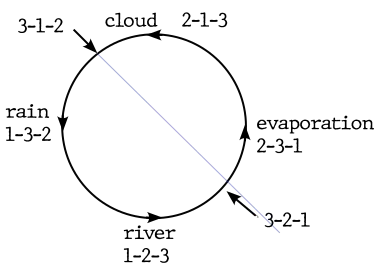
Take the example of the flow of water. Let our initial experience be of rain. We see that water falls (’flows’) from above to below; so let 1 be literally ’higher’ and 2, ’lower’. The crude form of the cycle is:
By ascribing 1-3-2 to rain, we establish the rest. There is a ’counterflow’ from lower to higher that we call evaporation and must have the form 2—3—1• In ’cloud’ and ’river’ we have other kinds of ’flow’. ’River’ produces the oceans, which are at the lowest level. ’Cloud’ produces the rain clouds at the highest level, where water condenses and droplets merge until gravity wins.
There are thus two kinds of ’reservoir’, one above and the other below; which are shown by the diagonal line. This line marks a transition from the tendency indicated by the form 3-1-2 to that indicated by the form 3-2-1, from ‘descent’ to ’ascent’ and vice versa.
In the transition from 1-3-2 to 1-2-3, what we can read is that the 3, the flow of water, passes from between 1 and 2 to a position ‘below’ 2: this is precisely what happens, since the oceans are lower than the land. The equivalent in respect of 2-3-1 and. 2-1-3 is less obvious until we mark 1 as the level at which rain falls from; the moist air rising from the oceans must be carried higher (by a rising air current) so that it expands (adiabatically) and cools enabling various processes of water-droplet and ice-particle formation to occur, leading to precipitation (the fall of drops which do not evaporate on their way down). It is therefore true that what is indicated in 2-1-3 does take place, i.e. that water rises above the level at which it will constitute rain.
The rising air current depends not simply on incident radiation from the sun but on the pattern of air movements brought about by the difference in temperature between equator and poles (and other factors such as the rotation of the Earth and the distribution of land and sea). Partin es of water, if they are to fall as rain, must gather sufficient mass to overcome both evaporation and the force of the air current. The formation of ice crystals is very important; condensation alone is not enough.
The transition from descent to ascent is indicated by 3-2-1. The part 2-1 represents the convection current in the atmosphere. 3-2-1 can be read as: water lying with large surface area is lifted by the convection current. The name ’evaporation’ we gave to 2-3-1 is not quite right, evaporation being a necessary precondition. In fact, 2-3-1 describes the ascending flow of moist air. 3-2-1 is then the ’source’ of ascending water.
The other transition, from ascent to descent, is by way of coalescence and aggregation. It is the increasing size of particles of water (within certain temperature conditions) that enables the direction 1-2 to dominate. Thus, we have the form 3-1-2.
In both 3-2-1 and 3-122, the forces indicated by 1-2 or 2-1 are ’there’ already: it is the state of the water component (3) that enables the transitions to be made.
Some very interesting features are shown in this example. In particular, we can understand quite clearly the significance of the position of the third term in the various forms:
in 1-3-2 and 2-3-1 3 is as a flow
in 1-2-3 and 2-1-3 3 is as an accumulation (pool)
in 3-1-2 and 3-2-1 3 is as a precondition
Further: in the ’sequence’ of forms:
3-2-1 the water as starting point for ascent
2-3-1 the water in upward flow
2-1-3 the water accumulating above
3-1-2 the water as starting point for descent
1-3-2 the water falling as rain
1-2-3 the water accumulating below
The description is perfect and transparent. We also see that, in this example, one term is not ‘causing’ another. All the effective causes are merely implicit and do not enter into the forms at all. Neither do we have some impossible abstract system, but a cycle that is dynamic and complex and the product of the energies of sun and earth: the water is not moving itself!.
Rain and its perpetuation or renewal signifies the whole cycle. A flow:
A  B
B
if it does not come to a stop, requires us to extend our view:
A B
The inputs and outputs from A and B have to do with the same thing (X):
(X) A (X) B (X)
With a stronger identification of the three (X)’s with each other, when we suppose there is a cycle:
B (X) A (X) B (X) A
What is significant in any true part of the cycle is given by the order of A, B and (X). Hence, we derive the six forms:
B (x) A 2-3-1
A (A) B 3-1-2
B A (X) 2-1-3
A (X) B 1-3-2
(X) B A 3-2-1
A B (A) 1-2-3
Because it is, we assert, the order of the terms that matters, there is no point in repeating any of the terms (such as in writing (X)A(X)B). By merely looking at the three different positions of the third term, we can deduce something about their nature. If the middle position, as in 1-3-2, signifies a flow; then then the final position suggests an accumulation, the making of reservoir; and the initial position suggests something ‘about to flow’, i.e. involved in a change of state or conditions.
Semantics
By correlating the six forms with definite models and testing these models with particular examples, taken from experience, we can make our reading of them both consistent and instructive. Thus, when we use the word flow we can now understand what it means in a structured context that includes accumulation or pooling, and change of state. Structure comes from the forms, while specific meaning comes from experience of and knowledge of physical processes in the real world. By actively looking for the full range of meaning of relatedness, we do not assume to know in advance what we might find. In a similar context, Mary Hesse wrote :
Scientific theory in general does not presuppose any particular mode of causal connection between events, but only that it is possible to find laws and hypotheses, expressed in terms of some model, which satisfy the criteria of intelligibility, confirmation and falsifiability. The mode of causal connection in each case is shown by the model, and changes with fundamental change of model, (from ’Forces and Fields’).
Just as we have various established classes or types of models of causal connection, so we can have models of relatedness. In our explorations, we have ranged far more widely and deeply than anyone has before, including Whitehead and Korzybski for example. However, agreeing with Korzybski in particular, we have always attempted to correlate our models with actual physical processes in the real world. This helps to assure us of a developed and effective semantics. In place of the vague concept of relationship, we now have a whole corpus of models which are correlated with readings of the basic forms, thereby enabling us to tie together information and experience from different domains. The key semantic invention is that of the forms, followed by their precise modelling in terms of actual events an (including intentions). It is the common base of the forms, coupled with the making of models, that has enabled us to proceed along a path of analogy that is capable of some precision and clarity. We have eschewed any 1 intuitional’ reading of the forms, preferring to translate them into analogues which model the connectivities within the world; as if to bind perception and thought together into one whole.
We believe relational thinking to be, in some respects, far superior to thinking in terms of causality. Causality is a restricted mode of connection, or an extreme case. As such, we should be able to deduce causality from relatedness.
In attempting this, we should bear in mind that behind relatedness is the deeper level of the monads We also need to dear in mind the difficult issue of choice which is the province of the dyad. Choice should tell us that, even before we make our attempt to. model a relation, we have rejected a whole way of looking. To say something, we must leave much unsaid. This is much the case when we come to identify what we have called the first or active force in a triad: prior to this identification there has been a choice, ma we tried to bring out in our discussion of the dyad, it is extremely difficult to bring to consciousness in what the choice consists. Consciousness itself, after all, is relational. It is even more than that (as we discussed in the context of the tetrad). What is provided by the forms is not mere description: it is assertive in the sense we have used this word before. However, this assertiveness of the forms is towards the real world and the real world responds (even if only in the guise of our thought) in such a way that shows a miss-match with what is asserted. In simpler words: the forms of relation do not easily show themselves in phenomena. That is where the making of models comes in: we are able to construct models which provide readings of the forms which make them intelligible with respect to the real world. Thus, we are able to make the combination of forms with reality meaningful.
In stating this, we remind ourselves of the 3-M equation:
‘Making Media Plus Matter Meaningful’
and we can correlate the forms with Media end the Seal world with Matter, Hence, our work has followed the relation formulated in the 3-M equation. And, we have come across a most interesting exemplification of Media in the triad itself. The triad is something that can only be characterized as ’pure information’ in the following sense: it does not describe anything in the real world as such; it has more the character of asserting how things ’ought’ to be; it has a logic sufficient unto itself. There is no way in which we can positively derive the triad from experience It refers to itself and not to the world. It acts rather as a director of thought. It can be regarded as An ’artifice’ but this does not divorce it from reality. It claims the whole of experience for its domain without asserting that it does this to the exclusion of all else.
The making of models – as ’making meaningful’ forms plus reality – affords a translation from the form of the triad to the events of the world. It also affords a translation in the other direction, giving a new way of describing experience.
Extension of Meaning
Using the idea of the third term as the point of balance and the equality of ratio between the terms, we can construct a pattern which contains all the forms:
(3) 1 (3) 2 (3)
This is a simplification of the pattern we introduced through the example of musical notes, Reading the pattern from both left and right and adopting the principle &£ that it is the order of the terms which is significant we can find all six forms.
The appearance of the third term to the extreme left and the extreme right signifies a projection from the meaning it has in the middle place. It is an extrapolation by analogy (similar logic – similar ratio). Finding a meaning for the mid-point between 1 and 2 enables us to look beyond both 1 and 2 by projecting that mid-point beyond them. It is the identification of the three appearances of (3) that makes for a relation in a strong sense, de can think of it in this way: if the three appearances are the same then the relation is self-contained. Even though we write down the three in different places, this is only to express the distinctions between the forms.
When we do extend the meaning of (3) we can do this only with respect to 1 and 2. There is no other kind of extension we can make. Therefore, it carries with it a certain measure of control, a certain logic. We can project (3) in the direction of 1 or in the direction of 2.
In the case of (3) as rain, we did this and found (3) as ocean and as droplets forming in cloud. In all physical examples, we would suppose that (3) designates an identity of substance, material or energy (in its three appearances).
When we say we project (3) in the direction of 1, we imply that the meaning of (3) is made more akin to 1; similarly for extension in the direction of 2. The implication here derives from taking the notion of ‘in the direction of’ to indicate a semantic direction. We have the given whole which is bifurcated (in contrast) and we are extending the ‘intensity1 of this bifurcation through our ‘extension’. Thus, the meaning of the (3) to the extreme left can be notated as (3) and that to the extreme right as (3). Let us take the example of the gift. We begin with the notion of ’ultimate’ extensions, thus:
(3)1 the gift as created
(3)2 the gift as that of life itself
The ultimate sense here is referable to God the Father and God the Son as in the Trinity; i.e. to the ultimate extension of Donor and Recipient.
The range of the extension depends on our understanding of the given interval between donor and recipient. It is this interval which – according to our model – is projected to either side (it is our measure of contrast). The step we introduced to the gift as created was to make a contrast with the relation in which only something owned by the donor was given. It raises the question of >o what degree the donor gives: does he give himself? There is a sense in which an artist as donor, giving away his own creations, is more intensely giving than the one who simply gives something he can buy. In literature, the convention is to dedicate a piece to someone; and this is a kind of giving.
Similarly – though in contrast! – the recipient can take something into himself, such as a meaning or inspiration. The gift may mean life or death. It may be a key to sheer survival.
The finding of extensions of meaning which are equivalent to the given interval has as its model the musical scale. In the scale, the same intervals can be identified even though they are physically measurable in terms of ratios: thus, an extension signifies a change in intensity or level.
Our extensions to left or right – towards 1 or 2 – are made to some degree independently of each other. This leaves us with the task of relating them once more, as we did in describing (3)1 and (3)2 in the example above. Significantly, we found that ’ultimate extension leads us into the Trinity. This is apt, theologically, since every relation must derive its meaning from the Ultimate Relation which is that of G-od with Himself, possibly the only true self-relation there is.
Hence, we can reverse the idea of extension and consider every ’empirical’ relation as a sub-division of the Ultimate One. This amounts to a method in which we decide what the ’octave’ is to be and then arrive at the ’notes’ within it.
The notion of extension (and sub-division) does much to explain the problems we ah have had in pinning down any given relation. The meaning of the terms will tend, almost of themselves, to extend and divide at every move of interpretation, A relation has its meaning within a scale of meanings (remember our notion of the A/Z ratio?) the position of which can be explored by means of the six forms.
The notion of scale derives from the bare concept of extension:
… (3) … (3)… (3) 1 (3) 2 (3) … (3) ….(3)
He can have also the notion of a cyclic whole:

Above is the simplest possible form of the cyclic whole, he can easily see that it can translate into the form of the pure relation:

where (3) appears as both intermediary and transcendent unity, the most common notion of the third force.
. all the things we human beings are competent to know are interconnected in the same manner … none are so remote as to be beyond our reach or so hidden that we cannot discover them – that is, provided we abstain from accepting as true what is not thus related, i.e., keep always to the order required for their deduction team one from another. … Having observed that however different their a (the sciences) objects, all agree in only considering the diverse relations or proportions to be found as holding between them, I thought it best to treat only of these proportions, taking them in a quite general manner, and without ascribing them to any other objects than those which might serve to facilitate the knowing of them (though without in any way restricting them to these objects), so that afterwards I might be the better able to transfer them to all the other things to which they may apply.
(Discourse on Method, Rene Descartes).
Summary Statement of the Six Forms
We are now in a position to attempt a summary of the meaning of the six forms, which we will do in a composite way, emphasizing the relatedness that must hold between them. The concept of meaning will be important.
A) We begin with the proposition that term 1 is ’more active’ than term 2. This is how it is intended by 1 and felt by 2. It is the basis of the first form 1-3-2 which we have characterized as ’from … to’.
B) Term 2 is independent of term 1, in that it can contribute something of its own to the whole. There is a related sense, then, in which 2 is ’active in its own right’: this ’activeness’ can only arise in response to the ’activeness’ of term 1. This is the basis of the second form 2-3-1-
C) The effect of 1 on 2 and of 2 on 1 is mediated by the third term. Term 3 is what 1 and 2 have in common. Relative to 1 and 2, term 3 is neutral: this only holds, however, when 1-3-2 and 2-3-1 ’agree’ with each other. These two forms signify the relation as communication.
D) In the forms of communication, term 3 appears as the ’meaning between’ 1 and 2. This meaning can be transposed such that: there is a (3) which is ’more active’ than 1 and a (3) which is is: ’less active than 2. These transpositions are made along the ’line’ defined by 1 – 2. They appear in the forms 1-2-3 and 2-1-3- The two transposition, of (3) define what may be called the ’octave’ of the relation.
E) Where the two transpositions of (3) coincide, this is in some other dimension to that defined by the line 1-2. Here, it is term 3 that is responsible for the combining together of 1 and 2 as if these two ’came out of’ term 3- We call this formation and the two forms in question are 3-1-2 and 3-2-1.
F) Term 1 can be ’active’ only in relation to harm a second term which is ’less active’. The initiative is given to term 1 in the form 3-1-2; whence results ensure ’mechanic.lly’. The issue of freedom arises with respect to term 2, so-to-say ’against’ term 1. This initiative is given to term 2 in the form 3-2-1. Thus, (3) is that which enables term 1 to be ’on top’ of term 2; and also that which enables term 2 to be independent of term 1. Hence, results ensue from 2 that cannot be ’foreseen’ from 1.
G) The relation ’moves from form to form’. The ’relative order’ expressed in the forms (e.g. 1-2 or 2-1) is significant in showing where the initiative lies. Avery foim influences other forms according to the similarities and differences obtaining between the different orders of terms. Thus, 1-2-3 will tend to enhance 1-3-2 while mitigating against 2-3-1′ A balance of all the forms is unlikely; but it is in the nature of the triad to establish conditions in which balance is possible. The most important feature of balance is that no one form is excluded or suppressed. Further, without balance, the relation does not last.
Below, we set out the forms and the names that we give to each of them:
|
Communication: |
Transmission |
Integration |
|
|
Transposition: |
Extension |
Concentration 2-1-3 |
|
|
|
|
|
The two columns are distinguished according to the order 1-2 on the left and 2-1 on the right. In these two columns we see the position of (3) shifting from place to place. The forms is appearing together in one of these columns are resonant with each other.
They are ’morphologically similar’. There is another effect, ’which can be illustrated by the contrary of the example at the top of this page: 1-2-3 will ’pass initiative’ over to 2-3-1, the last two terms of 1-2-3 being the same as the first two of 2-3-1. Hence, there is both a ’linear momentum’ of terms and a ’morphological conditioning’. A brief explanation of the names we have given to the forms:
|
Transmission (1-3-2): |
the form of ’from t0.. ’, e.g. a message, a gift, orders, energy |
|
|
Integration (2-3-1): |
the form of response to transmission, its complement; the provision of the situation in which transmission can take place, also ‘making sense’ of the transmission according to 2. |
|
|
Extension (1-2-3): |
the transposition ‘below’ 2, extension of the range of 1 through 2, divergence and accumulation |
|
|
Concentration (2-1-3): |
the transposition ’above’ 1, disclosure of the ’hidden’, the essence |
|
|
Organisation (3-1-2): |
formation of hierarchy, of 1 above 2 |
|
|
Liberation (3-2-1): |
formation of a channel in which 2 can act in its own way without conflict with 1. |
It is, of course, a difficult and perhaps impossible-to-realize task to make definitions of these forms which are transparent in every situation. However, consider the example of predation in regard to which the notion of transmission may appear obscure. Wat is transmitted in this case? The answer is: death. What is provided in response? The answer is life ! What, then, is the extension? We find this in the food-chain, that the underlying food is what the prey eats, And, the concentration? The converse, or what eats the predator. (Note that these extremes in the food-chain are indicators of (3) not the (3) as such; the extremes are extensions of 1 and 2. The (3) that is between 1 and 2 consists of the weak members of the prey population which are culled by the predator.) The forms of formation refer to the ’way in which the relation was established and is maintained; hence to evolution and ecology, roughly associated with 3-1-2 and 3-2-1 respectively.
It is possible to interpret the forms not as tending towards agreement with each other but towards disparate tendencies. In this situation of disintegration, we could have:
|
imposition |
deviation |
|
|
proliferation |
isolation |
|
|
ossification |
randomization |
and so on.
There is an even more extreme case that we can think of, in which each of the forms is ‘misapplied ‘. This will occur when the terms are not independent of each other and will be associated with subjectivity. J.G. Bennett explored this possibility under the notion of ‘negative laws ‘. It is important to recognize that an underlying criterion for the formation of a triad is that the terms can arise in independent ‘ locations’. That is why the biological domain is so useful in exemplification. In a single man, these independent locations are figured in different parts of the brain and organism. However, independence is prior to having an independent location. Thus, relatedness underlies the categories of space and time. Finally, we will draw up a parallel which correlates three different sets of terms;
|
Communication |
– |
Actual |
– |
Knowledge |
|
Transposition |
– |
Potential |
– |
Consciousness |
|
Formation |
– |
Possible |
– |
Understanding |
Reflections on the Enneagram and the Six Forms
The six forms and their mutual connectedness leans us to think of the enneagram with its inter-connected figure between six points. Following the notions of ‘linear momentum’ and ’resonance’, we can arrange the six forms as in this diagram:

The solid lines signify ’momentum’ and the dotted ones, ‘resonance’, We have omitted the links from 2-1-3 to 1-3-2, and from 1-2-3 to 2-3- These would only serve to repeat the cycle on either side. Instead, we have (arbitrarily) supposed that resonance takes over, as in the link 2-1-3 with 2-3-1. We have also omitted the resonant links between 1-3-2 and 3-1-2, and between 2-3-1 and 3-2-1. The resonant links between 3-2-1 and 2-1-3, and between 3-1-2 and 1-2-3 we take to be supportive of the links by momentum between those pairs of terms. Thus, what is represented in the diagram is only part the inter-connectedness of the forms. It is this part which conforms to the arrangement in the enneagram. Any starting point – any of the forms a in the first position top right – will provide the same pattern as any other. The resonant links are two-way whereas in the enneagram, they are one way. There is, thus, an imposition of a linear order on the interconnectedness of the forms. The six-fold figure in the enneagram is thus a linear arrangement of linearities; and it is usually contrasted with the pure pattern of the triad itself, superimposed over the six-fold figure. The six-fold figure executes a recurrent cycle, returning into itself, while passing uniquely through all six forms. It is the only arrangement in which this can happen.
The Two Forms of Transposition
In our discussion of the nature of the first two terms, we have ascribed greater intensity to term 1 while ascribing greater extensity to term 2, This is reflected in the diagram below.

The relation of intensity is shown by having term 1 above term 2. That of extension, by the length of each corresponding line. Simple geometrical construction shows what we mean by the ‘extension of 1′ and the ‘concentration of 2’. We have the extreme case of concentration, that of return to unity.
The extensive relation corresponds to experience. There are fewer predators than prey, x donor can give many gifts to many people. Those with power have it over many. In the heat engine cycle, the first term has less entropy than the second, x source of light is usually concentrated while an illuminated surface is spread out. Similarly for the intensive relation.
It is significant that transposition yields a figure in which we can identify four levels. Taking these as exemplified in the tetrad: automatic, sensitive, conscious and creative (or; physical, astral, causal and monadic) we have the levels in man, with the middle (3) signifying what we mean by mind.
If we do not close off the upper part of the figure, but suppose that 1 and 2 lie on a line that extends in the 2-direction without limit and in the 1-direction to some further terminal point; we can generate a series of points (3) above and below such that, above 1, they come closer and closer together; while, below 2, they come further and further apart. It is the ratios that remain the same.
Thus ‘above’ the octaves occur without limit but appear to merge into one (3), the first one. Whereas, ‘below’ the octaves also occur without limit but appear further and further ‘away’. It in this sense that we can think of the ’above’ as spiritual and the ’below’ as material. The spiritual merges into the ’inner mystery’ while the material extends into the ’infinite expanse’. It is thus that the spiritual potential of man is taken, usually, as without distinction – as ’soul’ or ’spirit’ – while his material nature is considered in relation with hierarchies of entities, ranging into the galaxies, superclusters and up to the possibility of many universes. Both are without limit but appear in sharp contrast to each other, v/e suggest that this arises from the antithesis of intension and extension which occurs in the combination of the active and passive terms.

The diagram above shows some of the related notions involved in the argument. It further suggests that such ideas as animism are a transposition in the form of concentration (2-1-3) while attempts to realize e.g. thoughts as neural events are a transposition in the form of extension (1-2-3). We believe that what is most important is to arrive at the nature of the intermediary (3) and consciously follow through its transposition.
Forms of ‘Formation’
The forms 3-1-2 and 3-2-1, which begin with (3) are the most difficult to describe, and hence to read, of all the forms; the reason for this being that we do not find any kind of obvious linearity in their meaning. With 1-3-2 and 2-3-1, we have the functional idea of flow. With 1-2-3 and 2-1-3, we have the idea of projection which is based on that of levels of being represented in a linear, hierarchical order. Hence the simple symbolism which we introduced to underline the models we were using:

When we turned to the forms beginning with (3), we used circles, What we now want to introduce is a symbolism like this:

The core meaning of these symbols is the release of 1 and 2 to act towards each other. In 3-1-2, 1 is released to act towards 2. We have called this ’organisation’ having the hierarchical sense of this word in our minds, meaning the taking over of functions at the 2 level by something at the 1 level. There is an additional meaning: both 1 and 2 in some way ’come out of’ (3) and, in some way, 1 and 2 ’blend’ to reinforce (3) with in which they began. Thus, the form 3-1-2 is cyclic in nature and, hence, our use of a circular symbol to show its meaning. In 3-2-1, there is also a cyclic meaning and a coming out and going into the same (3). However, in this case, the core meaning is the release of 2 to act towards 1; which we have described as ’liberation’.
Let us take an example: business. Business will be our (3) and out of this comes 1 as management and 2 as workers; alternatively, 1 as producers and 2 as markets (consumers). We have these two versions because one represents the internal dynamism and the other the external one. An even wider possibility is 1 as technology and 2 as economy. On whatever scale, business as (3) establishes the requisite organization in which 1 is set over 2, We have taken the jaundiced view that e.g. producers ’drive’ markets! In the cycle, the possibility of business becomes the actualization of business.
The ’nature’ of the business sets up the order of 1 over 2. In the form 3-2-1, it is the same business that releases 2 from being ’under’ 1. This is 2 being ’given voice’. Thus, for example, business has required workers to become more skilful and literate, etc. and provided that impetus towards education which gave the ’working class’ its own say in how things are run. We can think here, too, of such developments as ’consumer rights’ and the controls the economy puts on “technological development. However, what is crucial here is to realize that whereas 3-1-2 operates almost mechanically, 3-2-1 requires intelligence. Why do we say this and what does intelligence mean in this context? We define intelligence as that which liberates something from subservience to the higher level (1). This means that something significant can be done only at the (2) level. Thus, management cannot dictate or order the use of initiative. Only the right context can release it. Intelligence is not an absolute power but one relative to level. It does not necessarily mean that the exercise of intelligence is antithetical to organization. It is not meant as gratuitous freedom.
We can even say that intelligence is the independence of 2 towards 1 in any context. Thus, intelligence is to be understood in relation to an affirmation! By ’independence’ we do not refer to ’permitted because indifferent actions’; no, we mean significant actions which are unforeseen by 1.
Another way of looking at 3-2-1 – which, as we shall explain, amounts to the same thing – is that it describes the ’power’ of (3) separating the 1 from the 2. We would see 1 ’rising up out of’ 2. How is this? Because the (2) had hidden in it the 1; rather as in the ’Story of the Pearl’ where the Prince (3) goes down into Egypt (2) to ’recover’ the Pearl (1). The object of this quest is not the Pearl as such but the setting up of the form 2-1-3 whereby the spiritual development (3) may take place at the higher level. The parallel between the two descriptions we have given is in this: the independence of the 2 towards the 1 is shown in the 2 ’producing’ something at the level of 1: this is the crucial test. The use of the term ’producing’ can mislead; it is more in the way of a realization, a connection with an inward potential.
We can take business in the most general sense as work. In the 3-1-2 sense it is occupancy and production. In the 3-2-1 sense it is becoming more intelligent. Hence 3-1-2 is concerned with doing while 3-2-1 is concerned with seeing. In 3-1-2, the 1 ’takes over’ the higher nature of 2; i.e. we must remember that 2 is predisposed to respond to (1). In 3-2-1, the higher nature of 2 is released as (its own) 1.
We emphasize that in the form 3-2-1 there should not be read ’revolt’. ’Within the relation, the form 3-2-1 means that the release of the (1) nature of 2 is in accord with 1. How is this? Because the (3) is mutually understood as needing that. Hence the initiative shown in times of crisis. A crisis cannot be organized! The contemporary management notion of ’turbulence’ is a hybrid of organization and liberations in which some recognition is being given to the necessity of a crisis being dealt with at the point at which it arises – which requires 3-2-1.
A further comment is that in 3-1-2 we have the different levels kept apart; whereas in 3-2-1 they are made interchangeable, There is a false idea that being can be adequately accounted for in terms of a linear hierarchy. Being is both hierarchical and non-hierarchical. Thus, we have both above and below and essential and existential. 3-1-2 is the harmonic structure of levels while 3-2-1 is the release of essence. Hence the smaller or the weaker can have a significance with respect to the greater or more powerful and the part can influence the whole; the humble petitioner can have the ear of the monarch. Such a perspective was even written into the Rules of the Benedictine Order, which it was the responsibility of the Abbot (3) to fulfil. It is interesting to reflect on the dilemmas of education in the light of the two forms.
In traditional societies, there was usually a day during the year when official authority could be mocked: in England, this was under the guidance of the ’Lord of Misrule’. This may remind us that the most important manifestation of 3-2-1 in our experience is that of humour.
Some Explorations of the Forms of Formation
- Meaning. Let 1 be Universal and 2 Particular. Then;
3-1-2 : classification membership
3-2-1 : uniqueness ipseity - Perception (ayn). Let 1 be arupa and 2 rupa. Then:
3-1-2 : the outer world
3-2-1 : the inner experience - 3 – M. Let 1 be Media and 2 Matter. Then:
3-1-2 : metacontrol
3-2-1 : entering the unknown
Table of the Simple Symbolism of the Forms

The Six Implications of the 3-M Equation
Media ’contains’ all that Matter ever will be or has been. In it, everything is connected with everything else, It is a cup that ’brimeth over’. Not subject to the limitations of time, place and person, it is the ’idea’ which is true at all times and in all places and for all people.
Whenever Meaning is made, this cannot consist of merely what we know and what we can do. The making of Meaning is an act that allows Media into Matter. This is not adding something to Matter like an ingredient added to a dish. It is a kind of revelation. Media is like a source of light that needs a surface on which to be shown.
Media is the affirmation that has come out of a need that is cosmic. It is this need which has brought forth life and consciousness and all the greatest works of man.
Matter is the ’image ‘of this affirmation, as inertia is to a force. It has come out of the immovable, the static, the attained whether in the stars or on Barth. Hence it is represented in our thoughts by the elements.
Meaning is in the Great Work which strives to harmonize the affirmation with the ’denial’, Media with Matter.
CREATIVITY 1-3-2 . Media ’flows’ as meaning into matter. Matter is stimulated and awakened. The creative flow finds pathways which cannot be calculated from the known. To keep this going, to realize this, is to centre oneself in meaning.
INSIGHT 2-3-1 – Matter ’flows’ back in response as meaning. Media is given shape and form appears’. To realize this, is to feel every thing we know as a ’pointer’, a sign, of Media.
TO THE HEART OF MAT TER 1-2-3 . The power of Media takes us deeper than matter, to what Teilhard de Chardin called the ’heart of matter’. Making this contact is to find hidden powers and energies within matter, to attain magical powers.
TO THE SOURCE OF MEDIA 2-1-3 . Stripping everything away from Matter that is not absolutely real we are taken beyond media to its source. This is the cosmic sense of need and hope, the truly spiritual.
META CONTROL 3-1-2 . We are within a Greater Meaning from which media emerges at every moment to inform what we do in the realm of matter. Logosynthesis.
ENTERING THE UNKNOWN 3-2-1. what is completely unknown.
Food and Enablement
The two forms 1-2-3 and 2-1-3 both represent the ’production of food’.
It is in fact an important extension of the notion of ’food’ that was first introduced by Gurdjieff; it extends the notion beyond the range of palpable nourishment. We can make a crude picture to aid our understanding of what this extension might mean. Consider a man. There is the palpable eating in which he engages; but he is also regarded as, in the end, food for worms. Added to this, we have the feeling that something comes out of his mind, a spirit, which is not entirely accounted for in terms of his creative works in the world.
Taking our model of the forms of transposition, we find we have to identify the two terms 1 and 2 in order to form a conception of the (3) which is their outcome. Consider man as 2. What can we choose as the 1? Let us simply assume some form of higher intelligence, bearing in mind that this should not be identified with what is divine in relation to men. Then, the model suggests:
(3)
1 higher intelligence
2 man
(3)
According to J.G. Bennett, the ’flow’ (in our language) between the higher intelligence and man consists of ideas. This is important and has to be imagined as between 1 and 2 in the diagram, how, we have some such proposition as this:
In 1-2-3s the ratio between 1 and 2 is extended .downwards beyond 2 to amplify or extend the meaning of what exists between 1 and 2, at their mid-point.
In 2-1-3? the same ratio is extended upwards beyond 1 to amplify or concentrate the meaning of what exists at this same mid-point.
In Gurdjieff’s cosmology, we find a striking and unusual assertion: that man (as a non-free mechanism) is food for the moon. This ’food’ is taken to consist of ’negative emotions’; it is, therefore, the negative analogue of ideas. There is also in Gurdjieff’s cosmology a parallel notion of man as providing ’food’ for Cod. This has to do with the pure and free realization of will; it is, therefore, the higher positive analogue of ideas. In certain places, these ’foods’ are called help; end here we have the general character of what we are taking to the extended meaning of ‘food’. In both help and food there is the notion of sustaining power.
How may we now interpret the two forms 3-1-2 and 3-2-1? Up until now, i7e ha/e no G made clear the relation between the (3) in these forms and the (3) in the others. Our proposition is that we should take the (3) in 3-2-.’1 to mean the combined sense of the ’middle’ and ‘lower’ (3); and the (3) in 3-1-2 to mean the combined sense of the ‘middle’ and ‘higher’ (3). Thus:
|
|
|
||
|
|
1 |
|
|
|
|
|
||
|
2 |
|
||
|
|
|||
|
(3) |
|
In the diagram, the spacings between the terms is significant. The upper bracket indicates that the relation is ‘ weighted downwards’ and the lower that it is ‘weighted upwards’. Thus, the former is of the character of organization, which, in its higher meaning, is the state of harmony. The latter is of the character of liberation, which, in its lower meaning, is sometimes referred to as ‘waking up’.
The two forms 3-1-2 and 3-2-1 can be understood to describe enablement. They complement the forms of ‘help’, 1-2-3 and 2-1-3. By helping, man is empowered. By his existence as part of organic nature, man has to help the moon in some way. Perhaps it is on account of the ‘erratic’ nature of the moon that there arises those disturbances which underlie his moments of awakening?
What of the two forms 1-3-2 and 2-3-1? In the former, ideas come in which direct and influence human attitudes, the way man regards the world. In the latter, he seeks to know himself, through communication with his higher nature. 1-3-2 is intellect, while 2-3-1 is heart.
The Inner and Outer Octaves
In our idea of extension we have used the notion of replicating the ratios prevailing between 1, 2 and 3 on a larger scale; but we have not presented any rules of calculation for doing this. Here is one suggestion which builds in an obvious way on the interpretation of analogy in terms of ratios.
We take it that the extensions above and below are on a scale corresponding to the interval between 1 and 2. This interval is to be modified according to the ’place’ of the third term between 1 and 2. We define the interval between 1 and 2 as the ’inner octave’ of the relation and we are seeking to establish the corresponding ’outer octave’• According to the principle of the octave the mid-point between 1 and 2 is given by the ratio 3/2 above 2 and 3/4 below 1.
The application of analogical reasoning proceeds as follows.
As (3) is 3/2 above 2, so the ’higher’ (3) is 3/2 above 1. This corresponds to the extension 2-1-3
As (3) is 3/4 below 1, so the ’lower’ (3) is 3/4 below 2. This corresponds to the extension 1-2-3.
The diagram below shows the relevant ratios and intervals and also how the inner and outer octaves appear in terms of the diatonic scale (major),

The outer octave is twice that of the inner octave. ‘We cannot extend the notion of the diatonic scale, however, since the notes corresponding to (2) , (3), (1) do not fall in harmonious positions if we treat the outer octave as an interval of one whole octave. (In the whole note scale, (2) would correspond to the first, note above do, (3) to the third note above do and (1) to the fourth note above do; but only very approximately).
What we do find is that the ratio of the (3)’s is that of octaves, as defined by the interval (1)-(2). (1) and (2) appear near the intervals in the outer (double) octave £ those marking the me-fa transition. The three (3)’s appear near the si-do transitions.
In the relation between the three (3)’s, 1 and 2 appear as the major thirds. Of course, each (3) is an octave above or below the others and this is the main overtone of a note. The position of 1 and 2 in the outer octaves of (3)’s is the inverse of that of (3) between 1 and 2. This inversion may explain the principle often claimed by Rene Guenon that, in analogy, the pairs between which the analogy is made are inverted in their relation.
In the form of ’enablement’ 3-1-2, the (3) is the unison of the upper and middle (3)’s. In the form 3-2-1 it is the unison of the lower and middle (3)’s. We have in 3-1-2 an enablement ‘from above’ and, in 3-2-1, an enablement ’from below’. We must make a comment on the meaning of ’from above’ and ’from below’ when we are referring to (3). These forms of relation are not completely of the kind that prevails between 1 and 2. We show 1 as above 2 and construct a linear hierarchy from this arrangement. We are able to do this by virtue of the third term, in the way we have shown. However, the third term is not exclusively directed by the ’line’ obtaining from 1 to 2. In it, there is something independent of that line. We must remember that we are still ’projecting’ from the two-dimensional figure into linear forms. Thus, although the (3) appears ’in a line with’ 1 and 2, it is also not in that line.
The hierarchical arrangement of 1 and 2 is the most common representation: of relations of being. Being is stratified into levels. The higher level is capable of organising the level below it; or, we may regard it as more intelligent, or more conscious. These are all approximations to an underlying being-apprehension which issues in the notion of levels. J. G. Bennett’s description of the appropriate measure of being as ’intensity of inner togetherness’ sums up and transcends all the approximate ideas.
Placing the (3) terms along the line of the levels of being, the strata of ’intensity of inner -togetherness, should not prevent us from realizing that these terms signify/some other kind of component of reality. This component is will. There is an analogue of level that applies to will – and which, therefore, enables us to ascribe a place for these terms in the levels – but this is to be understood more in the sense of ’degrees of freedom’ than an intensive measure. Though we find that 1 and 2 are ’distanced’ from each other because they are at different levels, the (3) terms have no such ’distance’ between them: thus, they are the ’same’. We have used the analogue derived from our subjective experience of the octave to link the (3)fs together ’as in unison’ in order to represent these terms in the line of being without violating their intrinsic character, which pertains to will.
In the cosmology derived from Gurdjieff, J. G. Bennett differentiated between the different ’degrees’ of will – corresponding to levels of being – by ascribing fewer ’laws’ or forms to the higher degrees than to the lower. The higher degrees of will, therefore, are more free. Now, this has interesting consequence#: the lower degrees have included in them the same ’laws’ as the higher, though they are coupled with additional ones. When we say that the (3)’s are the ’seme’, we mean that they include – though not exclusively – the same laws or forms.
The whole basis of the analogical reasoning which we have been pursuing is just in this property of will. What we have called transposition is an act of will. It is an act of will that is possible i.e. is within the ’laws’. We can put it more strongly and say that there must be an action equivalent to that between 1 and 2 – represented in the middle (3) – both above 1 and below 2. However, this ’must’ is not that of necessity but of a propensity.
The propensity is to be found arising in the forms 3-1-2 and 3-2-1 as enablement. Thus, 3-1-2, the enablement from above, is ’driving’ the action below 2; while 3-2-1, the enablement from below, is ’drivino’ the action above 1. We have called the former organization and the latter liberation® We can easily see that 3-1-2 is to be associated with the concept of creation and the unfolding of lower and lower levels, one under the other, tied into a harmony® 3-2-1 is, in a sense, against creation, directed towards the transcendence of the limitations so-to-say imposed by the higher levels on the lower ones.
In an earlier part of our discussion, we described 3-1-2 as the ’unifying principle of 1-3-2 and 1-2-3, and 3-2-1 as the ’unifying principle’ of 2-3-1 and 2-1 -3. He now have a better idea of what that might mean. 3-1-2 is the principle of authority, while 3-2-1 is the principle of independence.
The ’octaves’ of (3) already hold within them the possibilities of 1 and 2. In this sense, the stratification ’comes out of’ the forms 3-1-2 and 3-2-1. The blending and the separation of 1 and 2 are prefigured in these two forms. Just as the middle (3) may be regarded as a blending of 1 and 2, so may the upper and the lower (3)’s. Thus: the middle (3) produced by the blending of 1 and 2, is recurs above and below 1 and 2 respectively in their separation. In this is the weaving together of will, and being; through the reconciliation of separateness with togetherness.
The form 3-1-2 produces two propensities, one in the ’inner octave’ and one in the ’outer octave’. In the inner octave, forces are aligned to produce the middle (3). Gurdjieff himself called this process the harnel-miatznel. The nearest equivalent in our scheme is the form 1-3-2. According to Gurdjieff, in harnel-miatznel the ’higher blends with the lower to actualize the middle’. This ’middle’ is a ’new arising from the previously arisen’. On the basis of this new arising, further results may be obtained, through further bleedings. In describing this process, Gurdjieff draws attention to the evolutionary possibilities, i.e. according to the form 2-1-3, that is a (3) evolves out of the original 1 and 2 that reaches to the original (3) that was above the 1, However, the same structure of harnel-miatznel allows for an involutionary movement, reaching downwards to the lower (3) that is the counterpart of the upper one. 1-3-2 by extension leads into 1 -2-3. The extension downward is the result that can be obtained through 3-1-2 in the ’outer octave’.
Similar considerations apply with respect to the form 3-2-1. In the ’inner octave’, the corresponding aspect of blending is given by 2-3-1. As we shall see more clearly later, it is useful to regard 1 as an intention and 2 as as a location or 1 definiteness1. Reflecting on tnis, we can appreciate the subtle distinction between 1-3-2 and 2-3-1, even though they amount to the same thing, or (3).In the ’outer octave’, 3-2-1 leads into 2-1-3, in that the extension upwards to the higher (3) can be obtained through 3-2-1.
Thus, 3-1-2 and 3-2-1 reflect two visions of the same totality which is diagrammed on page xxx
3-1-2 derives the (3) as something in its right place; whereas, 3-2-1 derives the (3) as something free to move in its own righto In Gurdjieff’s cosmology, 3-1-2 applies almost exclusively with respect to the Creation which, having been set into motion by the Will of God thereafter proceeds mechanically. 3-2-1 is then implicit only when it comes to life, its arising intelligence and the critical stage is given just by the ‘freedom to move about’ which is, of course, characteristic of animals.
The notion of inner and outer octaves is not confined to any cosmology. Stere: We can put our attention purely on meanings and come to understand that the upper (3) stands in relation to the middle one as its universal – almost literally, its representative in the universe as relative totality. What then is the relation of the lower (3)? It is akin to the material explanation, which we can understand in terms of an atomism. Thus:
(3) upper Universal
(3) middle Meaning
(3) lower Atom
It is amusing to think of the upper (3) as the religious and the lower as the materialistic, versions of the middle (3). The upper version may also be regarded as the abstract and the lower as the concrete. And so on. All such forms of thought are possible because meaning is in itself relational, and transposition is then inevitably possible.
Creation According to G – An Interpretive Sketch
Without regard to G’s special terminology and brief to the point of a G-string:
The solar system., Prom this analogy takes us to the Absolute Above and the Absolute Below. We have the Sun and the Earth. Beyond the Sun is the starry heaven. Underlying the Earth is the material sea.
In analogue of the Sun, the primal sun, the Sun Absolute. In analogue of the Earth, (in relation to the Sun) the most dispersed and unformed state of matter, the Absolute Nothing (no-thing).
The relation is between the most active and the most passive. The most active: intense concentration, high energy. The most passive; utter diffuseness, low energy. In the Sun Absolute, complete concentration of everything. In the Nothing, complete emptiness of everything. ’Something’ as a concentration of nothing, as a place of everything.. Between the passive and the active, without the reconciling, empty space.
Between Sun and Barth, in a special way of between, there arises life. Reflecting outwards the relation of Sun and Earth, we reach to the origins of the relation between All and Nothing.
1. There is a weakness in the All, the Absolute Sun. It has to replenish itself from the Nothing. It reaches out across the emptiness of space to the Nothing, which is the ocean of possible matter. It calls or commands, as the Word of God. Concentrations of matter form. A Between begins to exist: a Universe.
The weakness in the All comes through what is called inflation: a bubble of space-time inflates.
At a certain point, mass-energy forms with vast energies.
The crisis is met by Creation. The basic nature of Creation is the formation of matter. Radiation (bosons), particles (quarks, leptons), nuclei, atoms, molecules, strings,; the structure of super-clusters, clusters, galaxies, gases, stars.

The Word of God is the One Law for the Universe, from which derives all the parameters which make suns, planets, life possible. It is Active-Reconciling. The Prime Matter is passive.
2. The making of Suns produces a further result. Every sun is a concentration. Relative to such a concentration, all the other suns in its neighbourhood space are diffuse. The single sun is then active and the rest, in totality, are passive. The Word of God carries the message of the Law, ordains the further consequences, makes them possible.
A heliocentric version of the Medieval world-view. The starry heavens as the Empyrean. The Word of God is (3), the Sun (1) and the starry heaven (2). lmagine that the outer circle is somehow ’beyond the centre’. 3-1-2: organisation. The Sun is in business. Around it, the debris of the galaxy, the fruits of explosive self-destruction of stars as they move in the vicinity. From the very first localized concentrations, what is in the neighbourhood matters. The debris – including left overs from the formation of the sun itself – gathers into an accretion disc. Planets form. Around the Sun. It has to be the right mix of stuff.

3-1-2 becomes 1-2-3. The Word of God enters into planets. Becomes the Mother-to-be of Life.
3. Not directly mentioned by G. but the Moon is there to act as punctuation mark to the Word, the statement of God: ’Kun! LET THERE BE. Let: the Word of God issuing forth. There: the suns in image of the Absolute. Be: the planets. The Light that is born is that of LIFE on the planets. Life arises on the Earth, made out of the same chemicals and states of existence that have been wrought in the Big-Bang, the life of stars and the formation of planets (e.g. liquids, etc.). Something else is happening with the coming of life.
4. The Universe has arisen to overcome the inflation of space-time through use of materialization. A critical cosmological question is whether there is enough matter concentrated to overcome or balance the expansion of the universe. The Word of God determining the logic of the four forces of matter; making possible concentrations, making possible suns (balance of weak force with gravitation), novae, quasars, planets (solid matter).
5. The planets do not produce matter and energy. They cannot act in their turn as (1) in relation to all planets as (2). Planets can only modify the conditions within a solar system. Sun as input to life, Earth as womb: Father and Mother.
6. The universal radiation is that of gravity. Within a solar system, electromagnetic (novae can fry their neighbours, too). The weak: and strong forces working inside suns to create the substances of planets.
7. The force of creation ends with reproduction – ’similarities to the already arisen’. Reproduction is creation ’sideways’ instead of ’downwards’. It marks the turning point, the point of transition between downwards and upwards.
8. When living things begin to move about of themselves, i.e. change their location, it is getting interesting; so much so, God Himself sees a golden opportunity. He sets in motion processes which lead to the development of an individualized intelligence. He does this by enabling organisms to develop in themselves substances which correspond in some way – we don’t know what – with the ’earlier’ and more intense stages- of the creation. Even getting as powerful as the Sun itself. Becoming ’little suns’. That is, becoming creative. And being able to upset things on Earth (letting off atomic bombs?). Some correspondence of mass-energy-know-how. The material conditions do not matter so much. Really cold fusion! In the extreme, idea that the organic body gives way to higher types of body.
9. So, God himself intervenes. Holy Ghost! The cosmic ghost in the machine! He gives life a lift-off, 3-2-1. Organisms can concentrate in a counter-creation 2-1-3. This last 3 is soul. The (3) in 3-2-1 is God Himself. Thus, God gives life soul. Man is made in the image of God, Amen. But He still has to make Himself. God just does 3-2-1, It’s up to man to make it 2-1-3! God gives man the freedom to work on himself. What is the core method of 3-2-1? It is that the world does not make sense. What the hell am I doing here? The world designed and combined to awaken. The original legonomism. The books of revelation just trying to bring this into focus; but too glib with the ‘answers’. Objective science as the most religious learning. Away from functions towards being. What is it to IS? an tries to turn away from the emptiness to the All, to reach God, Who is the cause of his soul.
A Crude Note on Questions
Three great questions:
Why Anything?
What is the Meaning of Life? Why Life?
Why me?
What do we look for in asking such questions, questions of why?
What is the CAUSE of this? Is there a law, a command or an authority ? Is there some irreducible and final force?
But, can we ever rest with such kinds of answer? Bo we not know that they merely reflect our cultural conditioning, the social order in which we live, where one can command others or set laws? Are we not led to giving up on this, saying; ’Well, that’s how it just is. ’?
What is the underlying SUBSTANCE of this? Is what is, at a deep enough level, just what it is, being that? This might be the materialist solution, set on finding atoms; or the metaphysical solution, set on finding Being Itself. But, we enquire after, we question; can we ever rest content with what does not answer? maybe. ’Take me as you find me’. Is there any possible pure IS?
What is the reason of this? If we ask WHY? then the kind of answer we can find must correspond with WHY? We ask WHY? and the answer coming back is: ’Why do you ask?’. ‘When we ask WHY? the answer can be a question.
An ultimate answer to WHY? is: ’Because you ask!’. This is a form of the Anthropic Principle.
The Anthropic Principle – the Universe is as it is because it is us who exist in it and ask the questions – lends itself to the principle of analogy. We exist in our questioning as the universe exists in its conception. We can find analogues between the deepest questions we are able to ask and the deepest principles of the existence of the Universe. This is the essence of the idea that man is a microcosm analogous to the Universe as macrocosm. This is man in his core as a question and also in his existence as a living being on a planet. Thus the Universe as the ’Word of God and as the Body of God; with the inversion that, whereas for man his world is outside him, for God it is inside Him. What is outside God is pure nothing. The unity of man and God is the question and the answer. Inside man is nothing. That is why he asks questions which only God can answer. Is God pure relation?
The Partial Views
Since each of the forms is to be associated with a definite type of phenomena, a certain appearance, or a kind of intention, etc. we can equally well askx associated efinite meanings to the partial combinations of the forms. So far, we have on the one hand considered the depurate forms and on the other the relation as a whole. Combinations of the forms are, therefore, intermediary between the forms and the whole.
Incidentally, the whole should not be regarded as a form; in that it is of a different order. In essence, the whole, the relation, is a meaning that cannot be made to appear in parts. The whole relation is not, strictly speaking, articulate; and , therefore, in principle cannot be described.
We turn to metaphor once more and consider the whole relation as analogous to white light, while each of the forms is of a definite colour. There already exists a model for this approach in the physics of fundamental particles; where the fundamental units are taken as quarks, each of which is denoted by a ‘colour’, capable of combining to give composite particles, themselves ’white’. Thus, three quarks – with the colours red, green and blue say – combine to give one white one. Also, two quarks can combine – as in the case of red and anti-red say – to give white particles.
What we need to do is to insert into our scheme the reasonable notion that 2-3-1 is the complement of 1-3-2, 2-1-3 that of 1-2-3 and 3-2-1 that of 3-1-2. We then make the following :
|
|
red |
|
|
|
-p |
|
|
+q |
green |
1-2-3 |
anti-green |
2-1-3 |
-q |
|
|
+r |
blue |
3-1-2 |
anti-blue |
3-2-1 |
-r |
We then derive the ’white particles’:
(p,q,r (-p,-q,-r)
(p,-p) (q, -q) (r,-r)
(p.q.r,-p,-q.-r) which is the complex articulation of the whole relation
In case they come in useful, we give symbols to each of these.

The possible interpretive range pertaining to these ’particles’ is very wide. All that we can hope to do is to give indications of Kha some interesting lines of thoughts
|
V |
CAUSATION The greater dominates the lesser. The three aspects of flow, extension and organization. Causes set off other subsidiary causes within a framework. |
|
|
A |
CONTINGENCY The lesser acts of itself. The three aspects of counter-flow, concentration and liberation. Unexpected results. The small that makes all the difference. |
|
|
EXCHANGE The to-and-fro between the protagonists. Activity. The actual goings-on. Power and adjustment |
||
|
LIFE The evolution and the involution of substances. The balance between order and disorder. |
||
|
PATTERN The what-is-possible. Rather akin to the ‘attractors’ in chaotics. |
||
|
DYNAMISM The inherent changelessness of change. Where all the elements are elements of change, the combination of them as energy. |
The struggle of western thought has been with the question of how ’law’ could allow – or even side with – ’freedom’. Just a simple arrangement of words would show us the range of possibilities, such as: ’freedom-law’, i.e. God; ’law-law’, i.e. determinism; ’law-freedom’, i.e. evolution; ’freedom-freedom’, i.e. existentialism. We have puzzled over how constraint could co-exist with all that we value. Our path is to seek in relation what is common to both; such that there cannot be constraint without value! The same determinism is responsible for chaos and chaos is the condition for local increase in complexity which, in its turn, is the condition for that which we feel as choice. The only argument is whether to regard ’chance’ as empty or full! That is: is it bare accident, or the incidence of an intention? This is the dyad.
The Translations
To complement the possibility of stable combinations of the elementary forms, we will deal with the possibility of ’translations’, i.e. translations from one form into another. We use the word ‘translation’’ in the sense of moving from one to the other; so that a certain form will tend to give way to another. It is fairly obviously the case that no one form will be stable in isolation.
We have – rather unsuccessfully – tried to give expression to the notion of a triadic ’force’, tending towards wholeness and equilibrium. In this context, though, we may see it as ’pulling out of the vacuum’ other possibilities to complement or in some way complete and harmonize any partial manifestation of the underlying relation. Thus, we are now allowing for translations; where one form will tend to give rise to or stimulate another. Such an arrangement would permit the stable combinations to transform into other ones, giving us something akin to the transformation of elementary particles.
The idea that we have taken over from particle physics is that of a dynamic whole which appears as a set of particles which can transform into each other. What we see in phenomena are not the elementary particles as such but their combinations, each of which is a reflection of the underlying whole. He also see their transformations, which are possible because any one of the combinations is not complete. We have no way of knowing how it is that the primal relation exerts its ’triadic force’ amongst its component forms. It is something that by-passes any particular physical model. The main reason we have for saying this is that we are claiming relation to underlie all forms of connectedness: connectedness e.g. in the guise of physical forces is taken to exemplify relatedness, whereas relatedness is not to be derived from the connectedness of forces. Harking back to our quotation from Mary Hesse, we must realize that there is no general and complete model of what forces ’are’: we should not imagine that forces are known, while relation is not; or that forces are physical realities while the triad is a matter of speculation.
It still behoves us to say something about the relevance of our understanding of forces to the triad and relatedness. The most striking thing is that whereas forces are strictly reciprocal – a principle established by Newton – in relatedness we have been insisting on an asymmetry. Indeed, the very formulation of the terms of the triad, in particular the contrast between terms 1 and 2, is an assertion of asymmetry. At the very best, we can say that forces are to be represented as  or
or  ‘exchange’: we would then presume an amalgam of 1-3-2 and 2-3-1 such that the individual forms are not apparent. We can, if we like, picture the situation as follows; a disturbance in one element (1) is propagated to another (2) according to the form 1-3-2, which elicits a response propagated in return (2-3-1). This exchange continues until another equilibrium is achieved. We can picture one electron moving close to another and an exchange through virtual photons (3) that brings the second electron into a corresponding state. The situation describes is, of course, totally artificial in that for the first electron to be disturbed there is required a field that would equally well have an effect on the second electron.
This element of the field would be expressed in our system by x or ’pattern’ where the external field takes the role of (3) in 3-1-2 and 3-2-1. The pair 1-2-3 and 2-1-3 would then express the perturbation field by the interaction between electron 1 and 2
It is not surprising that we can find some meaning for the forms as they occur in pairs, where the asymmetries are ’buried’.
Our discussion suggests a simple notion: that forces arise where there is an equivalence between terms 1 and 2. This is a degenerate situation. We have a difference only if we are interested in one rather than the other, as in quantum experiments where a property of one electron is changed and the effect on another is observed. But this takes us outside the frame of forces, since this particular kind of experiment points to non-local effects.
In dealing with the triad as it might be applied to material systems, J. G. Bennett introduced the notion of negative ’laws’. The coupling of positive and negative forms indicated a precise balance, a null-state. His motive for doing so, in part, derived from the need to generate 96 different forms for the material world, in conformity with a scheme first put forward by Gurdjieff, though not explained. It corresponds with the view that the ’lower worlds’ are bound to be more complex than the higher ones, i.e. more involved in conditions and connections. This view presupposes that the forms of the triad have always the character of conditionings or constraints, so that the more forms or ’laws’ there are, the less the degree of freedom. The notion is appealing but rests on carrying over from the realm of legality a meaning of ’law’ into the realm of cosmology ( or ’physics’ in the old sense) that is misleading. Just as the rules of grammar do not of themselves constrain the expression of meanings but, rather, enable this expression to take place, so the forms of relatedness do not themselves constrain self-realization, creativity, the existence of beings, or the material world
The notion of an overall constraint con be applied only to the Unfathomable – that in which anything is permitted by any means. In other words, it is not any thing that is being constrained. Also, it cannot be the triad in its various forms that does the constraining. Things come with forms in a, single package.
The projection of such social constructs as ’law’ upon the universe has been a feature of western thought we should be wary of. At best, it affords us a metaphor; but one to be used with circumspection. Other and more pertinent metaphors can be used as we shall show later,
We return to the question of transformations – translations between forms. In a previous section , we spoke of ’resonance’ and ’momentum’. It is resonance that belongs with the combinations while momentum belongs with the transformations. The idea of ’momentum’ is this:
the form a-b-c ‘activates the b-c linkage such that
the form b-c-a ensues
This gives the following sequences:
1-3-2 . . .3-2-1 … 2-1-3
2-3-1 .. . 3-1-2 … 1-2-3
We must note that in these sequences the inner and outer possibilities of the third term are reduced to a single state. Picturing the situation with this proviso, we then notice that the first form in each of the sequences has its equivalent in the combination of the other two. The supposition in this model is that the terms 1 and 2 act as ’reflectors’ towards the impulses generated via the third term. The impulse for example 3-2, can neither come to an arrest at 2 or ’pass through’ it. Its only recourse is to return towards 1. Thus, the form 3-2-1 is activated. But, what is this form? We can best understand it as akin to a linguistic construct. In the limited context of the impulse from 1 towards 2 via 3, it is a new reading of the relation. If we regard the inner octave between 1 and 2 as consisting of words, then we could regard what is evoked by the linguistic element 3-2-1 as a new thought. When we say ’evoked’ we mean to refer to the ’outer octave’. Here, there is no causality as such just as reading has no cause. Proceeding in this way, we can give an entirely fresh meaning to the notion of inner and outer octaves. We can picture the inner octave as that of the explicit forms or entities and the outer octave of the implicit ones. In this picture, the inner octave is existential and the outer essential. Thus, we had in our example the inner octave as grammar and the outer as .thought. Thought ranges between the most abstract and the most sensual, lords have a range , too, between the merely formal and the evocative.
Essential and Existential Forms
When the inner and the outer are arranged ’according to law’ we are e.g, ‘thinking in words’., The. arrangement is crucial. It means that we have an exact analogue between inner and outer, between existential and essential. The aspect of relation 3-2-1 that we arrive at ’within’ the range of 1 and 2 can be read in an essential way, beyond them.
After rejecting the traditional projection of social constructs on the cosmos we may be held guilty of projecting mentalist ones! We have shifted our ground from physical forces to language and thought. Our reasoning was based on two things: (a) that the transformations could take place only within the confines of the range 1-2, (b) the forms so evolved corresponded in a meaningful way with the forma pertaining to the intervals outside these confines. We find ourselves doing the very thing we are discussing. Thus, we are ’reading’ the forms and their possibilities making a quantum jump from formalism to reality, We are trying to establish the basis for talking of existential and essential.
In the scheme developed by Bennett, the distinction between existential and essential was applied to the terms as they appeared in the forms: this multiplied the number of possible forms through, for example, distinguishing 1*-2-3 from 1-2-3 or 1-2*-3, etc, de have ourselves found that similar properties may be found through the use of the notion of ’inner’ and ’outer* intervals. But, we have to extend our notion of ’outer’ interval to encompass an essential term 1 and term 2 to correspond with the existential ones of the ’inner’ interval, What we arrive at has an unexpected feature, for the linear relation of terms 1* and 2* has to be reversed for terms 1 and 2:
2
(3)
1*
(3*)
2*
(3)
1
At one point, we made reference to something always emphasized by the Traditionalist Rene Guenon in his treatment and use of analogy: that, in a true analogy as between the ’above’ and the ’below’, relations are inverted. In the context of our discussion, we can put it like this: the existential stands the essential on its head. The linear relation of the existential terms cannot be extended to the essential ones, The essential terms are not ’above’ or ’below’ the existential ones. We allowed the positioning of the two essential forms of (3) above and below the existential ones. This is valid only because of the special character of the third term, When it comes to the two terms 1 and 2, an inversion of linear order indicates the change of nature. It is significant that the arrangement we have set out allows us to read off the various forms as they appear in the scheme of J.G. Bennett. The arrangement also reduces to:
|
2 |
||||
|
1* |
||||
|
3/3* |
where 3* = |
3* |
||
|
2* |
||||
|
1 |
||||
It is, of course unlikely that we could generate a diagram showing all the possible forms in their simplest guise. It is enough to establish the principle, which is based on the three points:
(i) extension – the (3) ’above’ and ’below’
(ii) inversion – the reverse order of 1 and 2 to that of 1* and 2*
(iii) mixing – the relation of essential and existential terms
The above is the composition of what we mean by analogical understanding.
The formalism is there largely to point the mind towards what is possible; it does not prove anything; it is an articulation of what was always implicit in the notion of relation once we had decided on the fundamental importance of having three terms. It can equally well be said that we have been exploring an algebra of reflection. We have taken the notion of reflection seriously, that is also in a literal sense. To reflect on something is to have a reflection and to contemplate this something and its reflection; in a word, to structure a relation. Using the word loosely, we generate a grammar, a way of speaking about which is also speaking from and in and towards. This grammar, we claim, is very near to the situation itself because it is derived from the possibilities of the given relation.
We may still hesitate to see this grammar as speaking of reality. There remains the residue of believing that beyond a reference to agreed facts of the world, our constructions of relation are mere acts of mentation. Our minimum position in the face of this is that our ’grammar’ shows us what the given situation can mean. In the given existential situation, we can act; our grammar gives a way in to realizing how our act is possible. In the simplistic terms, we can act in situations because of what we are, because of our essence.
If we take our given situation to be the obvious one of existing on the face of this planet amidst living entities in a complex of relations, then our reflection takes us in one direction to the Noosphere and, in the other, to the Thanosphere. Just as, in ancient and not-so-ancient times, men read their ancestors as existing under the surface of the Earth as much as they saw divine souls in heaven. In our time, the Thanosphere is the realm of ’dead’ matter, the ultimate reduction. It is an attempt at the essential, as the nothing-but. In the time relation, the lower reflection is history as fact or traces; and, the higher reflection is in the creative future. The ’present situation’ is the existential which is reflected upon through essential history. It is permeated in its meaning with ’beginnings’ or origins and ’endings’ or finalities. The question of ’what is there?’ or, even, ’what is going on?’ is located in the question of ’why is it so?’.
We are still tending to obscure a subtle distinction. This is the distinction between the linear order of levels and the order pertaining to existence and essence. The latter is not the seme as the former. If we regard the linear hierarchical order as prescribed by the forms 1-2-3 and 2-1-3, then the existential-essential order is prescribed by the forms 3-1-2 and 3-2-1. Typically, these two forms appear as the ’transcendent’ and the ’immanent’ forms of the essential. (3), representing the essential, appears in these two ways in the existential. In the one, we have the ’essence beyond’ and in the other the ’essence within’. ^-1-2 speaks of harmony and 3-2-1 of individuality Previously, we have given them a meaning in terms of the hierarchical order, hence ’organization’ and ’liberation’.
If we are seeking to understand our given situation as existing as part of the Biosphere, then we have:
- exchange
the balance of power
’experimentation’ in (3) - life
the interplay of levels
involution and evolution of (3) - pattern
the relation of essence with existence essential and existential (3)
These three kinds of understanding derive from different intuitions of the meaning of the interval 1-2. In the first, it is one based on power, with the realization of a degree of freedom in (3), the ’means of exchange’. In the second, it is one based on level, where the overall directedness of the higher level is almost ineluctable once conjoined with the lower one. (3) ’is’ the coupling between levels.
The Essential World
It provides the unity of form and content and naturally extends outside the range 1-2. The third is based on the distinction between essence and existence such that the interval 1-2 is seen in both modes. The essential (3) is pure meaning, i.e. not the meaning ’of something’. Hence, the reading of the forms 3-1-2 and 3-2-1 reveals 1 and 2 as the pure forms of 1* and 2*, i.e. without any contingencies. In this sense, for example, we might think of the essence of life without regard to how living things are on this particular planet. Implied in this thought is the belief that life is intrinsically ’necessary’: there would have to be somewhere in the universe where life could occur in some way. We might say the same about God!
In fact, at a deeper level, we can understand that life itself is to be characterized as the existential counterpart of the essential reconciliation.
Essence does not ’make’ anything happen; i.e. it has no power. Indeed, it is often said that in a man his essence is weaker than his existential self or personality, neither is it something on a higher level to what exists. Rather, it is like a meaning which can be ’read’ in the frame of things. Thus, only according to the ’literacy’ of something will that something respond to essence. It is a state of affairs far far removed from causation: essence has no power over existence as one existing thing might have over another. In human terms, its effect is that of the fascination of a story, a fairy-tale perhaps. All attempts to turn the fairy-tale into an explicit account of existing things is doomed to failure. de are extending the possible meaning of such things very widely and asserting that, throughout the universe, at all levels, there is a corresponding type of reading and ’stories’, ’images’ and so on to be read. Analogy again.
THE ESSENCE OF THINGS IS TO READ THE ESSENCE OF THINGS
In making these wide—ranging analogies, we are adopting the principle of continuity. The human phenomenon of reeding must have its counterparts throughout existence. This is not to say that it is everywhere the seme; it will be only analogous. As we have been arguing, it is reflection on relation that leads us to this point, which is here we began, with the notion of relation as ‘sameness in difference’. Through reflection we can understand that the relations pertaining within the sphere of human existence are a reflection of relations pertaining within a wider sphere. This wider sphere is both existential and essential. Where we do not have access to ‘greater’ existing things, we have only the apprehension of essential relations, which draw us forward towards their realization: such is the case with what we call religion. It is no mere accident of history that there has arisen the doctrine of the Trinity which is established as the most widely known representation of essential relation. Nor should it ever surprise us that the forms of understanding of essence do not contain information on existing things. Metaphysical entities are fictions but, in our understanding, fictions are a reflection of reality.
There is, then, no argument with anyone who claims that the essential world is not part of what can be known and studied through scientific means. The essential world arises for us only when we endeavour to ’think together with many things all at once’.
Also, in spite of our engagement in experiments in formalism and conceptual argument, the apprehension of essence is more a matter of the feeling of existing things than techniques and analysis, applied to them. Feeling ‘fills the gaps’ in our intellectual representations. Unless we feel in a certain way, certain things cannot be understood. That is why it is that our contact with the essential world seems at times to be capricious; until we have learnt how to conjure with our feelings.
The essential world is not the ‘world above’ the ideal world divorced from the contingencies of life, except in the narrow sense given in the form 3-1-2; for it is also the ‘world below’, the guts of how things are, the passion residing in everything, the groping inchoate desire to be. That is why no teaching based entirely on levels has the feel of reality: in strict terms, it would be a blasphemy against the Holy Ghost.
Materiality and Spirituality
In our discussion of forces, we suggested that such physical phenomena become possible when there is an equality between terms 1 and 2. The two are bound together in a reciprocal exchange – in the context of modern physics, an exchange based on the arising and dissolution of virtual particles between them,, The action of one upon the other is the same as the action of the other upon the one, Therefore, we reasoned, in the physical world, we have a domain where the strong distinction of character between 1 and 2 no longer holds. There is reduction. In fact, the limit we arrive at is characterised in physics as equilibrium. On the cosmic scale, this was described in the nineteenth century as the ’heat death’ of the universe. Thus, the absolute state wherein 1 = 2 is that of pure death, the Thanosphere. Equilibrium still entails exchange, so we have by no means reached the absolute nothing. The ultimate nature of exchange comes from the activity of the vacuum. It is impossible to conceive of any cessation in this.
In contrast with this picture of material equilibrium, we want to represent to ourselves a very different state of affairs; that in which terms 1 and 2 become distinct. What we are describing is not the mere breaking up of equilibrium – although it sounds very like that – but the origination of difference. We can refer to our own experience: when there is a consciousness of separation between two levels of the mind, we find this difficult to sustain and even to bears there is strong tendency to collapse (towards equilibrium). The sustaining of nonequilibrium conditions is one of the startling features of life. In contrast, the material world shows itself in the movement towards equilibrium.
The nature of the distinction between 1 and 2 – the strong distinction – is intensive and associated with level. There is a kind of ’force’ between levels in a relation that is necessary for there to manifest the forms of involution and evolution, 1-2-3 and 2-1-3. Without this ‘force’ we would have only the kind of situation that holds in quantum physics, where discrete levels exist. Even with quantum levels, there are conditions in which transfers take place between them. We picture the relation between different levels as akin to a passionate affair: they want to join but, if they do, they lose what it is that made them attracted to each other! This is the mystical problem of love which has been the province of the world’s greatest poets. Without this passion, the distinction of levels would be sterile. It is also the case that we have to understand much more than would be the case if the levels somehow ’pre-existed’ and were just waiting to be ‘filled-up’ by corresponding entities (rather like the electron-shells around the nuclei of atoms). The attraction between levels which involves them in each other, modifies the arrangement of levels itself.
In our scheme the arising of levels (and ’things’ of these levels) is within a ’frame of the possible’ which we have said is characterized by 3-1-2 and 3-2-1, In general, 3-1-2 is the frame of creation, in which lower things are to be derived from higher things. 3-2-1 is the frame of autonomy in which lower things can have a say in the scheme of things. These are reflected in religion as God the Creator and God the Saviour.
As in the Trinity, the passion between 1 and 2 is the Spirit, the Holy Ghost, the third force. That is why 1-2-3 and 2-1-3 show the third force as an outcome of the ’embrace’ between 1 and 2. We then have God the Spirit.
What is this arising of the separation of 1 and 2? First, we want to give it the traditional name: I AM. If anyone has ever had that taste of consciousness which can only be expressed as ’I am’, then its meaning is obvious. It is discovery and assertion at the same time. It is intentional and factual. It is subjective and objective, and so on. It is essence and existence. ’I’ and ’am’ are both conjoined and separate. As most people come to recognize, in our personal experience the ’I am’ is not sustained but rapidly gives way to ’this-and-that’. The traditional metaphysical proposition is that the ’I Am’ is a cosmic reality which never ceases. Enlightenment is a matter of realizing this in spite of appearances. In the language of J. G. Bennett, it is the Cosmic Individuality.
The second name we wish to give this initial and primary separation is: the SEED. It is from this that there comes the generation of the world and its living processes of involution and evolution. It is the basis of cosmic sex of Bennett, it is the Cosmic Individuality!
Separation as it occurs between levels is not the same as separation in space and time: spatial and temporal concepts can be made useful by analogy but there is an essential feature they do not convey: how something that is the same can be different from itself. The point is, that we can have a separation of level only when this is a separation within the same thing. In contrast, spatial separation obtains between different things. The contrast is, of course, a simplification; but it serves to make the point the point that is significant. We need to cultivate a very wide idea of ’thing’. Thus, for an important instance, we cannot ’animals have evolved into men’ since no animal has done this. At best, we can say that ’some region of animality has evolved, into a region of humanity’. This would, mean that a 1-2 separation has taken place within that region, with certain consequences.
If 3-1-2 is taken to mean ’the arising of a potential’, then 3-2-1 means ’the taking of the gap’. Potential comes from separation of level and is a global property. Entering the gap is to utilize this potential and is local. Thus, the human potential would have to have been exploited by a particular contingency.
What is spiritual is not the existence of different levels but the origination of their possibility: the ’I Am’. Eastern commentators, reflecting on such things, easily tend to regard consciousness as underlying all phenomena. The reason for this is straightforward: the origination of separation of level is represented in a way that betokens consciousness in its strongest sense. de should note that this spiritual act is logically prior to any act of will and to any process of any kind.
All that goes on, lies between the extremes of ecstasy and death.